Archive for the ‘hf’ Category
 Skye Activations? Remember the 7 Ps!
 July 16th, 2014 |
  Author:
 Last year we went back to the Isle of Skye after our first visit over a decade ago. We rented a self catering cottage near Dunvegan and a great time. The scenery (and the whisky) is spectacular and the dogs loved it, so we decided to go back this year.
 |
| The cottage |
 |
| The view from the cottage |
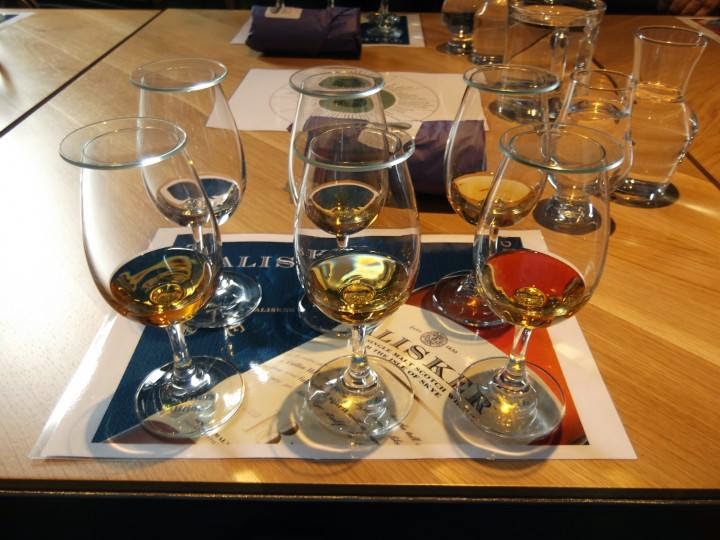 |
| The tasting experience at the Talisker Whisky Distillery |
The holiday coincides with the 50MHz/6 Meter UKAC contest and the opportunity to operate from the rare IO67 locator square was something I was looking forward to, I was totally realistic as to my chances given my set up, the terrain and power restrictions.
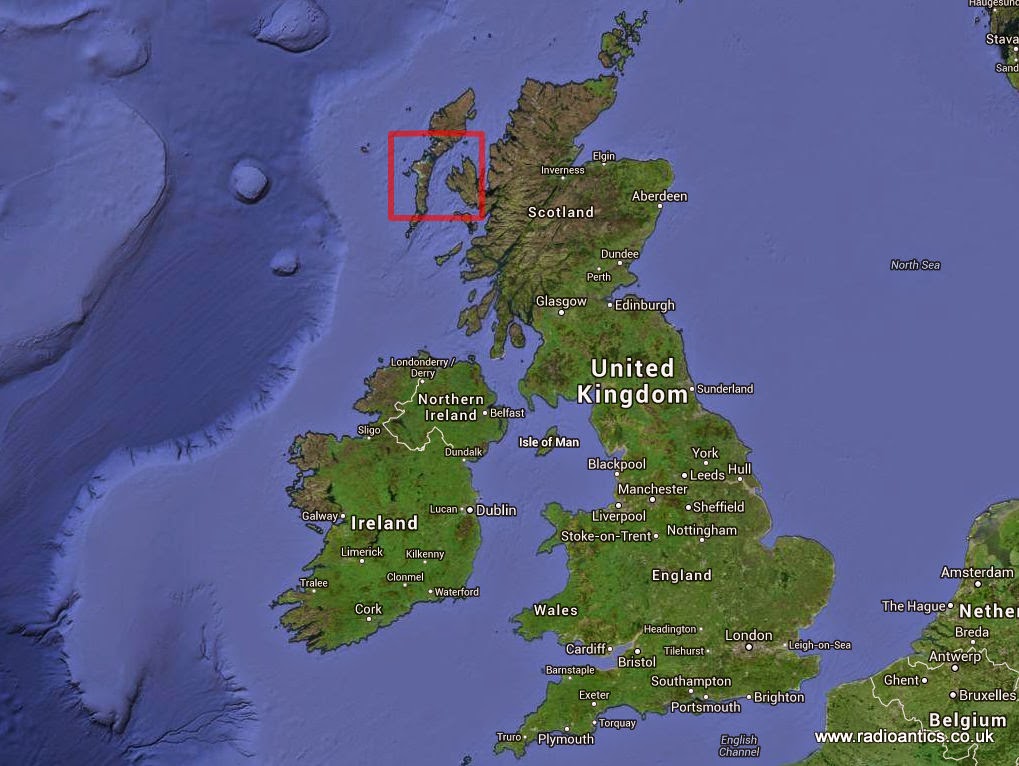 |
| IO67 Locator Square |
I abandoning the idea of a multi-element quad beam once I realised the sheer size it would be and the lack of space in the car and so opted to make a manageable two element quad.
I modelled up the antenna in MMANA-GAL to check the dimensions, made a nice short wooden boom, and cut the fibreglass pole for the spreaders, initially cutting them all to the wrong length! Cue expletives!
So I cut another set to the correct length and made the wire loop elements and tried to put it all together. Unfortunately the fibreglass spreaders are far too thin and bend and sag under the weight of the wire! Cue even more colourful expletives!
Plan-B is now just a simple tuned dipole and all I can hope for is some Sporadic-E on Tuesday evening!
I am packing the HF antennas a Magitenna and the HW-20HP from Nigel at M0CVO Antennas. I haven't done a great deal on HF finding the operating a little intimidating however I will endeavour to be on air during the week having realised in the last couple of days that I can 'activate' the island and some 'rare-ish' grid squares for the Worked All Britain (W.A.B) scheme, as well as 'activating' for the Island On The Air (IOTA) scheme. I might convince the wife to let me take the rig portable on a planned trip across to the Isle of Raasay for another activation.
With just 48 hours left I am rapidly reading up on what I need to do... as my wife pointed out I have had weeks/months to prepare for this... the 7Ps indeed!
If I do get on the air as 2M0NRD/A or 2M0NRD/P during the week please be patient and treat me gently! I will be on voice and maybe JT65 and PSK. The cottage has wi-fi so will post updates on my twitter feed @nerdsville.
Making Plans for the Colorado 14er Event
 The Colorado 14er Event (Aug 3) is less than a month away so it is time to get ready. This event was born out of the basic observation that many hiking hams were taking along their radios (typically, a VHF/UHF handheld) when they climbed the Colorado 14,000 foot mountains. So we thought “let’s all climb on the same day and see who we can contact.” The typical 2m FM contacts have expanded to other frequencies and modes, including the high frequency bands, with the potential for worldwide propagation. We’ve also embraced the Summits On The Air (SOTA) program, opening up over 1700 summits in Colorado for ham radio activity.
How can you join in the fun? The most active way to participate is to operate from a summit. If you are interested in climbing 14ers, then you may want to operate from one of the 54 14,000 foot mountains. In my opinion, all of the 14ers are strenuous hikes, so be sure to assess your ability and check out the challenge of any summit you attempt. There are a few that you can drive up, Pikes Peak, Mount Evans and Mount Bross (4WD only). Note that a “non-motorized final ascent” is required if you want to qualify as a SOTA activation, which is encouraged. See this web page for some great tips on activating a SOTA peak. If you want to try something less difficult, consider one of the easier SOTA peaks (more than 1700 in Colorado). Everyone can find a SOTA peak that fits their particular hiking ability.
If you can’t get out and operate from a summit, you can still have fun trying to contact the radio hams on the various summits. There will be quite a bit of activity on 2m FM, starting with 147.42 MHz and moving up from there using the standard Colorado band plan. You’ll want to be roughly within “line of sight” to as many peaks as possible for working them on VHF. Many radio operators will be on the HF bands, too. See the recommended frequency list here.
Summits On The Air has some great infrastructure that we can use during the event. The SOTAwatch web site is using for “spotting” SOTA stations so that you know who is on the air. Spotting yourself is encouraged and can be done from many peaks using a mobile phone. SOTA Goat is a great iOS app for making and tracking spots.
Take a look at this posting for some additional SOTA resources. There’s quite a bit of information out there so take advantage of it. Remember, the Colorado 14er Event is based on the fundamental purpose of ham radio: to have fun messing around with radios. But be careful out there, we don’t want anyone to get hurt.
Questions, comments, let me know.
73, Bob K0NR
Disclaimer: Climbing mountains in Colorado can be dangerous. Only you are responsible for your safety. In particular, be very aware of the lightning danger if you are hiking above treeline.
Check out the sunspots!
Just before the 4th of July, several sunspot regions rotated into view. Today, they are significant players in elevating the solar output of Extreme Ultraviolet energy — the energy helpful in ionizing the F-region of our Earth’s ionosphere. That, in turn, means better propagation conditions, even on higher shortwave frequencies.

As seen by the Solar Dynamics Observatory, the Sun is sporting quite a few sunspots, today. These are helping elevate the 10.7-cm flux, which is a proxy for solar output that strengthens the ionospheric propagation of higher frequencies in the shortwave spectrum. Expect good conditions on HF, this weekend.
73 and best DX!
Space Weather, HF Radio Propagation – The Interview on ‘Ham Radio Now’
Why would an amateur radio operator be interested in space weather? Is it worth the time and resources to forecast propagation, in the daily operation of a typical ham radio station?
Gary, host of the popular ‘Ham Radio Now’ video podcast, talks with Tomas Hood (NW7US), propagation and space weather columnist for CQ Amateur Radio Magazine (and in the late ‘Popular Communications Magazine’ as well as ‘CQ VHF Quarterly Magazine’) and The Spectrum Monitor Magazine. Gary discusses with Tomas how scientists forecast space weather, and how the average ham radio operator can also make predictions, and what propagation forecasting can bring to the daily operations of an amateur radio enthusiast.
Watch on YouTube: ‘Ham Radio Now’ Episode 156: Propagation…

Tomas, NW7US, talks about radio propagation on shortwave (HF) as well as space weather.
Noises Off!
RFI is referred to as QRM or QRN and I am learning the difference.
QRM means "I being interfered with" and is interference coming from someone using radio equipment. This covers deliberate jamming, people tuning up or just normal operations on a crowded band that causes QRM.
QRN means "I am troubled by static" and technically means interference from a natural noises but has come to refer to interference coming from anything that is not an intentional radio emission and interferes with reception of transmissions. So now covers atmospheric noise, static or the noise generated by electronic devices.
Noise isn't a new issue here as I have posted before. It has tended to be sporadic and bearable but since becoming licensed I have become more sensitised to it. Until now I have tended to focus on the VHF/UHF side mainly contesting venturing only briefly onto HF.
My HF set up is limited at the moment with just a single antenna which isn't optimal for the lower bands. Due to the day job I am largely restricted to evening/night time operation when the upper bands have largely been closed anyway so haven't really attacked HF with much enthusiasm apart from data modes such as JT65 and WSPR which have immunity to noise.
When I have got the chance for some early morning daytime operation or at the weekend I have struggled with noise. Recent weekends have seen some special event stations operating for the Museums On The Air and the GB1JSS Summer Solstice which have been predominately on the 40M band but I just cannot hear anything on that band due to noise.
I am aware the Sun has been particular active recently producing a number of large flares and CMEs that have caused a number of radio blackouts, but this noise isn't due to atmospherics I am certain it is man made by one of neighbours.
I made this video last weekend
and this video was from the weekend before that
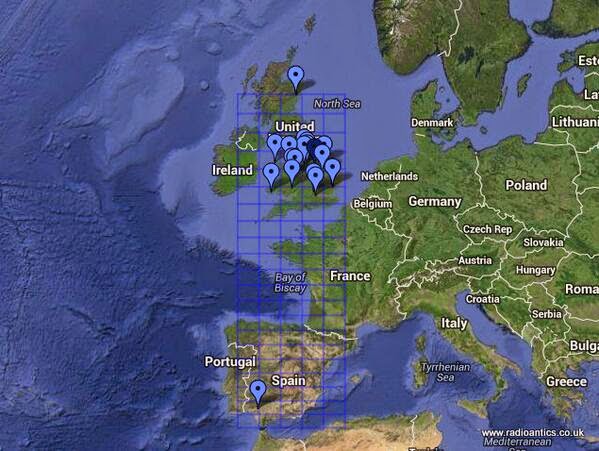
This weekend was the 50MHz Trophy Contest which I was looking forward to, sadly it was also to become a victim of the QRN as this screenshot from my SDR will confirm, for much of the time I was operating I was just listening to noise.

I wasn't operating constantly, just grabbing a few minutes here and there and I did manage to make some decent contacts when the QRN subsided even catching some of the sporadic E opening to get EF7X in Spain.
I have ruled out any noise being generated by myself by powering everything off and running on battery. This leaves me in a bit of a quandary I could go around and locate and confront the culprit or even contact OFCOM but at the same time I don't want to antagonise anyone who could then object to any antennas I might want to put up in the garden.
Rotating the 6M Moxon around at the weekend during the contest as at least pointed me in the direction of one strong noise source. I am also convince that much of my problem is due to an evil PLT device in an adjacent property.
Following on from the weekend last night was the UKAC 50MHz contest and yet again I was troubled with noise leading to mostly local contacts.
I have been looking at some of the noise cancellers that are available from MFJ and others. I have heard conflicting options on their effectiveness but I am willing to try one if I can obtain one cheaply, or even home-brew one from the numerous designs available.
These devices work by using a second antenna which receives just the noise which is then mixed out of phase with the main antenna signal hence nullifying the noise. By all accounts they are tricky to use and often need constant adjustment but may be my only viable solution at present.
Radio propagation and space weather course
As the propagation columnist for several amateur radio magazines, I hear from a diverse group of interested people that find space weather and the propagation of radio waves fascinating. I admit: I am a space weather and radio propagation nut, and it is always good to correspond or meet with other interested folks. This is an aspect of our hobby that never grows old, as there is so much that we don’t yet know–we communicators are in a perfect space to make discovery and to make improvements to our understanding of this science. Over the years, I’ve heard a lot from readers of my columns, expressing their fascination with the science of radio and solar phenomenon.
Are you interested in learning about the Sun and the Sun-Earth connection (space weather), including topics of sunspots, solar flares, coronal mass ejections, and so on? Do you want to delve deeper into topics including the ionosphere, the magnetosphere, and how radio waves propagate from transmitter to receiver?

The critical frequency (foF2) for mornings during June 2014.
You might consider a time-proven “course”–material that is very comprehensive–that you can self-study, to become well-versed in this information. The course (one that has been used in professional disciplines) is offered either stand-alone, or bundled with the ray-tracing PropLab PRO software.
Some may say, “But, I like the magic of just getting on the air and trying my luck! If I learn all this stuff, then it becomes science, and not a hobby.” It is true that there’s a joy at being dazzled with the magic of radio; buy a super cool transceiver, and a factory-made antenna with coax already fitted with connectors, adding the necessary accessories to make it come alive, then begin exploring the shortwave frequencies. Magical, indeed! But, there are many in the hobby that wish to learn how all of that works. Some even begin learning how to build antennas, radio kits, and discover the joy of the “science” of radio. A few eventually take the step with gained “scientific” knowledge of electronics, and they design and build equipment for their hobby. The course is part of that mix: learning how the Sun affects getting a radio signal from point A to point B, and how to leverage their time and efforts, is a joy, indeed.
Interested? Here’s the web page: http://hfradio.org/swp_course/

PropLab PRO creates ray-traced radio wave analysis
If any disclosure is necessary, here you go: The proceeds from a purchase of this course go to the funds I use to keep cw.HFRadio.org, swl.HFRadio.org, and other resources at HFRadio.org, plus http://SunSpotWatch.com up and running. There are monthly fees, yearly fees, and software licensing to cover, as well as the purchase of hardware from time to time. These operating and maintenance funds are mostly covered by me, Tomas, NW7US, out of my personal funds. Any donations and sales helps out. Haters and Hecklers can send their comments to the bit bucket.
73 de NW7US
Learning Morse code? Want to increase your skill?
Are you looking for some aids on learning Morse code, or to increase speed and skill? Let’s look at some great information and some software aimed at making your efforts successful.
(Note: I am not associated with any of the software. I just want to help you…)
I encourage you to look at the time-proven Koch method of learning Morse code. Below, we’ll look a little closer at this method of learning and honing your Morse code skill. In the meantime, if you just wish to skip the details, here are some software links for learning tools using the Koch method:
+ For the PC, I prefer the G4FON Morse code ‘Koch Trainer‘. It is a slick program that is set up to help you learn and enhance your skills with Morse code: http://nw7us.us/g4fontrainer – and his web site is at: http://www.g4fon.net/

G4FON Koch Trainer – Morse code learning on the PC
+ For the iPad and iPhone: On these devices, I use the ‘Koch Trainer’ by Nick / N3WG, found in the store here: https://itunes.apple.com/us/app/koch-trainer/id405137883?mt=8
+ For the Android: I use the same software as for the iPad and iPhone, the ‘Koch Trainer’ by Nick / N3WG, here: https://play.google.com/store/apps/details?id=com.n3wg.kochtrainer – however, note that it is not compatible on the S4.
+ Some other Android possibilities that I have not tried:
- https://play.google.com/store/apps/details?id=net.iz2uuf.cwkoch
- https://play.google.com/store/apps/details?id=uk.co.bitninja.kmtpro
Again, I have not tried those last few.
Now, let’s talk about the Koch Method of Morse code training!
From my page on the Koch method (text was used by permission from the author):
Koch’s method is a simple, direct way of building reflexes. However, it requires either a computer and Morse software or a personal trainer. That’s why it was overlooked for so many years. Now that computers are commonplace, it should become the standard Morse training method. Here’s how it works:
You start out by setting up your computer (or a microprocessor-based code tutor machine) to send you Morse characters at 20 wpm and at an overall sending speed of at least 15 wpm. You then get out your paper and pencil and have the machine start sending — but only two characters. That’s right, for your first sessions, you’ll only have two choices. Copy on paper for five minutes, then stop the machine and compare what you copied with what the machine sent. Count characters and calculate your percentage of correct copy.
If your score is 90 percent or better — congratulations! You just learned your first two characters, and, importantly, you learned them at full speed. You’ll never have to learn them over again. If you didn’t make 90 percent, practice some more. As soon as you can copy the first two characters with 90 percent accuracy, add a third character to your practice. Your accuracy will drop as you work on assimilating the new character, but it will rise again to 90 percent or better. Then you add the fourth character, and so on.
This method does not allow you to build that lookup table in your brain. To copy at full speed, you must build the reflexes in order to achieve 90 percent accuracy. And that’s what you’re spending your time doing — building reflexes. Think of it as a parallel to perfecting a tennis swing or mastering a gymnastic routine; you’re practicing until you get it right. The Koch method of building code proficiency character-by-character is similar to standard methods of teaching touch typing, another skill that must be reflexive.
…
While the Koch method is the fastest method of Morse training, speed alone is not its principal advantage. Its principal advantage, and a major difference from other methods, is that it provides you with constant positive reinforcement. This begins with your realization, after mastering the first two characters, that you can copy code at 15 or 20 wpm, because you just did it. After that, each new character mastered is further proof of your progress. Contrast that to slowly trying to build speed up from 4 or 5 wpm, then hitting the plateau at 10 wpm and seeing no progress for a long time. With the Koch method, frustration is at a minimum.
Constant testing is necessary to ensure that you maximize the effectiveness of the Koch method. You must copy on paper, so you can grade yourself. Remember, if you score 90 percent accuracy or better, add another character. If you score any less than that, try again. By constantly testing yourself on continuous copying of at least five minutes, you know exactly how you’re doing and exactly when you should add another character. This results in the fastest progress possible.
…
As you proceed toward your goal, remember that some days are just going to be better than others and some characters will take longer to assimilate than others.
(Read the entire article: the Koch method).
Again, here’s the PC software link: http://nw7us.us/g4fontrainer
And, here’s a web-based way to learn Morse code.
Good luck! If you have questions, please share them – I’m @NW7US













