Archive for the ‘hf’ Category
 Celebration of SKCC – K3Y Special Event
 January 12th, 2015 |
  Author:
 Special event, “K3Y,” the Straight Key Century Club’s annual January celebration, commemorates the Straight Key Century Club’s founding in 2006 following the American Radio Relay League’s “Straight Key Night” (SKN). A small group of participants wanted to extend the fun of SKN throughout the year. The Straight Key Century Club (SKCC) is the result.
For the first three years, the club’s founders used the special event callsigns of K1Y, K2A, and K3Y as the celebration’s special-event calls. But, someone cleverly noticed that a ‘3’ is nothing more than a backwards, curvaceous ‘E’. This “KEY” event has operated under the special event callsign of ‘K3Y’, ever since.
The on-air party is open to members and non-members alike. It runs from 0000 UTC Jan. 2 through 2359 UTC Jan. 31. It’s a great time to introduce others to the joys of hand-crafted Morse code using straight keys, bugs, and side swipers.
In this video, you can “sit in” with NW7US, the control operator of the regional activation of special event station, “K3Y/0”, during one of the many shifts during January (2015).
+ The SKCC website is at http://skccgroup.com
+ The K3Y special event page is http://www.skccgroup.com/k3y/index.php
+ The NW7US website is at http://NW7US.us
+ Some more CW/Morse code resources can be found at http://cw.hfradio.org
HF contests
I am not a great fan of HF contests. As a QRPer, I find CW contests all but impossible as people tend to send and receive at incredible speeds usually with PCs. SSB is usually better and often the “other end” has worked you before realising you are running QRP. Later stages of contests are usually easier as the big guns are sweeping for remaining points and looking to work weaker stations.
I have been unable to work in the ARRL 10m contest (visitors this weekend) ) and I forgot the CQWW SSB contest this year! Last year, I was in hospital. It is 2 years since I last took part in CQWW SSB, which I find a very fruitful contest. I usually stick with 10m only.
Each Tuesday evening the RSGB organises a rotating series of VHF/UHF contests (UKAC) and I try to come on for the 50, 144 and 432MHz contests where I am at home and available. I use 5w pep and a V2000 vertical on 50MHz, a 3 el on 144MHz and 5 el on 432MHz. On 144 and 432MHz the antenna is hand-rotated. On 50MHz it is vertical and fixed. I can usually work 150-250km in these contests despite my 5W.

My Latest Contraption, a QRP portable, all in one, seat & table, etc!

I added a bungee cord on each end to prevent damage from the radio accidentally falling off the table.
 The cord does not touch the buttons.

View from the back

All in one, QRP seat, table, umbrella and antenna anchor! The bottle on the table is bug spray! LOL

The table is a cutting board attached to the existing shelf.
The cutting board is bigger than the existing shelf, so I have more room for logging and a sturdy place to attach the antenna!
A bungee cord takes up the slack from the antenna in the wind. In a real world test, I found that one radial is all I need.
I tried an experiment, adding two, then four radials. There was no detectable change in signal level by ear on or the S meter.
One radial did the trick, and 4 radials didn’t improve the signal at all.

Note the guy ropes. This is to hold the chair in place. The golf umbrella is stuffed into a piece of PVC pipe.
The PVC pipe is tied to the chair with cable ties.
Wind and the antenna pulling on the table would easily turn the chair over.

Satisfaction! I can’t wait for the next ham radio outing with my QRP buddies.
Largest Sunspot Region (so far) in Sunspot Cycle 24
Look at this huge sunspot, the largest yet of Sunspot Cycle 24! It is about the same diameter as Jupiter! Notice how tiny Earth is, in comparison. Sunspots are regions on the Sun’s photosphere, formed by the “convection” of solar plasma deep inside the Sun, causing the twisting and shifting of magnetic fields. They look like spots on the photosphere because they are cooler than their surrounding solar material, giving them their dark, blemish-like appearance.

Close-up view of NOAA Active sunspot Region AR 12192 (short: 2192)
The sunspot is the largest since November 1990, and is larger than a monster sunspot that spawned a series of major solar flares over Halloween in 2003. AR 2192 was one of the biggest observed sunspots of all time, ranking 33rd largest of 32,908 active regions since 1874, according to NASA scientists C. Alex Young and Dean Pesnell.
Interestingly, this sunspot never released any major coronal mass ejection (CME), because the magnetic fields were too strong to let any significant plasma escape! However, this sunspot group unleashed a fair number of moderate to strong x-ray flares (see one of them in this video at < http://g.nw7us.us/1s7L0vF >). All told, AR 2192 popped off 26 M-class flares, and six X-class flares! Of course, during the last sunspot cycle, Cycle 23, there were many active sunspot regions unleashing flare after flare within hours of each other. That’s typical during the active phase of most sunspot cycles. This cycle, however, is one of the weakest on record, so this large sunspot with its many flares is exciting.

A Close-up of AR 2192
Each sunspot region gets a consecutive number assigned to it by the National Oceanic and Atmospheric Administration (NOAA). This sunspot region is NOAA AR (active region) Nr. 12192 (we often drop the first digit when speaking of a sunspot, so in this case, this region was often referred to as AR 2192).

One of the many x-ray flares originating from Active sunspot Region AR 2192 – this one seen in Extreme Ultraviolet at 131 Angstroms.
This sunspot region increased the ionization of the ionosphere, creating excellent conditions on all of the high frequency spectrum (shortwave, or HF). Even ten meters was alive with world-wide propagation. And, the best news is that this provided an exciting playing field for the CQ WW SSB contest in late October, 2014.
This sunspot region has now rotated away, but may return on about 24 days.
Credit: NASA/SDO/HMI
Check out: http://SunSpotWatch.com
Get the space weather and radio propagation self-study course: http://NW7US.us/swc
Portable in a very windy Cumbria
Things change and sadly I became disillusioned with the sport as seemingly endless rule changes and its increasing popularity saw it losing its core ideal, what was meant to be fun for dog and handler had sadly become too competitive, professional and commercial, too many people now make money out of the sport and what was once an enjoyable social activity is now spoilt by unsportsmanlike behaviour, complaints and bitchiness.
When my dog Boris suffered a cruciate injury the enforced time-out made me realise I didn't want to do it anymore and so I don't.. well apart from the odd exception, last weekend was the West Lakes Agility Club Show held in the small town of Haverigg on the Cumbria peninsula (Locator IO84IE)
This is a lovely old-style small friendly show with the bonus of being held just a stones throw from the sand dunes and beach. I had agreed to go and like the recent holiday in Skye it was initially planned with no thought for any radio operating.
We would be caravanning at the show for the best part of four days without any electrical hookup and the wife had volunteered to help on Saturday leaving me on my own for most of the day... so a plan was hatched at the last minute.
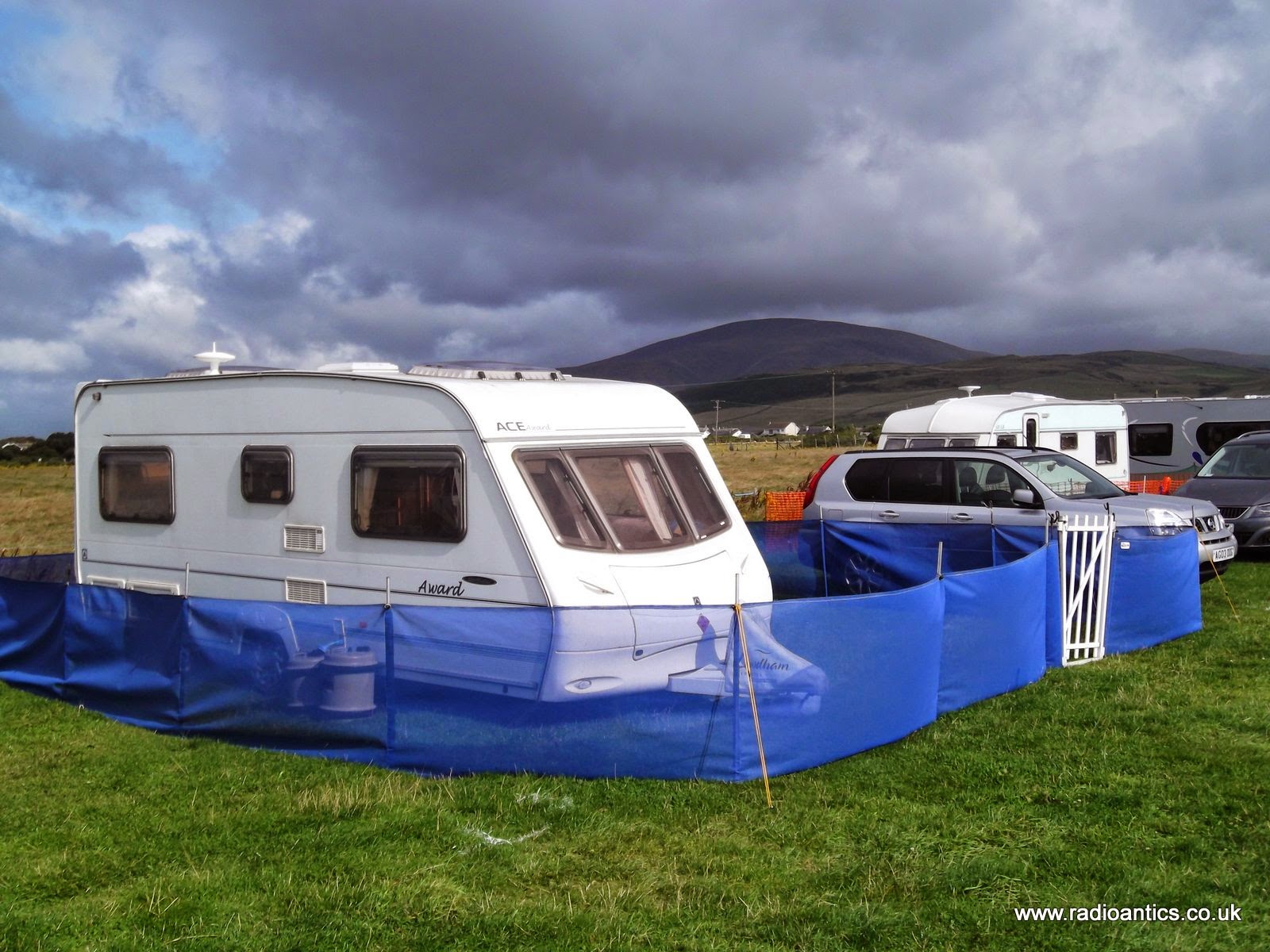
I purchased a nice new 'spare' 100A/h leisure battery and smuggled on board the FT-857D with some suitable battery clips, headphones, a fiberglass pole, some antennas. I don't own a suitable 'portable' ATU at present, having borrowed one from SKARS on several occasions but as this was a last minute thing I would have to chance operating without it. I took the M0CVO HW-20P OCF-Dipole, which has a usable VSWR on 20m, 17m, 15m, 12m and 10m without an antenna tuner and the M0CVO Magitenna, but wasn't sure what I would get from this as I'd only ever used it with a ATU.
The weather was difficult all weekend, we arrived on the Friday to be met with warm and sunny conditions but a steady strong wind. There was bit of a battle to get the caravan awning up but we managed it.Saturday the wind just got stronger, the forecast for Sunday was for even stronger winds so it was dismantled and packed away, indeed it was worse around 25-30mph with must stronger gusts.
Undeterred I got the antennas up, however the fiberglass pole I have must be getting on for 10 years old, and would often fly a pirate flag when camped at agility shows. It had already lost it's top section many moons ago but was still quite tall and so I hoisted up the OCFD balun and coax and the end of the magitenna wire in the buffeting wind and it was swinging around wildly - almost inevitably it proved too much and the remaining top section splintered!
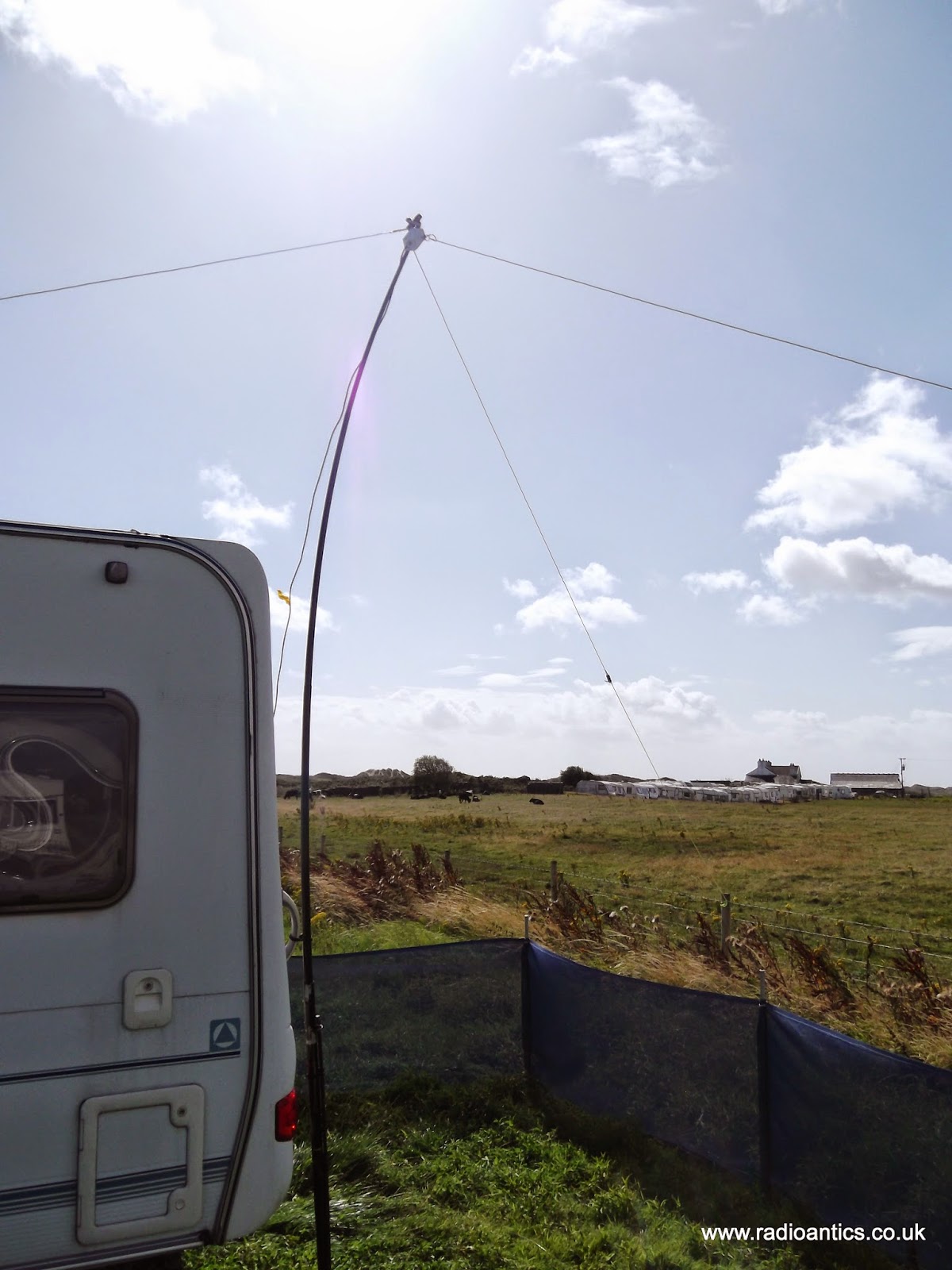
Despite losing over in a metre in length I tried again and managed to get everything up, the OCFD wires were tied out to form a sort of inverted-vee using a handy nearby fence, the Magintenna was pulled to form a sloper across over the front of the caravan, but due to the lost height actually touched the front of the roof. Amazingly I got an almost 1:1 VSWR on 40m and loud and clear RX.
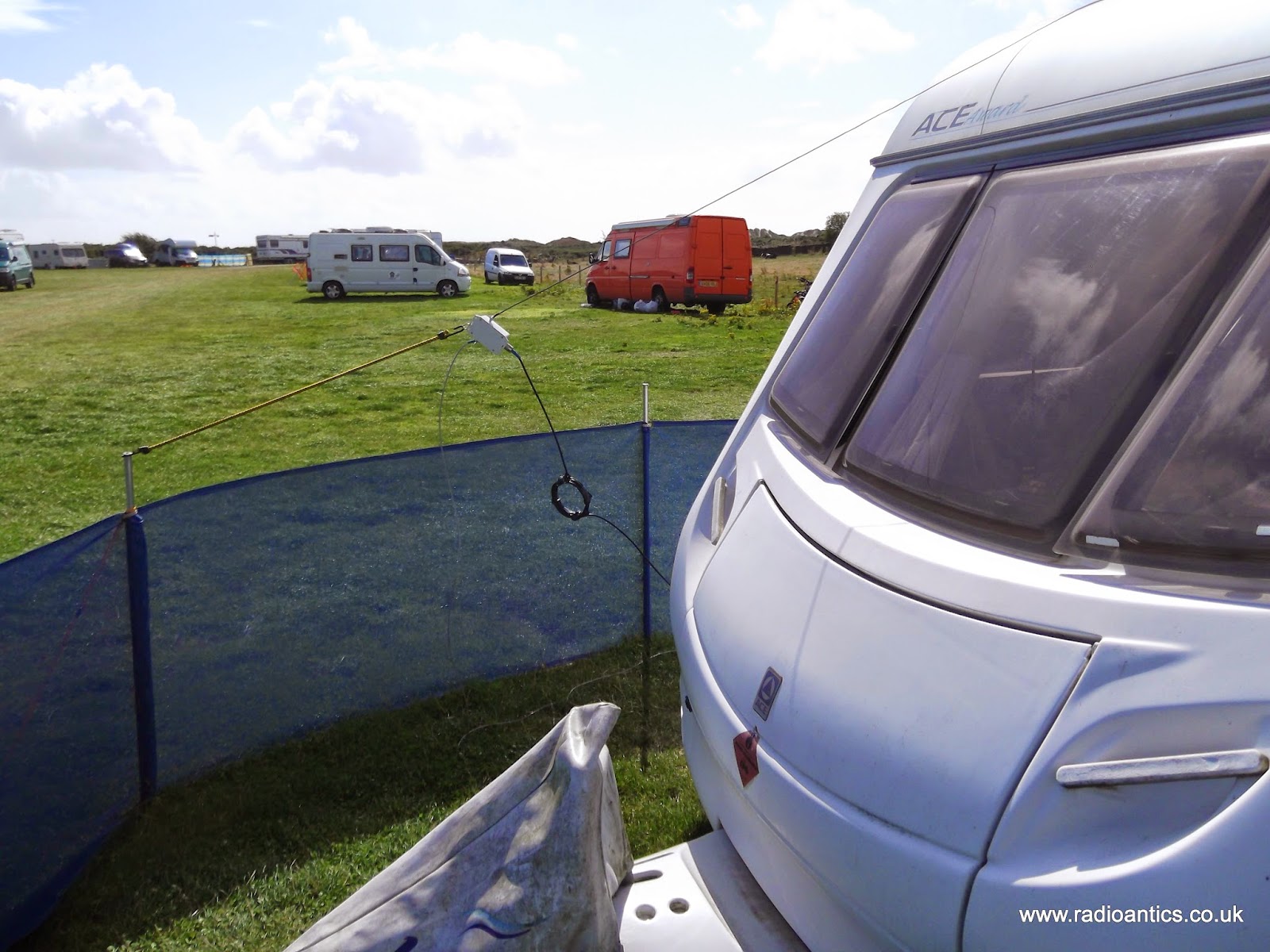
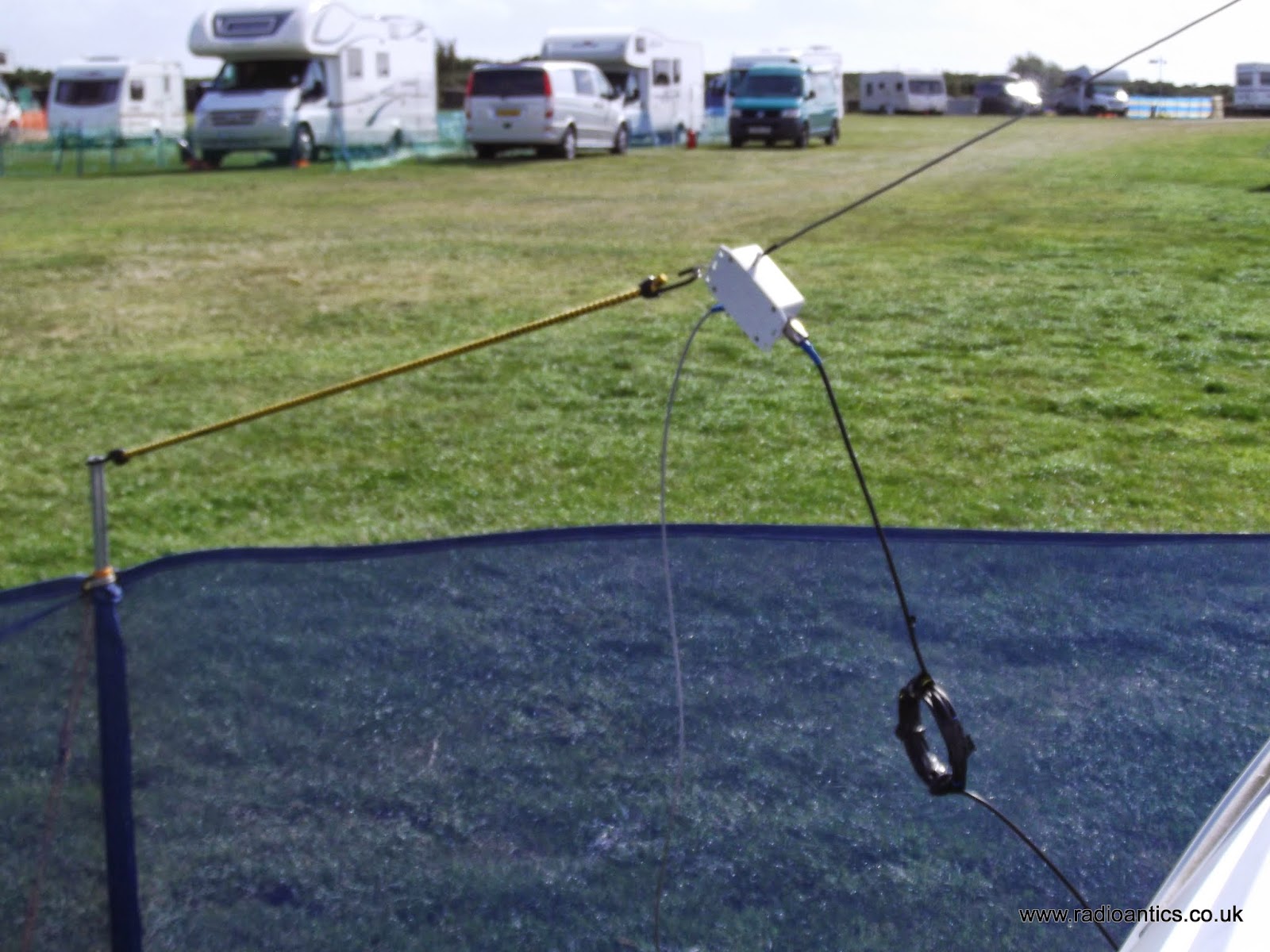
This weekend was the International Lighthouse and Lightship Weekend (ILLW) this annual event has been going since 1995 and promote public awareness of lighthouses and lightships and their need for preservation and restoration, and at the same time to promote amateur radio and to foster International goodwill.
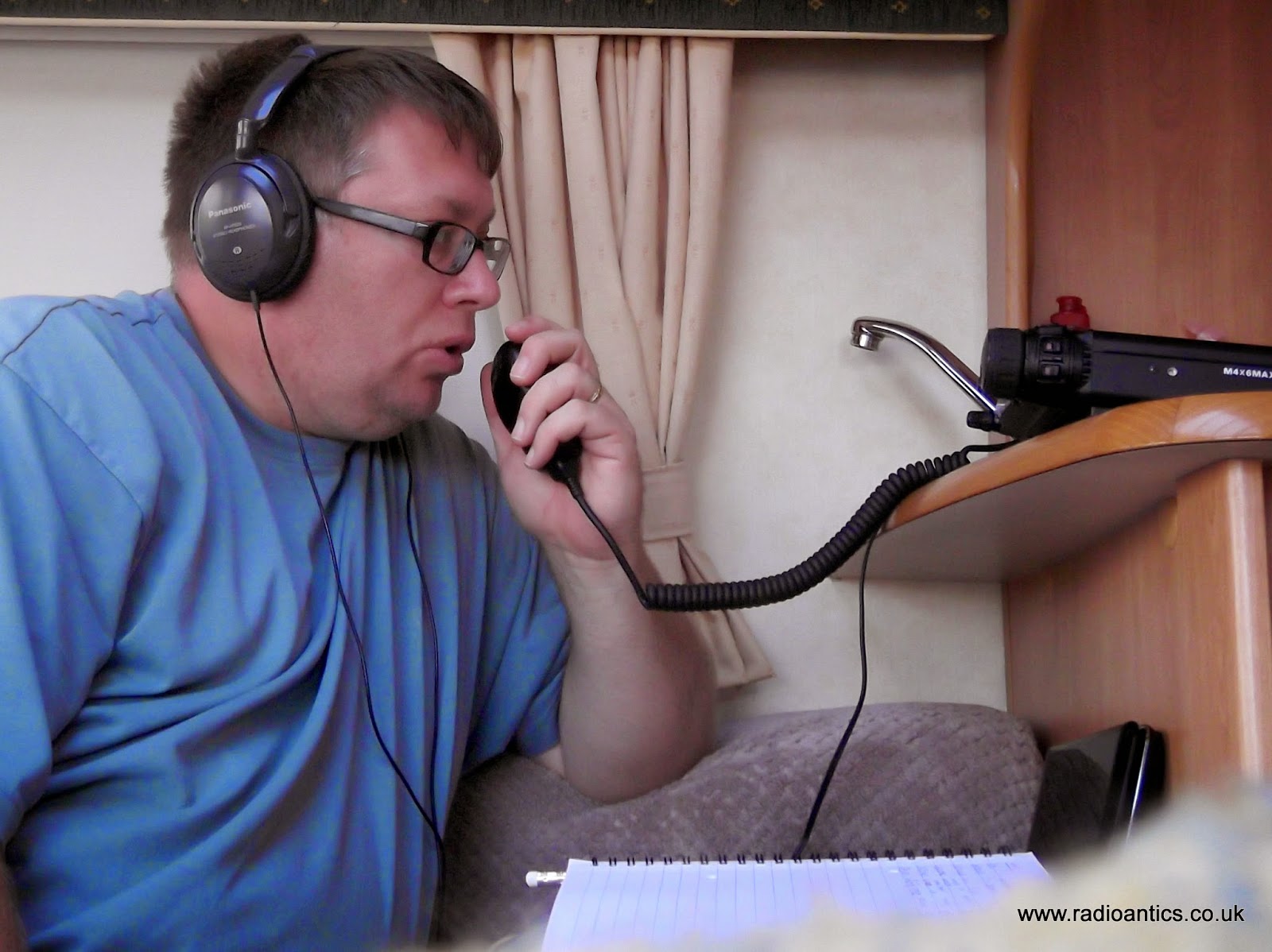
The bands were kind and I had an enjoyable Saturday afternoon and a few hours on Sunday making QSOs with a number of UK and European lighthouse stations on 40m and 20m and it seems the whole event was a great success. Alas the wind proved too much for the remainder of the fiberglass pole and it developed a large crack in the bottom section forcing me off the air.

By coincidence Haverigg has two lights, the old Hodbarrow beacon and the restored Hodbarrow Point lighthouse (pictured above from the beach). Last year we walked to the restored lighthouse but since the restoration was completed in 2004 it is sadly looking in need of some remedial work.
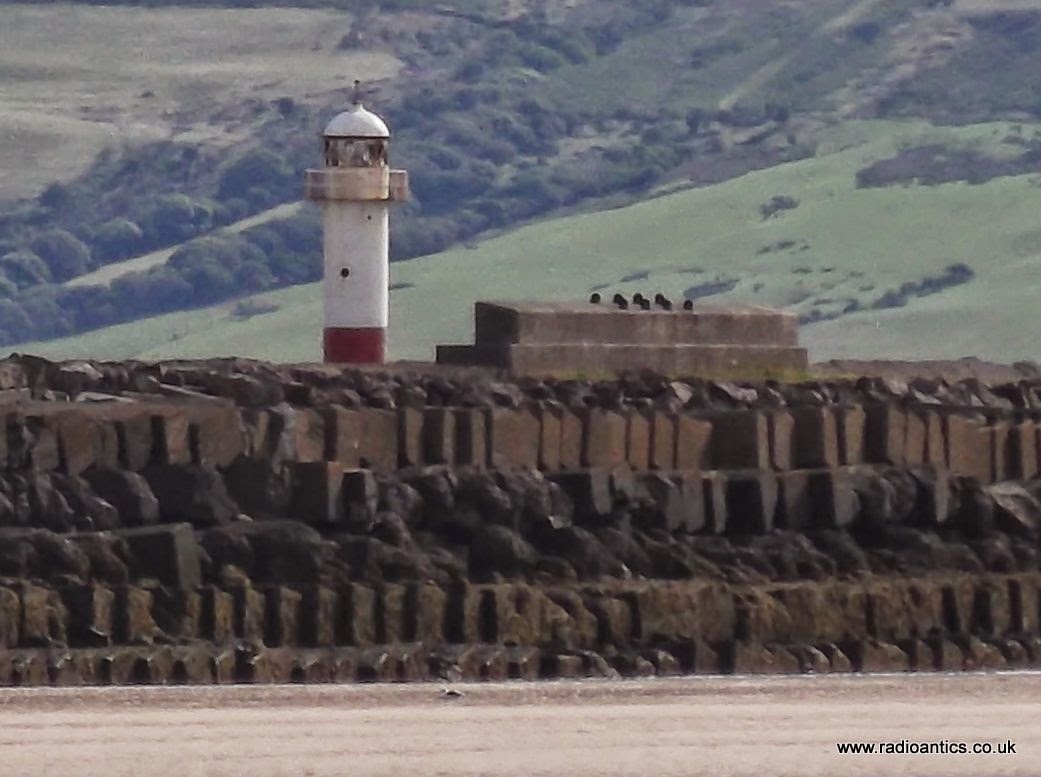
I only learned of the ILLW event at the last minute and sadly neither of the Haverigg lights were activated that weekend, next year if the show is on at the same time I may look at trying to operate from them.
Oh and the wind? Here is a video of a walk on the beach on the Sunday morning..
Noises Off – WiMo QRM Eliminator
In desperation I had been looking at some of the noise cancellers available from MFJ and others. I had heard conflicting options on their effectiveness but was willing to try one if I could obtain one cheaply. The MFJ units are in my opinion expensive to purchase new so I bid on several that came up second hand on eBay but they invariably also went for silly money. I was even contemplating building an home-brew one from the numerous designs available.
Then I discovered the WiMo QRM Eliminator, made by the German company WiMo Antennas and Electronics. Several online reviews and numerous YouTube videos seemed to indicate its effectiveness and taking up the then summer discount offer I ordered one for the princely sum of €147 including postage, around £116.
Due to heavy demand and low stock levels following the International Ham Radio Exhibition at Friedrichshafen I was told the unit wouldn't be available till the middle of August, so I was pleasantly surprised when the unit turned up last Friday morning.
New toy in time for the weekend ;-) Thank you @wimo_de pic.twitter.com/4Xfuv5ccHB
— Andrew Garratt (@nerdsville) August 1, 2014 I have connected it up and briefly tried it out and am impressed, as this video illustrates.Even using one for a short time I would agree that they are something of a black art to set up and use and can understand why people might consider them useless, but this may be due to lack of understanding of how they work.

I have created a diagram showing a typical scenario.
The operators main antenna is designed to pick up distant signals, not necessarily DX but signals not emanating from the immediate vicinity, however they will also pick up locally produced QRM as shown, perhaps generated by a neighbours TV or PLT device.
The QRM eliminator has a second antenna which isn't as efficient as the main antenna and ideally just receives the local QRM at a similar level to the main antenna. The device then takes this second signal and inverts the phase so when it is mixed with the main antenna signal the QRM is cancelled out.
The principal is quite simple, if you take two in phase signals and combine them you will end up with a signal with a larger amplitude. However if the signal is 180 degrees out of phase, the positive and negatives of the waveform cancel each other, producing a null signal.
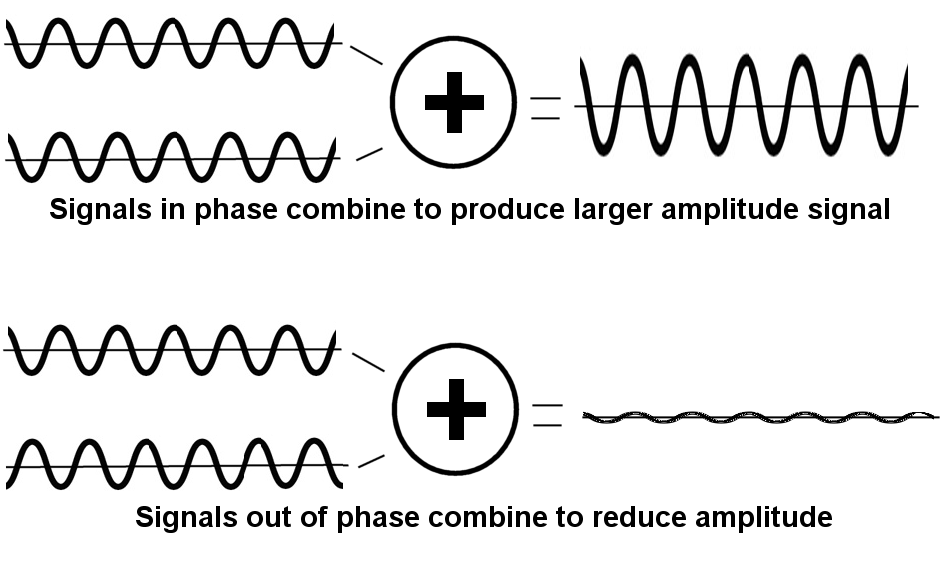
At present I just have several meters of wire running as the noise antenna along the side of the shack and this seems to fairly effective.
The unit is powered from 12V and can be left in line, but requires the PTT/TX-GND signal from the CAT/Linear socket from the transceiver to activate a bypass when transmitting and I don't have the appropriate 8-pin plug at present. If the unit is powered off the bypass is automatically engaged.
All in all, first impressions are good and looks like a worthwhile purchase.
This Spewed Out of the Internet #28
 More important
 things have spewed forth from the interwebz:
HamRadioNow interviews the Ham Hijinks guys and has the nerve to actually publish the video. Later the Hijinks crew posted this article about changes being made to Field Day.
Baofeng is going to change its name. Or is this just another Ham Hijinks article?
WE2F writes: 146.52 Reasons to Monitor VHF Simplex but whatever you do, do not use 146.52 MHz on Field Day. Mike AD5A posts Why Operate QRP from Summits? The FCC kicks the butt of a cell phone jammer manufacturer, to the tune of $34.9M and also fines a couple of 14.313 MHz problem children.
A Broadband Over Powerline (BPL) provider bites the dust. Did I mention that it is a really dumb idea to transmit bits over AC power lines?
I did a little explaining about those antenna connectors on handheld radios. Randy (K7AGE) has a neat video showing some basic 2m FM portable operating.
I knew it: Digital is overrated and vinyl is making a comeback. Really.
Due to popular demand, I updated the VHF QRP page. Yes, some radio hams do operate QRP above 50 MHz…apparently for the same reasons that people operate HF QRP. Which is to say we really don’t know why.
I also found that the domain name for the Colorado 14er Event was broken, so I fixed it. See ham14er.org This event is the most fun you can have dorking around with radios in the Colorado mountains. Also, be sure to check out these operating tips.
73, Bob K0NR













