 |
 Part 2 of….. Antenna solve one problem to only create another.
 22 July 2026 | by
 If you have not read Part 1 of this post, go HERE and then make your way back. To recap, I was having an issue with my Hustler 4BTV vertical antenna, and I discovered that water was making its way into the 15m trap. Once I had the antenna reassembled and back in the upright position, I went into the house to check the SWR. I like to do this whenever I work on the antenna. To my surprise, the minimum SWR was 2.4:1 on 15m, but10m, 20m, and 40m were all ok. I had taken my time putting the antenna back together, so I really wasn't sure what had happened.
I got my NanoVNA out and performed a sweep from below the 15m band through the entire band 15m band. The results showed that the antenna was resonant at around 20.540 MHz instead of in the 15m  amateur band, so something was definitely wrong with the trap. I knew that on Hustler vertical antennas the outer trap tubing can be moved up or down to adjust the resonant frequency. I double-checked my trap adjustment marks, and they were exactly where they should have been. I needed some time to think this one through, so for the time being I let the automatic antenna tuner (ATU) in my Icom 7610 took care of the high SWR. The only thing I had changed on the antenna was adding silicone. That got me thinking about the old saying, "less is more." I had wanted to make absolutely sure the plastic cap on the 15m trap wouldn't allow water to get inside. I was convinced that I had applied too much silicone, and I decided to investigate the following day. My theory was that I had somehow changed the electrical characteristics of the 15m trap with the excess silicone. When I took the trap apart the next day, my question was answered. I had been very generous with the silicone—so generous, in fact, that it had bridged the gap between the main antenna tube and the trap's adjustable outer tubing.
Silicone is not a conductor, but it also does not have the same dielectric properties as air. By filling that air gap, the silicone increased the capacitance of the trap and shifted its resonant frequency. I disassembled the trap once again, carefully cleaned all of the excess silicone from inside the tubing, and this time remembered that less is more when applying silicone. Once the antenna was reassembled and back upright, I checked it again. This time the SWR was exactly where it should be. Lesson learned the hard way—but I'm glad I was able to figure it out.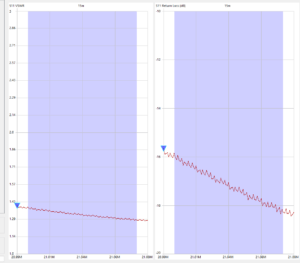
Mike Weir, VE9KK, is a regular contributor to AmateurRadio.com and writes from New Brunswick, Canada. Contact him at [email protected]. |
| My new SWR on 15M |

 |
| Issue found. |
2 Responses to “Part 2 of….. Antenna solve one problem to only create another.”
Please support our generous sponsors who make AmateurRadio.com possible:
 Ham Radio Deluxe |
 W5SWL Electronics |
 Ham Radio Prep |
 KB3IFH QSL Cards  Hip Ham Shirts  QRV QRV Reliance Antennas Reliance Antennas |  morseDX  Ni4L Antennas  R&L Electronics R&L Electronics antennas.us antennas.us |
- Matt W1MST, Managing Editor

Thank you for publishing your investigation! Your discovery that silicone had displaced air in a trap as the cause of the problem is fantastic.
Dielectric characteristics are specific but most of us just don’t think about that. A ‘waterless’ condition just seems like any other ‘waterless’ situation-Until electromagnetism gets involved! Great work!! Keep on keeping on!!
Good morning James and thanks for leaving a comment. Yes I was pleased I was able to narrow it down and find the issue. On my main blog I had a comment that the last pic was a 10m sweep and not a 15m sweep. That has been corrected and the updated post should appear sometime today on this site. Because of the re-post your comment may vanish.
73,
Mike
VE9KK