Archive for the ‘hf’ Category
 There’s a new radio hobby magazine in town!
 June 1st, 2014 |
  Author:
 Recently, a number of hobby radio magazines have either retired, or have merged into a digital mix of several. Filling that void is the new The Spectrum Monitor, a creation of Ken Reitz KS4ZR, managing editor for Monitoring Times since 2012, features editor since 2009, columnist and feature writer for the MT magazine since 1988. Ken offers this digital, radio communications magazine monthly. The web site is at http://www.thespectrummonitor.com/

The Spectrum Monitor magazine – get your’s, today.
Ken, a former feature writer and columnist for Satellite Times, Satellite Entertainment Guide, Satellite Orbit magazine, Dish Entertainment Guide and Direct Guide, is also contributing editor on personal electronics for Consumers Digest (2007 to present). He is the author of the Kindle e-books “How to Listen to the World” and “Profiles in Amateur Radio.”
The Spectrum Monitor Writers’ Group consists of former columnists, editors and writers for Monitoring Times, a monthly print and electronic magazine which ceases publication with the December, 2013 issue. Below, in alphabetical order, are the columnists, their amateur radio call signs, the name of their column in The Spectrum Monitor, a brief bio and their websites:
Keith Baker KB1SF/VA3KSF, “Amateur Radio Satellites”
Past president and currently treasurer of the Radio Amateur Satellite Corporation (AMSAT). Freelance writer and photographer on amateur space telecommunications since 1993. Columnist and feature writer for Monitoring Times, The Canadian Amateur and the AMSAT Journal. Web site: www.kb1sf.com
Kevin O’Hern Carey WB2QMY, “The Longwave Zone”
Reporting on radio’s lower extremes, where wavelengths can be measured in miles, and extending up to the start of the AM broadcast band. Since 1991, editor of “Below 500 kHz” column forMonitoring Times. Author of Listening to Longwave (http://www.universal-radio.com/catalog/books/0024u.html). This link also includes information for ordering his CD, VLF RADIO!, a narrated tour of the longwave band from 0 to 530 kHz, with actual recordings of LW stations.
Mike Chace-Ortiz AB1TZ/G6DHU “Digital HF: Intercept and Analyze”
Author of the Monitoring Times “Digital Digest” column since 1997, which follows the habits of embassies, aid organizations, intelligence and military HF users, the digital data systems they use, and how to decode, breakdown and identify their traffic. Web site: www.chace-ortiz.org/umc
Marc Ellis N9EWJ, “Adventures in Radio Restoration”
Authored a regular monthly column about radio restoration and history since 1986. Originally writing for Gernsback Publications (Hands-On Electronics, Popular Electronics, Electronics Now), he moved his column to Monitoring Times in January 2000. Editor of two publications for the Antique Wireless Association (www.antiquewireless.org): The AWA Journal and the AWA Gateway. The latter is a free on-line magazine targeted at newcomers to the radio collecting and restoration hobbies.
Dan Farber ACØLW, “Antenna Connections”
Monitoring Times antenna columnist 2009-2013. Building ham and SWL antennas for over 40 years.
Tomas Hood NW7US, “Understanding Propagation”
Tomas first discovered radio propagation in the early 1970s as a shortwave listener and, as a member of the Army Signal Corps in 1985, honed his skills in communications, operating and training fellow soldiers. An amateur Extra Class operator, licensed since 1990, you’ll find Tomas on CW (see http://cw.hfradio.org ), digital, and voice modes on any of the HF bands. He is a contributing editor for CQ Amateur Radio (and the late Popular Communications, and CQ VHF magazines), and a contributor to an ARRL publication on QRP communications. He also wrote for Monitoring Times and runs the Space Weather and Radio Propagation Center at http://SunSpotWatch.com. Web site: http://nw7us.us/ Twitter: @NW7US YouTube: https://YouTube.com/NW7US
Kirk Kleinschmidt NTØZ, “Amateur Radio Insight”
Amateur radio operator since 1977 at age 15. Author of Stealth Amateur Radio. Former editor,ARRL Handbook, former QST magazine assistant managing editor, columnist and feature writer for several radio-related magazines, technical editor for Ham Radio for Dummies, wrote “On the Ham Bands” column and numerous feature articles for Monitoring Times since 2009. Web site: www.stealthamateur.com.
Cory Koral K2WV, “Aeronautical Monitoring”
Lifelong air-band monitor, a private pilot since 1968 and a commercial pilot licensee since 1983, amateur radio licensee for more than 40 years. Air-band feature writer for Monitoring Times since 2010.
Stan Nelson KB5VL, “Amateur Radio Astronomy”
Amateur radio operator since 1960. Retired after 40-plus years involved in mobile communications/electronics/computers/automation. Active in radio astronomy for over twenty years, specializing in meteor monitoring. Wrote the “Amateur Radio Astronomy” column for Monitoring Timessince 2010. A member of the Society of Amateur Radio Astronomers (SARA). Web site: www.RoswellMeteor.com.
Chris Parris, “Federal Wavelengths”
Broadcast television engineer, avid scanner and shortwave listener, freelance writer on federal radio communications since 2004, wrote the “Fed Files” column for Monitoring Times.http://thefedfiles.com http://mt-fedfiles.blogspot.com Twitter: @TheFedFiles
Doug Smith W9WI, “The Broadcast Tower”
Broadcast television engineer, casual cyclist and long distance reception enthusiast. “Broadcast Bandscan” columnist for Monitoring Times since 1991. Blog:http://americanbandscan.blogspot.com Web site: http://w9wi.com
Hugh Stegman NV6H, “Utility Planet”
Longtime DXer and writer on non-broadcast shortwave utility radio. Former “Utility World” columnist for Monitoring Times magazine for more than ten years. Web site: www.ominous-valve.com/uteworld.html Blog: http://mt-utility.blogspot.com/ Twitter: @UtilityPlanet YouTube: www.youtube.com/user/UtilityWorld
Dan Veeneman, “Scanning America”
Software developer and satellite communications engineer writing about scanners and public service radio reception for Monitoring Times for 17 years. Web site: www.signalharbor.com
Ron Walsh VE3GO, “Maritime Monitoring”
Retired career teacher, former president of the Canadian Amateur Radio Federation (now the Radio Amateurs of Canada), retired ship’s officer, licensed captain, “Boats” columnist and maritime feature writer for Monitoring Times for eight years. Avid photographer of ships and race cars.
Fred Waterer, “The Shortwave Listener”
Former “Programming Spotlight” columnist for Monitoring Times. Radio addict since 1969, freelance columnist since 1986. Fascinated by radio programming and history. Website: http://www.doghousecharlie.com/
Thomas Witherspoon K4SWL, “World of Shortwave Listening”
Founder and director of the charity Ears To Our World (http://earstoourworld.org), curator of the Shortwave Radio Archive http://shortwavearchive.com and actively blogs about shortwave radio on the SWLing Post (http://swling.com/blog). Former feature writer for Monitoring Times.
This Spewed Out of the Internet #27
 More important things spewing forth from the interwebz:
The Ham Hijinks guys have been at it again, with this article: New Drug Aims To Get More Hams On The Air
Warning: Do Not Take These Guys Seriously, It Only Encourages Them
Chiming in on April 1st, Dan KB6NU reported that the FCC is going to reinstate the Morse Code test.
I posted an article about using UTC over at HamRadioSchool.com: Does Anybody Really Know What Time It Is?
KB9VBR has a nice article that explains the common types of antenna connectors used with ham radio.
Elliot KB0RFC has been writing some interesting stuff about D-STAR, DMR and other things digital on his blog. See his latest article: Developing a DMR / D-STAR radio
James R. Winstead, KD5OZY, of Coleman, Texas found out that sometimes the FCC does show up and bust radio amateurs that are causing problems on the air. See the ARRL article here. It always cracks me up when the FCC Engineer reports that during their station inspection, the offender’s radio is still tuned to the frequency where the problems were occurring.
Serious DXers all over the world are in severe depression after finding out that Crimea is Not a New DXCC Entity. Conspiracy Theory: the whole thing was instigated by a group of hams that believed Crimea would be a new one.
73, Bob K0NR
The KP2 Slacker DXpedition Guide
I’ve had several opportunities to take amateur radio along on vacation and do a little radio operating from other countries. I try not to focus too much on ham radio during such a trip, as it has a tendency to create marital discord and can suck the fun out of the vacation. Some people call this a “holiday style” DXpedition, or maybe it’s just the slacker approach.
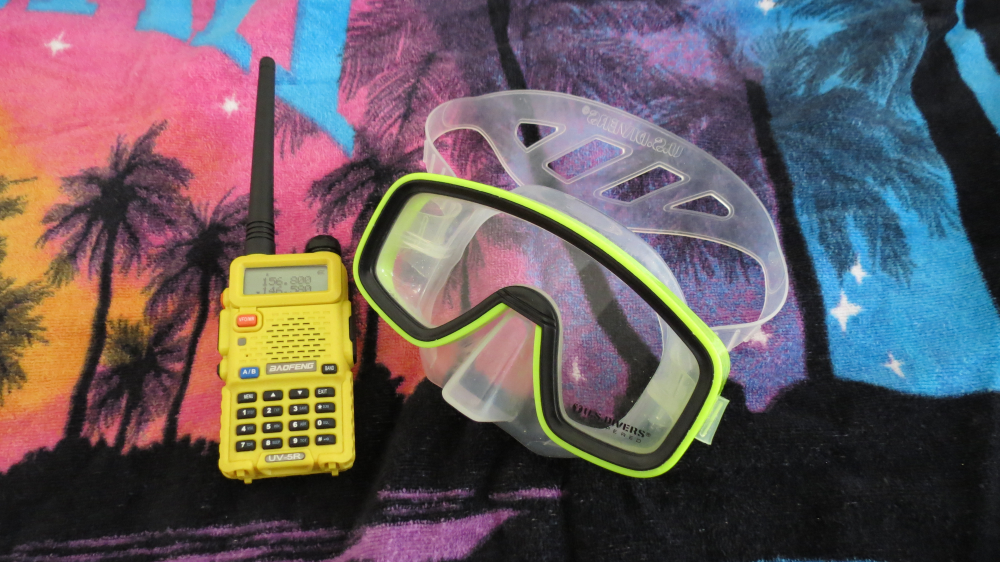
The marine yellow Baofeng UV-5R handheld transceiver got a lot of use.
St John USVI
Joyce (K0JJW) and I were planning a vacation with three other couples that we’ve known for years. It turns out that six of the eight have their ham licenses. (We’re still working on the last two.) Our primary goal was to find an island location with great beaches and snorkeling. Someone proposed the island of St John in the US Virgin Islands and the idea took hold.
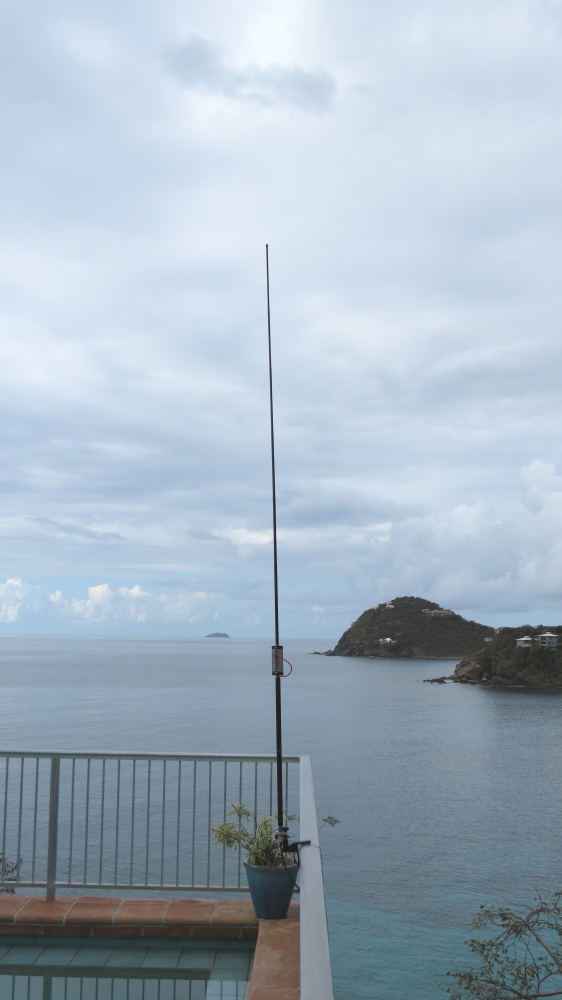
The Buddistick antenna is mounted on the railing of the patio, overlooking the sea.
From a ham radio perspective, USVI is an interesting choice since it does count as a DXCC entity (“country”), even though it is a US possession. See my article on HamRadioSchool.com for more information on how that works. Anyone with an FCC license can operate from there without any special licensing or approval. KP2 is the prefix for USVI, so identify as KP2/<callsign> to indicate that you are operating from USVI.
Radio Gear
We were trying to pack light, so the radio equipment had to fit into our normal luggage. I took my Yaesu FT-817 and a Buddistick™ antenna. Paul (KF9EY) took along a Yaesu FT-100D, while Denny (KB9DPF) transported his FT-817 and a G5RV Junior antenna. Our primary operating mode was using the FT-100D (more power, baby) to drive the Buddistick, which was attached to the railing on the patio.

The FT-100D was the primary operating rig, carefully placed on a random table out by the pool, with the St John Guidebook nearby.
I decided that the true slacker approach required some Official Beach QRP contacts in the style of Buddies in the Caribbean (see the video). One day on the beach, I took along my FT-817 and the Buddistick and set up for some QRP action.
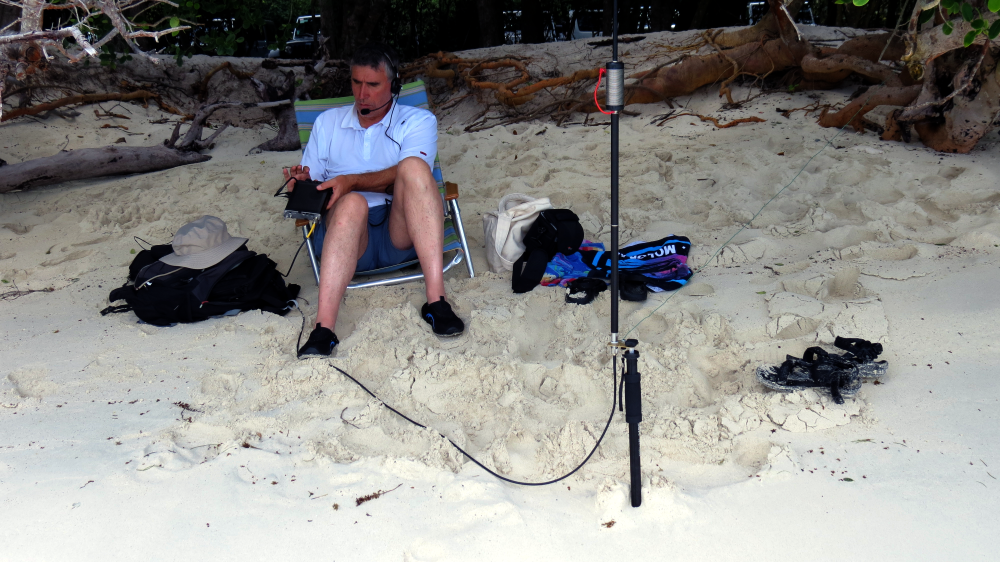
Some slacker beach operating (Bob K0NR).
The Buddistick was mounted on a Dolica WT-1003 camera monopod stuck into the sand, with the radial trailing off into the vegetation. My compact Heil headset was a convenient way to make some phone contacts without blasting my fellow beach bums with noisy audio.
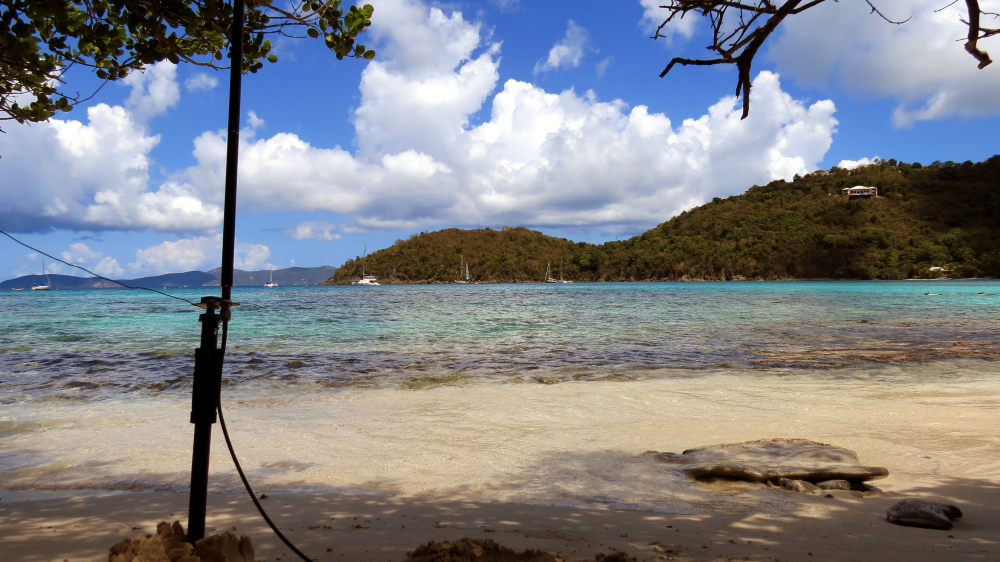
The view looking out from the beach operating location.
How did we do on the HF bands? We managed to make a number of contacts on 20m, 15m and 10m into the Americas and Europe. I was a bit disappointed that we never really got a pileup going. I think our signal was plenty strong but KP2 is maybe just not that rare.
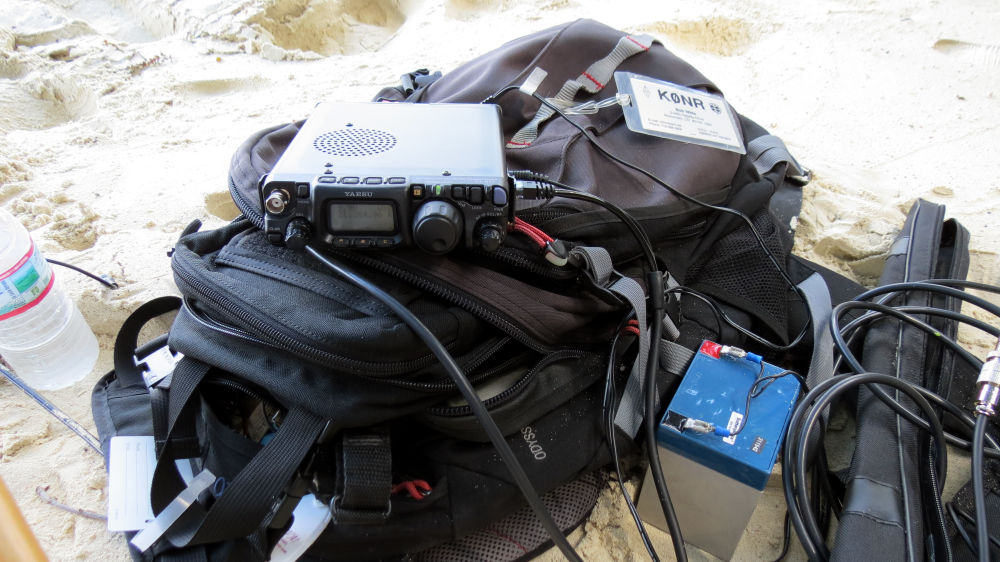
The innovative “plop the rig on top of a backpack” operating configuration.
We spent quite a bit of time exploring the island, driving around in two rental Jeeps. For mobile communications, we chatted back and forth on 146.58 MHz, the Golf-November-Tango frequency, using handheld transceivers. In the end, these radios probably got the most use during the trip. (Did I mention this was a slacker DXpedition?) There are a few 2m repeaters in the islands but we did not make use of them.
I brought a Yaesu FT-60 and a Baofeng UV-5R along on the trip, but mostly ended up using the Baofeng radio. If was the perfect radio to take to the beach — does the job and not that big of a loss if it landed in the ocean. Using the dual receive feature of the HT, I monitored the marine calling frequency, 156.80 MHz, listening to the boat traffic.
So if you are looking for a great place to go to enjoy the sand and water, I highly recommend St. John. Go ahead and take along some ham gear and do some slacker DXing. For more information on KP2 ham radio, see the ARRL Virgin Islands Section web site.
— 73, Bob KP2/K0NR
QSL to KP2/K0NR via Logbook of the World or to K0NR via Buro or Direct with SASE
Not much more to go now
Change is a really handy tool. I’m in the business of delivering projects which always means change. So when it came to managing some change at home I thought I knew what I was doing. When I say change I mean a little bit of landscaping that a fellow ham was going to do and at the same time put in a new cables and a post ready for my new mast and antenna. This mean a bit of planning, cost control and some stakeholder management. Or so I thought.
I had originally decided on extending the house and had some lovely plans drawn up (which included a mast and antenna), put them through planning (domestic / xyl and local council) had them approved only to find that the local builders wanted huge sums for a small job. Hence the scope was reduced to meet the budget.
For the last few weeks I have toiled int he freezing rain to drill new holes in the side of the house, removed old and corroded (poor finishing by me) cables and then set about running new ones before removing some old decking that was the cause of our problem (wooden decking and West Cumbria should be avoided). What is going to go in its place is a mast stub in the ground, ground mounted rotator, heavy duty 12.5m mast and a folding hexbeam.
The schedule is hectic but I imagine in a matter of 4 weeks I will be back on the air on hf and there will be a very tired out g7kse, ready for for some leisurely operating on hf and perhaps in time for some early Es. Until then its the UKAC VHF tuesday nights for me still.
Colorado 14er Event – August 3, 2014
 During the Colorado 14er Event, Amateur Radio operators will be climbing many of Colorado’s 14,000-foot mountains and SOTA summits to set up amateur radio stations to communicate with other radio amateurs across the state and around the world. Join in on the fun on Sunday August 3 and see how many of the mountaintop stations you can contact.
The new Colorado 14er Event logo is now available on t-shirts and more.
Starting in 2012, Summits on The Air (SOTA) is part of this event. This means there are over 1700 summits that you can activate in Colorado, with a wide variety of hiking difficulty. This opens up the event to a lot more people and a lot more summits. See the new SOTA page.
Radio operators with 14er climbing experience who plan to activate a summit should log their name and intended peak at the Ham14er Yahoo group. This is also the email list for discussing the event and asking questions.
75% Chance of M-class Flares, 30% For X-class
Solar Flare Alert:
Active Sunspot Region 11944 has a 75% chance of producing an M-class flare, and a 30% chance of producing an X-class flare, in the next 24 hours. Smaller flares are also possible.
We are expecting a glancing blow from a Coronal Mass Ejection (CME) sometime in the next 24 hours.
The Earth’s polar regions are under a proton event (Polar Cap Absorption, or PCA, event). This is degrading HF communications over polar regions.

(Live data and more info at https://Facebook.com/spacewx.hfradio or http://SunSpotWatch.com/ )
Contest Results Are In
 In the past two weeks, the results of several ham radio contests from last summer were posted. The typical contest takes months for the official results to be finalized and I have usually forgotten about the contest by then. The more serious contesters share their results via the 3830 web site so they can get an early read on how they did relative to their peers. But you need to be patient for the official results.
In the ARRL June VHF Contest, I placed in the top ten for the new Single Operator 3 Band category. This category is restricted to 50, 144 and 432 MHz, which is a good match to my radio interests. We had good 50 MHz conditions in Colorado (relative to other parts of the country), so CO stations seemed to score well.
Speaking of Colorado, in the Colorado QSO Party I finished first in the Phone – Low Power – Single-Op category. I was actually not that pleased with my score this year (45,500), which was considerably less than my score from last year (76,464). Oh well, I will invoke the Universal Purpose of Amateur Radio and say I had a great time in the contest, regardless of the score. Thanks to the Pikes Peak Radio Amateur Association for sponsoring this event.
The ARRL Field Day results are also posted. Joyce K0JJW and I did a one transmitter (1B) operation from the cabin using the club call KVØCO, resulting in a modest score (454). We mostly made phone contacts on 20m, 15m and 6m. We had some nice sporadic-e on 50 MHz, which is always a treat. Remember, the key to a fun Field Day is: Season To Taste.
73, Bob K0NR













