Posts Tagged ‘Mountains’
 2015 SOTA VHF Activity Days
 March 8th, 2015 |
  Author:
 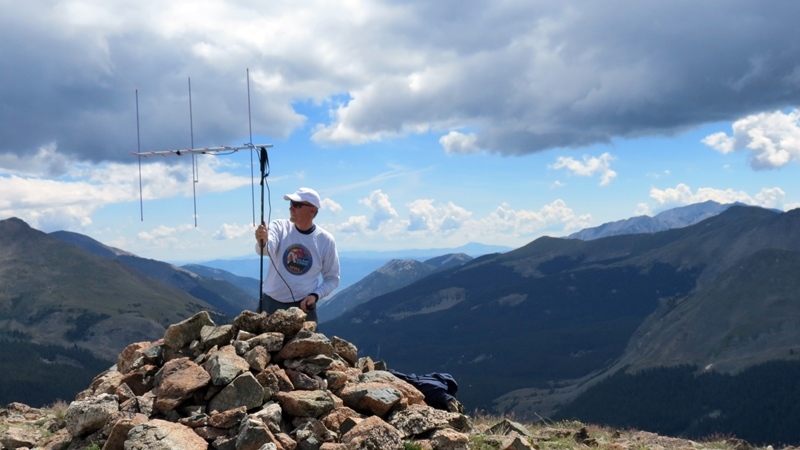 On the topic of operating events for Summits On The Air (SOTA) activations, Guy N7UN suggested focusing on six major events for 2015. Most of these are VHF-oriented but HF activity can also occur on these days.
- Jan 24-26: ARRL Jan VHF Contest + NA SOTA Winter Activity Weekend
(oops, I guess we already missed that one) - Apr 18-19: North America SOTA Spring Activity Weekend
- Jun 13-15: ARRL June VHF Contest + NA SOTA Summer Activity Weekend
- Jul 18-19: CQ WW VHF Contest + optional for SOTA
- Aug 1-2: Colorado 14er Event + NA SOTA Rocky Mtn Rendezvous + W7 SOTA Activity Weekend + ARRL UHF Contest
- Sept 12-14: ARRL Sept VHF Contest + NA SOTA Fall Activity Weekend
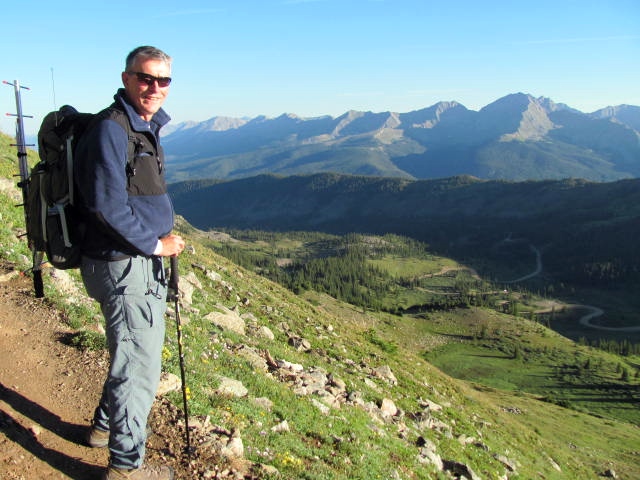 Of course, any day is a good day for SOTA activity. I also think six weekends are a great way to focus our operating activity and create S2S (summit to summit) radio contacts. The August 1-2 weekend looks to be the alignment of the planets with four events happening on that weekend. Early August usually offers excellent conditions for hiking the highest peaks in Colorado, so come on out and play.
For more info on VHF SOTA, see How To Do a VHF SOTA Activation.
Get off the couch, put on your hiking boots, grab your backpack, grab your radio but most important: get on the air!
73, Bob K0NR
The post 2015 SOTA VHF Activity Days appeared first on The KØNR Radio Site.
SOTA Activation: Kaufman Ridge HP (W0C/SP-081)
It was a nice fall day, so Joyce K0JJW and I decided to go for an easy hike up Kaufman Ridge HP (W0C/SP-081) and do some SOTA operating. Well, maybe the hike was her idea and the Summits On The Air thing was my contribution to the plan. The hike is less than a mile and has about 900 feet in elevation gain, depending on where you start the hike.
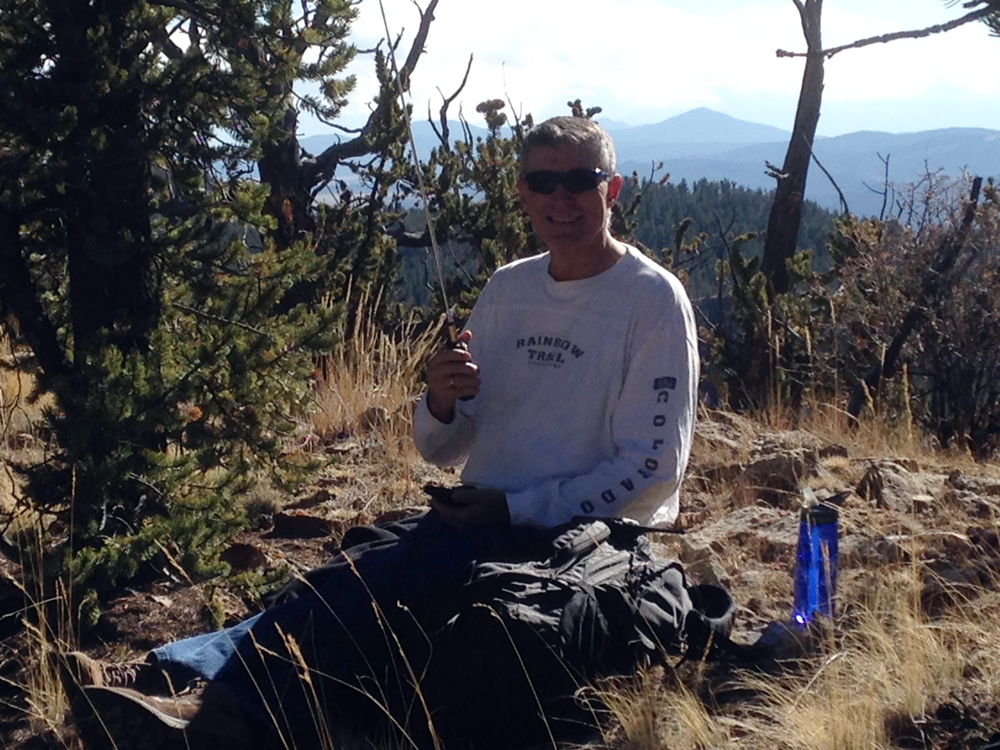
This definitely a slacker operation: easy access, easy hike, great weather and 2m FM activation via a handheld radio and the 1/2-wave whip.
Note that there are two SOTA peaks with the “Kaufman Ridge” name: Kaufman Ridge North (W0C/SP-085) and Kaufman Ridge HP (W0C/SP-081), located near Trout Creek Pass in Colorado. Today we headed to SP-081 which we reached by following County Road 318 from Trout Creek Pass, which is also called Buckrake Drive and then Windmill Drive. These roads pass through private property to reach the San Isabel National Forest, where there is a gate that closed from December to April (see map). At this point, the road is easy 4WD, most 2WD high clearance vehicles will do fine. You can also approach from the south on FS 308 through Mushroom Gulch. 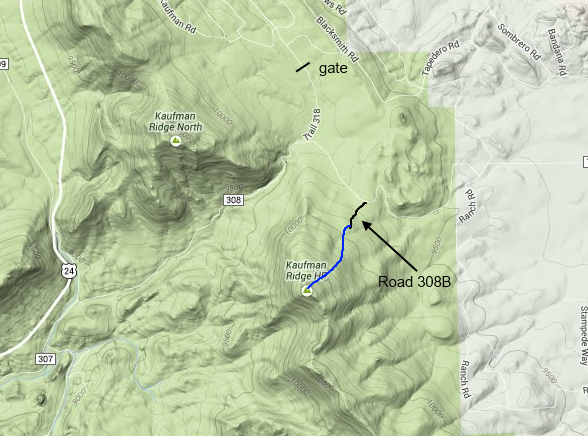
We turned left onto FS 308 and then took a short side road FS 308B toward the summit. There are several over turn offs but 308B seems the best (shown in black on map). The road is blocked for vehicular traffic at 38.858659° N / 105.933921°W. You can continue walking on the road a ways or just head straight for the summit. While the hike is short and not that steep, there are plenty of downed logs to give you a challenge.
You never know who is going to show up on 146.52 MHz in the mountains but I had put the word out via email to some of the local hams to let them know I was doing a SOTA activation. When I got to the summit, I had a few stations already calling me and I quickly worked Ron N0MQJ, Fred N0VXE, Dave K0HTX, Jim KD0MRC, Bob W0BV and Don K0DRJ. Don was my “best DX”, about 60 miles away in Woodland Park with a few mountains in the way. Thanks to everyone that came on frequency and contacted me.
Side note: if you want to activate SP-085, go north on a forest service road (not shown on map) near where 318 and 308 intersect. Just drive a short ways north, find a parking spot and bushwack your way up the summit. You could easily activate both summits in one day.
73, Bob K0NR
The post SOTA Activation: Kaufman Ridge HP (W0C/SP-081) appeared first on The KØNR Radio Site.
Mt Herman: SOTA plus VHF Contest
The North America SOTA Weekend coincided with the ARRL September VHF Contest, which I interpreted as a great opportunity to do a combination SOTA activation and QRP VHF operation. A few other folks thought that was a good idea so we all got on the air from SOTA peaks on the Sunday of the weekend. I decided to operate from Mount Herman (W0C/FR-063) in grid DM79. I hiked up the same mountain for last year’s September contest and got soaked by the rain. Fortunately, the weather was excellent this year, making it a great day.
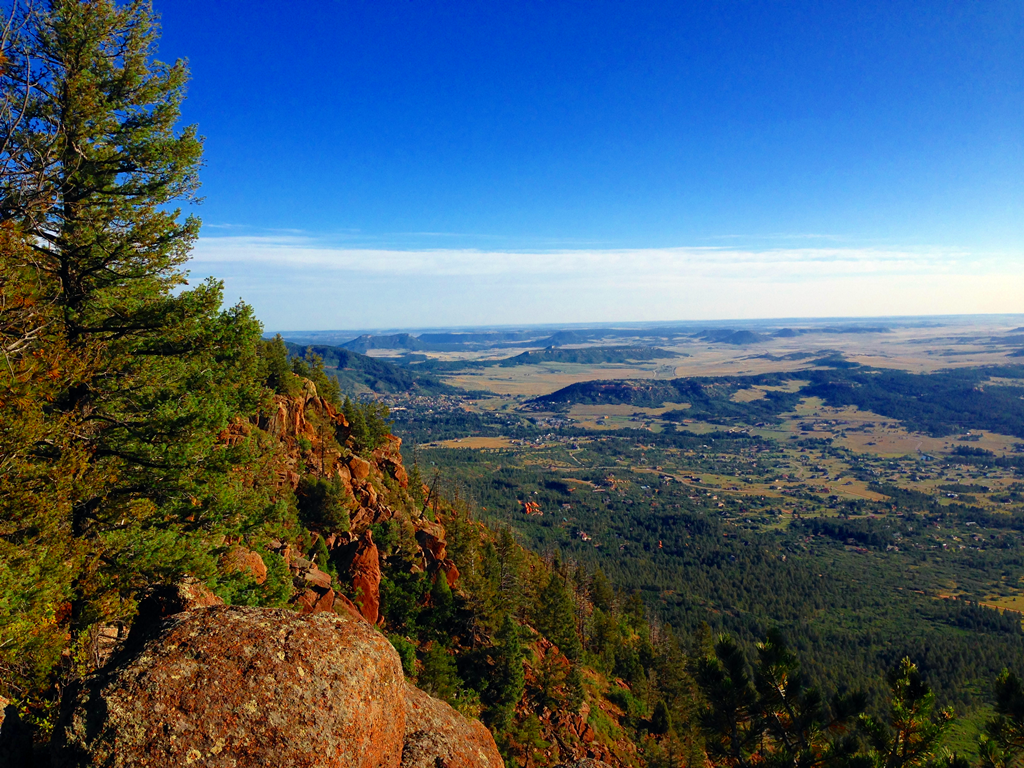
View from the south side of Mt Herman
For radio equipment, I took a couple of HTs for 2m and 70 cm FM and the FT-817 for CW/SSB on 6m, 2m and 70 cm. Most of the SOTA action would be on 2m FM but SSB is critical for working the VHF contest. I did put out the word to the usual VHF contesters that there would be FM activity and did work a few of them via 2m FM. The 2m FM calling frequency, 146.52 MHz, is commonly used for SOTA but is not allowed for contest use. (Another example of how this rule is just a barrier to contest activity.) We used 146.55 MHz for the contest contacts. 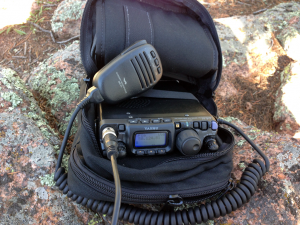 I had coordinated with Brad WA6MM who was going to be on Grays Peak (W0C/FR-002), one of the Colorado 14ers. When he made the summit, I had my 2m yagi antenna pointed in his direction and easily worked him on 2m FM at a distance of 65 miles. Brad was using an HT with a 1/2-wave vertical antenna. Also, I worked Stu W0STU and Dan N0OLD on Bald Mountain (W0C/FR-093) , which sits on the east side of I-25 right at Monument Hill. Contest activity was light, as usual for the September contest in Colorado. We did have two rover stations that activated a few of the unpopulated grids in eastern Colorado: George AB0YM and Jonesy W3DHJ.
Band       QSOs X pt =  QSO pts.  X   Grids   =     Points
 -----------------------------------------------------------
 50         8      1      8             5             40
 144        23     1      23            5             115
 432        14     2      28            3             84
 -----------------------------------------------------------
 TOTALS     45            59            13            767
My contest score was not bad for a few hours of operating QRP portable. It turns out that I had set the Colorado section record for “single-op portable” back in 1990 with just 624 points (using my old callsign KB0CY). Oddly enough, 24 years later it appears that I set a new record. (This speaks more to the lack of QRP activity during the September contest and less about my incredible operating ability.)
All in all, it was a great day in the mountains to take a hike and play with radios. I will probably do the SOTA + VHF Contest activation again.
73, Bob K0NR
SOTA Summit Activation: Sandia Crest (W5N/SI-001)
Joyce KØJJW and I were headed to the Duke City Hamfest in Albuquerque when we decided to make a side trip up Sandia Crest for a low overhead (read: slacker) Summits On The Air (SOTA) activation.
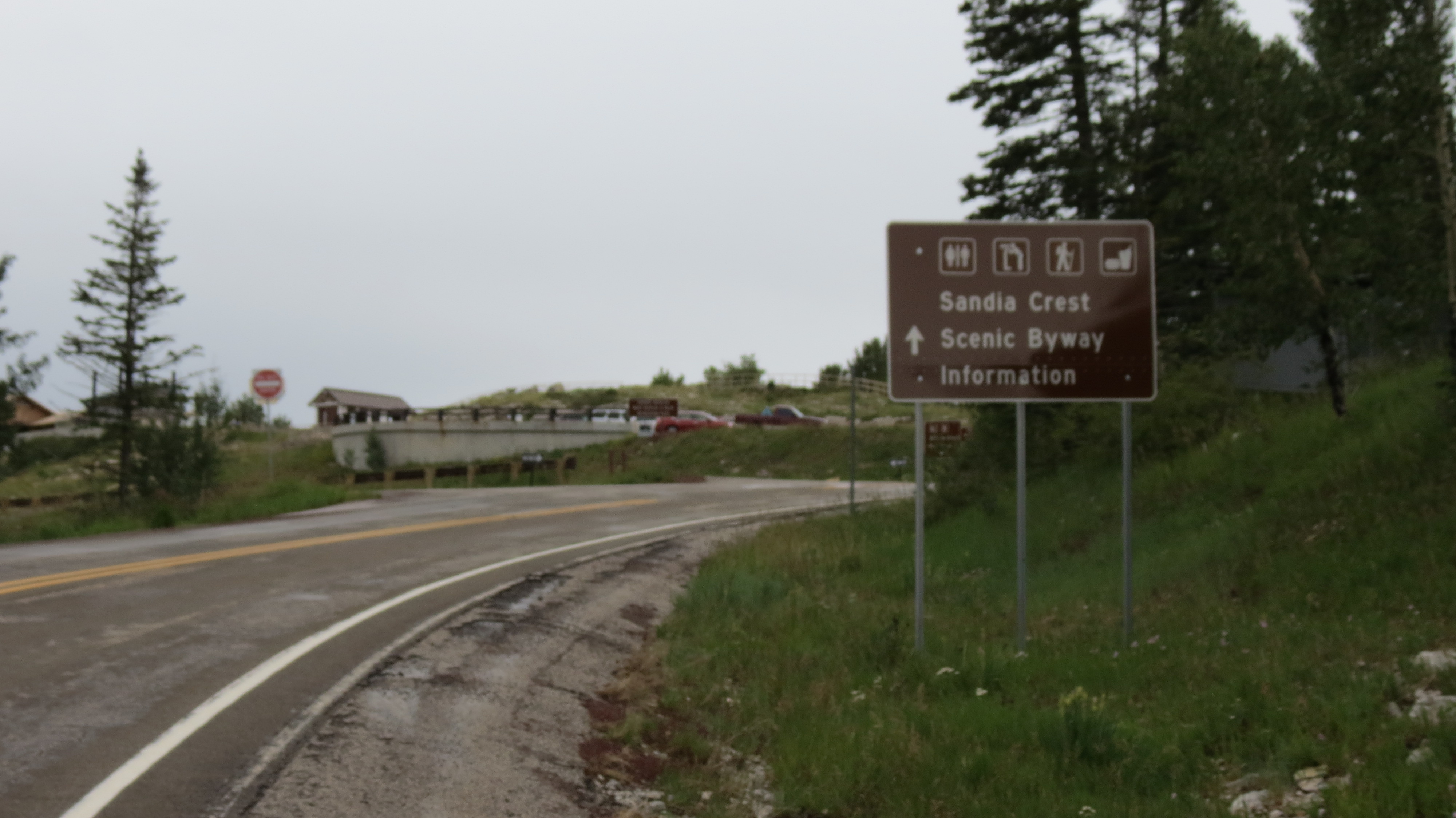
The view of the summit when approaching via the Sandia Crest Road.
Sandia Crest pokes up 10,678 feet, towering over Albuquerque at roughly 5000 feet. Although the weather was rainy, we enjoyed the drive up the paved Sandia Crest Road through the Cibola National Forest. This looks like a great area to explore and we’ll probably be back sometime in the future.
At the parking lot, about 40 vertical feet below the summit, we paid the $3 per day use fee (self-service USFS station), grabbed the radio gear and headed up the walkway to the top. There is a gift shop and restaurant at the south end of the parking lot, along with several hiking trails. A large radio site on the north end of the parking lot has numerous towers and high power transmitters. The field strength is so strong that a sign has been placed there to warn of radio interference to car alarms and keyless remotes.
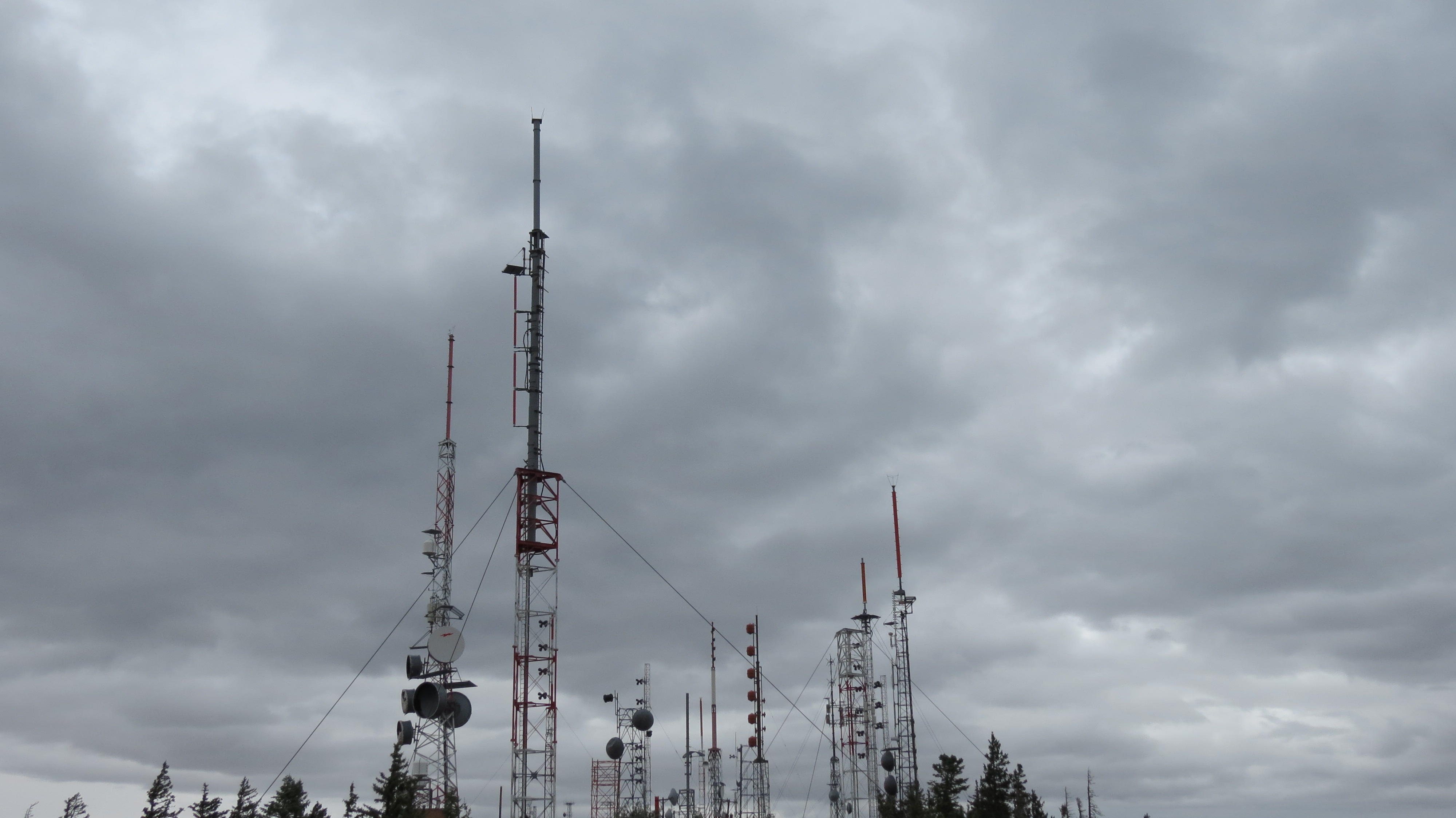
There is a large radio site with powerful transmitters near the summit.
I pulled out the trusty Yaesu FT-60 handheld transceiver with the MJF-1714 1/2-wave antenna for 2 meters. I gave a few calls on 146.52 MHz and heard no replies. I am thinking, “surely with so many hams in town for the hamfest, someone is listening on five two.” Joyce was standing next to me with her FT-60 and a rubber duck antenna. We noticed that her radio was hearing signals that I could not hear.
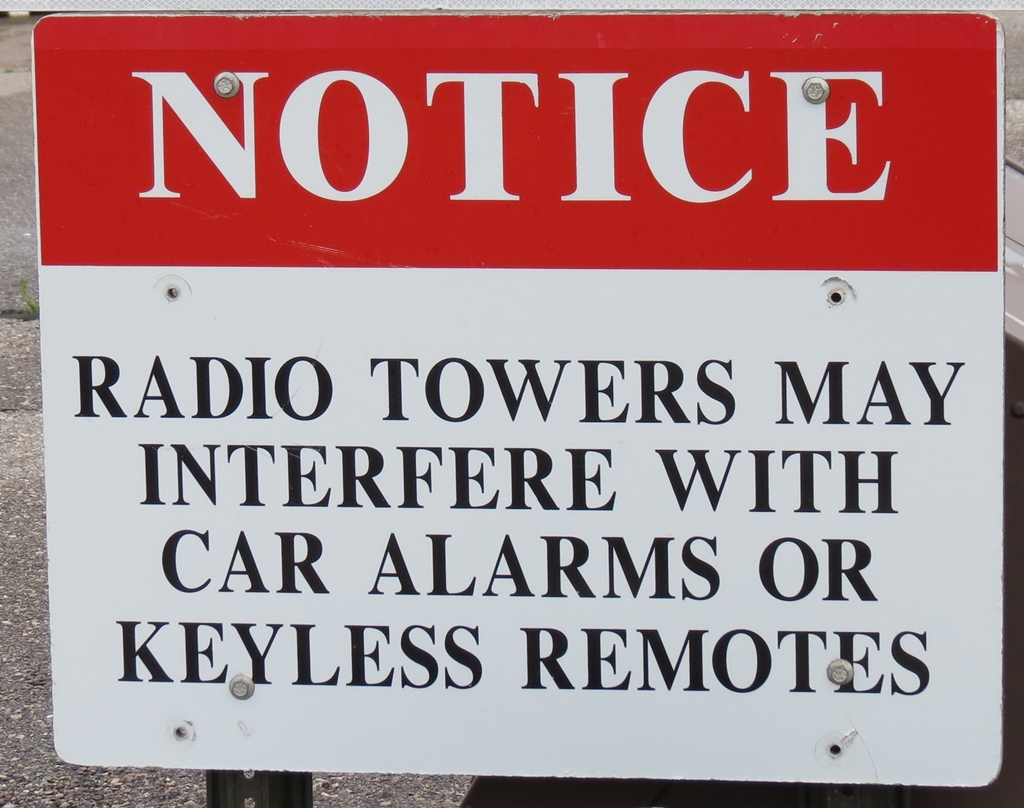
Well, this sign did warn me of radio interference.
Hmmm, the radio with the better antenna is not able to hear anything but the radio with a crummy rubber duck is working fine. At this point, I realized that my HT was being overloaded from the transmitter site with my high-efficiency antenna doing a great job of coupling those signals into my radio. I had to chuckle about this since I’ve often pointed out the poor performance of your typical rubber duck antenna. In this case, the less effective antenna was doing us the favor of reducing interference.
I swapped antennas and began making calls on 2m fm with the rubber duck. I also moved further away from the radio site to reduce the signal level. Yep, now I heard some guys coming back to me on 146.52 MHz. I could tell there was still some interference but it was workable. In short order, I had these stations in the log: KE7WOD, W5AOX, K5LXP, WB5QXD and K0JJW (after moving downhill outside of the activation zone),. Thanks for the QSOs!
I will admit that NM5SW mentioned the interference problems on this peak, so I had fair warning. Keep in mind that the FT-60 has reasonably good intermod performance, probably better than your average HT, and was getting completely blocked with the long antenna. I was glad that I was not using one of the Baofeng HTs. It made me wonder how well my FT-817 would do under the same conditions, but that will be a test for another day.
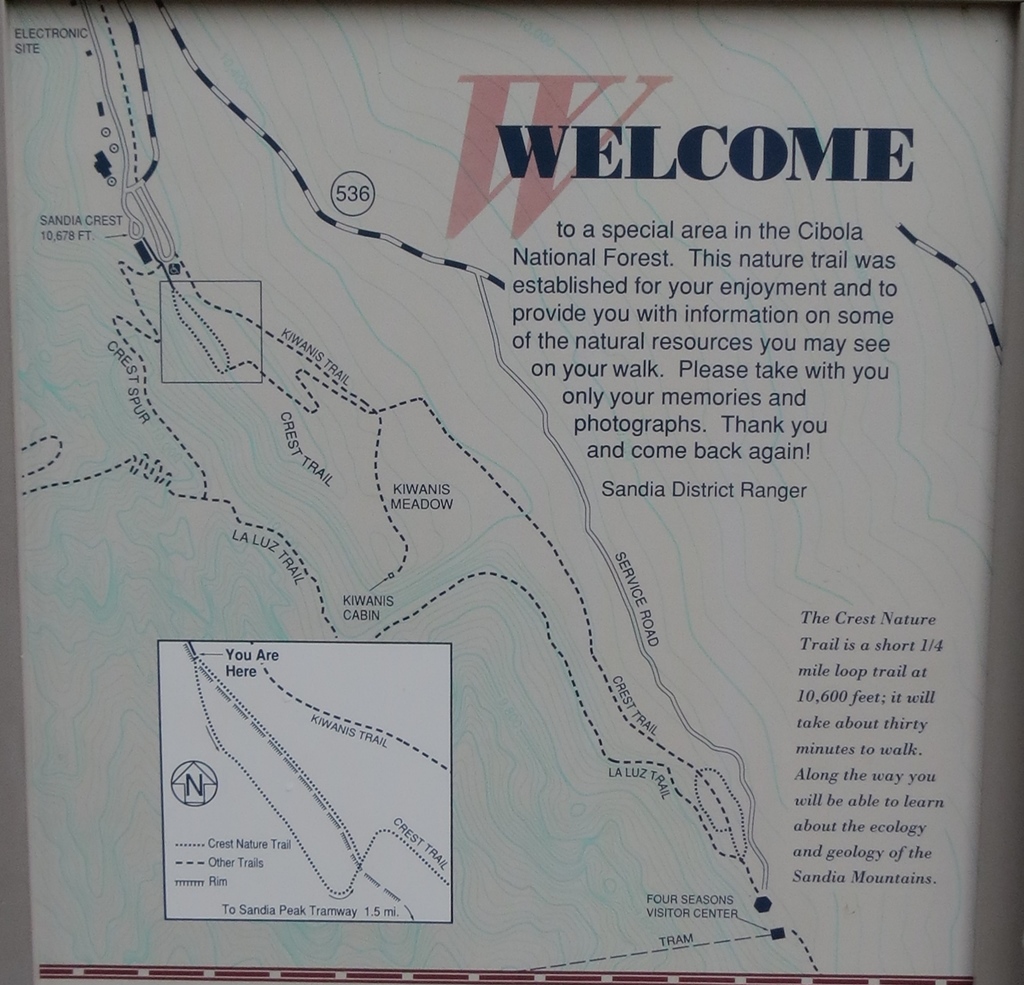
This sign shows the trail system at the summit and the location of the tram.
Another way to ascend the peak is via the Sandia Peak Tramway, which comes up from the Albuquerque side. We came across this sign that shows the trail system near the summit and indicates the top of the tram (click to expand). The tram drops passengers off some distance from the actual summit, so you’ll have about a 1.5 mile hike to the summit.
In summary, it was a successful activation although the weather could have been better. The big thing I learned was that a more efficient antenna is not always the best antenna. Sometimes a crummy rubber duck does better!
73, Bob K0NR
P.S. I later heard from Mike KD5KC that the Kiwanis Cabin (shown on the map) is a good place to operate from without radio interference issues on HF and VHF.
SOTA Summit W0C/SP-042 Activation
For the 2014 Colorado 14er Event, Joyce K0JJW and I decided to try a summit close to our cabin near Trout Creek Pass. The basic idea was to activate a non-14er SOTA peak with good VHF paths to all of the Colorado mountains. We also wanted to demonstrate the idea of activating Summits On The Air peaks during the 14er event.
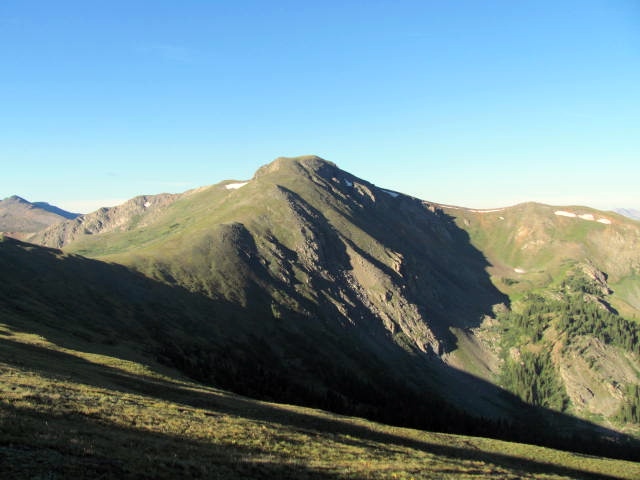
SOTA summit W0C/SP-042
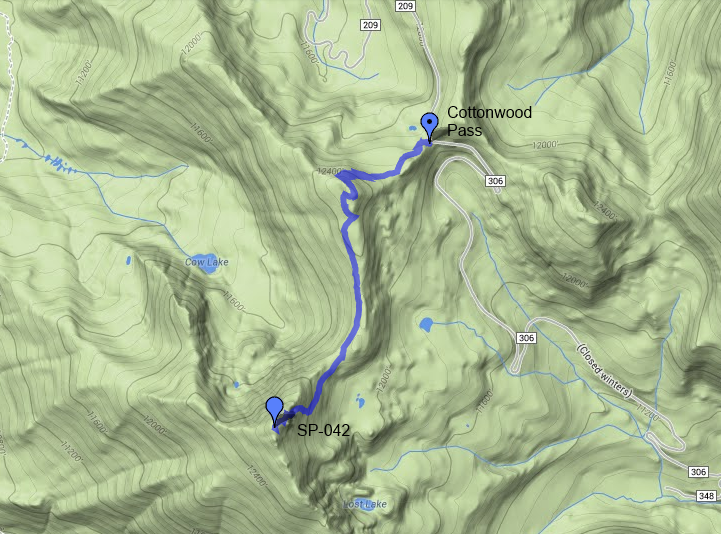
We chose an unnamed peak (W0C/SP-042) that rises to 12,792 feet near Cottonwood Pass . This summit was already on my list of SOTA peaks to activate, so that was another plus. The trail starts at Cottonwood Pass, right on the continental divide and runs along the divide for about 2 miles.
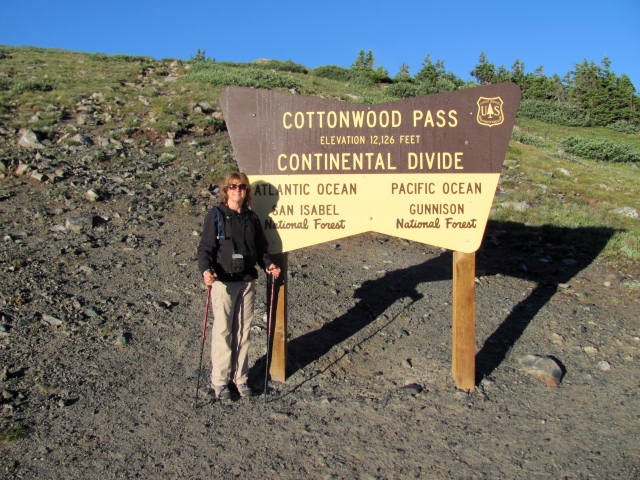
Joyce (K0JJW) at the trail head, Cottonwood Pass.
In fact, we followed the Continental Divide Trail (CTD) to get to this SOTA peak. I’ve done several backpack trips on the CTD and its always a blast to be walking along the top of the continent enjoying the awesome views.
The trail starts at Cottonwood Pass and runs along the Continental Divide.
The main trail passes over the top of another summit at 12,400 feet before continuing on to SP-042. The trail does not go to the top of SP-042, passing it on the east side. We just stayed on the trail until we were due east of the summit, then climbed up the east side which turned out to be a bit steeper than it looked. On the way down, we left the summit by following the ridge a bit to the south and found a gentler route back to the trail. Also on the way back, we followed a side trail to the east of the 12,400 foot summit, saving some vertical gain and loss. My GPS app on the iPhone logged the one-way distance as 2.2 miles (including going over the first summit). It looks shorter on the map but the switchbacks add some distance.
Bob (K0NR) on the trail.
After we reached the summit around 9 am, I quickly assembled the 2m/70cm Arrow antenna and mounted it on my hiking stick. Once I had the FT-817 up and running, I spotted myself on Sotawatch.org using the SOTA Goat app. Logging was done with HamLog on my iPhone.
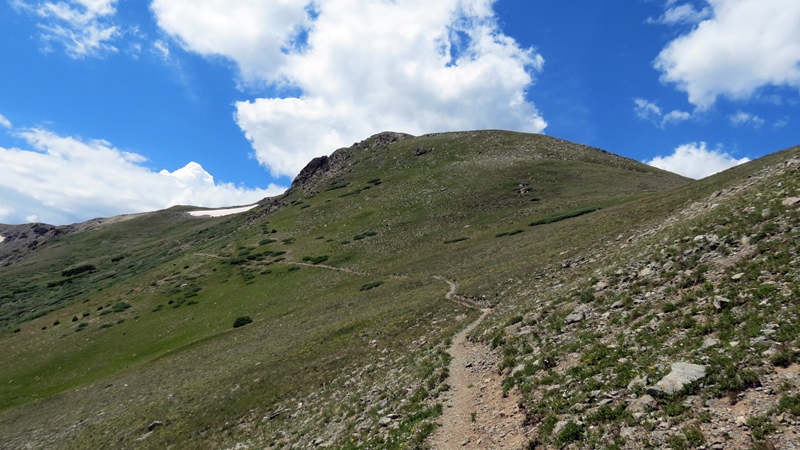
Typical trail conditions on the CTD.
I worked a number of mountaintop stations on 2m fm (147.42 and adjacent simplex frequencies) with the best DX being N4MMI on Redcloud Peak, about 80 miles away. I tried calling on 2m and 70 cm SSB without any luck. Joyce made a few contacts on 446.0 MHz using an HT with a vertical antenna.
Bob (K0NR) pointing the 2m yagi (vertically polarized) for maximum signal strength.
The weather cooperated all morning with mostly white fluffy clouds. We stayed on the summit until noon and then hit the trail back to the pass. This hike is now one of our favorites, really good for visitors that want a taste of hiking above treeline with great views.
73, Bob K0NR
This Spewed Out of the Internet #28
 More important
 things have spewed forth from the interwebz:
HamRadioNow interviews the Ham Hijinks guys and has the nerve to actually publish the video. Later the Hijinks crew posted this article about changes being made to Field Day.
Baofeng is going to change its name. Or is this just another Ham Hijinks article?
WE2F writes: 146.52 Reasons to Monitor VHF Simplex but whatever you do, do not use 146.52 MHz on Field Day. Mike AD5A posts Why Operate QRP from Summits? The FCC kicks the butt of a cell phone jammer manufacturer, to the tune of $34.9M and also fines a couple of 14.313 MHz problem children.
A Broadband Over Powerline (BPL) provider bites the dust. Did I mention that it is a really dumb idea to transmit bits over AC power lines?
I did a little explaining about those antenna connectors on handheld radios. Randy (K7AGE) has a neat video showing some basic 2m FM portable operating.
I knew it: Digital is overrated and vinyl is making a comeback. Really.
Due to popular demand, I updated the VHF QRP page. Yes, some radio hams do operate QRP above 50 MHz…apparently for the same reasons that people operate HF QRP. Which is to say we really don’t know why.
I also found that the domain name for the Colorado 14er Event was broken, so I fixed it. See ham14er.org This event is the most fun you can have dorking around with radios in the Colorado mountains. Also, be sure to check out these operating tips.
73, Bob K0NR
Making Plans for the Colorado 14er Event
 The Colorado 14er Event (Aug 3) is less than a month away so it is time to get ready. This event was born out of the basic observation that many hiking hams were taking along their radios (typically, a VHF/UHF handheld) when they climbed the Colorado 14,000 foot mountains. So we thought “let’s all climb on the same day and see who we can contact.” The typical 2m FM contacts have expanded to other frequencies and modes, including the high frequency bands, with the potential for worldwide propagation. We’ve also embraced the Summits On The Air (SOTA) program, opening up over 1700 summits in Colorado for ham radio activity.
How can you join in the fun? The most active way to participate is to operate from a summit. If you are interested in climbing 14ers, then you may want to operate from one of the 54 14,000 foot mountains. In my opinion, all of the 14ers are strenuous hikes, so be sure to assess your ability and check out the challenge of any summit you attempt. There are a few that you can drive up, Pikes Peak, Mount Evans and Mount Bross (4WD only). Note that a “non-motorized final ascent” is required if you want to qualify as a SOTA activation, which is encouraged. See this web page for some great tips on activating a SOTA peak. If you want to try something less difficult, consider one of the easier SOTA peaks (more than 1700 in Colorado). Everyone can find a SOTA peak that fits their particular hiking ability.
If you can’t get out and operate from a summit, you can still have fun trying to contact the radio hams on the various summits. There will be quite a bit of activity on 2m FM, starting with 147.42 MHz and moving up from there using the standard Colorado band plan. You’ll want to be roughly within “line of sight” to as many peaks as possible for working them on VHF. Many radio operators will be on the HF bands, too. See the recommended frequency list here.
Summits On The Air has some great infrastructure that we can use during the event. The SOTAwatch web site is using for “spotting” SOTA stations so that you know who is on the air. Spotting yourself is encouraged and can be done from many peaks using a mobile phone. SOTA Goat is a great iOS app for making and tracking spots.
Take a look at this posting for some additional SOTA resources. There’s quite a bit of information out there so take advantage of it. Remember, the Colorado 14er Event is based on the fundamental purpose of ham radio: to have fun messing around with radios. But be careful out there, we don’t want anyone to get hurt.
Questions, comments, let me know.
73, Bob K0NR
Disclaimer: Climbing mountains in Colorado can be dangerous. Only you are responsible for your safety. In particular, be very aware of the lightning danger if you are hiking above treeline.













