Posts Tagged ‘Contests’
 NPOTA: ARRL’s Best Idea?
 January 4th, 2016 |
  Author:
  The National Parks on the Air (NPOTA) is off and running. Making contact with a handful of stations currently operating from NPOTA locations has made me wonder if the ARRL has had a good idea with NPOTA as a way to help celebrate the anniversary of the National Park Service.
From ARRL: “Throughout 2016, Amateur Radio will be helping the National Park Service celebrate their 100th anniversary. Hams from across the country will activate NPS units, promote the National Park Service and showcase Amateur Radio to the public.”
I am a huge fan of both the National Parks and the National Park Service. Anyone who is interested in the history of our National Parks would be well rewarded to start with the Ken Burns documentary The National Parks: America’s Best Idea. Yellowstone generally gets credit for being the first National Park back in 1872. However, the National Park Service was not established until 1916. That period in between provides us a very good reason that there are times when we need a government organization to protect us from ourselves. During that in between period, the Army was given the mission of attempting to protect both Yellowstone and Yosemite. Like most missions the Army received, they were underfunded, under equipped, and undermanned. They did, however, do the best they could to protect these amazing areas. Many Americans saw these new National Parks as areas for economic exploitation. If it wasn’t for many individuals working long and hard for the establishment of the National Park Service, it is very likely we would not be able to enjoy the parks we have today. Stephen Mather and Horace Albright were the two primary individuals who secured the establishment of the National Park Service. Ken Burns talks about these two individuals in his documentary and there are also a few books that do a great job telling the story (Creating the National Park Service: The Missing Years and The Birth of the National Park Service: The Founding Years, 1913-33).

The National Parks exist for our enjoyment. Generally that enjoyment manifests itself in some type of hiking, camping, fishing, watching for wildlife, or learning about history. This interaction between Park and citizen can be passionate, emotional, revitalizing, inspirational, and an educational experience.
With all that being said, I was a bit surprised to hear stations making contacts for NPOTA locations like it was a contest. Each NPOTA location is identified by a letter-number combination. No discussion of where they actually were. No description, no discussion. It is a bit sad to see there is a Leader Board – which only facilitates looking at NPOTA as a contest rather than an actual celebration.
I also wonder how these activations are impacting those non-amateur radio enthusiasts who are visiting a NPOTA site. Is this putting amateur radio in the best light?
Are these NPOTA activations promoting the National Park Service or showcasing Amateur Radio to the public?
If so, how?
What would Stephen Mather and Horace Albright think about NPOTA?
It will be interesting to see how NPOTA progresses over the coming weeks and months.
My CQ WW CW contest overview.
 |
| The QRP setup |

Since I am operating QRP and using small MFJ loop antenna on the balcony my operating style was as follows
- I Use my VFO B to save a strong DX station that at the time has a huge pileup going. This stops me from wasting time trying to break the pile. Better to come back when the crazy pileup is gone. This worked great when I came across a Senegal station.
- Even when a station is at an S2 level but is just calling and listening my 5 watts can and did many times make it through for a contact.
- I don't use a spotting network as I found most of these stations have a huge pileup but I do have an Elecraft P3. Using some hardware and software my P3 is seen on a 19 inch monitor and I am able to point and click on signals. My K3 then moves to that signal this allows me to see the activity on the band and Search and pounce these stations.
- When possible stay with a band such as 15m were my MFJ loop does not need to be retuned at all across the whole CW portion.
- Stick with my 250hz Inrad 8 pole CW filter so I can get between tight signals and only hear the op I want to contact.
In my post I am going to go into detail about my software I am now using and finding to be great for contesting and general QSO's It's now time to grab some eats and relax.
HF Slacker Operation for CQ WW SSB
The CQ Worldwide DX SSB contest was last weekend and I applied my signature HF Slacker™ operating methodology to this event. Most of the HF gear I have is kept at our cabin in the mountains but I had to be at the house this weekend due to some commitments. I decided to apply Field Day principles and rig up whatever I could with equipment on hand.
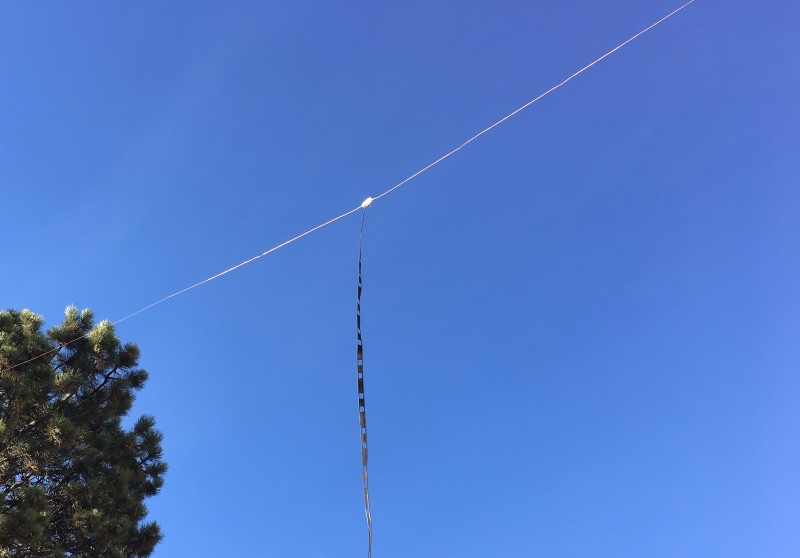
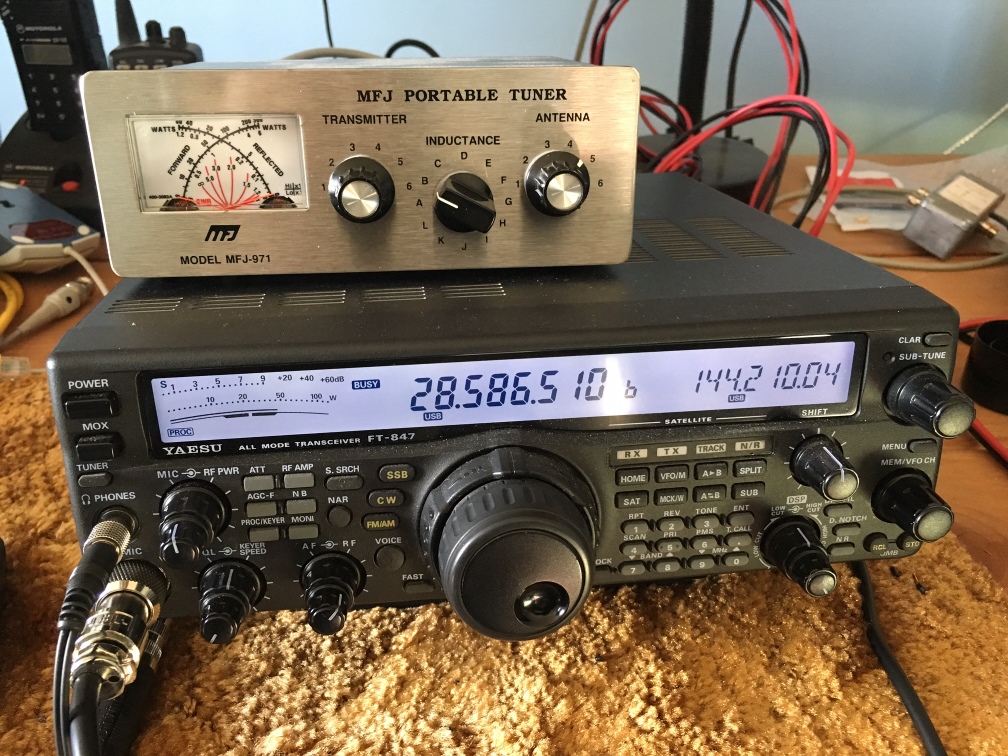 I dug out the Yaesu FT-847 transceiver, an MFJ antenna tuner and a half-size G5RV antenna to configure a basic HF station. Using a fishing pole to cast a steel washer over a tall tree in the back yard, I rigged up the antenna between the tree and the house. The G5RV is a compromise antenna…I’d much rather have something like a trap or fan dipole. But it’s what I had on hand, so I made it work. The impedance presented by this antenna is all over the map, so a decent antenna tuner is a must.
 I started out on 15m with a few contacts to Europe and Central America. Later I moved up to 10m and made even more contacts there. I was mostly searching around for the best DX but still working a few stateside stations. Later in the afternoon, the bands swung towards the west and I managed to work KH7CW and JR3NZC before going QRT for the day.
Sunday morning brought more propagation, first to Europe, then the Caribbean and South America. The high point was working AHØBT in the Mariana Islands and VK2GGC in Australia. AHØBT was not real strong, maybe S5 at my location so I thought I’d struggle to punch through the noise and QRM on the band. However, it only took a couple of calls to make the contact. That’s what I like about the 10m band!
I used the N1MM logging program during the contest. A snapshot of the log is shown below.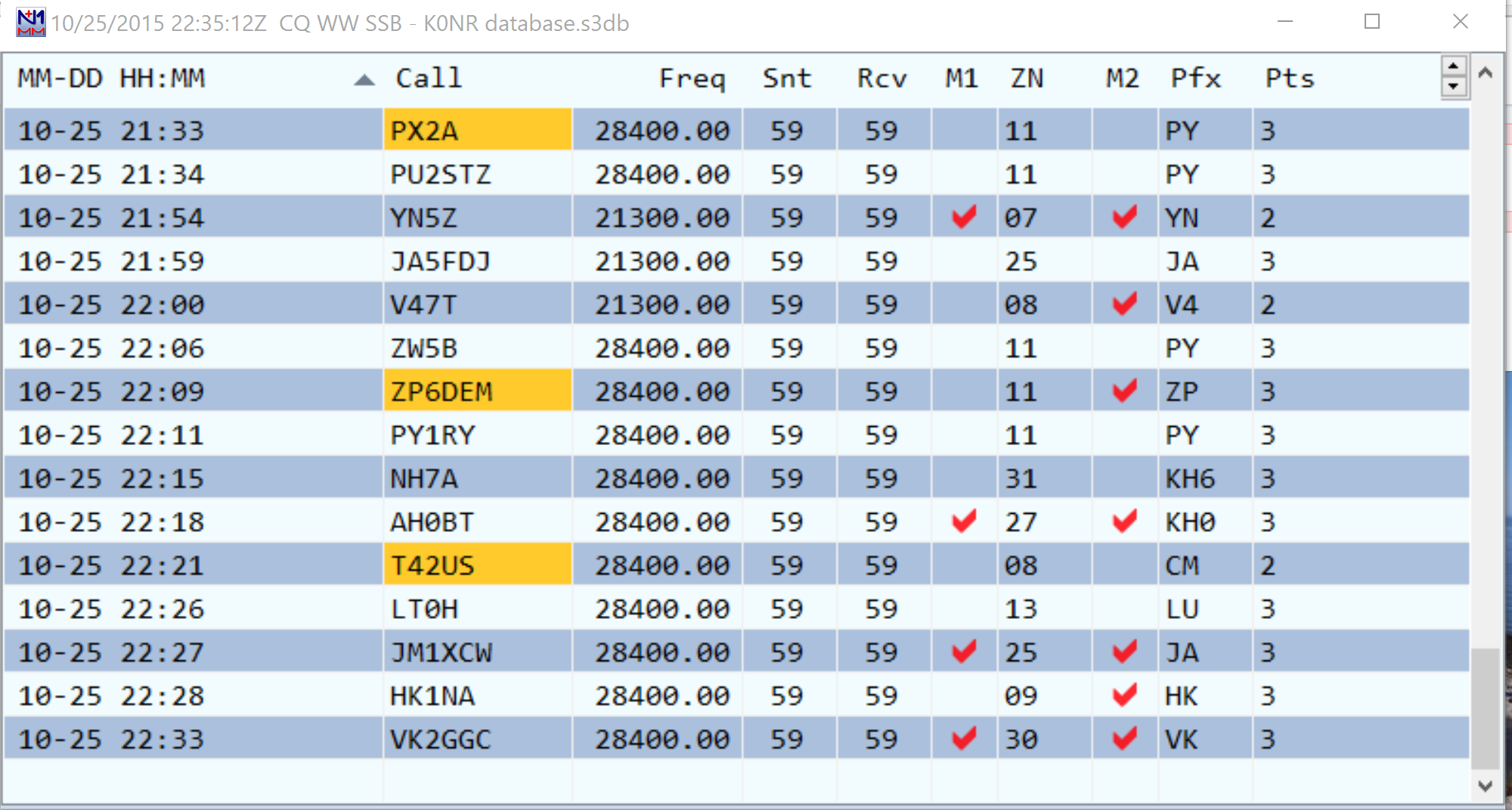 I only worked the contest intermittently on Saturday and Sunday, maybe 5 or 6 hours total operating time. Still, I managed to work 49 countries and 30 CQ Zones. That’s half way to DXCC on one weekend with a very basic HF station. Radio contests stimulate activity and DX contests bring out the DX. I point this out to encourage others to give it a try, even if they don’t have huge antennas on a tower and a linear amplifier. Almost all of my contacts were on 15m and 10m, which tend to be more productive when conditions cooperate. Twenty meters gets jammed with high power stations so it is often tough going for the little pistols.
 Band     QSOs     Pts  Zone  Country
    14       2       3    2    2
    21      30      70   13   21
    28      52     136   15   26
 Total      84     209   30   49
Score: 16,511
Another weekend of having fun messing around with radios. Even if I’m an HF Slacker™. 
73, Bob K0NR
The post HF Slacker Operation for CQ WW SSB appeared first on The KØNR Radio Site.
2014 September VHF Contest Certificate
The certificate for my entry in the 2014 ARRL September VHF Contest arrived in the mail last week. Given that it has been 11 months after the contest, I had pretty much forgotten about the effort. The ARRL VHF contest certificates look great, even if they do take a while to get issued. It turns out this contest entry was the combination VHF contest plus Summits On The Air (SOTA) activation from Mt Herman that I blogged about.
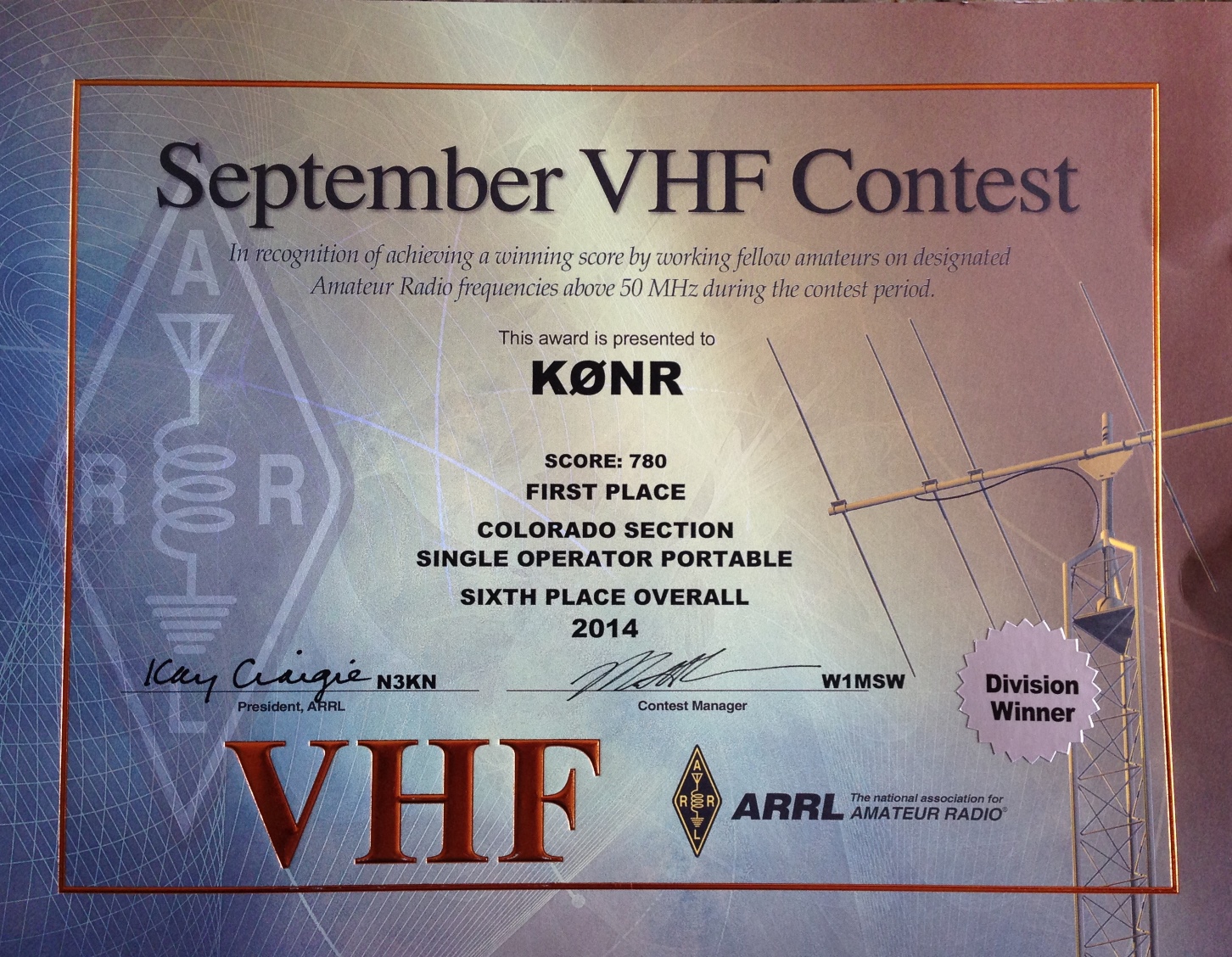 My blog posting said my score was 767 but the actual score was 780. Not a big score by any standard but not bad for ~4 hours of operating on a Saturday afternoon. As I suspected, this sets a new record for the Single Operator Portable category in the Colorado Section. What I did not expect is placing sixth in the overall contest (for my category). For the most part, this was just a really fun SOTA activation that included some VHF contest action.
Summary: The score doesn’t matter; any day having fun with ham radio is a good day.
73, Bob K0NR
The post 2014 September VHF Contest Certificate appeared first on The KØNR Radio Site.
Coming Soon: 146.52 MHz in ARRL VHF Contests
 I’ve been known to
 whine complain comment about the prohibition against using 146.52 MHz during ARRL radio contests. For example, see The One Frequency You Should Never Use on Field Day and Mt Herman: SOTA plus VHF Contest.
During my presentation on Mountaintop VHF for SOTA at the Central States VHF Society Conference in Denver today, I mentioned this is an issue. Basically, I pointed out that Summits On The Air (SOTA) operators often default to the 2m fm calling frequency, which is prohibited for use in the ARRL contests. This gets in the way when mountaintop stations do a combination SOTA and VHF Contest operation.
During my presentation, Brian Mileshosky N5ZGT, ARRL Director of the Rocky Mountain Division, reported that the ARRL has decided to remove the prohibition of 146.52 MHz in VHF contests. It will take some time for this to work its way into the actual rules, so stayed tuned for further developments.
This is great news…a cleanup of an unnecessary impediment to VHF contesting. Now, will the CQ Worldwide VHF Contest do the same?
73, Bob K0NR
The post Coming Soon: 146.52 MHz in ARRL VHF Contests appeared first on The KØNR Radio Site.
Another June VHF Contest In the Bag
Last weekend was the ARRL June VHF Contest, my favorite ham radio event of the year. For me, this is “vhf activity weekend” when all of the vhf radio enthusiasts come out to play on the bands above 50 MHz. The sporadic-e propagation that is (almost) always present during the contest means that 6 meters will be hopping.
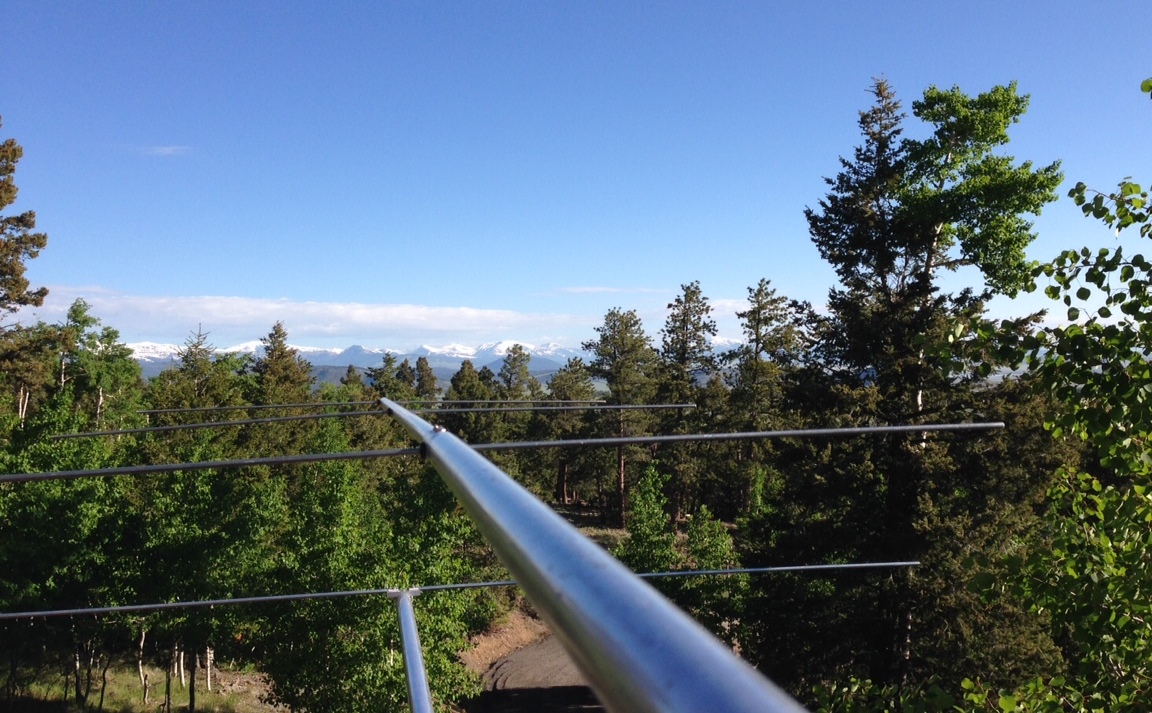 I entered in the 3-Band Single Operator category, using 6m, 2m and 70cm. My 6m rig is a Yaesu FT-950 driving a 6M5XHP Yagi antenna. For 2m and 70cm, I use a Yaesu FT-847 to drive a 2M9SSB Yagi on 2m and a similar Yagi for 70 cm. I set up portable masts at our cabin in DM78av, near Trout Creek Pass, Colorado (9600 feet).
This year, propagation seemed OK but not great. My score turned out to be about the same as last year with similar effort and same equipment, but down from previous years. 6m had sporadic-e openings very late both evenings, about the time I was ready to give up. Fortunately, I stuck with it and made quite a few contacts late into the evening.
The rovers kept things from getting too boring when 6m was not cooperating. Thanks to W3DHJ/R, ABØYM/R and WE7L/R for roving in eastern Colorado. WBØGAZ/R passed through South Park heading towards Denver and give me a few contacts. I also got a few contacts from KØCS/R and KØJJW/R. Thanks for roving!
Best DX was ZF1EJ in EK99, a new country for me on 6m.
73, Bob KØNR
K0NR June VHF Contest Summary:
 Band  QSOs  Mults
-------------------
    6:  190    83
    2:   30    13
  222:
  432:   11     6
-------------------
Total:  231    102  Total Score = 24,684
The post Another June VHF Contest In the Bag appeared first on The KØNR Radio Site.
Good Operating Habits on Field Day
In preparation for ARRL Field Day, I will be doing a presentation at our radio club meeting, explaining how FD works. We have lots of newer hams, so I want to cover the basics well. I looked around on YouTube for some video of typical Field Day contacts so our members could hear what it sounds like.
This video shows Andy K5PO doing an outstanding job of operating the WR5P Noise Blankers Field Day station. Give a listen and notice how he keeps the contacts short and to the point, clearly communicating using phonetics.
73, Bob K0NR
The post Good Operating Habits on Field Day appeared first on The KØNR Radio Site.













