Posts Tagged ‘Contests’
 CQ WPX, LoTW and the End of QSL Cards
 April 4th, 2015 |
  Author:
 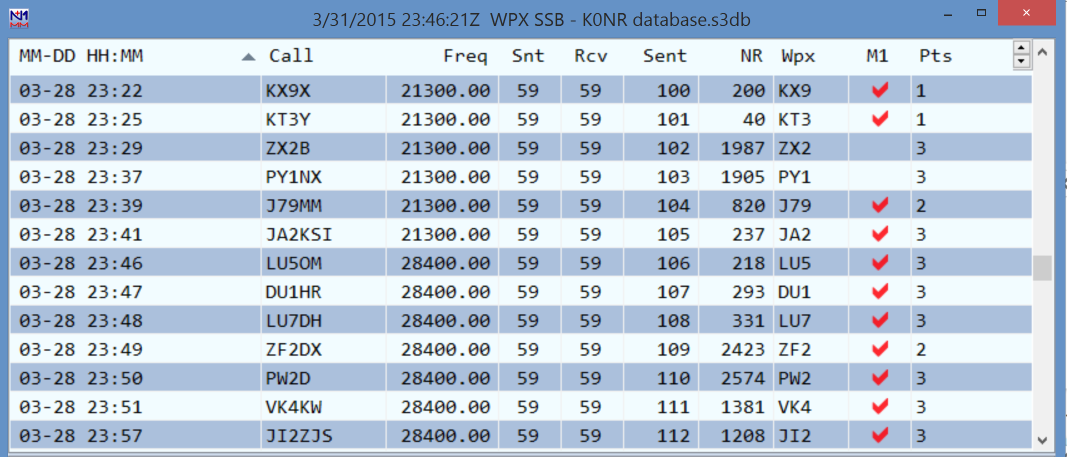 Last weekend, I had a fun time working the CQ WPX contest on SSB. I’ve always liked the format of the contest with the callsign prefix as the score multiplier (e.g., K1, K2, W1, W2, VE1, VE2 are all multipliers). Its like every new contact is a multiplier. This contest attracts plenty of DX but unlike some DX contests, everyone works everyone.
Consistent with the contest, the CQ WPX Awards Program issues operating awards based on callsign prefixes. The initial mixed mode (CW, SSB, digital) award requires confirmed contacts with 400 different prefixes. Back in the 20th century, I kept track of my confirmed contacts for WPX but lost interest along the way. I am sure I’ve worked more than 400 prefixes but the challenge was getting them all confirmed. More recently, the ARRL Logbook of the World (LoTW) added support for the CQ WPX Awards, so I started paying attention again, watching my CQ WPX total grow. I am not a big awards chaser but I have found value in using them as a specific goal to motivate me to get on the air.
Right before the CQ WPX contest, I had 380 prefixes confirmed via LoTW, so I figured that if I worked a few new ones during the contest, I could punch through 400 without too much trouble. I used my signature HF slacker approach at the cabin, using the Yaesu FT-950 to push 100 watts of RF power to wire antennas in the trees. For 40m, 20m and 15m, I used a trap-dipole antenna and for 10m I used a newly built ladder-line j-pole mounted vertically.
On Saturday, the propagation on the 10m band was smokin’ hot, strong signals from all continents. The 10m j-pole performed well. It was an absolute blast to easily work into Africa, Europe, South America, Australia, New Zealand and Asia. The 15m and 20m bands were also very productive. My approach was to tune around, looking for new prefixes to add to my confirmed total. Propagation was not as good on Sunday but still respectable but I only operated a few hours.
After the contest, I submitted my log to the contest web site and loaded my contacts into LoTW (188 QSOs and 157 prefixes). Immediately, I received two new confirmed prefixes. Over the next few hours, I checked back to watch my CQ WPX confirmed total climb on LoTW. It did not take long before it passed through 400 (and the total is still climbing). I will admit that I really liked the instant gratification of seeing my QSOs immediately confirmed.
That’s when it hit me: I am done with paper QSL cards. The amount of time and effort it takes to get 400 paper cards in my hand is just not worth it. It is soooooo 20th century.
Disclaimer: Actually, I still enjoy and use paper QSL cards…they are now just a secondary activity for me.
The post CQ WPX, LoTW and the End of QSL Cards appeared first on The KØNR Radio Site.
2014 World Radiosport Team Championship
From the World Radiosport Team Championship (WRTC) website:
The World Radiosport Team Championship (WRTC) is a competition between two-person teams of amateur radio operators testing their skills to make contacts with other Amateur Radio operators around the world over a 24 hour period. All teams use identical antennas from the same geographic region, eliminating all variables except operating ability.
WRTC2014 included 59 competing teams from 29 qualifying regions around the world. Competitors represented 38 different countries.
This is a unique contest in that the stations used are roughly identical so that operator skill is the main variable. I love watching these guys work the radios, especially the CW ops. Even if you are not a contester, take a look at this excellent video and enjoy radio hams having fun messing around with radios.
WRTC 2014 Documentary from James Brooks on Vimeo.
The post 2014 World Radiosport Team Championship appeared first on The KØNR Radio Site.
Dorking With VHF Contest Rules
 One continuing discussion in the VHF community is how to promote more activity, especially during the major VHF contests. One central theme that always emerges is how to modify the VHF contest rules to make them better, to make them fairer and to encourage new contesters. (Let me say up front that there is room for improvement in the contest rules but I don’t think rule changes alone will change contest participation significantly.)
In 2013, the ARRL contests added the Three-Band Single Operator and Single Operator FM Only entry categories. In January 2015, the ARRL added three more categories: Single Operator Unlimited High Power, Single Operator Unlimited Low Power, and Single Operator Unlimited Portable. These “unlimited” categories allow “passive use of spotting assistance” which roughly means these operators can monitor the various DX spotting networks but not spot themselves. The CQ Worldwide VHF Contest already allows passive assistance for all participants and self-spotting for digital EME and meteor scatter contacts. See the CQ WW VHF rules.
In January, the ARRL announced additional changes:
The Board … adopted amendments to the General Rules for ARRL Contests Above 50 MHz to encourage greater participation and band utilization. The changes become effective with the 2015 June ARRL VHF Contest. The revisions stemmed from recommendations offered by the Board’s Programs and Services Committee’s ad-hoc VHF and Above Revitalization subcommittee, composed of active VHF/UHF contesters, and they received strong support from the VHF/UHF community.
The subcommittee was charged with developing recommendations to increase the level and breadth of ARRL VHF and above contest participation and encourage operation on lesser-used bands. As a start to the process, the Board approved three changes that will permit assistance for all operator categories, with no effect on entry category; permit self-spotting for all operator categories, and allow single operators to transmit on more than one band at a time.
The changes will permit assistance in arranging contacts, but not in conducting contacts. They will, for example, allow a station to announce its location in a chat room, on a repeater, or even via e-mail.
The self-spotting/assistance issue is a hotly debated issue among VHFers, with two main schools of thought:
1) Contacts should be made completely independent of non-amateur assistance. Sometimes passive spotting assistance is allowed, but some folks want to eliminate that practice as well.
2) Contacts can be made with non-amateur assistance (spotting networks, chat rooms, etc.) as long as a complete radio contact occurs over the ham bands. This follows the common practice of internet spotting for EME and meteor scatter. Also, some rover stations have requested the ability to spot themselves when they enter a new grid.
There are a number of shades of gray positions between these two points of view (see the CQ WW VHF rules, for example), but I won’t try to explain them here. In general, I support the move to loosening up the restrictions on assistance (#2). Without good 6m propagation, VHF contests tend to be “QSO poor” and expanded use of spotting will allow for additional contacts. The potential risk is that we’ll get sloppy with what constitutes a legitimate contact. Once I know the exact frequency and call sign of the other station, it will be easier to “hear” the other station even when the path is not there. Of course, we already have this situation when we complete a QSO on one band and QSY to another band to work the same station. We know the frequency and call sign (and the grid)…did we really hear the other guy or just think we did? In the end, it all comes down to the integrity of the radio hams involved in the contact.
Those are my thoughts. What do you think?
73, Bob K0NR
The post Dorking With VHF Contest Rules appeared first on The KØNR Radio Site.
Christmas Cumulative’s
So Christmas has left us again. this time I’ll be glad to see the back of it after being and bit part player in the events in George Square, Glasgow just before Christmas and spending most of the subsequent days either laid up in bed or coughing and  spluttering my way round the place.
On a lighter note the days between Christmas and New Year led themselves nicely to The RSGB Christmas Cumulative VHF series. A Contest run between the 26th and 29th December that gets me out of the house and either into the wilds of Cumbria at this time of year, or as it happened yesterday one of the clearest, crispest days we’ve had in a long time.
The contest is only a couple of hours long and the choice of band(s) is up to you. I thought it would be a good opportunity to take my dual band 2m and 70cm antenna that I got from Nuxcom in the summer. The antenna is a tad fiddly to construct in the field as the elements wander with the slightest touch but the lack of wind helped there.
The rig was the usual FT-857 that I have had on loan from the club for a while now that gives me my choice of 10w out on the VHF bands.
The map above shows my results. ODX was 450 miles to G7RAU, which equals my best to date. Other bigger stations will have undoubtedly made more miles but it’s not all about the DX. Hopefully I will get the chance to get out and about on the UKAC evenings as well as the back end of the year was a bit of a non event for me. Here’s an obligatory view form the ‘shack’ and dual band antenna (Here’s a link to the original site for the antenna)


Mt Herman: SOTA plus VHF Contest
The North America SOTA Weekend coincided with the ARRL September VHF Contest, which I interpreted as a great opportunity to do a combination SOTA activation and QRP VHF operation. A few other folks thought that was a good idea so we all got on the air from SOTA peaks on the Sunday of the weekend. I decided to operate from Mount Herman (W0C/FR-063) in grid DM79. I hiked up the same mountain for last year’s September contest and got soaked by the rain. Fortunately, the weather was excellent this year, making it a great day.
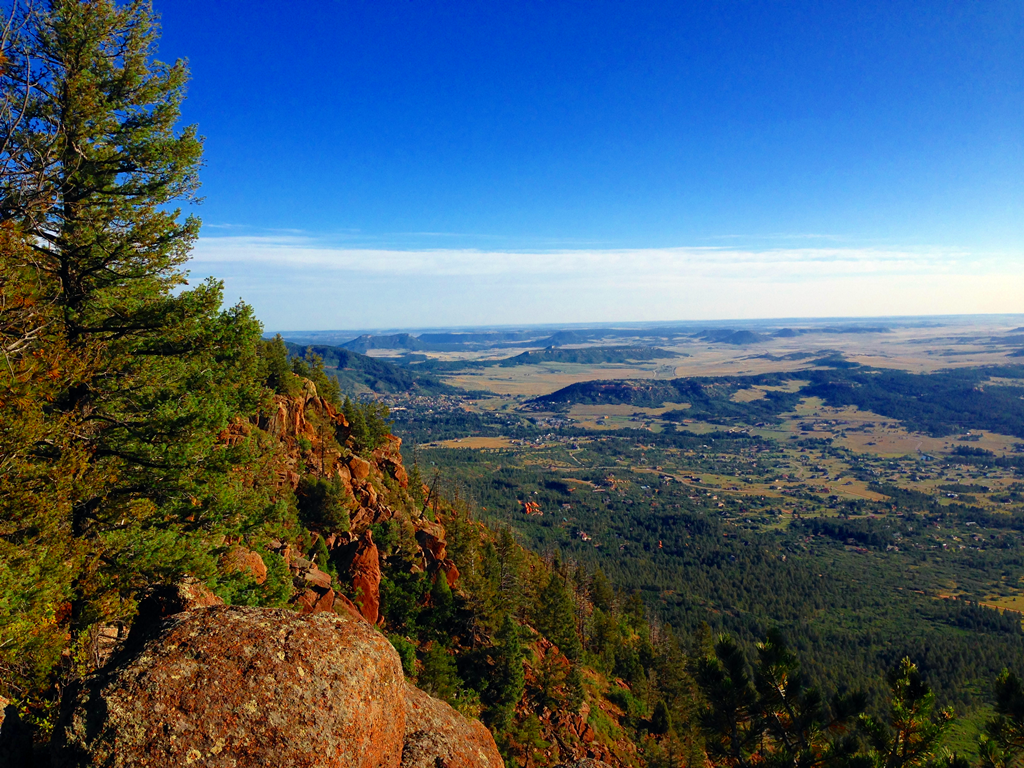
View from the south side of Mt Herman
For radio equipment, I took a couple of HTs for 2m and 70 cm FM and the FT-817 for CW/SSB on 6m, 2m and 70 cm. Most of the SOTA action would be on 2m FM but SSB is critical for working the VHF contest. I did put out the word to the usual VHF contesters that there would be FM activity and did work a few of them via 2m FM. The 2m FM calling frequency, 146.52 MHz, is commonly used for SOTA but is not allowed for contest use. (Another example of how this rule is just a barrier to contest activity.) We used 146.55 MHz for the contest contacts. 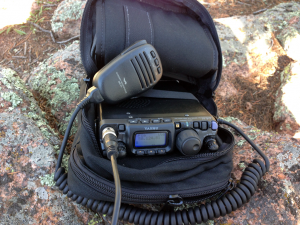 I had coordinated with Brad WA6MM who was going to be on Grays Peak (W0C/FR-002), one of the Colorado 14ers. When he made the summit, I had my 2m yagi antenna pointed in his direction and easily worked him on 2m FM at a distance of 65 miles. Brad was using an HT with a 1/2-wave vertical antenna. Also, I worked Stu W0STU and Dan N0OLD on Bald Mountain (W0C/FR-093) , which sits on the east side of I-25 right at Monument Hill. Contest activity was light, as usual for the September contest in Colorado. We did have two rover stations that activated a few of the unpopulated grids in eastern Colorado: George AB0YM and Jonesy W3DHJ.
Band       QSOs X pt =  QSO pts.  X   Grids   =     Points
 -----------------------------------------------------------
 50         8      1      8             5             40
 144        23     1      23            5             115
 432        14     2      28            3             84
 -----------------------------------------------------------
 TOTALS     45            59            13            767
My contest score was not bad for a few hours of operating QRP portable. It turns out that I had set the Colorado section record for “single-op portable” back in 1990 with just 624 points (using my old callsign KB0CY). Oddly enough, 24 years later it appears that I set a new record. (This speaks more to the lack of QRP activity during the September contest and less about my incredible operating ability.)
All in all, it was a great day in the mountains to take a hike and play with radios. I will probably do the SOTA + VHF Contest activation again.
73, Bob K0NR
IARU HF 2014
Call: K8GU
Operator(s): K8GU
Station: K8GU

Class: SO CW LP
QTH: FM19li
Operating Time (hrs): 5
Radios: SO2R

Summary:
 Band  CW Qs  Ph Qs  Zones  HQ Mults
-------------------------------------
  160:    0     0       0       0
   80:   50     0       3       4
   40:   87     0      11      12
   20:   47     0       7      15
   15:   16     0       7       9
   10:    0     0       0       0
-------------------------------------
Total:  200     0      28      40  Total Score = 25,092

Club: Potomac Valley Radio Club
Since the birth of our second child, I’ve had to become a little more creative in my approach to operating contests. There are rare days when both children are in phase with their eating and sleeping needs and we can accomplish some things, and then there are the other days. With the coincidence of the quadrennial World Radiosport Team Championship (WRTC) and IARU HF World Championship contests this year, I thought I would make a game of trying to contact all 59 of the competitors rather than maximizing contest score. The motivation for this is that WRTC was in New England this year, which is a stone’s throw away from me and middle-of-the-night operation would yield QSOs with the WRTC stations on 40 and 80.
I did end up working all 59 of the WRTC stations with their distinctive 1×1 callsigns by furiously searching and pouncing on both radios on 40 and 80. In fact, I worked most of them twice before I finally found K1T. I’m going to do an analysis of the standings of the teams versus when I worked them to test if any of the teams were better at “marketing” than others. Should be fun! Anyhow, all of these operators were really outstanding but a special congratulations to N6MJ and KL9A who seem to have run away with the whole thing operating as K1A.
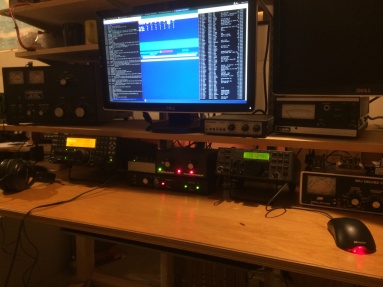
In the lead up to the contest, I finally managed to get the station fully SO2R (single operator, two radio—essentially the ability to operate interference-free duplex on any pair of HF bands) again. And, in the process, I have automatic band switching again, so I don’t have to run across the basement to switch antennas. Thank goodness for small conveniences.
Here’s the mess for low-power (100 watts and less): KK1L 6×2 switch to connect two radios to any of six antennas, W3NQN single-band 200-watt transmitting filters for each band (10-80 meters shown here since I still don’t have a 160 antenna yet), and the K6KV-K8GU triplexer that allows me to share the feedline to the G3TXQ broadband hexagonal beam with both radios. All this stuff was homebrewed by me but it is all available in commercial form as well.
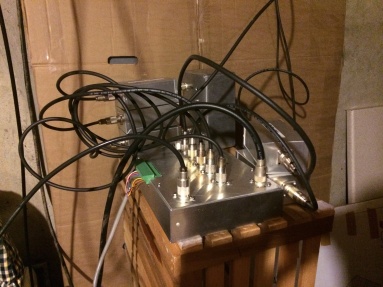
I’ve described the W3NQN filters considerably in the past, but the triplexer is new (built in March 2014) and since I’ve had some e-mail traffic from a couple of people who know I built one, I’ll probably write something up on it in the next few weeks. I mention it here because WRTC is actually one of the events that popularized the use of triplexers, which are downright freaky when you think about plugging two 100-watt class radios into a box that separates/combines the signals. Electrical engineering for the win on this one. Anyhow, I based my triplexer off the K6KV QST article from June 2010, finding some beautiful Johnson capacitors in a flea market for $5 each and using leftover toroids from the W3NQN filter project instead of the solenoid coils used by K6KV. The whole thing set me back about $30 total and it works great with the W3NQN filters, to say the least.
This was the second contest with TRLinux contest software by N6TR and W9CF. It has some idiosyncrasies, such as the effect of CAPS LOCK on the shortcut keys. For example, did you know that ALT-r is not the same as ALT-R? The great thing about it is that TRLinux talks natively with the YCCC SO2R+ box that I use to handle keying and audio switching for both radios. And, the band data is handled by the YCCC SO2R+ with TRLinux, so I didn’t have to buy a band decoder for the K2. That whole process of setting up the band decoding was another midnight oil project Friday night before the contest started. Fun and games. But, it worked flawlessly.
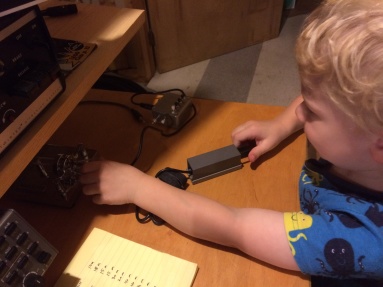
And my three-year-old son, future SO2R CW operator, rocking the Bencher and Palm paddles…”I’m doin’ lots of Morse code!”
Check out the sunspots!
Just before the 4th of July, several sunspot regions rotated into view. Today, they are significant players in elevating the solar output of Extreme Ultraviolet energy — the energy helpful in ionizing the F-region of our Earth’s ionosphere. That, in turn, means better propagation conditions, even on higher shortwave frequencies.

As seen by the Solar Dynamics Observatory, the Sun is sporting quite a few sunspots, today. These are helping elevate the 10.7-cm flux, which is a proxy for solar output that strengthens the ionospheric propagation of higher frequencies in the shortwave spectrum. Expect good conditions on HF, this weekend.
73 and best DX!













