Posts Tagged ‘Contests’
 There’s a new radio hobby magazine in town!
 June 1st, 2014 |
  Author:
 Recently, a number of hobby radio magazines have either retired, or have merged into a digital mix of several. Filling that void is the new The Spectrum Monitor, a creation of Ken Reitz KS4ZR, managing editor for Monitoring Times since 2012, features editor since 2009, columnist and feature writer for the MT magazine since 1988. Ken offers this digital, radio communications magazine monthly. The web site is at http://www.thespectrummonitor.com/

The Spectrum Monitor magazine – get your’s, today.
Ken, a former feature writer and columnist for Satellite Times, Satellite Entertainment Guide, Satellite Orbit magazine, Dish Entertainment Guide and Direct Guide, is also contributing editor on personal electronics for Consumers Digest (2007 to present). He is the author of the Kindle e-books “How to Listen to the World” and “Profiles in Amateur Radio.”
The Spectrum Monitor Writers’ Group consists of former columnists, editors and writers for Monitoring Times, a monthly print and electronic magazine which ceases publication with the December, 2013 issue. Below, in alphabetical order, are the columnists, their amateur radio call signs, the name of their column in The Spectrum Monitor, a brief bio and their websites:
Keith Baker KB1SF/VA3KSF, “Amateur Radio Satellites”
Past president and currently treasurer of the Radio Amateur Satellite Corporation (AMSAT). Freelance writer and photographer on amateur space telecommunications since 1993. Columnist and feature writer for Monitoring Times, The Canadian Amateur and the AMSAT Journal. Web site: www.kb1sf.com
Kevin O’Hern Carey WB2QMY, “The Longwave Zone”
Reporting on radio’s lower extremes, where wavelengths can be measured in miles, and extending up to the start of the AM broadcast band. Since 1991, editor of “Below 500 kHz” column forMonitoring Times. Author of Listening to Longwave (http://www.universal-radio.com/catalog/books/0024u.html). This link also includes information for ordering his CD, VLF RADIO!, a narrated tour of the longwave band from 0 to 530 kHz, with actual recordings of LW stations.
Mike Chace-Ortiz AB1TZ/G6DHU “Digital HF: Intercept and Analyze”
Author of the Monitoring Times “Digital Digest” column since 1997, which follows the habits of embassies, aid organizations, intelligence and military HF users, the digital data systems they use, and how to decode, breakdown and identify their traffic. Web site: www.chace-ortiz.org/umc
Marc Ellis N9EWJ, “Adventures in Radio Restoration”
Authored a regular monthly column about radio restoration and history since 1986. Originally writing for Gernsback Publications (Hands-On Electronics, Popular Electronics, Electronics Now), he moved his column to Monitoring Times in January 2000. Editor of two publications for the Antique Wireless Association (www.antiquewireless.org): The AWA Journal and the AWA Gateway. The latter is a free on-line magazine targeted at newcomers to the radio collecting and restoration hobbies.
Dan Farber ACØLW, “Antenna Connections”
Monitoring Times antenna columnist 2009-2013. Building ham and SWL antennas for over 40 years.
Tomas Hood NW7US, “Understanding Propagation”
Tomas first discovered radio propagation in the early 1970s as a shortwave listener and, as a member of the Army Signal Corps in 1985, honed his skills in communications, operating and training fellow soldiers. An amateur Extra Class operator, licensed since 1990, you’ll find Tomas on CW (see http://cw.hfradio.org ), digital, and voice modes on any of the HF bands. He is a contributing editor for CQ Amateur Radio (and the late Popular Communications, and CQ VHF magazines), and a contributor to an ARRL publication on QRP communications. He also wrote for Monitoring Times and runs the Space Weather and Radio Propagation Center at http://SunSpotWatch.com. Web site: http://nw7us.us/ Twitter: @NW7US YouTube: https://YouTube.com/NW7US
Kirk Kleinschmidt NTØZ, “Amateur Radio Insight”
Amateur radio operator since 1977 at age 15. Author of Stealth Amateur Radio. Former editor,ARRL Handbook, former QST magazine assistant managing editor, columnist and feature writer for several radio-related magazines, technical editor for Ham Radio for Dummies, wrote “On the Ham Bands” column and numerous feature articles for Monitoring Times since 2009. Web site: www.stealthamateur.com.
Cory Koral K2WV, “Aeronautical Monitoring”
Lifelong air-band monitor, a private pilot since 1968 and a commercial pilot licensee since 1983, amateur radio licensee for more than 40 years. Air-band feature writer for Monitoring Times since 2010.
Stan Nelson KB5VL, “Amateur Radio Astronomy”
Amateur radio operator since 1960. Retired after 40-plus years involved in mobile communications/electronics/computers/automation. Active in radio astronomy for over twenty years, specializing in meteor monitoring. Wrote the “Amateur Radio Astronomy” column for Monitoring Timessince 2010. A member of the Society of Amateur Radio Astronomers (SARA). Web site: www.RoswellMeteor.com.
Chris Parris, “Federal Wavelengths”
Broadcast television engineer, avid scanner and shortwave listener, freelance writer on federal radio communications since 2004, wrote the “Fed Files” column for Monitoring Times.http://thefedfiles.com http://mt-fedfiles.blogspot.com Twitter: @TheFedFiles
Doug Smith W9WI, “The Broadcast Tower”
Broadcast television engineer, casual cyclist and long distance reception enthusiast. “Broadcast Bandscan” columnist for Monitoring Times since 1991. Blog:http://americanbandscan.blogspot.com Web site: http://w9wi.com
Hugh Stegman NV6H, “Utility Planet”
Longtime DXer and writer on non-broadcast shortwave utility radio. Former “Utility World” columnist for Monitoring Times magazine for more than ten years. Web site: www.ominous-valve.com/uteworld.html Blog: http://mt-utility.blogspot.com/ Twitter: @UtilityPlanet YouTube: www.youtube.com/user/UtilityWorld
Dan Veeneman, “Scanning America”
Software developer and satellite communications engineer writing about scanners and public service radio reception for Monitoring Times for 17 years. Web site: www.signalharbor.com
Ron Walsh VE3GO, “Maritime Monitoring”
Retired career teacher, former president of the Canadian Amateur Radio Federation (now the Radio Amateurs of Canada), retired ship’s officer, licensed captain, “Boats” columnist and maritime feature writer for Monitoring Times for eight years. Avid photographer of ships and race cars.
Fred Waterer, “The Shortwave Listener”
Former “Programming Spotlight” columnist for Monitoring Times. Radio addict since 1969, freelance columnist since 1986. Fascinated by radio programming and history. Website: http://www.doghousecharlie.com/
Thomas Witherspoon K4SWL, “World of Shortwave Listening”
Founder and director of the charity Ears To Our World (http://earstoourworld.org), curator of the Shortwave Radio Archive http://shortwavearchive.com and actively blogs about shortwave radio on the SWLing Post (http://swling.com/blog). Former feature writer for Monitoring Times.
K0NR June VHF Contest 2013
My award certificate for the 2013 ARRL June VHF Contest arrived in the mail this past week. The new VHF contest certificates look great, don’t you think? Nice job, ARRL! Similar to other years, I operated from the family cabin at 9600 feet elevation in DM78 near Trout Creek Pass with temporary antennas (see my previous blog posting.) I knew that I scored OK in the contest but I’ve had higher scores in the past. The June VHF results article is a good summary of the national activity.
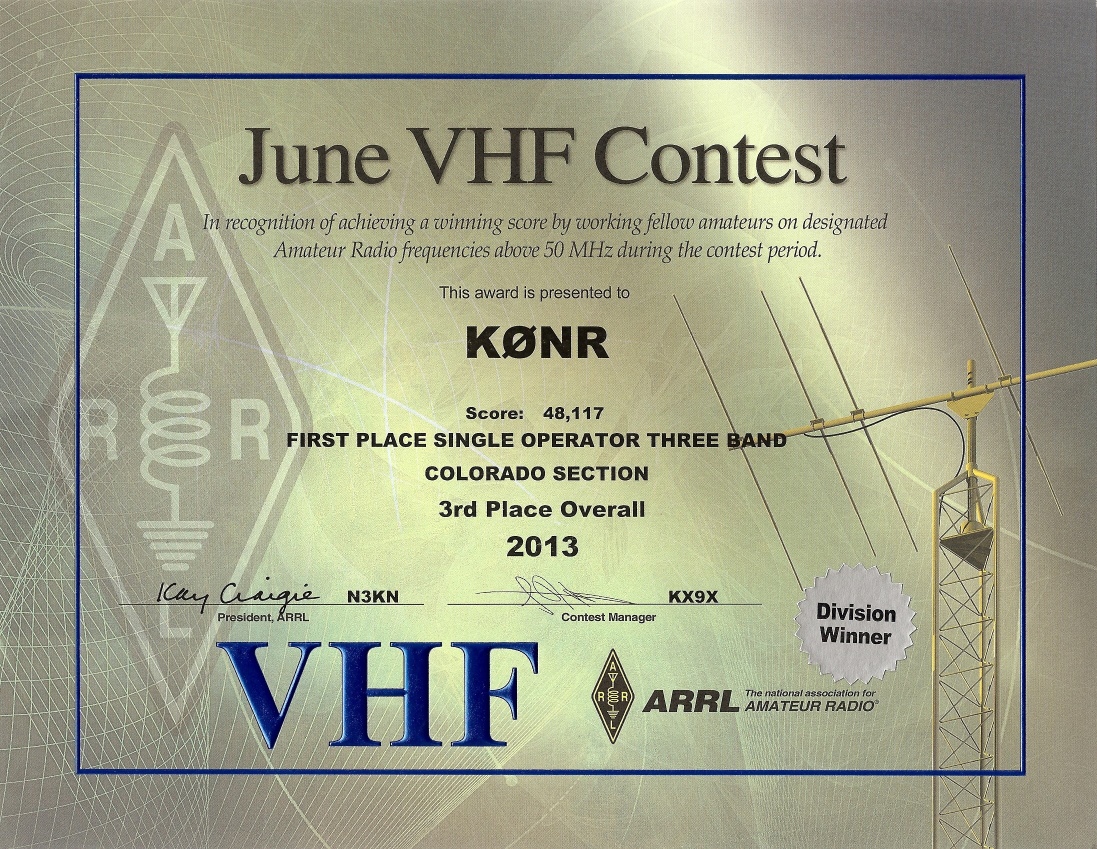
This was the first year for the Single Operator Three Band category, defined as operating on 50 MHz (100W limit), 144 MHz (100W limit) and 432 MHz (50W limit). I found this category to be very attractive because my interests are focused on VHF and not the higher bands. Often, I’ll just run 6m and 2m during VHF contests but with the three-band category it was not a big stretch to add in 70cm. The scoring system for the normal single operator categories provides a large incentive to operate on 1.2 GHz and higher, which makes it more difficult for a “VHF only” station to win in those categories. Some guys like the challenge of operating more bands and pushing the limits of going higher in frequency. I totally get that, so more power to them…it is just not that interesting to me.
It was not a big surprise that I took first place in Colorado and the Rocky Mountain Division because there were only a handful of entries in my category. I was pleased to place third in the overall contest. I expect that competition in this category will get more intense as other single-op stations realize they can win in this category. But limited to three bands and 100W, this competition will be more about propagation and operator skill, and less about deploying lots of gear.
The 2014 June VHF Contest is just around the corner (June 14-15), so time to get the station ready!
73, Bob K0NR
You never know until you submit.
 |
| Boy was I surprised to get this! |
ARRL DX with the K2
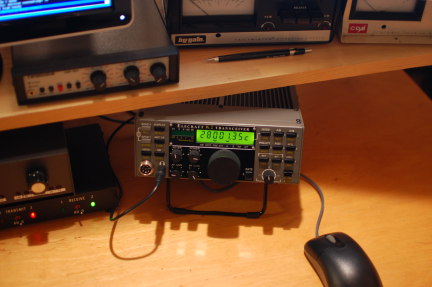
One of the goals I had for the K2 that I failed to mention in the previous post was to fill-in for the K3 in DXpedition service. This is a tall order. It also necessitated upgrading the basic K2/10 to a 100-watt K2/100—being loud (enough) is an important part of pileup control. I had the good fortune to come across an already-assembled final amplifier unit at an attractive price a few days after I purchased the radio. I took that as a sign!
Another rite of passage for the K2/100 would be…how does it perform in a pileup? One of the really great things about ARRL DX CW since the advent of the CW Skimmer and Reverse Beacon Network is that literally any U.S. station (especially on the East Coast, my Western and Midwestern friends will remind) with a modest signal can elicit a blistering run of Europeans. I’ve been relatively unhappy with the K3′s response to pileups, with callsigns often being mushed together more than with other radios (e.g., the TS-930S). I understand that tailoring the K3′s AGC should help this—the KE7X book now graces my shelf but I haven’t had a chance to explore all of his suggestions yet. Having heard anecdotally that the K2 does better in this regard, I was excited to break it in with ARRL DX.
Sarah worked this weekend and I was frankly wiped out from a full week at work plus shoveling 18 inches of snow and cutting up trees from the previous week’s ice storm! Nothing approximating a “full” operation was in the cards. In about two hours of operating, mostly on Sunday, I made about 140 QSOs on 10 and 15 meters. I’m happy to report that the K2 did quite well with regard to the pileup response and I didn’t manage to break it CQing hard at full power. The K2 also passed the “W3LPL test”…Frank lives just a few miles away and is frequently quite loud here. But, I could still hear nearby stations with no problem at all. The one thing that disappointed me about the K2 is that it seemed a little deaf as the 15-m band was closing to Europe. A number of stations were right at the noise floor and were tricky to copy. This might have been “one-way” propagation, too, a topic I should write about at some point.
The upshot is that I’m extremely pleased with the K2 and I look forward many more QSOs with it!
Soggy Contest
I should really get extra points for being out in the West Cumbrian winter but hey ho at least it wasn’t Corney Fell, that really is nasty in the driving rain.
Another reasonable attempt with the 5w and 3 ele beam. A bit frustrating tonight as I could here many stations much further away but just couldn’t work them but then again I’m not in it for the glory, just a bit of fun.
Here’s the map all the same. The east coast does get missed quite a bit but there is a lot of rock in the way.

Contest Results Are In
 In the past two weeks, the results of several ham radio contests from last summer were posted. The typical contest takes months for the official results to be finalized and I have usually forgotten about the contest by then. The more serious contesters share their results via the 3830 web site so they can get an early read on how they did relative to their peers. But you need to be patient for the official results.
In the ARRL June VHF Contest, I placed in the top ten for the new Single Operator 3 Band category. This category is restricted to 50, 144 and 432 MHz, which is a good match to my radio interests. We had good 50 MHz conditions in Colorado (relative to other parts of the country), so CO stations seemed to score well.
Speaking of Colorado, in the Colorado QSO Party I finished first in the Phone – Low Power – Single-Op category. I was actually not that pleased with my score this year (45,500), which was considerably less than my score from last year (76,464). Oh well, I will invoke the Universal Purpose of Amateur Radio and say I had a great time in the contest, regardless of the score. Thanks to the Pikes Peak Radio Amateur Association for sponsoring this event.
The ARRL Field Day results are also posted. Joyce K0JJW and I did a one transmitter (1B) operation from the cabin using the club call KVØCO, resulting in a modest score (454). We mostly made phone contacts on 20m, 15m and 6m. We had some nice sporadic-e on 50 MHz, which is always a treat. Remember, the key to a fun Field Day is: Season To Taste.
73, Bob K0NR
A Soggy Mount Herman SOTA Activation (W0/FR-063)
Although I’ve operated a number of VHF contests from the summit of Mount Herman, I had not yet activated it as a Summits On The Air (SOTA) peak. Mount Herman is a 9063 foot mountain just to the west of Monument, Colorado, pretty much in ”my back yard.” Steve WG0AT did the first SOTA activation of Mount Herman, back in May 2010, chronicled here in one of his famous videos. There is a sometimes rough Forest Service Road 320 that leads to the trailhead, then it’s a little more than a one mile hike to the top with 1000 feet of elevation gain. I call it a tourist hike, since it has just enough challenge to make it feel like a climb and there’s a great view at the top. At least on most days.
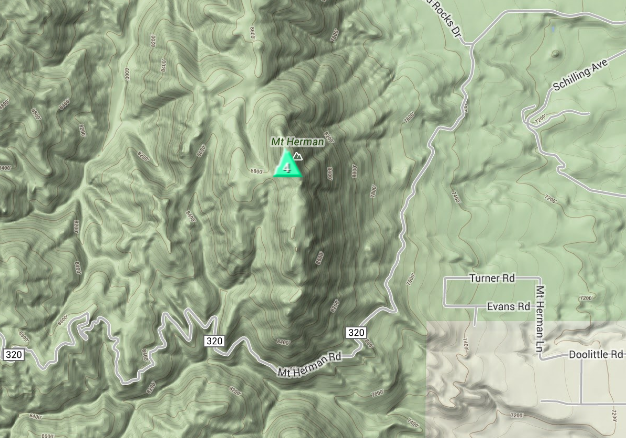
I was not expecting much of a view today since low rain clouds were dominating the sky. I was just hoping I would not get completely drenched by rain. The weather was definitely marginal but from my house I saw the clouds lift a bit, so I thought it was worth a try. The ARRL September VHF Contest is also this weekend, so it was a great combo opportunity: SOTA + VHF Contest.
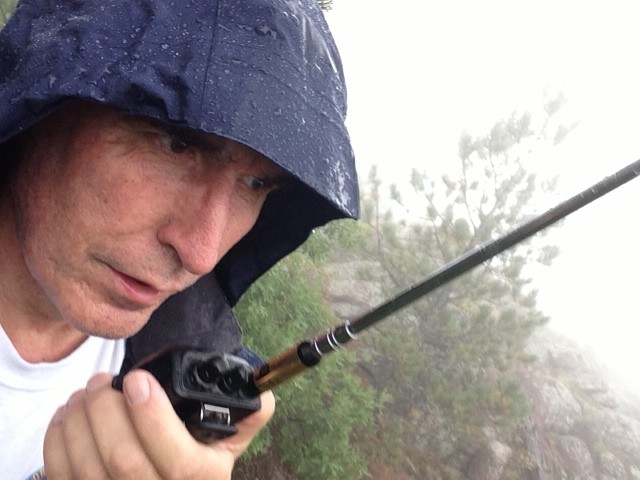
I hopped in the Jeep and quickly made the drive to the trailhead. Then I scooted on up the trail, making it to the summit in about 30 minutes. Just as I reached the summit, the rain really kicked in. I set my gear down under a tree, got out my HT, attached the 1/2-wave antenna and started calling on 147.42 MHz. I wanted to bag my four SOTA qualifying contacts in case the weather turned worse. I quickly worked Frank K0JQZ and Steve WG0AT. Then George AB0YM, operating as a rover in the VHF contest called me from grid DM78, so I worked him as well.
I had my trusty Arrow Yagi antenna with me but I didn’t want to bother with assembling it in the rain. I got out the FT-817, put a vertical antenna on it and called on 144.200 USB. I found stations working the VHF contest and completed QSOs with them: WB0RRU and K3ILC.
The rain intensified so I abandoned the summit and headed back down. All in all, it was not a great hike but I was successful in activating Mount Herman.
73, Bob K0NR













