Archive for the ‘hf’ Category
 Weekly Propagation Summary – 2015 Nov 23 16:10 UTC
 November 23rd, 2015 |
  Author:
Here is this week’s space weather and geophysical report, issued 2015 Nov 23 0602 UTC.
Highlights of Solar and Geomagnetic Activity 16 – 22 November 2015
Solar activity was at very low to low levels over the period. Low levels occurred on 17-18 November and 21-22 November with Regions 2454 (N13, L=121, class/area Dac/130 on 22 Nov) and 2457 (N11, L=032, class/area Dsi/130 on 21 Nov) responsible for the C-class flare activity. The largest flares of the period were a pair of C5/Sf flares at 22/0210 UTC and 22/0538 UTC originating from Region 2454 which was in a growth phase after 21 November.
Two filament eruptions were observed at the beginning of the period that resulted in coronal mass ejections (CMEs). The first was an approximate 21 degree long filament, centered near S11W17, that lifted off around 15/2114 UTC. The second was an approximate 19 degree filament, centered near S26W24 that lifted off around 16/0114 UTC. Two CMEs were observed lifting off the SW limb in SOHO/LASCO C2 imagery at 15/2336 UTC and 16/0312 UTC, respectively. Analysis of these CMEs indicated a likely glancing blow early on 19 November. Later in the period, another filament eruption, centered near S20E10, occurred around 22/0600 UTC. An associated CME, observed in C2 imagery beginning at 22/0836 UTC, was mostly directed off the east limb. Subsequent analysis of this CME indicated a very low chance for a glancing blow.
No proton events were observed at geosynchronous orbit.
The greater than 2 MeV electron flux at geosynchronous orbit was at high levels on 16 November with a maximum flux of 3,129 pfu at 16/1525 UTC. Normal to moderate levels were observed from 17-22 November.
Geomagnetic field activity ranged from quiet to minor storm periods over the period. Solar wind conditions began the period near nominal levels with prolonged periods of southward Bz near -6 nT on 16 November. Subsequently, the geomagnetic field responded with unsettled to active periods. Quiet to unsettled levels were observed on 17 November. At approximately 17/1941 UTC, a solar sector boundary crossing to a mostly negative (towards) sector occurred followed by an increase in solar wind speed from 370 km/s to around 530 km/s by early on 19 November. An abrupt increase in total field from 6 nT to 12 nT occurred at 18/1925 UTC with a maximum southward deflection of the Bz component to -11 nT indicating the likely arrival of the CMEs from 15-16 November coupled with influences from a negative polarity coronal hole high speed stream (CH HSS). A geomagnetic sudden impulse (70 nT at the Wingst magnetometer) was observed at 18/2010 UTC. The geomagnetic field responded with (G1) minor storming late in the period on 18 November with quiet to active conditions on 19 November. Solar wind speed continued a slow decay over the rest of the period to background levels resulting in quiet to unsettled levels on 20-21 November and quiet conditions on 22 November.
Forecast of Solar and Geomagnetic Activity 23 November – 19 December 2015
Solar activity is expected to be low with a chance for M-class (R1-R2, Minor-Moderate) flares from 23-25 November due to flare potential from Region 2454. Very low to low levels are expected from 26 November through 07 December. There is also a chance for M-class flare activity from 08-19 December with the return of old Region 2454 (N13, L=121).
No proton events are expected at geosynchronous orbit.
The greater than 2 MeV electron flux at geosynchronous orbit is expected to be at normal to moderate levels with high levels likely from 26-28 November and again from 06-13 December due to CH HSS influence.
Geomagnetic field activity is expected to be at unsettled to active levels from 25-26 November and 05-12 December with (G1) minor storming likely on 06-07 December due to recurrent CH HSS activity.
Don’t forget to visit our live space weather and radio propagation web site, at: http://SunSpotWatch.com/
Live Aurora mapping is at http://aurora.sunspotwatch.com/
If you are on Twitter, please follow these two users: + https://Twitter.com/NW7US + https://Twitter.com/hfradiospacewx
Get the space weather and radio propagation self-study course, today. Visit http://nw7us.us/swc for the latest sale and for more information!
Check out the stunning view of our Sun in action, as seen during the last five years with the Solar Dynamics Observatory (SDO): https://www.youtube.com/watch?v=zXN-MdoGM9g
We’re on Facebook: http://NW7US.us/swhfr
What is the big deal with amateur radio? What is it that you hear? (Part 1)

Shortwave radio has been a source for great sci-fi plots, spy intrigue novels, movies, and so on, since radio first became a “thing.” But, what is the big deal, really? What is it that amateur radio operators listen to?
In this video, I share some of the types of signals one might hear on the high frequencies (also known as shortwave or HF bands). This is the first video in an on-going series introducing amateur radio to the interested hobbyist, prepper, and informed citizen.
I often am asked by preppers, makers, and other hobbyists, who’ve not yet been introduced to the world of amateur radio and shortwave radio: “Just what do you amateur radio operators hear, on the amateur radio shortwave bands?”
To begin answering that question, I’ve taken a few moments on video, to share from my perspective, a bit about this shortwave radio thing:
Link to video: https://youtu.be/pIVesUzNP2U — please share with your non-ham friends.
From my shortwave website:
Shortwave Radio Listening — listen to the World on a radio, wherever you might be. Shortwave Radio is similar to the local AM Broadcast Band on Mediumwave (MW) that you can hear on a regular “AM Radio” receiver, except that shortwave signals travel globally, depending on the time of day, time of year, and space weather conditions.
The International Shortwave Broadcasters transmit their signals in various bands of shortwave radio spectrum, found in the 2.3 MHz to 30.0 MHz range. You might think that you need expensive equipment to receive these international broadcasts, but you don’t! Unlike new Satellite services, Shortwave Radio (which has been around since the beginning of the radio era) can work anywhere with very affordable radio equipment. All that you need to hear these signals from around the World is a radio which can receive frequencies in the shortwave bands. Such radios can be very affordable. Of course, you get what you pay for; if you find that this hobby sparks your interest, you might consider more advanced radio equipment. But you would be surprised by how much you can hear with entry-level shortwave receivers. (You’ll see some of these radios on this page).
You do not need a special antenna, though the better the antenna used, the better you can hear weaker stations. You can use the telescopic antenna found on many of the portable shortwave radios now available. However, for reception of more exotic international broadcasts, you should attach a length of wire to your radio’s antenna or antenna jack.
Weekly Propagation Summary – 2015 Nov 16 16:10 UTC
Here is this week’s space weather and geophysical report, issued 2015 Nov 16 0630 UTC.
Highlights of Solar and Geomagnetic Activity 09 – 15 November 2015
Solar activity was at very low to moderate levels over the period. The period began at moderate levels with an M3/2b flare at 09/1312 UTC from Region 2449 (S12, L=207, class/area Dao/150 on 08 Nov). Associated with the flare were Type II (957 km/s) and Type IV radio sweeps, a 670 sfu Tenflare, and a partial halo coronal mass ejection (CME). Originally, the CME was thought to have a partial Earth-directed component; however, there was no arrival apparent in ACE/SWEPAM data. Low levels were observed on 10 and 13 November due to low level C-flare activity from Regions 2443 (N07, L=316, class/area Fkc/650 on 01 Nov) and 2452 (S08, L=169, class/area Axx/010 on 11 Nov). Late on 15 November, two filament eruptions occurred in the SW quadrant. The first was an approximate 21 degree filament eruption centered near S11W17 that was observed lifting off around 15/2114 UTC in SDO/AIA 304 imagery. The second was an approximate 19 degree filament eruption centered near S26W24 observed lifting off around 16/0114 UTC. Analysis was ongoing for these two events, however given their location and initial trajectory, an Earth-directed component is probable.
An enhancement (below S1-Minor threshold) of the greater than 10 MeV proton flux occurred at 09/2130 UTC associated with the M3 flare. Particle flux measurements reached a maximum of 3.7 pfu 10/0020 UTC before declining to background levels by early on 11 November.
The greater than 2 MeV electron flux at geosynchronous orbit was at high to very high levels over the period. Very high levels occurred on 11 and 13 November with maximum flux levels of 59,508 pfu at 11/1915 UTC and 88,813 pfu at 13/1355 UTC, respectively.
Geomagnetic field activity ranged from quiet to major storm levels. The period began under the influence of a prolonged negative Bz component followed by a solar sector boundary crossing mid-day on 09 November. Shortly after, a co-rotating interaction region preceding a positive polarity coronal hole high speed stream (CH HSS) became geoeffective starting in the latter half of 09 November. Total field rose briefly to 12 nT with solar wind speeds increasing to the 650-750 km/s range. Solar wind continued to be enhanced through 12 November as CH HSS effects declined. The geomagnetic field responded with unsettled to (G1-minor) minor storm levels on 09 November, active to (G2-moderate) major storm levels on 10 November, and quiet to minor storm levels on 11 November. Quiet levels were observed on 12 November. By 13 November, another positive polarity CH HSS became geoeffective causing total field to initially rise to 10 nT with solar wind speeds in the upper 400 km/s range. Total field remained slightly agitated from 14-15 November with total field ranging from 5-9 nT. As a result, quiet to active levels were observed on 13 November, with quiet to unsettled levels on 14-15 November.
Forecast of Solar and Geomagnetic Activity 16 November – 12 December 2015
Solar activity is expected to be at very low to low levels with a chance for M-class (R1-R2, minor-moderate) flares from 22 November through 05 December with the return of old Region 2443 (N07, L=316).
No proton events are expected at geosynchronous orbit.
The greater than 2 MeV electron flux at geosynchronous orbit is expected to be at high levels from 16-18 November and again from 01-12 December due to recurrent CH HSS influence. Normal to moderate levels are expected from 19-30 November.
Geomagnetic field activity is expected to be at unsettled to active levels from 16-19 November due to prolonged southward Bz as well as a negative polarity CH HSS on 18-19 November. Multiple recurrent positive polarity CH HSSs are expected to influence the geomagnetic field from 30 November-02 December, 05-08 December, and 10-12 December causing unsettled to active levels with (G1-minor) storm periods likely on 30 November-01 December, and 06-08 December.
The eruptive filaments on 15-16 November are not in the present forecast as we are waiting on further imagery to model these events.
Don’t forget to visit our live space weather and radio propagation web site, at: http://SunSpotWatch.com/
Live Aurora mapping is at http://aurora.sunspotwatch.com/
If you are on Twitter, please follow these two users: + https://Twitter.com/NW7US + https://Twitter.com/hfradiospacewx
Get the space weather and radio propagation self-study course, today. visit http://SunSpotWatch.com/swc for the latest sale and for more information!
Check out the stunning view of our Sun in action, as seen during the last five years with the Solar Dynamics Observatory (SDO): https://www.youtube.com/watch?v=zXN-MdoGM9g
We’re on Facebook: http://NW7US.us/swhfr
Weekly Propagation Summary – 2015 Nov 09 16:10 UTC
Here is this week’s space weather and geophysical report, issued 2015 Nov 09 0211 UTC.
Highlights of Solar and Geomagnetic Activity 02 – 08 November 2015
Solar activity was at very low to moderate levels. The summary period began with numerous weak to mid-level C-class flares from Regions 2443 (N07, L=316, class/area Fkc/650 on 01 Nov) and 2445 (N15, L=026, class/area Dac/240 on 02 Nov) observed on 02-03 November. Activity increased to moderate levels (R1-Minor) on 04 November. At 04/0326 UTC, Region 2445 produced an M1/1n flare with an associated Type II radio sweep (790 km/s estimated shock velocity). In addition, discrete frequency bursts of 56,000 sfu and 41,000 sfu were observed on 245 MHz and 410 MHz, respectively. Region 2445 also prodcued an M2/1n flare at 04/1203 UTC with an associated Type II sweep (1033 km/s estimated shock velocity). Shortly afterward, Region 2443 produced an M3/2b flare with associated Type II (955 km/s estimated shock velocity) and Type IV sweeps. This event also prodcued an associated partial-halo coronal mass ejection (CME), first observed in LASCO C2 imagery at 04/1436 UTC.
By 05 November, activity levels declined to very low levels. Levels increased to low on 06-07 November with weak to mid-level C-class activity observed from Regions 2446 (N15, L-349, class/area Cro/020 on 01 Nov), 2448 (N06, L=234, class/area Dao/140 on 06 Nov), 2449 (S12, L=209, class/area Dao/150 on 07 Nov) and 2450 (S23, L=200, class/area Bxo/010 on 07 Nov).
No proton events were observed at geosynchronous orbit.
The greater than 2 MeV electron flux at geosynchronous orbit was at normal levels on 02-03 November and high levels on 04-07 November due to enhanced solar wind speeds.
Geomagnetic field activity was at quiet to major storm levels. The summary period began with quiet to unsettled levels on 02 November. Solar wind speeds, measured at the ACE spacecraft, were weak at about 300 km/s. Field activity picked up to unsettled to minor storm levels (G1-Minor) on 03-04 November due to effects from an equatorial, positive polarity coronal hole high speed stream (CH HSS). Wind parameters observed a rapid increase in winds speeds to an average of about 675 km/s with a peak of near 770 km/s early on 04 November. Total field (Bt) increased to peak at 34 nT about 03/0700 UTC while the Bz component reached a maximum southward extent of -24 nT at 03/0620 UTC. Activity levels decreased to quiet to active on 05 November through early on 06 November as effects from the CH HSS waned. Quiet levels were observed from 06/0300-1800 UTC. During this time frame, wind speeds decreased to near 475 km/s while Bt and Bz relaxed to nominal levels.
On 06/1800-2400 UTC, field activity increased to active levels and further increased to minor to major storm levels (G1-G2 / Minor-Moderate) for the first half of 07 November. This increase in activity was attributed to the arrival of the 04 November CME. Wind speeds increased to 719 km/s at 07/0257 UTC, Bt increased to 20 nT late on 06 November and the Bz component varied between +18 nT to -16 nT. The last half of 07 November through the first half of 08 November saw field conditions relax to quiet levels. Wind speeds declined to about 425 km/s while Bt and Bz relaxed to nominal levels. By midday on the 8th, wind parameters indicated the likely onset of a co-rotating interaction region in advance of a recurrent positive polarity CH HSS. Wind speeds peaked to near 550 km/s late on the 8th while Bt reached 10 nT and Bz was mostly southward to -6 nT.
Forecast of Solar and Geomagnetic Activity 09 November – 05 December 2015
Solar activity is expected to be at predominately low levels with a chance for moderate levels (R1-R2 / Minor-Moderate) through the outlook period. Regions 2443 and 2449 , coupled with the return of old Region 2437 (S18, L=098) on 12 November, are the regions most likely to produce M-class activity.
No proton events are expected at geosynchronous orbit in the absence of any significant flare activity.
The greater than 2 MeV electron flux at geosynchronous orbit is expected to be at moderate to high levels on 09-16 November and again on 01-05 December due to an enhanced solar wind enviroment as recurrent CH HSSs become geoeffective. Normal to moderate levels are expected on 10-30 November.
Geomagnetic field activity is expected to be at unsettled to active levels on 09-11 November. Minor storm levels (G1-Minor) are expected on 09 November as a recurrent, positive polarity CH HSS impacts Earth. Unsettled to active levels are expected on 16-17 November due to extended periods of southward Bz. Unsettled to active levels are expected on 30 November – 02 December and again on 05 December, with minor storm levels likely on 30 November and 01 December. This activity is due to recurrent positive polarity CH HSSs. Quiet to unsettled levels are expected for 12-15 and 18-29 November.
Don’t forget to visit our live space weather and radio propagation web site, at: http://SunSpotWatch.com/
Live Aurora mapping is at http://aurora.sunspotwatch.com/
If you are on Twitter, please follow these two users: + https://Twitter.com/NW7US + https://Twitter.com/hfradiospacewx
Get the space weather and radio propagation self-study course, today. visit http://SunSpotWatch.com/swc for the latest sale and for more information!
Check out the stunning view of our Sun in action, as seen during the last five years with the Solar Dynamics Observatory (SDO): https://www.youtube.com/watch?v=zXN-MdoGM9g
We’re on Facebook: http://NW7US.us/swhfr
Weekly Propagation Summary – 2015 Nov 02 16:10 UTC
Here is this week’s space weather and geophysical report, issued 2015 Nov 02 0132 UTC.
Highlights of Solar and Geomagnetic Activity 26 October – 01 November 2015
Solar activity was at low levels on 26-30 October and 01 November with numerous C-class events, primarily observed from Region 2443 (N07, L=316, class/area Fkc/650 on 01 Nov). An isolated M1/Sf (R1-Minor) flare was observed on 31 October at 1752 UTC from Region 2443. On 29 October, Type II (estimated 972 km/s shock velocity) and Type IV radio emissions were detected at 0219 UTC and 0230 UTC, respectively. SOHO/LASCO C2 imagery observed a non Earth-directed CME off the SW limb at 29/0236 UTC, believed to be associated with the Type II and Type IV radio activity.
A short-lived greater than 10 MeV at greater than or equal to 10 pfu proton event was observed on 29 October. The event began at 29/0550 UTC, reached a maximum of 23 pfu at 29/1000 UTC and ended at 29/1700 UTC. Coincident with this event was a short-lived greater than 100 MeV at greater than or equal to 1 pfu event. This event began at 29/0435 UTC, reached a maximum of 2 pfu at 29/0610 UTC and ended at 29/0930 UTC. Both of these events were most likely associated with activity just beyond the SW limb described above.
The greater than 2 MeV electron flux at geosynchronous orbit was at normal levels on 26, 30-31 October and 01 November with moderate levels obsered on 27-29 October.
Geomagnetic field activity was predominately at quiet levels with some unsettled periods observed on 30-31 October and 01 November. Solar wind parameters reflected a mostly nominal environment with wind speeds ranging from a high of 483 km/s at 26/1145 UTC to a low of 287 km/s at 29/0746 UTC. Total field strength ranged from 1-10 nT while the Bz component did not vary much beyond +/- 7 nT. Phi angle was in a positive (away) orientation from the beginning of the period through early on 28 October when a switch to a negative (towards) sector was observed. Phi switched back to a positive sector at about 29/1915 UTC and remained so through the balance of the summary period.
Forecast of Solar and Geomagnetic Activity 02 November – 28 November 2015
Solar activity is expected to be at predominately low levels with moderate levels (R1-R2.Minor-Moderate) likely through the outlook period. Region 2443, through 10 November, and the return of old Regions 2434 (S09, L=165) on 07 November and 2437 (S18, L=098) on 12 November are likely to produce M-class activity through the outlook period.
No proton events are expected at geosynchronous orbit in the absence of any siginifcant flare activity.
The greater than 2 MeV electron flux at geosynchronous orbit is expected to be at high to very high levels on 02-13 November due to an enhanced solar wind environment as a recurrent, trans-equatorial coronal hole high speed stream (CH HSS) becomes geoeffective. Normal to moderate levels are expected from 14-28 November.
Geomagnetic field activity is expected to began the period at G1 (Minor), G2 (Moderate) and G3 (Strong) levels on 02 November followed by G1 to G2 levels on 03 November as a recurrent, trans-equatorial CH HSS impacts Earth. Unsettled to active levels are expected on 04-06 November as CH HSS effects wane. Unsettled to active levels are expected on 13-14 November and 16-17 November due to periods of southward Bz and a weak positive polarity CH HSS. Quiet to unsettled levels are expected for the remainder of the outlook period.
Don’t forget to visit our live space weather and radio propagation web site, at: http://SunSpotWatch.com/
Live Aurora mapping is at http://aurora.sunspotwatch.com/
If you are on Twitter, please follow these two users: + https://Twitter.com/NW7US + https://Twitter.com/hfradiospacewx
Get the space weather and radio propagation self-study course, today. visit http://SunSpotWatch.com/swc for the latest sale and for more information!
Check out the stunning view of our Sun in action, as seen during the last five years with the Solar Dynamics Observatory (SDO): https://www.youtube.com/watch?v=zXN-MdoGM9g
We’re on Facebook: http://NW7US.us/swhfr
HF Slacker Operation for CQ WW SSB
The CQ Worldwide DX SSB contest was last weekend and I applied my signature HF Slacker™ operating methodology to this event. Most of the HF gear I have is kept at our cabin in the mountains but I had to be at the house this weekend due to some commitments. I decided to apply Field Day principles and rig up whatever I could with equipment on hand.
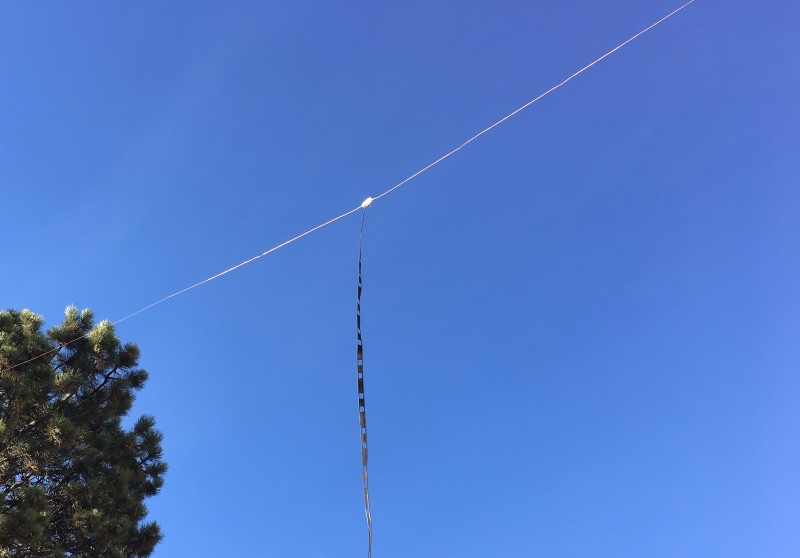
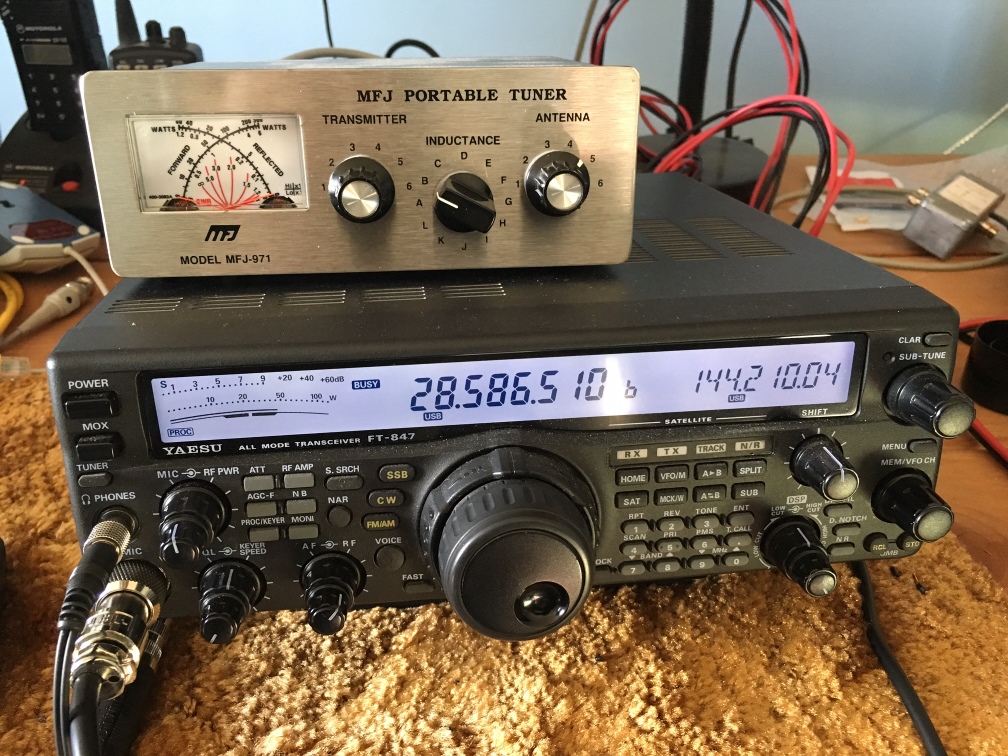 I dug out the Yaesu FT-847 transceiver, an MFJ antenna tuner and a half-size G5RV antenna to configure a basic HF station. Using a fishing pole to cast a steel washer over a tall tree in the back yard, I rigged up the antenna between the tree and the house. The G5RV is a compromise antenna…I’d much rather have something like a trap or fan dipole. But it’s what I had on hand, so I made it work. The impedance presented by this antenna is all over the map, so a decent antenna tuner is a must.
 I started out on 15m with a few contacts to Europe and Central America. Later I moved up to 10m and made even more contacts there. I was mostly searching around for the best DX but still working a few stateside stations. Later in the afternoon, the bands swung towards the west and I managed to work KH7CW and JR3NZC before going QRT for the day.
Sunday morning brought more propagation, first to Europe, then the Caribbean and South America. The high point was working AHØBT in the Mariana Islands and VK2GGC in Australia. AHØBT was not real strong, maybe S5 at my location so I thought I’d struggle to punch through the noise and QRM on the band. However, it only took a couple of calls to make the contact. That’s what I like about the 10m band!
I used the N1MM logging program during the contest. A snapshot of the log is shown below.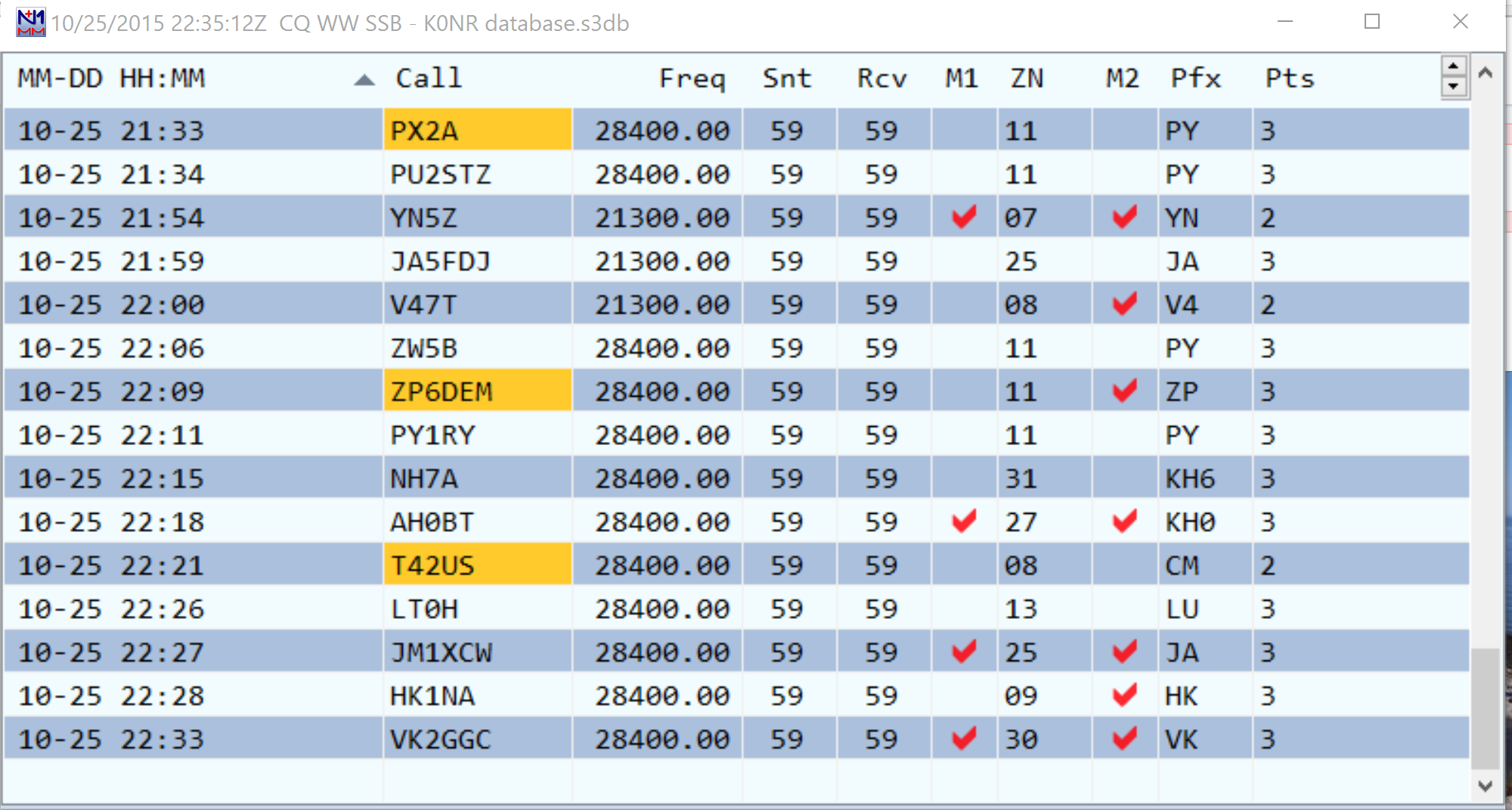 I only worked the contest intermittently on Saturday and Sunday, maybe 5 or 6 hours total operating time. Still, I managed to work 49 countries and 30 CQ Zones. That’s half way to DXCC on one weekend with a very basic HF station. Radio contests stimulate activity and DX contests bring out the DX. I point this out to encourage others to give it a try, even if they don’t have huge antennas on a tower and a linear amplifier. Almost all of my contacts were on 15m and 10m, which tend to be more productive when conditions cooperate. Twenty meters gets jammed with high power stations so it is often tough going for the little pistols.
 Band     QSOs     Pts  Zone  Country
    14       2       3    2    2
    21      30      70   13   21
    28      52     136   15   26
 Total      84     209   30   49
Score: 16,511
Another weekend of having fun messing around with radios. Even if I’m an HF Slacker™. 
73, Bob K0NR
The post HF Slacker Operation for CQ WW SSB appeared first on The KØNR Radio Site.
Colorado 14er Event: Mount Antero (W0C/SR-003)
For the 2015 Colorado 14er Event, Joyce K0JJW and I activated Mount Antero (W0C/SR-003) on the 2m and 70 cm bands. Alan NM5S joined us on the summit, operating mostly HF plus some 2m fm.
We took our Jeep Wrangler up the moderate 4WD road and parked at 13,800 feet. This makes for a very manageable hike to the 14,269 foot summit. Of course, you can always choose to start the hike from lower on the mountain, but you’ll end up walking along the road. This web site provides a good overview of the 4WD road. The 14ers.com web site and summitpost.org are additional sources of summit info.
Here’s a short video of our operation on the summit.
Here’s the K0NR log on the 2m band, fm and ssb:
August 2, 2015 K0NR Log, time in UTC
15:09     144MHz     FM     K0JJW
15:13     144MHz     FM     W0CP
15:16     144MHz     FM     KC5JKU     Mt Elbert
15:17     144MHz     FM     KD0WHB     Grays Peak
15:21     144MHz     FM     N0XDW      Pikes Peak
15:37     144MHz     FM     KD5HGD     Mt Elbert
15:42     144MHz     FM     KD0MRC
15:42     144MHz     FM     KE0DMT
15:44     144MHz     FM     NQ0L       Franktown
15:45     144MHz     FM     KE0EUO     Mt Democrat
15:46     144MHz     FM     K7SO       Mt Democrat
15:50     144MHz     SSB    KD0YOB     W0C/PR-005
15:53     144MHz     SSB    W0BV       Buena Vista
15:53     144MHz     SSB    K0YV       Buena Vista
15:57     144MHz     SSB    W0STU      Monument
16:06     144MHz     FM     KD0WHB     Torreys
16:13     144MHz     FM     KI6YMZ     Mt Elbert
16:19     144MHz     FM     KE0EKT     Mt Elbert
16:29     144MHz     FM     WZ0N
16:29     144MHz     FM     KE0DAL
16:31     144MHz     FM     WO9S
16:33     144MHz     FM     K0UO
17:10     144MHz     FM     KD2FHB     Pikes Peak
It was a great day on the mountain with quite a few Summit-to-Summit (S2S) SOTA contacts. See you next year on a Colorado mountaintop!
73, Bob K0NR
The post Colorado 14er Event: Mount Antero (W0C/SR-003) appeared first on The KØNR Radio Site.













