Author Archive
 What to do when WSJT tells you ‘invalid number of channels’
 January 4th, 2014 |
  Author:
 My excursion onto JT6M last night was a bit fraught, although ultimately very worthwhile and enjoyable. When I fired up WSJT, it errored – saying invalid number of channels.
I realised it was probably something to do with the fact that I had installed the VB-Cable audio driver onto the PC to route audio from the FCD to other applications. No worries, it’s just a simple case of adjusting the various device numbers.
Except that it wasn’t. Everything I tried still came up with the same error. WSJT-X was still working ok as was PZTLog, so I knew there wasn’t anything wrong with the interface or cabling. I disabled the VB-Cable driver, which put device numbers back where they originally were.No.
Starting to doubt my sanity which has been in question recently, anyway, I Googled it, realising that it was one of those times when the error was not what it seemed to be.
Fortunately I found this thread – thank you N0RQ! It looks like this can happen when you add or remove audio devices on your machine.
Deleted the WSJT.INI file, restarted WSJT, which of course creates a new INI file – entered my defaults and all was well!
A frustrating hour, but easily fixed once you know…
My first 50MHz JT6M Meteor Scatter QSO
This evening, I was watching the tweets go by and realised that it was the peak of the Quadrantids meteor shower. Not having a 2m beam up at the moment, the only possibility was 50MHz. And though I have got my old 50MHz beam back from a friend who had it on long term loan, it’s not in a state to go up at short notice. So the only game in town is the V2000 vertical.
I wasn’t too worried as I had heard a few meteor bursts on the vertical in the past, so I guessed if there was any reasonable activity, I might hear something.
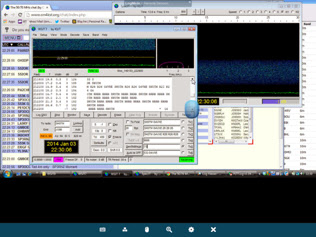
I quickly saw some bursts from an SM7 station and then a very considerable number from SK0TM up in JO86. So many, that I decided to go up to the shack, having been monitoring it all from the comfort of the sofa on the iPad.
Very much tongue-in-cheek, I started to call SK0TM with a report. To my enormous surprise, I very quickly got a R26 report back so was able to send Rogers and receive them. By the time we got to try and exchange 73s, the conditions seemed to have dried up, but we both had all we needed for a complete QSO.
Thank you, Stig – I know it’s possible to make MS QSOs using simple aerials, but I’ve never done it with a vertical before!
Musings on reworking the station
I haven’t bottomed this out yet, but it’s in my mind that I almost never use the FT1000MP anymore. It’s a lovely rig if you’re into CW and SSB DX chasing and has a great receiver, particularly on LF. I’m not doing any of those things currently. Most of my HF activity is using the FT847, which doesn’t have anything like the same receiver performance, but it works well for JT65/JT9 on 14MHz and above which is where I tend to be.
The FT1000MP doesn’t get switched on so much. I’m wondering whether to trade it in against something like a TS2000X, which would give me another nice flexible HF/VHF rig, with the benefit of 1296MHz. Again, I don’t think the HF performance is likely to be the same as the MP – but maybe that doesn’t matter so much.
If I do want to try and work a DXpedition then I ought to be able to do it on anything with a couple of VFOs!
Then there’s some antenna work to think about – particularly on the VHF side. The 2m beam on the mast isn’t working at the moment – that needs to be replaced. Again, I think with something quite compact – 5 elements or so, is quite adequate for what I need. The 70cms 10 element seems to work well – and if I go for 23cms, then, if I can get something small on the top of the mast, that could be good. I think I’ll need to replace the rotator really – it’s probably worth doing, to avoid failure.
I’m quite keen to put together something which makes it easy to put up temporary (and slightly larger) VHF beams in the back garden, for things like MS or EME tests – perhaps on a tripod. All that really needs is a decent run of coax down the garden to the shed or greenhouse where cables can be brought in.
I think the 50 and 70MHz Es systems are fine as they are on the vertical antennas – particularly with the addition of the Funcube Dongle receiver which should allow for good monitoring.
So, there’s quite a lot to think about here – and some exciting possibilities. How much of it will come to pass – I don’t know! But it’s good to dream!
A few tweaks to the UZ7HO packet config – more copy from the ISS
I mentioned yesterday that I only seemed to be copying a few frames from each ISS pass. Those seemed to be when the satellite was closest. Which is fair enough of course.
This morning, I spent a few moments reading the UZ7HO manual (which is very good!). You might argue that I should have done that a week ago. But I’m really not that sort of person, I’m afraid.
It transpired that my audio levels into the program weren’t as high as they should have been. I cranked these up almost as far as they would go and left the program monitoring the next ISS pass.
Definitely an improvement! Many more frames copied – great, including some more distant stations such as HG8PL. Rather than copying frames over a short period of time, it was usable over several minutes.
The default setting for the UZ7HO software seemed to be a monochrome waterfall display. I changed it into colour and then followed the manual’s advice to make it a green colour, with red when packet signals are received.
So, a few more frames digi-ed via the ISS today, and messages swapped between Pete, 2E0SQL and myself, over a ground path of around 12 miles, via a spacecraft travelling above us at 17,500MPH.
Packet signals through the ISS digipeater – success!
I posted a few days ago that I was hoping to have a go at digipeating my 145MHz packet signal through the digipeater on the International Space Station. I got all the gear and software set up and then the digipeater seemed to be switched off.
In fact, I think it was switched off for very good reason, whilst the astronauts were space walking; repairing the pump and deploying the cameras (and then undeploying them again).
I set it all up yesterday, before we went out family visiting. Apart from the fact that I didn’t connect the aerial!
Today I was slightly better organised and left things running whilst Julie and I went out for a chilly, but sunny walk. I was pleased to find that I had copied a frame from IW3RGK when I got back.
The next pass looked promising, being pretty much directly overhead. I started to hear the signals as the spacecraft approached, around 300 miles away and got some decodes so I decided to press the transmit button. To my delight, I saw the digipeater repeat my position: you can see on the screenshot below from the UISS program.
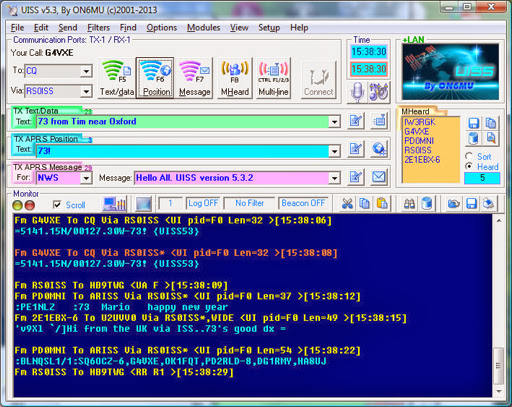
On transmit I was using the FT8900 to the V2000 collinear, so nothing too special. Although I am hearing quite a few packets on the pass, I only seem to be decoding the ones when the spacecraft is almost overhead – I suspect it’s the signal strength – or perhaps the doppler shift is messing with the Soundmodem decodes.
Great fun!
More fun with the Funcube Dongle Pro Plus (Skimmers, Spacewalks, 50MHz ES and more)
This morning, I decided to try the Funcube Dongle Pro Plus on HF. I connected it up to the Butternut vertical and tuned to 14MHz. First impressions were very good, with plenty of signals coming through with good quality.
Zipping around the signals on CW, I wondered whether I could get a Skimmer going. The Skimmer decodes the CW from an SDR (or other receiver) and shows the text on the screen. CW Skimmer software was developed by VE3NEA a few years back and it has changed CW contesting for ever, I understand. Happily we don’t need to worry about that here!
I downloaded the trial version of the software and installed it. When I looked at the setup, there was no mention of a Funcube Dongle, so I decided to try it as a Softrock receiver as suggested on this web page. I also grabbed the FCD Frequency utility which allows you to control the frequency of the dongle. I set it up to run on 28MHz and set it going – sure enough it worked!
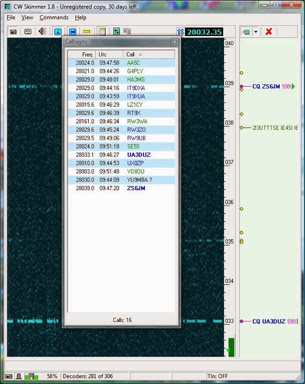
Even more impressive was when I set the Skimmer going on 7MHz, with Ws and JAs coming through (good band at this time of year, if you’re so minded, 7MHz). There were a few false decodes, which looked like Skimmer had done its best to resolve something that wasn’t really a CW signal, out of band, into CW! Fun though.
I have no particular need for a Skimmer on HF, although perhaps it might be fun on 28MHz, but certainly I can see it would be good during an Es opening on 50MHz.
I had hoped to be trying to receive the packet digi signals from the ISS today, but the digi was still switched off, with the astronauts engaged in a spacewalk to fix the errant pump. This proved a mixed blessing – as both Peter MI0VAX and Andrew M6GTG mentioned they’d been listening to the EVA comms from the astronauts on 143.625MHz, so I decided to try that.
Once the ISS was in range of Moscow, a huge signal, doppler shifting, appeared around 143.625MHz and it was easily possible to hear the astronauts talking in Russian. The FCD was connected to the V2000 vertical for this.
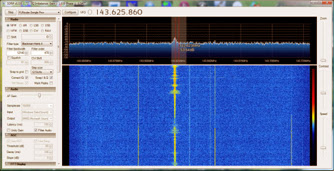
I noticed that the VO-52 satellite was making a fairly low pass during the late afternoon. I was curious to see if I transmitted a CW signal, using my terrestrial 70cms antenna, whether I would be able to hear myself coming back through the VO-52 transponder on 145MHz, using the FCD and the vertical antenna.
I haven’t quite figured out the doppler shift and where to transmit and where to listen, but after a bit of fiddling and faffing, I was indeed able to hear my CW coming back through the satellite. I tried a hasty CQ, but no luck this time… but it is the first time I have heard myself on VO-52. I will do better I am quite sure!
Feeling quite happy with all of that, I was just about to pack up in the shack, come downstairs and be sociable, when I noticed a tweet saying that there was some 50MHz Es about. I had missed an opening yesterday, so was keen to see if I could pick something up today.
I tuned the FCD to 50MHz and could immediately see LY1R coming through with a nice signal, so moved the antenna onto the FT847 and worked him after a couple of calls followed by OK1DOL. Things seemed to quieten down, so I popped the antenna back on the FCD for the benefit of the panoramic display.
This was very handy and I spotted several signals which I might have missed, had I just been on the FT847, so there was some rapid switching of the antenna between the FT847 and the FCD as I worked people, including DL1AX and DL3RBH on CW. I missed an SP5 on CW, who dived into the noise before I could work him.
All in all though, a very nice winter Es opening and I was delighted to find that the FCD worked so well on the band – the panoramic display proved so useful for spotting signals across the band.
Several times today, I have thought – why didn’t I get one of these FCDs before! Thank you again, Santa!
First impressions of the Funcube Dongle Pro Plus
Reading around before Christmas, I thought that the FCD+ could be very useful – partly for satellite work as a simple receiver and for general listening.
Christmas Day was busy and enjoyable and it was this morning before I could have a look at getting it going. Installation really couldn’t have been simpler – just a case of plugging in and letting Windows find and install the drivers.
I already had a copy of SDRSharp on my machine and ran that up and changed the input device to be the Funcube Dongle Pro Plus. By default, the configuration in SDRSharp has a frequency correction of 120ppm, which throws frequency accuracy a bit! Simply remove this and restart SDRSharp and accuracy will be bang on.
I fiddled around a little and had a couple of lockup issues – so I decided to download and install the latest SDRSharp nightly build. This seemed to cure the lockup problems – or at least, in several hours of playing around, it hasn’t happened again, despite the laptop that it is running on, not being particularly recent.
Experience so far is very positive indeed. I am amazed at the sensitivity of the dongle. It is on a par with the other receivers I have here, if not slightly better. I was hearing GB3VHF very easily on the FCD+ plugged into the V2000 vertical. So far I have tried it on 50, 60, 70, 144 and 432MHz with good success. I have listened on 1296.200MHz, but nothing so far!
I have listened to a couple of passes of the VO-52 satellite using nothing more than the V2000 verical and results have been great, hearing a number of stations very easily; LX2LA, IK8ZLD, SP9TTI, 9A2UV, GM4CFS (all from memory). So it maybe that a viable garden portable setup will be the PC and dongle for the receive side and the FT817 for transmit. Maybe I will wait for the weather to get a bit better before I try that!
I have also used the VB-Cable software (rather like Virtual Audio Cable, but free) to feed data out of SDRSharp and into UZ7HO Soundcard Modem (which was reasonably successful although I didn’t feel I was decoding quite all the packets that I should have done) and also into WSJT.
Using WSJT, I decoded the JT65B from GB3VHF, received off the V2000 vertical. This was particularly impressive, as the signals were not huge at the time. I will have to try something weaker. Doesn’t GB3NGI transmit JT65B as well?
All in all, I am very impressed indeed. The FCD Pro+ is a wonderful addition to my shack – I can see it will be very much used.
Thank you, Santa!













