Posts Tagged ‘SOTA’
 2015 SOTA VHF Activity Days
 March 8th, 2015 |
  Author:
 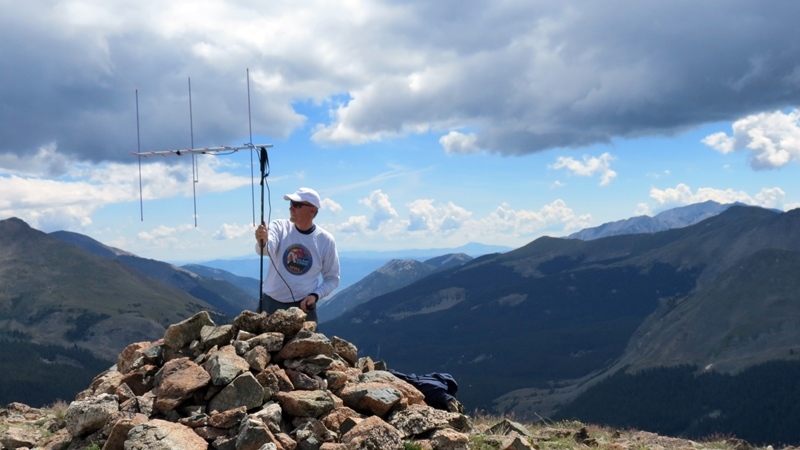 On the topic of operating events for Summits On The Air (SOTA) activations, Guy N7UN suggested focusing on six major events for 2015. Most of these are VHF-oriented but HF activity can also occur on these days.
- Jan 24-26: ARRL Jan VHF Contest + NA SOTA Winter Activity Weekend
(oops, I guess we already missed that one) - Apr 18-19: North America SOTA Spring Activity Weekend
- Jun 13-15: ARRL June VHF Contest + NA SOTA Summer Activity Weekend
- Jul 18-19: CQ WW VHF Contest + optional for SOTA
- Aug 1-2: Colorado 14er Event + NA SOTA Rocky Mtn Rendezvous + W7 SOTA Activity Weekend + ARRL UHF Contest
- Sept 12-14: ARRL Sept VHF Contest + NA SOTA Fall Activity Weekend
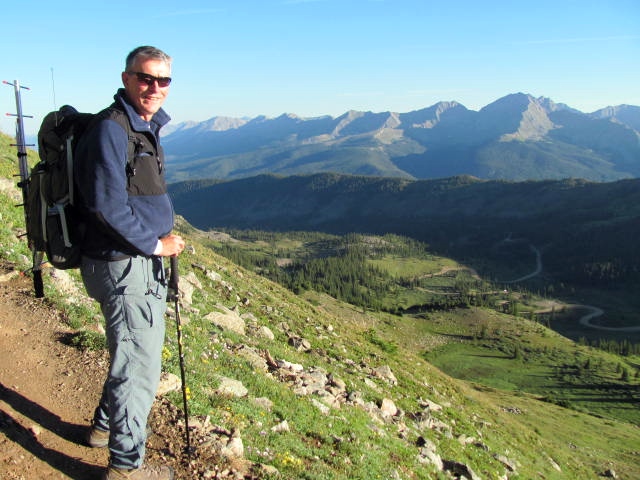 Of course, any day is a good day for SOTA activity. I also think six weekends are a great way to focus our operating activity and create S2S (summit to summit) radio contacts. The August 1-2 weekend looks to be the alignment of the planets with four events happening on that weekend. Early August usually offers excellent conditions for hiking the highest peaks in Colorado, so come on out and play.
For more info on VHF SOTA, see How To Do a VHF SOTA Activation.
Get off the couch, put on your hiking boots, grab your backpack, grab your radio but most important: get on the air!
73, Bob K0NR
The post 2015 SOTA VHF Activity Days appeared first on The KØNR Radio Site.
Is the QRP community close knit, or what?
To emphasize this point, here's a story that one of those friends, Jim W1PID, posted on QRP-L today:
An hour ago I got a call on my cell phone. The caller ID said New Jersey. Must be a telemarketer I think, so I don't answer. A few minutes ago another ring from the same number. It's Guy N7UN.
"HI Jim... this is Guy N7UN... did you call me?"
I explain that I got a call from him that I didn't answer. Well... turns out he's doing a SOTA activation on the highest mountain in Maui!
"You gotta rig?" I ask.
"Ya", he says." I'm on 14.062."
"OK, I'm going to the shack."
So I just had a QSO with Guy in Maui. Wow and Mahalo!

Holiday SOTA Activations
I am spending a few days at my Santa Fe, NM QTH for the holidays. There is snow on the ground and its only been above freezing about 3 hours since last Friday. However its a dry cold so its not too bad.
As always when I'm here I try to squeeze in some Summits on the Air (SOTA) activations. So far I've been able to do a couple as detailed below.
The Wagon Mound W5N/EL-016 6,930ft ASL 6 pts
The Wagon Mound gets its name from it's appearance. Without too much imagination you can see the outline of an old Conestoga Wagon on the summit outline. I chose this summit primarily because I've never done it, but also because, for the peaks in the area, it is at a relatively low elevation and the snow cover should be much less than higher peaks. When I departed Santa Fe, it was clear, sunny and 19F. I envisioned very thin snow cover, if any, on the mountain.
I was in for a little surprise, as you will see from the video below.
Wagon Mound, NM is 104 miles northeast of my QTH near Lamy, NM. About half way there we encountered fog. Visibility dropped, at times, to about 50 yards and the temperature dropped to 7F. I was beginning to have my doubts about making the climb. It was obvious that the snow accumulations were significantly more here, than back home. However I continued, postponing my decision until I could see the actual conditions at the base of the mountain..
Upon arrival, conditions had improved a little, visibility to 1 mile and the temperature was 13F at the base of the mountain. It wasn't a long climb, but it was steep. There was about 12 inches of snow on the ground. The problem with that is that this climb was a bushwhack over volcanic rocks and cactus. The snow cover completely disguised what might or might not be underneath. I decided to make the attempt. Cris, my XYL, was with me and she was willing to try as well. After all, we had just come over 100 miles.
The footing was treacherous. I had to plant my foot through the snow to discover what footing was below, whether solid ground or slippery rocks.We took our time and turned what should have been a 20 minute climb into about 40 minutes.
We set up about 30 feet below the summit, well into the activation zone. I used my KX3, 31 ft. piece of wire elevated with a 21 foot mast through a 9 to 1 balun, tuned by the KX3's tuner. Despite weather conditions, propagation was very good. I worked 31 stations on 20m CW in 18 minutes, a quick QSY to 40m yielded no results and since it was cold I didn't try any other bands. We packed up and retraced our steps down.
All in all a very satisfying activation given the challenges. We stopped on our way home in Las Vegas, NM and warmed ourselves up with some Mexican Food. A good day.
Summit 6860 W5N/SI-022 6,860ft ASL 6 pts
After my experience heading north, I decided to go south for my next activation. This summit is east of Albuquerque NM just south of I-40 and 67 miles from my QTH. This is a nice summit. Depending on where you start, the hike is 2. to 3 miles round trip. The elevation change is about 800 feet over that distance. There are numerous crisscrossing trails over the terrain, so there are multiple ways to get to summit. The trails are all nice trails, no bushwhacking required on this one.
The weather was near perfect for climbing, about 40 degrees, sunshine and little wind. Very enjoyable. You will see from the video below that the conditions were splendid and there was a little snow on the ground.
I used the same set-up here as described above. Conditions were good, 31 QSO's on 15, 20, and 30 meters.
So 12 more points in the log and some good exercise and, obviously, some stories to tell.
Happy New Year!!
Tromelin, Andamans and SOTA
So what's happened since I last blogged.
Tromelin Expedition FT4TA: The expedition team did a great job, making nearly all bands available with good signals, at least in South Texas. I enjoyed both working the expedition, to fill some band slots, but also the event. The daily news, conditions, the complaining, etc.... I worked them on 10m, 15m, 20m, 30m and 80m. All new bands except 20m. My practice, as I have written about here, is to try to work the expeditions, during the last days, QRP. I was not able to do that on this expedition. The pile-ups never really slacked off, which brings me to my point.
Now that many expeditions use Club Log and other online tools to post how many QSO's each caller has logged, the information is leading to much debate. I am on a particular reflector where an individual copied and posted the band scorecard for multiple individuals and berated them for making multiple band/mode contacts when so many needed Tromelin for an all time new one.
My thoughts on this one: As long as an individual doesn't dupe band/mode slots, working the expedition is fair game. If a DXer builds a station that is capable and puts in the time operating to work Tromelin on 20 band slots, why not. Telling him not to is like telling a guy with a Ferrari that he can only drive the speed limit. If, for whatever reason, a dipole is all you have, you know that working rare DX is a tough proposition. Why should the capable stations be made to wait on those not so capable. In my early days of DXing, not working an expedition motivated me to improve my station, improve my operating skills, improve my understanding of propagation, etc... Failure is often life's greatest teacher.
DX-peditions can control this somewhat by limiting the number of bands they operate on, but those guys paid their money, why shouldn't they have all the fun they can.
Andamans VU4CB and VU4KV: This team also did a nice job activating a pretty rare place, that from my part of the world, is difficult to work. I was able to get QSO's on a few bands and was impressed with the operation. I was not able to work these guys on QRP either. VU4VB operated from a rare IOTA which I also chased. So, please all around on this one.
SOTA Activations: I did find time to get in four SOTA activations near my Santa Fe, NM QTH during November. I activated three peaks, along with Fred KT5X and John K1JD, southeast of Albuquerque, NM.
SOTA Activation: Kaufman Ridge HP (W0C/SP-081)
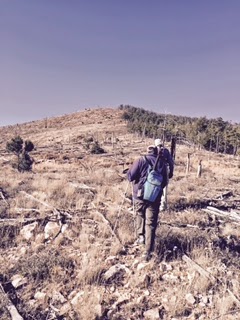
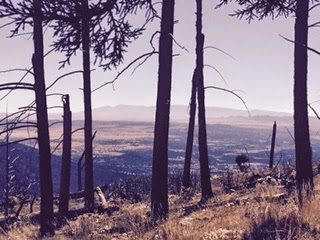
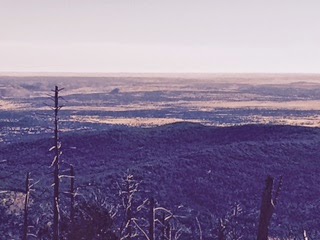
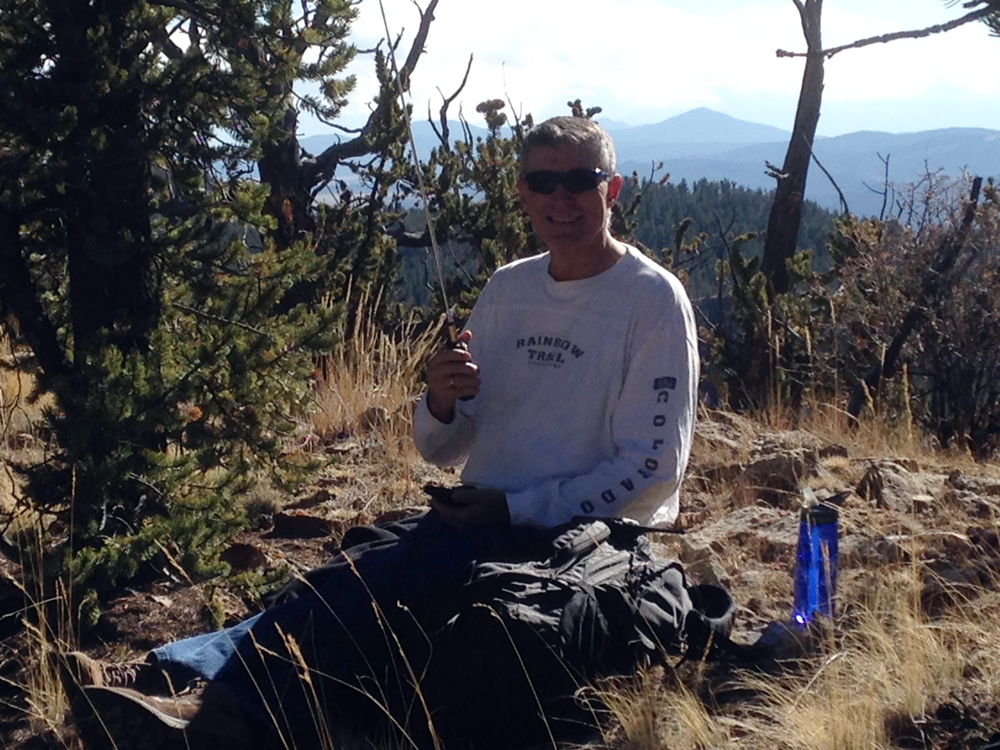
It was a nice fall day, so Joyce K0JJW and I decided to go for an easy hike up Kaufman Ridge HP (W0C/SP-081) and do some SOTA operating. Well, maybe the hike was her idea and the Summits On The Air thing was my contribution to the plan. The hike is less than a mile and has about 900 feet in elevation gain, depending on where you start the hike.
This definitely a slacker operation: easy access, easy hike, great weather and 2m FM activation via a handheld radio and the 1/2-wave whip.
Note that there are two SOTA peaks with the “Kaufman Ridge” name: Kaufman Ridge North (W0C/SP-085) and Kaufman Ridge HP (W0C/SP-081), located near Trout Creek Pass in Colorado. Today we headed to SP-081 which we reached by following County Road 318 from Trout Creek Pass, which is also called Buckrake Drive and then Windmill Drive. These roads pass through private property to reach the San Isabel National Forest, where there is a gate that closed from December to April (see map). At this point, the road is easy 4WD, most 2WD high clearance vehicles will do fine. You can also approach from the south on FS 308 through Mushroom Gulch. 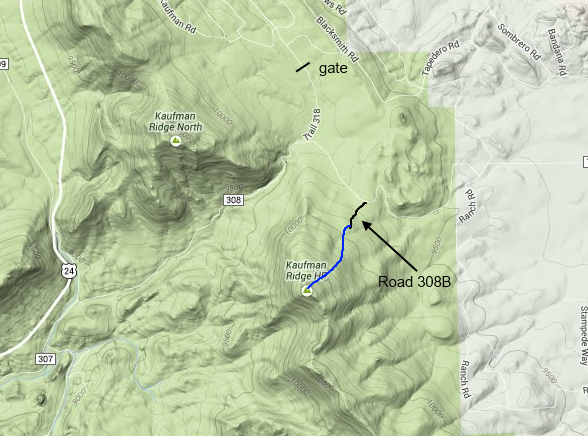
We turned left onto FS 308 and then took a short side road FS 308B toward the summit. There are several over turn offs but 308B seems the best (shown in black on map). The road is blocked for vehicular traffic at 38.858659° N / 105.933921°W. You can continue walking on the road a ways or just head straight for the summit. While the hike is short and not that steep, there are plenty of downed logs to give you a challenge.
You never know who is going to show up on 146.52 MHz in the mountains but I had put the word out via email to some of the local hams to let them know I was doing a SOTA activation. When I got to the summit, I had a few stations already calling me and I quickly worked Ron N0MQJ, Fred N0VXE, Dave K0HTX, Jim KD0MRC, Bob W0BV and Don K0DRJ. Don was my “best DX”, about 60 miles away in Woodland Park with a few mountains in the way. Thanks to everyone that came on frequency and contacted me.
Side note: if you want to activate SP-085, go north on a forest service road (not shown on map) near where 318 and 308 intersect. Just drive a short ways north, find a parking spot and bushwack your way up the summit. You could easily activate both summits in one day.
73, Bob K0NR
The post SOTA Activation: Kaufman Ridge HP (W0C/SP-081) appeared first on The KØNR Radio Site.
The Completely Updated Incomplete List of Ham Radio iPhone Apps
 It is about time I updated one of my more popular posts about my favorite ham radio apps on the iPhone and IPad. As usual, I will focus on free or low cost (less than $5) apps that I am actively using. Some apps have just disappeared from iTunes and new ones have emerged. While this list is completely updated, it is still incomplete, because there are so many apps to choose from.
From the Simple Utility Category:
Ham I Am (Author: Storke Brothers, Cost: Free) A handy app that covers some basic amateur radio reference material (Phonetic alphabet, Q Signals, Ham Jargon, Morse Code, RST System, etc.) Although I find the name to be silly, I like the app!
Maidenhead Converter (Author: Donald Hays, Cost: Free) Handy app that displays your grid locator, uses maps and does lat/lon to grid locator conversions.
HamClock (Author: Ben Sinclair, Cost: $0.99) A simple app that displays UTC time and local time. This one reads out to the second.
There are quite a few good apps for looking up amateur radio callsigns:
CallBook (Author: Dog Park Software, Cost: $1.99) Simple ham radio callbook lookup with map display.
Call Sign Lookup (Author: Technivations, Cost: $0.99) Another simple ham radio callsign lookup with map display.
There are a few repeater directory apps out there and my favorite is:
RepeaterBook (Author: ZBM2 Software, Cost: Free) This app is tied to the RepeaterBook.com web site, works well and is usually up to date.
For a mobile logbook (and other tools):
HamLog (Author: Pignology, Cost: $0.99) This app is much more than a logbook because it has a bunch of handy tools including UTC Clock, Callsign Lookup, Prefix list, Band Plans, Grid Calculator, Solar Data, SOTA Watch, Q Signals and much more.
To track propagation reports, both HF and VHF:
WaveGuide (Author: Rockwell Schrock, Cost: $2.99) This is an excellent tool for determining HF and VHF propagation conditions at the touch of a finger.
If you are an EchoLink user, then you’ll want this app:
EchoLink (Author: Synergenics, Cost: Free) The EchoLink app for the iPhone.
There are quite a few APRS apps out there. I tend to use this one because my needs are pretty simple….just track me, baby!
Ham Tracker (Author: Kram, Cost: $2.99) APRS app, works well, uses external maps such as Google and aprs.fi. “Share” feature allows you to send an SMS or email with your location information.
Satellite tracking is another useful app for a smartphone:
Space Station Lite (Author: Craig Vosburgh, Cost: Free) A free satellite tracking app for just the International Space Station. It has annoying ads but its free.
ProSat Satellite Tracker (Author: Craig Vosburgh, Cost: $9.99) This app is by the same author as ISS Lite, but is the full-featured “pro” version. Although it is a pricey compared to other apps, I recommend it.
For Summits On The Air (SOTA) activity, there are a few apps:
Pocket SOTA (Author: Pignology, Cost: $0.99) A good app for finding SOTA summits, checking spots and accessing other information.
SOTA Goat (Author: Rockwell Schrock, Cost: $4.99) This is a great app for SOTA activity. It works better when offline than Pocket SOTA (which often happens when you are activating a summit).
For ham radio license training, I like the HamRadioSchool.com apps. (OK, I am biased here as I contribute to that web site.)
HamRadioSchool Technician (Author: Peak Programming, Cost: $2.99) There are a lot of Technician practice exams out there but this is the best one, especially if you use the HamRadioSchool.com license book.
HamRadioSchool General (Author: Peak Programming, Cost: $2.99) This is the General class practice exam, especially good for use with the HamRadioSchool.com book.
Morse Code is always a fun area for software apps:
Morse-It (Author: Francis Bonnin, Cost: $0.99) This app decodes and sends Morse audio. There are fancier apps out there but this one does a lot for $1.
Well, that’s my list. Any other suggestions?
– Bob K0NR
The post The Completely Updated Incomplete List of Ham Radio iPhone Apps appeared first on The KØNR Radio Site.
Mt Herman: SOTA plus VHF Contest
The North America SOTA Weekend coincided with the ARRL September VHF Contest, which I interpreted as a great opportunity to do a combination SOTA activation and QRP VHF operation. A few other folks thought that was a good idea so we all got on the air from SOTA peaks on the Sunday of the weekend. I decided to operate from Mount Herman (W0C/FR-063) in grid DM79. I hiked up the same mountain for last year’s September contest and got soaked by the rain. Fortunately, the weather was excellent this year, making it a great day.
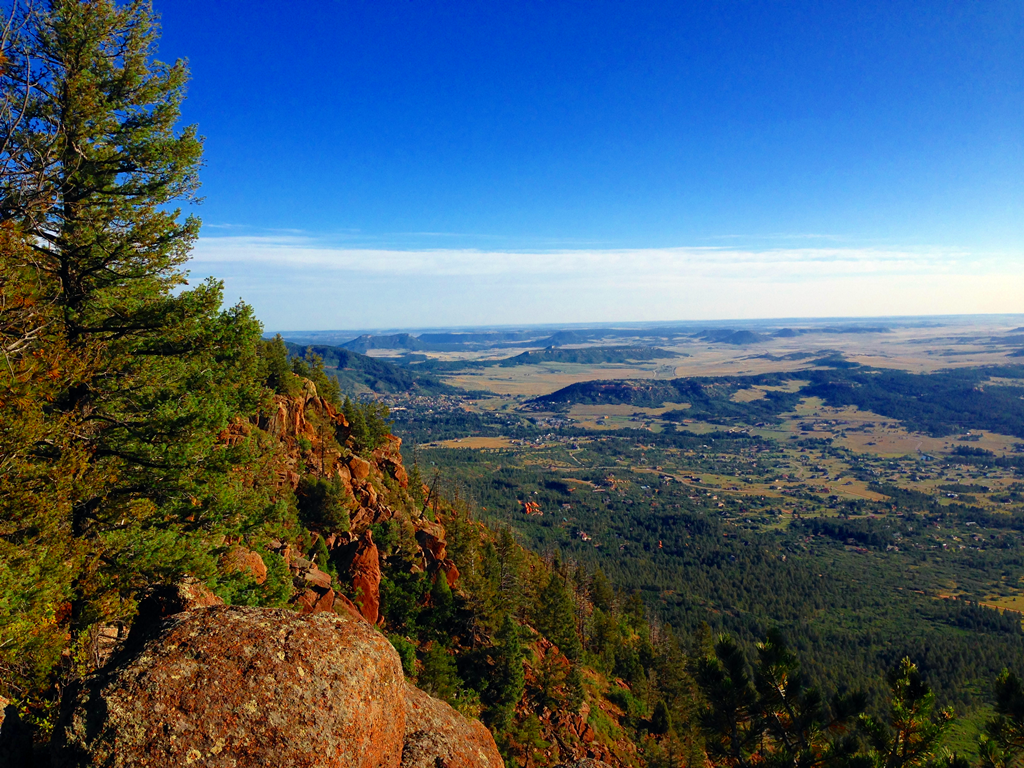
View from the south side of Mt Herman
For radio equipment, I took a couple of HTs for 2m and 70 cm FM and the FT-817 for CW/SSB on 6m, 2m and 70 cm. Most of the SOTA action would be on 2m FM but SSB is critical for working the VHF contest. I did put out the word to the usual VHF contesters that there would be FM activity and did work a few of them via 2m FM. The 2m FM calling frequency, 146.52 MHz, is commonly used for SOTA but is not allowed for contest use. (Another example of how this rule is just a barrier to contest activity.) We used 146.55 MHz for the contest contacts. 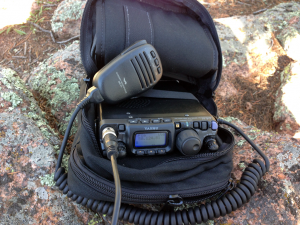 I had coordinated with Brad WA6MM who was going to be on Grays Peak (W0C/FR-002), one of the Colorado 14ers. When he made the summit, I had my 2m yagi antenna pointed in his direction and easily worked him on 2m FM at a distance of 65 miles. Brad was using an HT with a 1/2-wave vertical antenna. Also, I worked Stu W0STU and Dan N0OLD on Bald Mountain (W0C/FR-093) , which sits on the east side of I-25 right at Monument Hill. Contest activity was light, as usual for the September contest in Colorado. We did have two rover stations that activated a few of the unpopulated grids in eastern Colorado: George AB0YM and Jonesy W3DHJ.
Band       QSOs X pt =  QSO pts.  X   Grids   =     Points
 -----------------------------------------------------------
 50         8      1      8             5             40
 144        23     1      23            5             115
 432        14     2      28            3             84
 -----------------------------------------------------------
 TOTALS     45            59            13            767
My contest score was not bad for a few hours of operating QRP portable. It turns out that I had set the Colorado section record for “single-op portable” back in 1990 with just 624 points (using my old callsign KB0CY). Oddly enough, 24 years later it appears that I set a new record. (This speaks more to the lack of QRP activity during the September contest and less about my incredible operating ability.)
All in all, it was a great day in the mountains to take a hike and play with radios. I will probably do the SOTA + VHF Contest activation again.
73, Bob K0NR













