Posts Tagged ‘RFI’
 My YouTube debut……
 January 22nd, 2012 |
  Author:
has some good advantages over the way I am now......or was using.

With this configuration I am able to just push the RX ant button on the K3 and both units are inter connected. Also the way the MFJ 2026 is adjusted is a little different than I had previously adjusted the unit. I tried it and it is very easy, fast and works great!! So what are the advantages of hooking up your MFJ 1026 this way....well you never have to worry about the RF from your transmitting antenna getting into your receive antenna. With this hookup they are totally isolated. To include the MFJ 1026 it's as simple as powering up the MFJ unit and pushing the RX ant on the k3 and then some simple adjustment of the MFJ unit. Finally I decided to use my Iphone to video the results of the MFJ 1026 and the K3 and how they dealt with the Plasma TV noise. You will have to excuse the reflection of me in the Elecraft P3 and the audio may not be that great either but give it a go as it does show how the Plasma TV's interferance can be dealt with.

PLT a threat to British intelligence gathering?
A report produced for the British intelligence gathering organization GCHQ claims that noise from power line networking devices is causing a detectable increase in interference at its monitoring stations and could adversely affect its operations. The report, which can be found on the website Ban PLT, was originally released by GCHQ’s Director of Engineering and Technology but has since been disowned by GCHQ which now claims it contained “inaccuracies.” The government organization also forced the online tech news journal The Register, which published an article containing details of the report, to remove the author’s identity from the article using measures designed, ironically, to suppress information that could be considered a threat to national security. So much for freedom of speech.
Ofcom meanwhile continues to deny that PLT devices cause a problem, stating that there have been “only” 272 complaints of interference (all from radio amateurs) and that of 233 cases referred to BT all but one have been resolved so there is nothing to worry about. Has pressure been brought from on high to force GCHQ to disown the report which is embarrassing to BT which has a couple of million of the Comtrend PLT devices installed nationwide? It is blatantly obvious that Ofcom couldn’t give a damn about the possible effects on a few hobbyists who don’t even pay a license for the spectrum they use. But a threat to the country’s ability to monitor the short waves to gather intelligence about potential security threats is something they would have had to take seriously.

PLT a threat to British intelligence gathering?
A report produced for the British intelligence gathering organization GCHQ claims that noise from power line networking devices is causing a detectable increase in interference at its monitoring stations and could adversely affect its operations. The report, which can be found on the website Ban PLT, was originally released by GCHQ’s Director of Engineering and Technology but has since been disowned by GCHQ which now claims it contained “inaccuracies.” The government organization also forced the online tech news journal The Register, which published an article containing details of the report, to remove the author’s identity from the article using measures designed, ironically, to suppress information that could be considered a threat to national security. So much for freedom of speech.
Ofcom meanwhile continues to deny that PLT devices cause a problem, stating that there have been “only” 272 complaints of interference (all from radio amateurs) and that of 233 cases referred to BT all but one have been resolved so there is nothing to worry about. Has pressure been brought from on high to force GCHQ to disown the report which is embarrassing to BT which has a couple of million of the Comtrend PLT devices installed nationwide? It is blatantly obvious that Ofcom couldn’t give a damn about the possible effects on a few hobbyists who don’t even pay a license for the spectrum they use. But a threat to the country’s ability to monitor the short waves to gather intelligence about potential security threats is something they would have had to take seriously.
Death of short wave imminent
Amateur radio as we know it could be extinct by the year 2020. That is the only possible conclusion to draw from an unpublished EU policy document that has been leaked to several ham radio bloggers including myself. The document proposes that existing RFI standards protecting the short wave frequencies be torn up as “preventing the use or increasing the cost of essential technology in order to protect the activities of a small number of hobbyists makes no political sense.” This policy has already been unofficially in place at the UK’s Ofcom, which was one of the major contributors to the report.
The report suggests that withdrawing the standards relating to short wave RFI would save significant costs by removing the need to deal with complaints about interference. It also suggests that the UK Telecommunications Act (and similar laws in other EU countries) be amended to remove any right to protection from interference of the broadcast, amateur or CB services.
To support its recommendations the report claims that “short wave broadcasting is in rapid decline, with most broadcasters moving to the internet” and that “the intended use of Citizens Band as a personal communications service has largely been replaced by cellphone usage.” Amateur radio, it says, carries “little communication of any importance that could not be made using the telephone, cellular network or the internet.” The main use of ham radio, it suggests, is “largely recreational” and could be replaced by “online simulations and VOIP chat services.” Hams could also make more use of the largely interference-free bands above 400MHz which otherwise could be sold to commercial users. Radio amateurs “could still experiment with radio in the time-honoured manner, they just should not expect to be able to enjoy interference-free reception on the short waves.”
The reason for the desire to remove the protection of our frequencies becomes clear when you read the part of the report that describes forthcoming technologies that are expected to cause problems with RFI compliance. In order to meet carbon emissions targets and deal with expected power shortages caused by the early closure of nuclear power plants in countries such as Germany, the EU plans to introduce smart grids in all European nations by 2020. These smart grids use BPL technology to communicate with smart meters in each individual home. The smart meters, in turn, use PLT technology to communicate with smart devices in order to regulate their use. When demand for electricity is high, power cuts or the switching on of expensive standby power stations can be avoided by shutting off inessential devices instead. Examples of inessential devices given in the report include amateur radio linear amplifiers – assuming it’s still possible to hear anything on short wave over the BPL and PLT QRM in the first place.
The EU is also proposing that 80% of properties in member states should be equipped with solar panels by 2020. To achieve this target, installation costs will be heavily subsidized by governments, which clearly want to cut costs as far as possible. Estimates produced by a Chinese manufacturer of solar power systems suggest the cost saving that would result from eliminating the need for RFI suppression circuits in the power converters would amount to 4 billion Euro for the whole of Europe.
The report concludes that “the cost of protecting the short wave spectrum from interference from technologies that are essential to be installed throughout Europe in the next decade to meet emissions targets and maintain the well-being of all European citizens is quite simply prohibitive” and urges that EU Commissioners pass the necessary laws by 1st April 2012.

Useful RFI
I apologize for being even more grumpy than normal but I haven’t had much sleep. Olga and I were woken up at around 1 in the morning by a lot of noise outside. It was a group of young people who had apparently been having a party in the house opposite. Despite the fact that the temperature was heading for -7C and the girls, according to Olga who was looking out of the window, were none too warmly clad, they were not simply saying goodbye but continuing an animated conversation. Someone decided the party must be carrying on outside so they switched on a car’s headlamps and turned on the stereo very loud. Because of the way the houses are crammed together here with virtually no front gardens this was taking place right below our bedroom window. After ten minutes we were both getting very angry. It isn’t often that Olga uses the f word about people.
I felt like calling the police, but the chances of them actually making an appearance before the miscreants had slept off their hangovers was pretty remote so we discarded that idea. Olga went downstairs and turned on the lights to try and make it obvious that we had been disturbed. I went into the shack, switched on the K2 and sent a 10W dit on 30m, which switched on the security lights of the nearby neighbours that have them. This did appear to have the effect of making the tiny minds think “gosh, other people live around here and oh my, it’s after 1 in the morning, perhaps they are trying to sleep and our noise has disturbed them!” because shortly afterwards the group dispersed and peace and quiet resumed. But neither of us are good sleepers and it took a while before we calmed down enough to sleep again. Hence the foul mood this morning.
It has sometimes been a bit annoying that I can’t go on any band except 80m after dark because of the problem with security lights. But on this occasion it turned out to be useful. If only I knew that the thoughtless young people had touch sensitive lamps by their bedside I might even have been tempted to try a bit of all-night WSPR!

W3LPL-inspired 160/80 RX splitter
In an earlier post, I described my K9AY loop system. QRX for an update on the outdoor portion. But, after returning from a short and much-needed vacation at the beach yesterday afternoon, I whipped-up this little guy:
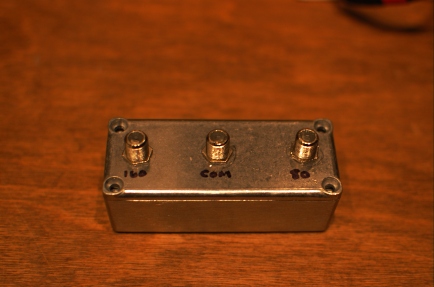
One of the big problems I have living in the city is overload from broadcast stations in the AM band. (This is especially true in the heavily-populated, full-of-hot-air DC area—Ed.) But, I digress. I also wanted to protect the preamp and receiver when I was transmitting on the higher bands into nearby antennas. So, some sort of filtering was in order.
I contemplated a number of topologies. But, the W3LPL filters were a good choice because they’re cheap and very good. A good reference on what I did is the NCJ article by K3NA and W2VJN about the VP6DX receiving antenna system. The Ducie Island system is considerably more complex than mine. But, they had more stringent requirements, more land for Beverages, and more money than I do.
Following the K3NA/W2VJN/W3LPL topology, I constructed a little diplexer filter for 160 and 80 meters that splits my K9AY to two receiver ports. This splitter is the first thing after the K9AY coax passes through the station ground bulkhead, requiring a preamp on each port. Since I don’t have a TX antenna for 160 yet, that port will go to the SoftRock-160.
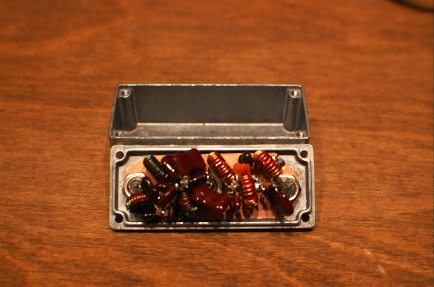
I’ve only tested the 80-meter portion (since I didn’t get the 160 portion done until this morning before work). But, it works like a champ and there is no overload from broadcast stations. Although there are some curious mixes coming from some of the big AM stations in the area that seem to be external to the receiver (this has been confirmed by N3OX—pretty amazing stuff); but, that might deserve its own post at a later date.
Pin 1 and a Pound of Ferrite
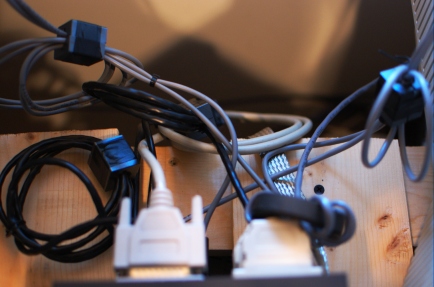
The commonly-held wisdom goes that an “ounce of prevention is worth a pound of cure.” As things typically go around the K8GU station, 50% of problems are solved by prevention and 50% by cure. Today, it was a cure. Readers of the blog are no doubt aware that I have a recently-discovered problem with QRM between my radios when they were on the 20- and 40-meter bands. (I didn’t notice this problem until I got both of the TS-930′s up and going again; so, it’s probably the result of the “new” station location and arrangement.)
I pulled the 20- and 40-meter W3NQN filters out of the circuit and measured them. They benefited from a little tweaking, but nothing that would have caused the problem. I put them back in and was rewarded with much lower VSWR in across both bands.
It didn’t matter which of the radios was on 20 and which was on 40, the interference, a popping hash that followed the leading edge of my keying, was there. The next step was to put a dummy load on the output of one radio, then both radios. Even when transmitting into the dummy load, the interference remained. This suggested to me that the problem was very close by. All of my gear is bonded together with heavy straps. So, I wasn’t too worried that it would be difficult to find. I noticed that the 40-meter LED flickered on my KK1L band decoder box following my keying. It became the prime suspect.
I found some split beads that AD8P and I bought from AA1K in the Dayton flea market a few years ago. I’m not sure what mix they are, probably 43 or possibly 77. Winding a few turns of the band data lines from each radio through the beads knocked down the interference a good bit. I slapped some more on the audio lines going to the Heil HCS that I use for SO2R audio and the interference disappeared. But, I was using the dummy load on one of the radios. As soon as I went back to the external antennas, the inteference came back.
Next, I dug out a couple of the 2.4-inch diamater mix-31 toroids that I purchased in the first K9YC “group buy” of these parts back in 2005 or 2006. I wrapped the DC power supply line to the KK1L box and the AC supply to the HCS. And, the problems pretty much disappeared. At least one of these is due to what K9YC calles “the pin 1 problem.” Basically, if the shield is brought through the metal enclosure to the circuit board, it conducts (noise) current that’s riding on it into the enclosure. So, I need to dissect the HCS and KK1L boxes to see if I can find a deeper fix than just slapping ferrite on the outside.
But, there’s hope for SO2R in this week’s NSL!














