Posts Tagged ‘QRP’
 W5CYF QRP CW
 November 2nd, 2011 |
  Author:
 Tinker John has been posting videos of Amateur Radio for a while now, and I have re-posted them on this blog a time or two because he does a really awesome job showing off Amateur Radio and the different modes he uses. He’s video of him doing QRP CW with just 5 watts. Yeah, I know, a lot of Hams do QRP, CW, but still, this is a great example for anyone looking to see how to do it. John’s videos are almost like a video Elmer. And as I have mentioned in older posts, inspired me to try a couple new things. But, enjoy his 5W CW fun.
Two Transistor Tranceiver for Ten
With ten metres opening up it seemed the right time to try building Roger G3XBM’s latest project: the XBM10-2. Roger describes it as probably just about the simplest CW transceiver possible for use on 10m, using just two transistors to produce about 60mW out.

This was my first attempt at construction since my radiotherapy and chemotherapy and I found it to be quite a struggle. First of all I found it difficult to concentrate while trying to work out the perf board layout. After that I got a bit frustrated with constantly juggling three pairs of spectacles due to my eyes apparent inability to focus at different distances. I also found soldering difficult due to my hands shaking whenever I brought the iron bit close to a component. I created quite a few solder bridges which I then had to clean up.
Construction took much longer than I would have taken a few months ago. But in the end it did work. Though not on ten metres yet. I’m waiting for a 28.060MHz crystal from the G-QRP club shop before I can try it out on the air.
One issue I have found (which Roger also comments on) is that the rig has a major chirp. It is definitely not T9 and I don’t know whether it is possible to improve on that. But at least it has character. If you hear a weak, chirpy signal near to the 10m QRP activity frequency give it a call. It might be me!

The bands are alive with the sound of CW
 |
| Action on 20 meters |

1000 miles per watting
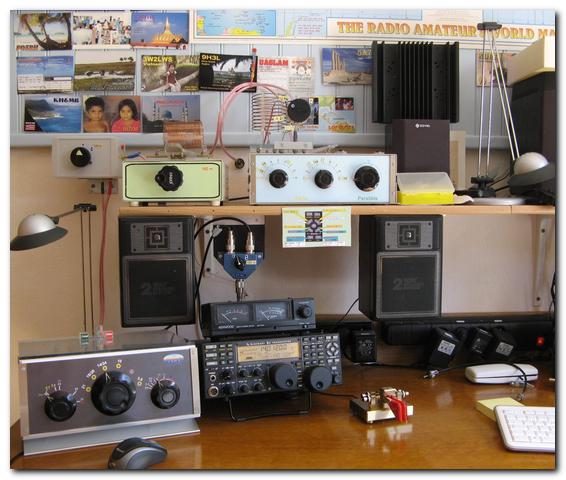 |
| F5HY station |
I then heard OZ3NP calling CQ on 20 meters and 3 watts just did not seem to cut it so I eventually cranked it up to 10 watts. Ben now heard me in Denmark and I was not sure if he was copying me at times but I'm in his log and I did get an email from him thanking me for the contact. That surprised me as this contact was plagued with propagation gremlins. AT QRZ.COM Ben has a great setup and with his son now a ham radio history goes back three generations in his family. It was time to shut things down as there was other things that had to be down around the house plus Julie and I were going to have Chinese takeout yummy.
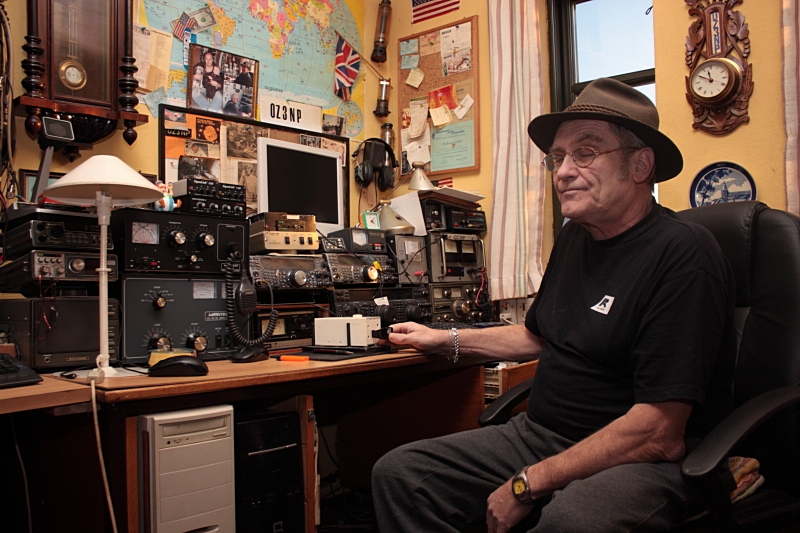 |
| OZ3NP |
I was able to get back on the radio again Saturday afternoon. I checked out 10 meters but it was dead there was some action on 15 so I thought I would give it a go. Rudy IK4VFD was calling CQ so I pumped my 3 watts into my attic dipole. Rudy came back to me and gave me a 529 this was strictly giving out RST, name and QTH as Rudy had a pileup waiting for him. There was a couple of repeats on my behalf as the 3 watts was struggling at times. With this contact my distance into Parma Italy was 1,412 miles per watt.
It was back to 20 meters as 15 seemed to be shutting down here I ran across UR4UC calling CQ Val came back to me on my first call. I received a 449 RST for some reason my keyer was acting up.....well at the time that was what I blamed it on. In fact it was my nerves getting the better of me during the contact. Not sure why but I can copy most QSO's when they are not a contact. As soon as I engage in a contact for some reason the code copying in my brain goes all funky. I also get all jumbled up with the sending at times as well. I could not understand why Val kept sending me "UC UC UC"....it was not until almost the final 73's that I realized I was sending UR4NC!!! If you read the blog Val sorry about that. This contact netted me my best miles per watt contact of 1,620 miles per watt.
It's now Sunday and I hope to get some radio time in this afternoon.

AmateurLogic.TV 33: One Jam Packed Show
George visits the Twit.tv studios and interviews Randy Hall, K7AGE. Tommy visits the Huntsville Hamfest. Jim builds an Audio Isolation Interface. Peter shows us the DATV QSO Party.
A day of ham radio
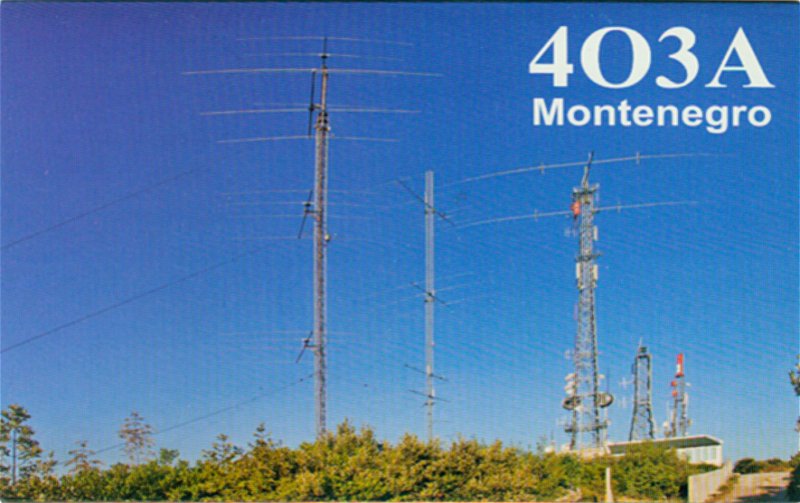
 So I setup VFO B on the k3 for 14.060 using my new Grove HS-900 antenna. This way I was able to listen for VA2OTA with in my right ear and on VFO A cruise all the other bands for contacts with my left ear. While waiting for VA2OTA my left ear picked up 4O3A at 14.019 I gave him a call and he came right back with a 599...not bad for 5 watts and an attic dipole. It was a very short QSO as he had many in line
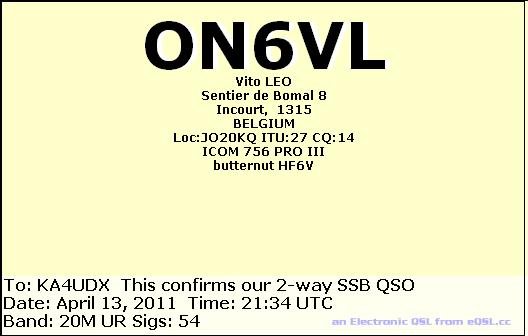
 waiting for him. I was hearing some action in my right ear but it was only other stations working VA2OTA so it was off to VFO A again to see what was out there. 40 meter was not to busy as it was still early so back to 20 meters. I came on a QSO that was just ending so I waited and called Vito ON6VL he came back to me and gave me a 559 report. Conditions were changing and Vito was starting to loose me so we ended our QSO. It was back to the computer and someone who posted a spot for VA2OTA said they had to use the audio peak filtering on their K3. That got me thinking and I not only used the APF (a link to YouTube for an example) but diversity mode as well. BINGO it worked at 14.060 VA2OTA jumped out of the noise floor. Now mind you it was...JUST....above the noise floor. I waited for my turn as there was a line up wanting to make contact. I gave him a call and he came back to me we exchanged reports and that was it. So over all the radio time was a success.


VK on a whip antenna
The amazing power of the WSPR mode to enable weak signals to be received over long distances was demonstrated conclusively when my 2 watt signals, transmitted into a 1.3m long telescopic whip antenna from inside the G4ILO shack,were received in Australia and the USA, not once but several times with SNR reports of up to -19dB.
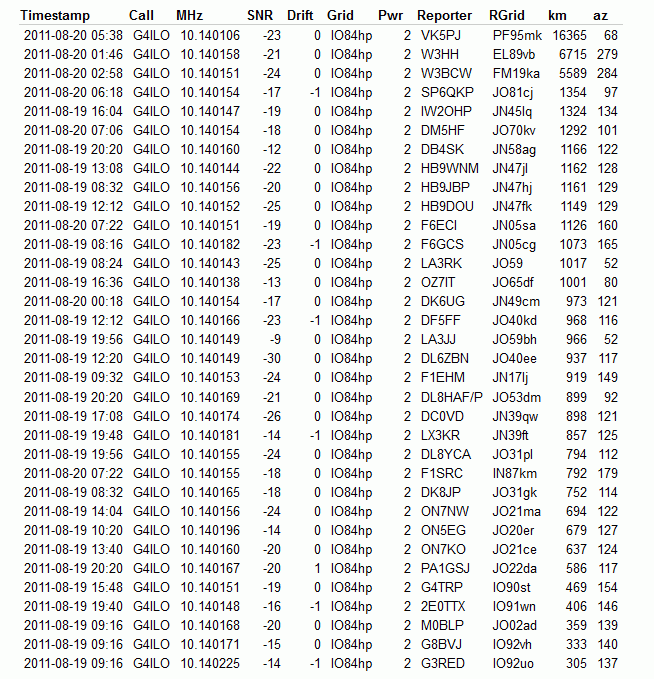
These spots were not achieved using a hand held radio as they occurred early in the morning when I was asleep. But they were made using a home made portable 30m whip antenna that I designed to be used with the VCXO-AXE portable WSPR transmitter I recently built. Here is a picture of the antenna taken during the tests.
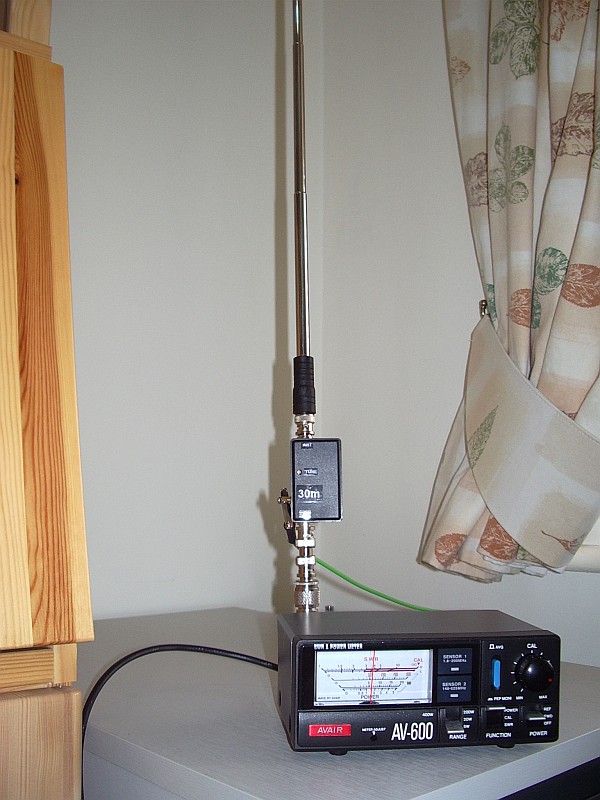
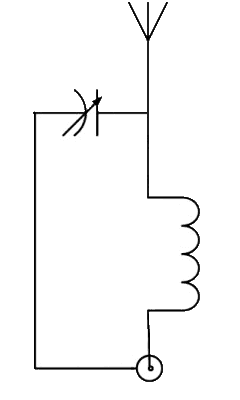
The antenna consists of an L-match mounted in a small plastic project box, with BNC sockets for the transmitter and the whip antenna.
The constructional details can be gleaned from this internal view here. Click the image to see a much larger version.
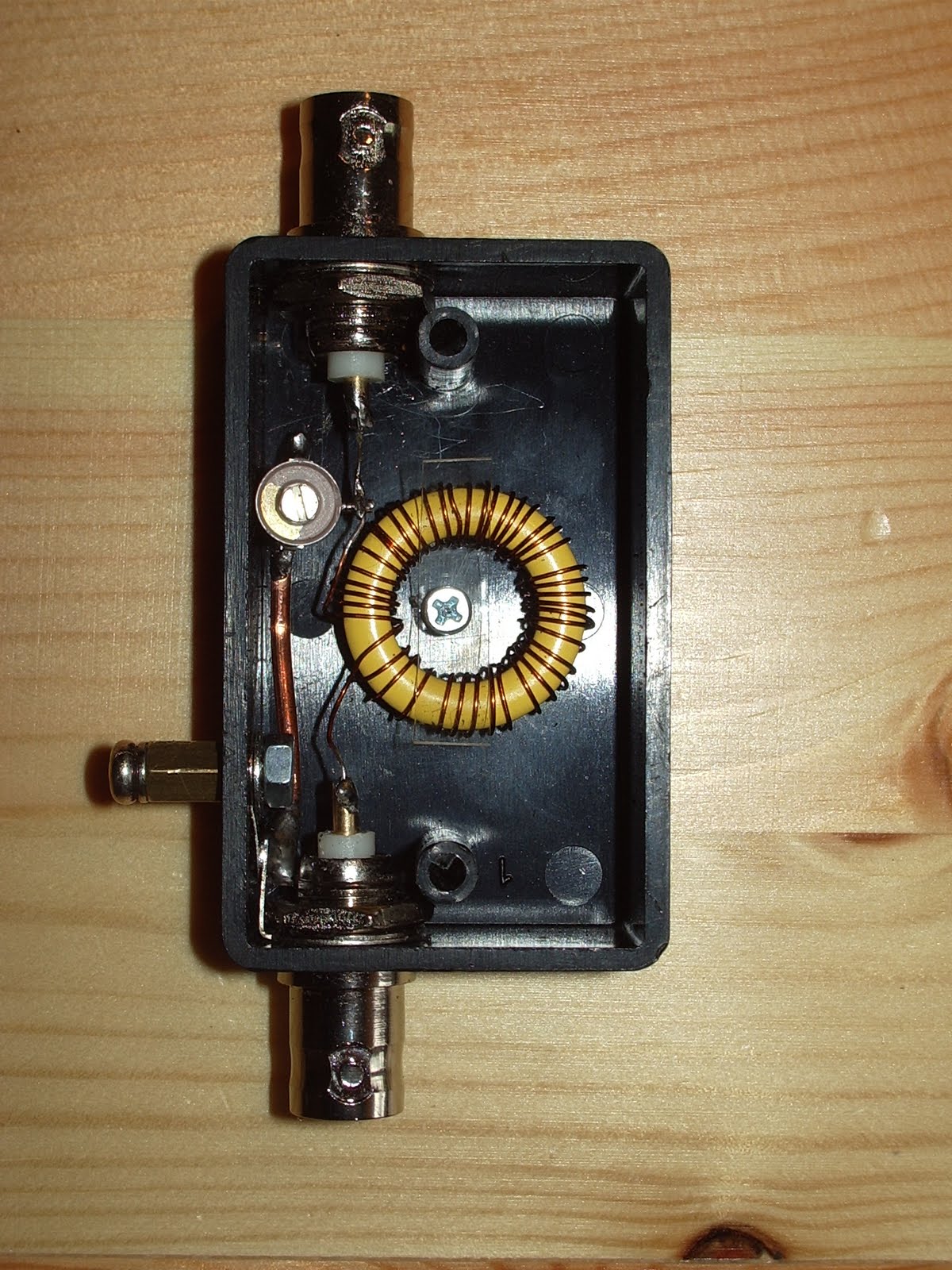
The loading coil consists of about 46 turns of 28SWG wire on a T80-6 toroid. The matching capacitor is a 4 – 40pF trimmer. The number of turns was determined empirically (i.e. using trial and error) so don’t ask me for details of how to make one for other bands. There may be formulas for calculating things like that but I don’t know them.
It would have been difficult to make this antenna without an antenna analyzer like my RigExpert AA-200 which displays the SWR across a range of frequencies graphically. With my first attempt at the inductor it was possible to obtain an SWR null at 10.140MHz but it was rather a broad dip and the minimum was around 3:1. However at lower frequencies I saw that I was able to obtain a much deeper, sharper null. This made it clear that what I needed to do was remove some turns until the deep, sharp null was at the frequency I wanted. A deep null indicates higher Q and therefore better efficiency.
You can see the SWR curve of the final version below.

Note, however, that this was taken inside the shack in the test position where reflections spoiled the SWR and broadened the dip. When measured out of doors the SWR curve dipped deeper and was narrower as long as I stood clear of the antenna. (It was interesting to note how the SWR was affected even if I was a metre away from the telescopic whip. This suggests efficiency would be adversely affected when used in true hand held fashion.)
A good ground or quarter wave counterpoise wire is needed with this antenna. The resonant frequency is affected by the ground system used as well as the length of the whip and the position of the trimmer. If you don’t want to take an antenna analyzer to the field to check and tune the antenna before operation you should use the same counterpoise. So it would be advisable to pair the counterpoise with the antenna.
Further tests would be useful to determine the extent to which a good match is reproducible in different locations using the same whip length and counterpoise without retuning.
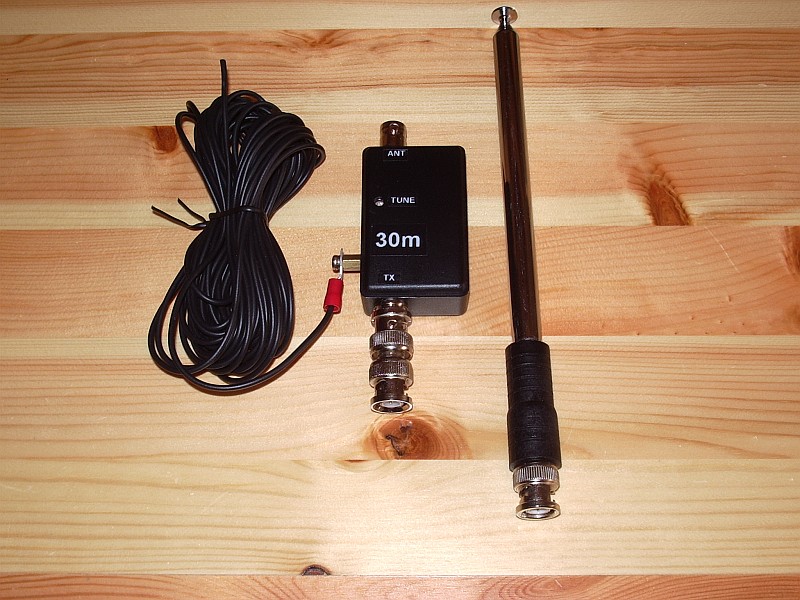
In case retuning is needed I added an access hole for the tuning trimmer. The resonant frequency can also be changed (increased) by shortening the telescopic whip a section or two.
This has been an interesting project. As a result of it I now have a completely portable, pocketable, battery powered system capable of sending a radio signal half way round the world, and I have developed a useful monoband 30m antenna.














