Posts Tagged ‘QRP’
 Fascinating signals: AA1TJ/QRPp
 August 18th, 2011 |
  Author: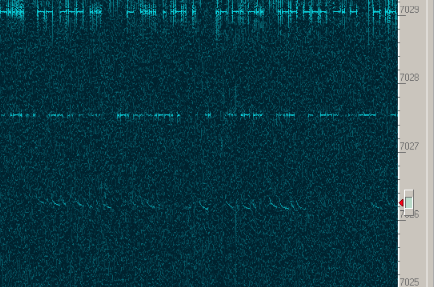
Last night, as I have been doing lately in both the evenings and mornings, I was trawling the bands with a SoftRock (a dual-band v6.0 built for 40 and 80 meters—my first SoftRock) and Rocky. Without fail, the waterfall enables me to see something interesting, which brings me to the point that I really need to integrate these receivers into my station. But, I digress. The really tantalizing, fascinating signals are the weak ones, especially when they are weak and unusual.
The subject weak and unusual signal is shown in the figure headlining this post. Rocky’s cursor shows the approximate bandwidth of the CW filter (250 Hz, if I recall correctly) and the center frequency (7026.25 MHz). I tuned it in and caught a CQ from “AA1T…” Recalling that I head read about Mike, AA1TJ‘s, Das DereLicht transmitter built mostly from parts scavenged from a dead CFL, I suspected it was him. After a moment the QSB came up and I caught the ‘J.’ Thanks to the fact that the SDR is not fully integrated into the station, I scrambled to plug my 15-year-old Small Wonder SW-40 in and get it online. Mid-scramble, Sarah handed Evan off to me for a diaper change, but I did manage to snap the screenshot above. By the time I returned to the shack awhile later to close things down, AA1TJ had disappeared.
Through the (ubiquitous) magic of the Internet, I sent Mike an apologetic e-mail QSL, which yielded a nice response. It turns out that he was trying a 40-meter version of the first transistor transmitter described in the amateur literature. The design for 146 MHz by K2AH appears in March 1953 QST. If you are an ARRL member, pull up those old QSTs in the archives and read about it. K2AH is on the cover of February 1953 QST with the same transmitter. Mike figures he was making 20 mW, or 20650 miles/Watt on the path from his station to mine. The more remarkable thing is that he was using a 1956-era point-contact transistor (the same type as in the K2AH article). Fascinating stuff! Hopefully, we’ll connect for a real over-the-air QSO sometime soon.
Thanks, Mike, for making my day by doing something interesting and sharing it on the air!
Should I or shouldn’t I?
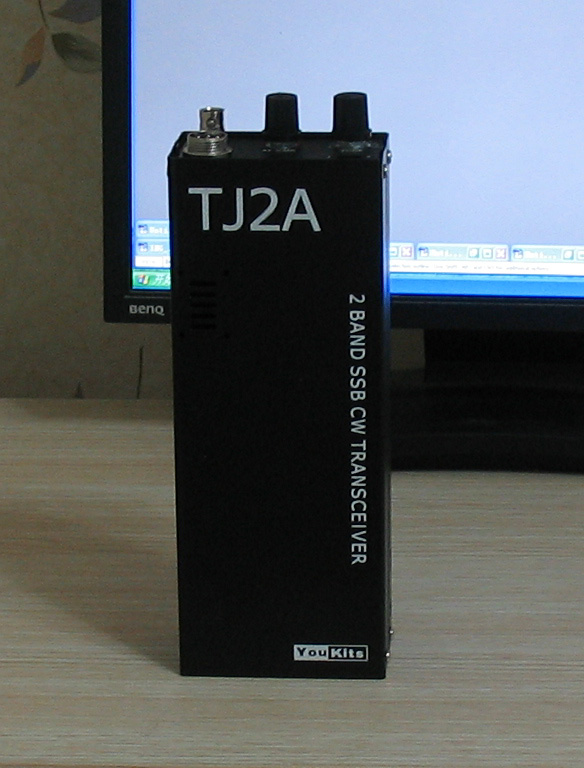
Thanks to the latest blog post from John AE5X I have the web page for a new QRP kit open in another browser tab and the pointer keeps hovering over the Buy Now button. The kit in question is the TJ2A, a two-band handheld SSB/CW transceiver for the 20m and 40m bands that has just been produced by YouKits of China.
Regular readers of my blog will know of my fondness for handheld radios. I’m finding this one very hard to resist even though I have an FT-817 and so no need for another handheld 20m/40m radio. At this point in my life I’m not even sure if building it is still within my capabilities. If I did try, it would be the most difficult kit I have attempted since my Elecraft K2, and I built that 12 years ago when my eyes were a lot sharper and I was not suffering the after effects of a brain operation. Should I or shouldn’t I?
The TJ2A looks like an updated and improved version of the Mizuho HF handhelds that were produced during the late 1970s which still fetch a tidy sum whenever they change hands on eBay. Like the Mizuhos, the TJ2A is VXO controlled and covers a portion of each of the two bands, though you can install alternative crystals if you would prefer to have full coverage of one band in two ranges. You could also choose other bands by changing the VXO crystal and bandpass filters.
The building instructions are on the web and it looks as if the kit uses mostly through hole components but there are some SMD transistors. It isn’t perfect. There is mention of warm-up drift in the first 5 minutes after switching on or changing bands. There is also a mod already to stop BFO leakthrough into the IF stages. And there doesn’t appear to be any high SWR protection for the PA so using the rig with handheld antennas – or any type of antenna that presents a mismatch prior to tune-up – might be problematic.
But it looks really cute. And it’s a kit. There are few things in ham radio more rewarding than hearing the first signals, then making the first contact, on a radio you built yourself. Should I or shouldn’t I?

Whispering with a VCXO-AXE
My VCXO-AXE WSPR transmitter kit from W5OLF came this morning. It was two weeks in the post, doubtless due to Customs which had opened the package. I wasted no time in building it, though it did take me somewhat longer to complete than it took AE5X.

The kit itself has been impressively put together. The PCB is extremely high quality and the instructions are almost of Elecraft standard. If the horrible Spectrum Communications Off-Air Frequency Standard kit had been produced to this level of quality it might not have turned out to be a failure for me. If American kit makers can produce nice silk screened and solder masked boards, why do ours make us struggle with boards that look like they were made by hand on somebody’s kitchen table?
The VCXO-AXE kit uses almost all through hole components and there is plenty of space around the solder lands. I doubt that anyone would have any trouble building this. The one part that induced a feeling of terror when I saw it was the VCXO itself.
As described, it is a “larger surface mount component.” But what I didn’t expect was that it didn’t have any pins or legs that stick out to solder to. Instead, you have to solder it so the solder goes under or up the side of the chip. You need a very fine tipped soldering iron for this. I couldn’t really see if I had successfully soldered the chip or not, so I took a couple of pictures.
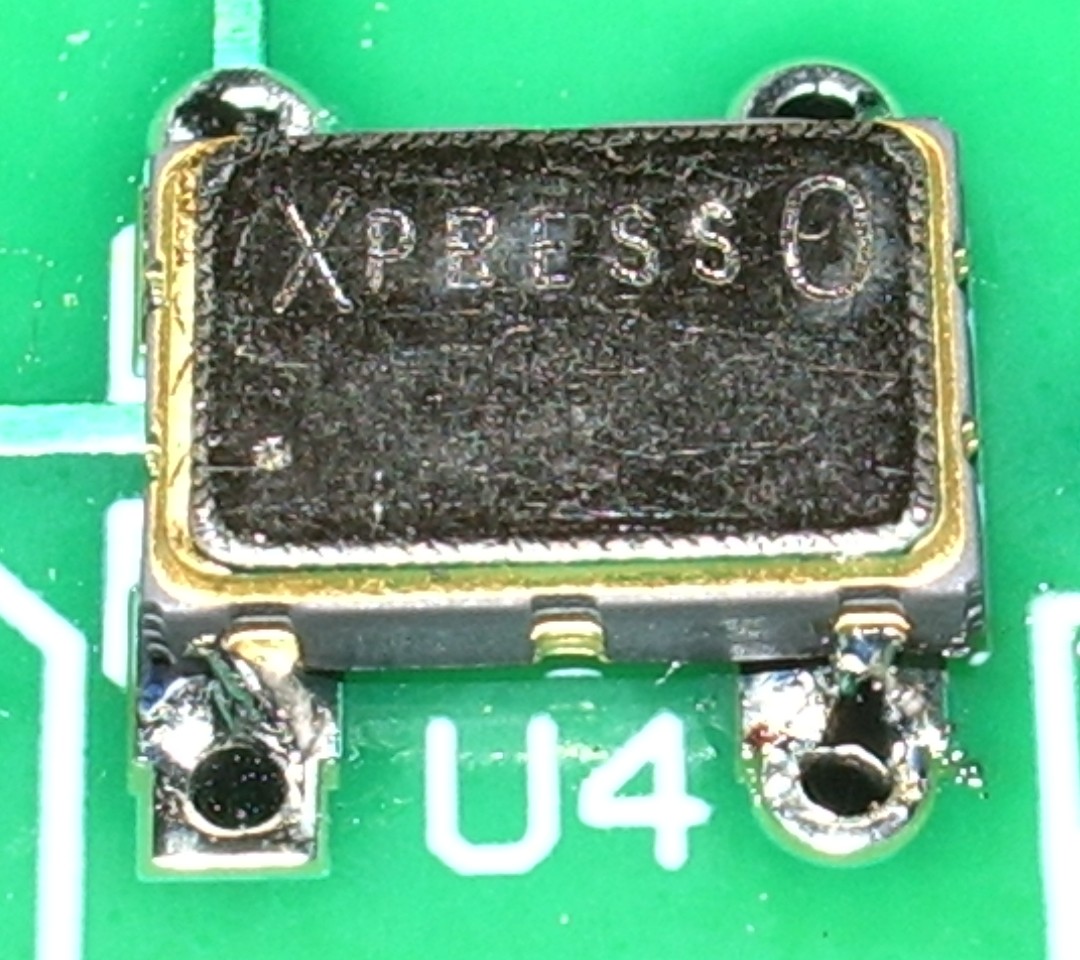
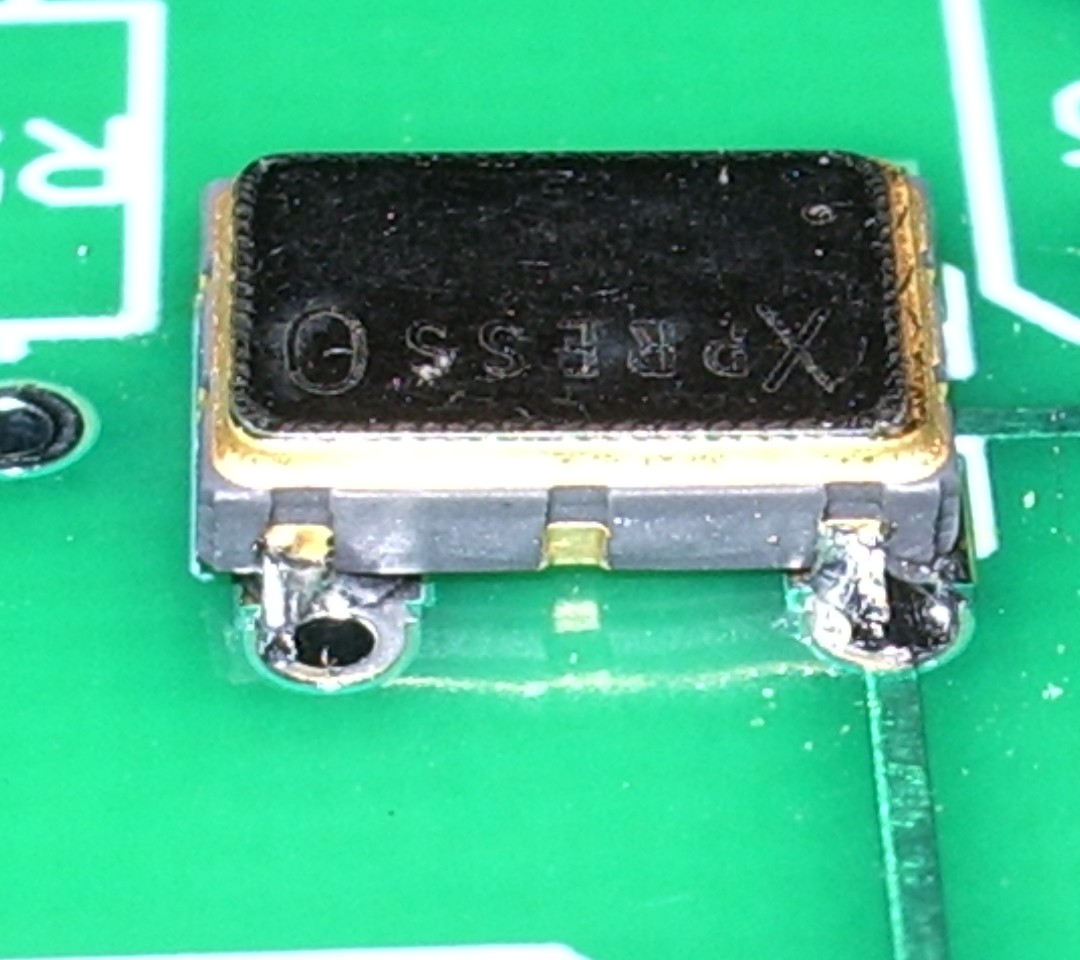
The result is not very pretty, but it must have been OK because the transmitter eventually worked!
When ordering, I specified my call, locator and the supply voltage I would be using (12V, as I planned to power the transmitter off a pack of 10 NiMH batteries.) The PICAXE controller chip came programmed with this information and a power level of 33dBm – 2 watts.

On a freshly charged battery pack I was actually getting nearer 3 watts output once the PA tuning capacitor had been peaked up, but after the first few transmissions the power did drop off a bit to become nearer the advertised 2 watts.
I hooked the VCXO-AXE up to my attic MFJ magnetic loop, watched the radio-controlled clock in the shack until it rolled over to an even minute, pressed the transmit button and a couple of minutes later had my first WSPR spots.
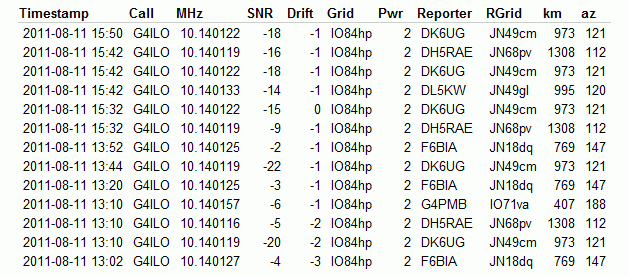
Soon after that I had several more. No great DX, but perhaps that is just down to conditions at the moment.
The instructions warn that second harmonic suppression of this transmitter is not great and an external low pass filter is advised. However, the magnetic loop (either the MFJ or my portable Wonder Loop) has a very high Q which I am sure does a good job of attenuating out of band harmonics on its own.
My next move will be to build the little transmitter into a plastic box and use it as a hand held portable WSPR rig. It would be fun to try making a 30m base loaded whip – which should also be fairly high Q – and see how well that works. So expect some WSPRing from various locations around Cockermouth some time soon!
This was a fun project and a good morale booster to prove to myself that I can still build stuff – and with an SMT part in it, too! Thanks to Jay W5OLF for making the kit available. A 20m version would be nice, as well!
If you want to buy one of these kits for yourself you have to look on eBay, though as of right now there doesn’t seem to be any for sale.

Bicycle mobile
I’ve always been a bit of an armchair traveller, and also an armchair cyclist. I like to read accounts of people’s travels through foreign lands, particularly if they are travelling by bike. The slower pace and need to stop and talk to more people means that they are able to convey more of a feel for the place than you get from reading grossly overrated travel writers like Bill Bryson. So having just come across the blog of Raf, ON5RZ, who is currently cycling through the USA and Canada with an FT-817 and wire antennas, I have some reading to catch up on. Perhaps you’ll enjoy reading it, too.

Whispering with wonder
A few days ago I dug out of the cupboard the Wonder Loop portable magnetic loop that I made a while ago. I had lost the pieces of uPVC electrical conduit that made a Heath Robinson support for the coaxial cable loop element. But I had always felt the saggy coaxial loop was a bit of an eyesore anyway. So I decided to make a new loop using microbore copper tubing. It turns out that you can buy this stuff on eBay – any diameter and length that you want shipped to your door next day by first class post. Three metres of 1cm dia tube cost just over £12.

The new loop looks a lot better and certainly hasn’t harmed the performance of the antenna which continues to amaze me. I tested it using WSPR at a 1W power level on all bands (40m – 15m) that my Wonder Loop covers. The best result was obtained yesterday afternoon on 20m, between 16:30 and 19:38z, when I received 15 reports from VK2XN of from -9 to -25dB SNR, at a distance of 16579km. This, I repeat, was using just 1 watt from the FT-817 with the Wonder Loop sat on my shack “workbench” almost exactly as in the picture. (The FT-817 was moved to the radio/computer desk during transmission.)
I also spotted 9 reports of VK2XN during the same period, which surprised me due to the extremely high noise level I have here on 20m. The SNRs weren’t so good, though, and he was running 10 watts. Still, that almost qualifies as a two-way contact.
I haven’t tried other modes yet, mainly because the shack is so small and these days I’m a bit wary about sitting inches from an antenna even if it is radiating no more than a watt or two. But the original Wonder Loop was very successful using PSK31 and I hope to try this one with JT65A shortly.
The one disadvantage of the new copper loop is that it isn’t exactly portable, which had been one of my original objectives when building the antenna. If you could get hold of some metal strip it might be possible to make the loop from six pieces that you can join together using bolts and wingnuts to form a hexagon. Possibly you could even do this using tubing, flattening the ends of each 60 degree segment and then drilling them so the loop could be bolted together. But as I’m not planning on taking the antenna anywhere at the moment I’ll keep the one-piece loop which I can stick behind the shack door for storage.
This is a really great antenna that should enable anybody to operate HF from anywhere.

QRP and DXing
I rarely post on the Elecraft reflector these days but I do check Nabble from time to time to see what’s going on and today I saw one thread that got me annoyed. Someone who had just built a new base version K2 posted that until he had done so he hadn’t realized that it was possible to work DX using 15 watts. Someone then piped up that QRP DX claims are pretty meaningless unless the antennas used are also mentioned – a point with which I’d agree. But then someone had to add the hoary old argument “They also don’t report how the guy they worked had to struggle to pull them out or what his equipment was.”
This argument gets my goat every time. Whilst many people use QRP through choice, when it comes down to antennas many people don’t have a choice. If you live in an apartment, or like me in a tiny house on a postage stamp sized plot, or if you have HOA restrictions, or again like me have an awkward neighbour who likes to make your life difficult just because he can, then having a tower and a beam, or even a decent long wire antenna high and in the clear simply isn’t an option.
What these people seem to be saying is: “If you can’t run high power and a beam like me then don’t waste my time.” Now, excluding a lot of people from the hobby just because they aren’t fortunate enough to be able to put together a top class station doesn’t seem to me like a good thing for the future of the hobby.
It is surprising what you can work using low power, even with modest antennas. And what the naysayers who have probably never even tried using low power and simple antennas don’t realize is that it is also surprising how many contacts don’t have to struggle to pull the QRP station out of the noise. In fact they have probably worked many low power stations themselves without realizing it because the other guy never mentioned he was using QRP. The attitude that “life’s too short for QRP” is just bullshit.
But when making contacts with low power and limited antennas is a struggle there are always other things you can do. Personally, ticking countries off a list has always seemed to me to be an exercise in frustration, especially since the advent of the DX Cluster which means that you’ll almost never come across a DX station that isn’t on the end of a pileup. And whilst it’s nice to have a chat uisng the radio, these days it’s so much easier to have a discussion about the hobby online using forums, blogs and so on.
For many of the QRP persuasion, ham radio is a lot to do with seeing how far a little radio signal can go. And there are so many ways you can do that – with QRSS beacons, WSPR and weak signal digital QSO modes like JT65A. Today I saw a Google Groups post from Joe W6CQZ/4, the author of the JT65-HF program, who is using the mode to make contacts running 500mW to a 20m Hamstick mounted on the metal roof of his shed. This sort of thing is much more satisfying than working DX using a superstation. Let’s fact it, anyone could do that if they had deep enough pockets and enough real estate. Where’s the challenge in it?
So if you can’t run a superstation don’t be discouraged by the braggers with their QRO gear and big antennas. There’s a heck of a lot of fun to be had in this hobby using low power and simple gear. And I’ll bet a whole lot less frustration, expense and envy as well.

Back to QRP
In a comment to one of my posts on my other blog, Roger G3XBM wondered whether exposure to materials used in electronic construction such as PVC, lead solder, flux etc. might have contributed to my having a malignant brain tumour. I have never worked in the electronics industry and it was mainly during my teens and in the last few years that I have melted solder to any great extent. I suspect my exposure has been quite a lot less than that of professional engineers and many other hams, so personally I doubt this is the cause, though I guess it could be one of those things like smoking and lung cancer where if you’ve done it at all you increase the risk.
The other thing Roger mentioned was exposure to RF. This was something I kept on thinking about during the days I was in the hospital bed staring at the ceiling. Could using antennas in the attic a few feet from my head have caused the tumour to develop? Or perhaps it was using hand-held VHF radios?
With the logic of the ignorant I was inclined to dismiss the fears. I have never been a particularly prolific operator and only in the last couple of years have I run more than 10 watts to my attic antennas. I suppose my liking for digital modes may have increased the strength of the RF fields I was subjected to. 40W of PSK31 is probably a more intense exposure than 100W PEP of SSB.
As a right-handed person my HTs are usually held on the right hand side of my face – the side the tumour was. Coincidence or not? On the other hand, most people on the planet use mobile phones far more than I do and they aren’t all dying of brain tumours. Would doctors use radio waves to kill cancerous tumours if exposure to RF caused them? I don’t know.
Mike G4GOC found an extract of an article “Increased mortality in amateur radio operators due to lymphatic and hematopoietic malignancies” which appears to suggest a link between RF exposure and myeloid leukemia. So I guess getting as much distance between yourself and a transmitting antenna is always going to be a good idea, hard though that is to achieve for people living on postage stamp sized plots like so many of us on this small island.
There may be no proof that anything I did in pursuit of my hobby contributed to this brain tumour, but ever since returning home and getting some of my interest in ham radio back again I have felt uneasy about being close to an RF field. Yesterday I took the K3/100 and the Kenwood 50W 2m rig off the shack desk and put them away. Perhaps I’ll have a change of heart but it’s going to be QRP for me right now. If I could go back in my life and do anything different that would have avoided getting this brain tumour I would do so. I just don’t know for sure that carrying on as I did before won’t harm my chances of beating the bugger or at least keeping it at bay for a while longer.














