Posts Tagged ‘emcomm’
 Waldo Canyon Wildfire in Colorado
 July 10th, 2012 |
  Author:
 You probably already heard about the terrible wildfire on the west side of Colorado Springs. The fire burned 18,247 acres, destroyed 346 homes and killed 2 people.
Here’s a map of how the fire progressed over time.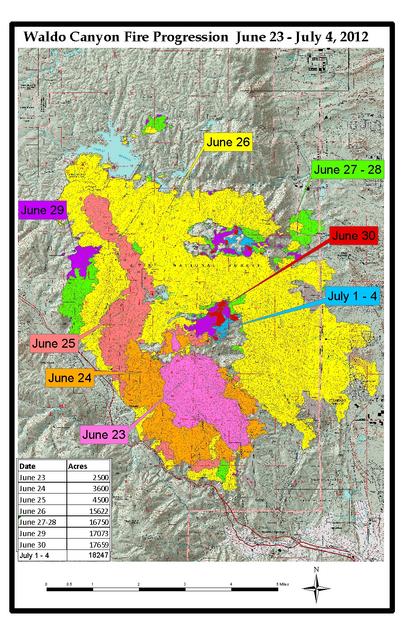
18,247 acres is a little more than 28 square miles of area burned. Think about a fire that consumes 28 square miles in your back yard. Pretty sobering.
Here’s a time lapse video that shows the fire from a distance.
The Denver Post has some of the best photos of the fire as it burned structures on the northwest side of Colorado Springs.
There were two major ham radio activities (that I am aware of) in response to the fire:
The RACES team (Special Communications Unit) attached to the El Paso County Sheriff’s office staffed the Emergency Operations Center in Colorado Springs. I did help out for one 12-hour shift, a relatively minor role.
Pikes Peak ARES supported the Red Cross, who operated the emergency shelters for ~32,000 people that had to evacuate their homes. The Pueblo newspaper ran an article about this.
The real heroes are the firefighters that battled the blaze, especially on that terrible Tuesday night when so many houses were lost. Those guys and gals are awesome!
- 73, Bob K0NR
How Not to Do a SOTA Activation
This weekend my wife and I were out exploring the San Juan Mountains near Ouray, Colorado. We found ourselves on a Jeep road to Engineer Pass. When we got to the pass, we stopped to have lunch and I examined the high peaks nearby. I saw some people on the summit of one of the peaks, which I determined was Engineer Mountain by looking at a topo map.
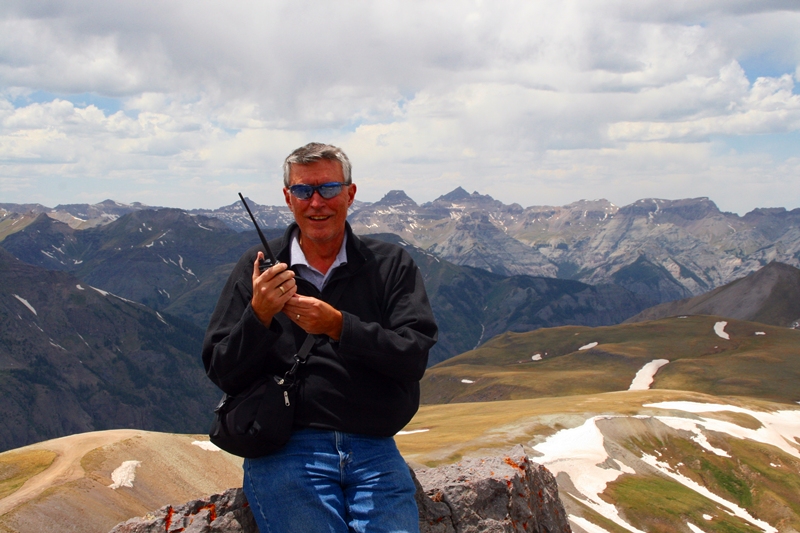
Hmmm, I said to myself, Engineer Mountain is a valid peak (W0/SJ-011, 12968 feet elevation) for a Summits On the Air (SOTA) activation. The only portable radio I had with me was a Yaesu VX-8GR with the stock rubber duck antenna. Not a great SOTA station. But if I could whistle up 4 contacts on 2M FM simplex, I would have a legitimate activation. We had already decided to climb to the summit, so any radio activity was just icing on the cake.
So off we went up the mountain. I got to the top and started calling on 146.52 MHz FM. Now it hits me that we are in the middle of a national forest, away from population centers and, to top it off, no one is expecting a SOTA activation here today. This might be a bit of a challenge to make 4 contacts. Then Thomas, KRØNK, answered my CQ. OK, there’s one contact. A little bit later Dave, AKØMR, comes on frequency and gives me a second contact. Both of these guys were in Grand Junction, CO, which is about 100 miles from Engineer Mountain. Not bad for a peanut-whistle HT using a standard rubber duck antenna.
I needed two more contacts. I tuned around for a repeater in the area and came across the 147.27 MHz machine which turned out to be a stones throw away from my location. It requires a CTCSS tone, so I fumbled around until I figured that out. No, I did not have a repeater directory with me…that was safely stored in the Jeep at the bottom of the mountain. I gave a quick call with my location and Ben WB5ITS came back to me. We QSY’d over to 146.52 to make my third contact. Anticipating a rough go of it, I asked my wife Joyce K0JJW to descend off the peak while I remained at the top, so she could be my fourth contact. (SOTA rules do not allow contacts between parties on the same peak.)
Somewhere along the way, I reach for a piece of paper to log the contacts, only to find that I did not have a writing utensil with me. Duh. I would have to remember the times and callsigns of the contacts and write them down later.
I completed the fourth contact and headed down. Later that evening I checked the ListsofJohn database and found that there are actually two peaks in the area called Engineer Mountain. Go figure. The SOTA database only recognizes one of them…of course, you guessed it, not the one I was on. It turns out that the Engineer Mountain I was on is subordinated by an adjacent peak: Darley Mountain (W0/RG-034, 13260 feet). However, since I operated from 13,218 feet on my Engineer Mountain, it is within the 75 foot vertical activation zone for Darley Mountain. So, this does count for a SOTA activation of Darley Mountain.
This is where I could claim that incredible skill, flexibility and a little luck ruled the day. I think a more appropriate analysis is to concede that a complete lack of planning and preparedness produced a marginal result.
What can we learn from this?
- Do your homework concerning the SOTA peak that you intend to activate before you start the climb. Make sure you know where it is and that you are really on it.
- Always keep a notepad and pen/ pencil in your backpack
- Even for casual hikes, take along a decent antenna for the HT. A half-wave vertical is way better than a stock rubber duck.
- Plan in advance so you can post your intended SOTA activation on sotawatch.org
- Have a repeater directory (or equivalent) available to identify repeaters in the area.
- And don’t forgot the normal hiking Ten Essentials
Beyond doing a SOTA activation, some of these items could be important if an emergency should occur. It runs out there was no mobile phone coverage in the area. I used to be pretty vigilant about taking an HT with spare batteries and extended antenna along on hikes but have gotten sloppy lately. See Rescue on Uncompahgre Peak, which describes an incident years ago when my radio turned out to be very useful during an emergency.
In the end, I did complete my first SOTA activation, so I can be happy about that. And it gave me the opportunity to relearn a few things about planning and being prepared.
73, Bob KØNR
P.S. The WØ SOTA guys recently created a great W0 SOTA page.
My Comments on FCC Proceeding 12-91
 At the direction of Congress, the FCC opened up Proceeding 12-91: COMMISSION SEEKS COMMENT ON EMERGENCY COMMUNICATIONS BY AMATEUR RADIO AND IMPEDIMENTS TO AMATEUR RADIO COMMUNICATIONS.
I decided to file my comments with the Commission, which can be read in full here. I’ll also provide the short version here:
1. The contributions of amateur radio operators during disasters and emergencies is substantial and well documented.
2. The key attributes that make the Amateur Radio Service so valuable in an emergency or disaster situation include the large number of trained operators available, the tendency for many amateur radio operators to prepare their stations for emergency operating conditions, the high degree of flexibility due to the wide range of spectrum and emission types available, and the ability of amateur radio operators to adapt to adverse operating conditions,
3. Restrictions from homeowners associations banning all external antennas is a serious and pervasive impediment to amateur radio emergency communications.
4. Limitations on emission type in Part 97 should be relaxed or eliminated.
5. There is the potential to improve the use of the Amateur Radio Service within the overall planning and organization of the federal government.
There are many different issues that could be highlighted but I decided to focus on these…with an emphasis on restrictive covenants.
What do you think? File your comments with the FCC here.
73, Bob K0NR
ARRL is doing a study
This came down from the leadership of Northern New Jersey ARES; but it should be of interest to anyone who is involved with Emergency Communications:
FYI…the info below comes from the ARRL’s EmComm and Regulatory offices and needs your thoughtful and timely input…the ARRL states:
“The FCC has released a Public Notice soliciting input for the Congressional directed study of Amateur Radio Emergency Communications and Impediments to the amateur’s ability to provide those communications. This is the ARRL-proposed study which we have been seeking for the last 3 years….”
The links below should help you with filing your comments and reports….thank you all in advance for you help in this and all EmComm related matters
Additional information is also on the ARRL Website:
http://www.arrl.org/news/fcc-seeks-public-comments-on-emergency-communications-by-amateur-radio-and-impediments-to-amateur-ra
and
http://www.arrl.org/ccr-study-information
If you have participated in an EmComm event or deployment since January 1, 2000, we ask you to provide specific information on the activation by completing this form by clicking here.
http://www.arrl.org/emergency-communications-response-actions
If you are affected the deed restrictions, HOAs, or CC&Rs, please complete this form by clicking here.
http://www.arrl.org/ccr-regulations
TIME IS OF THE ESSENCE! Congress directed that the FCC provide the report back within 180-days and that clock is already counting. The FCC is only accepting comments for a 45-day period, which will end May 17,2012. In order for the ARRL to collate your information in a common report, we ask that you send in your information no later than WEDNESDAY APRIL 25.
~~~~~~~~~~~~~~~~~~~~~~~~~~~~~~~~~~~~~~~~~~~~~~~~~~~~
I know a lot of you out there are involved in Public Service activities and communications, so please, if you have something to contribute, please do so!
72 de Larry W2LJ
QRP – When you care to send the very least!

LHS Show Notes #074
Introduction:
- They barely get the introductions done, and Richard is off on a tangent about the great hobo migration in Texas. All this just proves Larry Bushey of the Going Linux podcast is right: LHS rambles. More on this in a moment.
Announcements:
- Richard and Russ discuss a disparaging comment Mitt Romney made six years ago about ham radio operators. He’s since reversed his position, at least publicly.
- Larry Bushey says LHS rambles in episode 160 of the Going Linux podcast. You know, Larry, you’re right.

Topics:
- Terminal emulation programs for Linux.
- If you’re interested in running packet radio with your Linux computer, you’ll likely need a terminal emulation program to communicate with your terminal node controller(TNC). There are several Linux tools you can use:
- setserial is a command-line program designed to set and/or report the configuration information associated with a serial port.
- microcom is a very basic terminal emulation program. Tip: pressing Control-\ will access the menu.
- minicom is a menu-driven communications program. It emulates ANSI and VT102 terminals, has a dialing directory and auto zmodem download.
- At the command line, type “minicom -s” to begin configuration. The first time you run “minicom -s”, you’ll probably want to run it as root so you have write access to the configuration file.
- The first serial port in Linux is called ttyS0.
- Most things will work at 9600 baud, 8 data bits, no parity bit, and 1 stop bit.
- Text based modem control program.
- Runs in a terminal screen
- It’s useful for other serial port tasks, too.
- Ctrl-A followed by W turns on line wrap, so you won’t have long lines truncated.
- Install on a Debian-based system by using “apt-get install minicom” or use Synaptic.
- Press Ctrl-A then X to exit.
- GTK Term is a terminal emulator written with GTK+.
- Gets added to the launch menu during installation, but with the name “Serial Port Terminal”, not “GTK Term”.
- Has a nice looking interface.
- Easy access to the serial port settings.
- CuteCom is another graphical terminal emulator, with split input and output screens.
Feedback:
- Sean, AC0VD, writes about http://www.badgerbadgerbadger.com. Thanks, Sean. That’s pretty much where the whole badger thing on LHS began. Sean also likes the howto article Installing Linux on a Dead Badger.
- Ilan Rabinovich, of the Southern California Linux Expo, SCALE, sent a voice mail asking that we play promotions for the event. Unfortunately, we’re too late with releasing the LHS episodes to promote SCALE in time. We’ll try to do better next year.
- Richard has posted an article Making Yourself Clear on the Radio, and it received a couple of comments:
- Tim liked the article and agrees that talking slower helps.
- Lief, KC8RWR, notes that codes and ciphers are only prohibited when intended to hide the meaning of a transmission.
- We received a donation from Walter J. Thank you, Walter!
- John, KF6EFG, asks what was the open source podcast mentioned in a recent episode. We don’t remember, John, but it may have been any of these:
- ICQ podcast
- Tux Radar
- Linux Outlaws
- The Linux Link Tech Show (TLLTS)
- Going Linux
- Mintcast
- To answer the second part of John’s question, neither Russ nor Richard will be at the Indiana LinuxFest. If you would like to be the LHS ambassador there, please let us know.
- The Dalton Hamfest in Dalton, Georgia, will have an LHS ambassador on duty! Look for the LHS booth on February 25th, 2012.
- If you’d like your podcast included in the Black Sparrow Media empire, send us an email!
Contact Info:
- Contact Richard at [email protected], Russ at [email protected], or both at the same time at [email protected].
- Listen to the live stream every other Tuesday at 8:00pm Central time. Check the LHS web site for dates.
- Leave us a voice mail at 1-909-LHS-SHOW (1-909-547-7469), or record an introduction to the podcast.
- Sign up for the LHS mailing list.
- Sign up for the MAGNetcon mailing list.
- LHS merchandise is available at the Merch link on Web site. Check out the Badgerwear or buy one of the other LHS-branded items at PrintFection.com/lhs or Cafe Press. Thanks!
- Thanks to Dave from Gamma Leonis for the theme music.
Music:
- To be added.
2012 ARRL Field Day Information Packet Available
 ARRL Field Day is the single most popular on-the-air event held annually in the US and Canada. Each year over 35,000 amateurs gather with their clubs, friends or simply by themselves to operate.
The information packet for Field Day is now available on the ARRL web site.
- Bob K0NR