Posts Tagged ‘emcomm’
 Peoples is crazy!
 June 21st, 2013 |
  Author:
 When I was a kid, I vaguely remember a comedian on TV, who would say in a thick, mock German accent, “Peoples is crazy!” or something very similar to that. That line kept running through my mind tonight as I volunteered as a CERT member for South Plainfield Emergency Management at the South Plainfield High School graduation ceremony, held at the football field.

We provided a whole bunch of services. We directed people to parking spots, and as it was a hot day – we handed out cold bottled water to anyone who desired it, we provided “a presence” and kept our eyes peeled for anyone who looked like they might get ill or faint, or might otherwise need assistance.
By the end of the ceremony, 260 high school grads received their diplomas after many speeches, much cheering and screaming and hoopla.
The best came at the end of the night, though, as dusk was falling and the near full moon started to rise. On three separate occasions, I kept spectators from jumping over the chain link fence and running onto the football field to greet their graduates. In each case, I’m not talking about kids here. I am referring to older “Dad types” who should have known better than to attempt such a stunt. On each occasion, as the improbable was about to be tried, I simply but firmly stated, “Please go around to the gate and don’t jump over the fence.” The first two guys said nothing – and just complied.
The third guy? Oh, he was a good one. A rather snarky “And why should I listen to you?” was what I got for my request. Rather than argue, I just very politely asked, “Sir, do you really want your son or daughter to remember their high school graduation night as the time that Dad had to go to the Emergency Room to get stitches in his leg after he cut it while trying to jump the football field fence?” He looked at me, thought about it for half a second and went around to the gate.
Peoples is crazy!
72 de Larry W2LJ
QRP – When you care to send the very least!
Follow up – Saw my fence jumper today at the A&P – yep, the third guy. While I was shopping, he tapped me on the shoulder, shook my hand, and thanked me for preventing him from doing something “potentially very stupid”, as he put it. Sometimes it’s all worth it.
Trying a new template.
Not sure I like it; or will keep it, but it IS different from what I had. Is this template easier on the eyes? Some folks recently and privately commented to me that they didn’t like a white typeface against a dark background. Is this any better?
I joined my CERT group to aid South Plainfield with the running of the Holy Savior Academy 5K walk/run this morning. Luckily, I only had one obnoxious driver to deal with who couldn’t understand that the main roads were closed so that people wouldn’t be run over. “You actually expect me to park on this side street and walk a block to my house?”, I was asked. “Yes, sir”, I replied, “It’s for your protection as well as theirs.” He still huffed and puffed until he started getting unreasonable and a little belligerent, so at that point, I radioed for police assistance. They arrived and suddenly the light bulb went on over his noggin – he got the idea.
The thing that gets me is that not only is this an annual event; but it’s also very well publicized. Notice about it appears on the local cable channel. Sacred Heart Church, which loans out its parking lot for the epicenter of the event is by far the largest church in town. The notices for the “Family 5K Run/Walk” appears in their bulletin for weeks ahead of time. The local town paper published the details about the run/walk and the road closures the week before the event, also. The town puts it on their Website and their Facebook page. Don’t people read? Several of our CERT members suggested to our Director of Emergency Management that perhaps next year, on the night before the event, that we do an automated “reverse 911” call and telephone all the houses anywhere near the route that the roads will be closed. Oh, and by the way, the roads are closed for all of about an hour – 90 minutes tops!
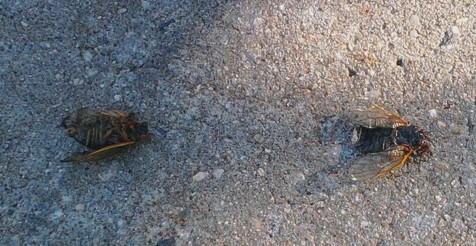
One of my Ham buddies, Marv K2VHW, who also lives in South Plainfield was at the event with me. He told me that his rain gauge had close to 4.5 inches (11 cm) of rain in it due to yesterday’s visit from Tropical Storm Andrea. Yesterday was definitely a soaker, and I’m willing to bet the cicadas weren’t too thrilled with it. I know that the tropical storm season does officially start with the end of May. I don’t recall us ever getting a visit by a named storm so early in the season. I hope it’s not a portent for things to come. Irene in 2011 and Sandy in 2012 were enough for me for a long, long time.
A Simple Wilderness Protocol: 146.52 MHz
 “The Wilderness Protocol” (ref. June 1996 QST, page 85), recommends that stations (fixed, portable or mobile) monitor the primary (and secondary if possible) frequency(s) every three hours starting at 7 AM local time, for five minutes (7:00-7:05 AM, 10:00-10:05 AM, etc.) Additionally, stations that have sufficient power resources should monitor for five minutes starting at the top of every hour, or even continuously.” The primary frequency is the National Simplex Calling Frequency…146.52 MHz. The secondary frequencies are 446.0, 223.5, 52.525 and 1294.5 MHz.
Here in Colorado, the summer months mean that many people head for the mountains. Mobile phone coverage has improved in many parts of the high country but is still not reliable in all areas. Amateur radio VHF/UHF repeater coverage is extensive but also does not cover the entire state.
The Wilderness Protocol is a good idea but is overly complex for practical use. Here’s my proposal to make it much simpler for practical backcountry use:
Principle #1: Don’t ever rely on a radio or mobile phone to get you out of trouble in the backcountry. Your primary strategy must be self-sufficiency. Avoid trouble. Be prepared for the unexpected.
Principle #2: Know what repeaters are available in your area. We have many wide coverage repeaters available but you need to know the frequency, offset and CTCSS tone (if any). The Colorado Connection is a linked repeater system that covers many remote parts of the state.
Principle #3: In remote areas, monitor 146.52 MHz as much as possible. This applies to backcountry travelers, mobile stations and fixed stations.
I’ve been making it a habit to monitor 146.52 MHz in the backcountry. I often come across hikers, campers, fisherman, 4WD enthusiasts, SOTA stations, mobile operators and others monitoring that frequency. It is fun to chat with other radio amateurs having fun in the mountains.
Just my opinion.
73, Bob K0NR
Note: This is a repost of an older article with minor edits.
GNT Shirts Now Available
The Committee to Preserve Golf November Tango is pleased to announce the availability of the new GNT Polo Shirt. The origins of the GNT frequency traces back to the incident when three ham radio operators found themselves stranded on the shore of Lake Michigan, calling out in desperation for Gin and Tonic. You may recall the unfortunate circumstances that caused confusion about the correct Golf November Tango calling frequency.
Fortunately, this has all been cleared up and The Committee has authorized the sale of the Golf November Tango shirt, with the official GNT frequency embroidered on it. (It seems that the group is really bad at documenting things, so they figured that if they all had a shirt with the frequency written on it, it could only help. See the logo shown to the left.)
These awesome polo shirts are available online in both mens and womens sizes at the Ham Radio Techwear store. The committee apologizes that these shirts are a little late for Christmas presents, but there is always next year.
Remember, when all else fails, make a call on the GNT Frequency.
73, Bob K0NR
Getting ready for the next one.
Sandy’s visit through the area has taught me a lot. I thought I was prepared; and for the most part, I was. But things can always be improved upon – some points for me to remember, that I think are worth sharing:
1) You can’t have enough ice. If you don’t have / want / or use an emergency generator, you can’t have enough ice. I bought four huge bags last Sunday, the day before the storm hit. I could have used twice that – and I should have been making my own, filling plastic containers with water and sticking them in the freezer. As it was, after the third day, I had begun to run out of ice and all the perishable items in the refrigerator had to be tossed.
2) Generators. Lots of folks purchased generators after their experience with Hurricane Irene last year. That was fine until the gas ran out, then they were in the same boat as me. Most of the gas stations around here had plenty of fuel, but also lacked the electricity they required to pump it. I have ordered an 1100 Watt AC inverter that was mentioned in SolderSmoke and I am going to purchase a couple deep cycle marine batteries and a charger. Once I start using them after a power outage they may not last for long, but at least I will be able to power up the freezer and refrigerator for a while.
Related to this – if you know that a big storm or blizzard is headed your way – gas up those vehicles! All of them! You don’t know how long gasoline might be in short supply afterwards. Go and Google “long New Jersey gas lines after Sandy” if you want a dose of stark reality.
3) Candles. You can never have too many. I thought I had an adequate supply; and I did. Our power was out for close to five days. If it had been out much longer, I would have started to reach the “uncomfortable zone” of running out. Oh, and if you’re like me, make sure your emergency candles are the unscented variety. It might have lifted someone else’s spirits; but I didn’t need the house smelling like a flower shop.
4) Flashlights. Forget the big honker ones that use “D” batteries. I bought some “D” batteries and flashlights, and they are a waste as far as “bang for the buck” goes. I have purchased two LED camping style lanterns that use four “D” batteries each and they will last a lot longer while providing tons more light than normal flashlights. For regular flashlight usage, get the small handheld LED flashlights. I had two of them and am going to get more. Each of these babies used three “AAA” batteries which are still plentiful in the stores (I mean really, most people use “AAA’s” for their remotes, right?). They were used throughout this crisis and they were as bright on the final day as the first. Also, those headband LED lights? Some may consider them “dorky”, but I am going to purchase a few. They will be invaluable for the times you have to do something in the dark that requires both hands. (I.E. – shaving on the morning darkness with one hand holding the safety razor and the other holding the flashlight was less than ideal. Trying to move ice around from cooler to freezer with one hand – less than ideal).
5) Firewood / Fire logs. I had a small supply left over from the last heating season. I should have laid in a bigger supply. I didn’t run out; but was running uncomfortably low, and it was starting to get chilly here. I would wake up in the morning, and go look at the thermostat to see that the house temperature had fallen to 56F (13C) overnight.
6) Charge up everything! All my handhelds, HF radio batteries, cell phones were charged to the max ahead of time, I also broke out my solar panel and had it ready to charge up 12V gel cells if needed as this wore on.
Food and water were no problem We had the stove top available for cooking. The electronic ignitors didn’t work; but kitchen matches did the job (I have multiple boxes of those). We had an AM / FM radio for news/entertainment. That was a necessity – however, I want to purchase one of those offered with the built in hand crank generator. This will cut down on the amount of batteries needed and many of these models also have USB ports so that you can use the hand crank generator to charge up your cell phone, kindle, Nook, Kobo, etc.
What did bother me when we would listen to the radio; and the announcers would say, “To report (such and such) please go to this Website ……..” How the heck am I supposed to go to the Internet when there’s no electricity? Also, going through my e-mails after the fact yesterday, I saw there were calls for ARES radio volunteers at the Middlesex County hospitals. The requests came via e-mails. How was I supposed to have seen those? I am one of the last persons in the world NOT to have a smartphone and my “18th century” cellphone handles e-mail, well, …… let’s just say “crappily”. Maybe that’s just a personal problem and I need to get “with it”. Not going to sweat that one for now.
The KX3 was invaluable and a God send – thank you Lord, for Elecraft! But seriously, any battery powered HF rig (PFR3, ATS, MTR, Yaesu FT-817, etc) is so essential if for nothing more than to ward off boredom. I would come home after work, eat dinner and then ………. nothing. Too early to turn in, I took afore mentioned LED flashlight and headed down to the basement shack and spent the night on the bands. I worked a fair amount of DX and even had a QSO with DL3GA who commented that “It is nice to hear a station on the air from New Jersey”. Hey, how many times have you heard THAT before? Maybe, never? (LOL!)
But I was also able to keep in touch with a lot of my QRP friends, including Jim W1PID who would check in with me every night. Just those brief, continual QSOs did a lot to improve my psyche and moral, knowing that there were folks out there that I personally knew that I could stay in touch with.
This is by no means an exhaustive treatise on being prepared for an emergency – it was one of some personal observations. But do yourself a favor. If you’re given enough notice that a big storm / blizzard / whatever, is coming your way – get ready and try not to wait until the very last moment to do so!
72 de Larry W2LJ
QRP – When you care to send the very least!

Can I Use My Ham Radio on Public Safety Frequencies?
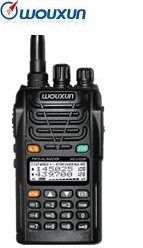 We have quite a few licensed radio amateurs that are members of public safety agencies, including fire departments, law enforcement agencies and search and rescue. Since they are authorized users of those public safety channels, they often ask this question:
Can I use my VHF/UHF ham radio on the fire, police or SAR channel?
It is widely known that many amateur radios can be modified to transmit outside the ham bands. The answer to this question used to be that amateur radio equipment cannot be used legally on public safety channels because it is not approved for use under Part 90 of the FCC Rules. (Part 90 covers the Private Land Mobile Radio Services.) The only option was to buy a commercial radio with Part 90 approval and a frequency range that covered the desired amateur band. Some commercial radios tune easily to the adjacent ham band but some do not. The commercial gear is usually two to three times as expensive as the amateur gear, and just as important, does not have the features and controls that ham operators expect. Usually, the commercial radios do not have a VFO and are completely channelized, typically changeable only with the required programming software.
The situation has changed dramatically in the past two years. Several wireless manufacturers in China (Wouxun, Baofeng, etc.) have introduced low cost handheld transceivers into the US amateur market that are approved for Part 90 use. These radios offer keypad frequency entry and all of the usual features of a ham radio. It seems that these radios are a viable option for dual use: public safety and amateur radio.
Here is a short list of the most common radios on the market:
| Model | Features | Price |
| Wouxun KG-UV2D, KG-UV3D | Several different models with slight variation in features, check carefully before ordering 136-174/420-470 MHz 5 kHz is smallest frequency step | $120 |
| Wouxun KG-UV6D | Several different models with slight variation in features, check carefully before ordering 136-174 / 420-520 MHz 2.5 kHz frequency step | $175 |
| Baofeng UV-5R, UV-5RC | The UV-5RC is an updated case style 136-174 / 400-480MHz 2.5 kHz frequency step | $65 |
Some Things to Consider When Buying These Radios
- The manufacturers offer several different radios under the same model number. Also, they are improving the radios every few months with firmware changes and feature updates. This causes confusion in the marketplace, so buy carefully.
- Make sure the vendor selling the radio indicates that the radio is approved for Part 90 use. I have seen some radios show up in the US without an FCC Part 90 label.
- Make sure the radio is specified to tune to the channels that you need.
- The 2.5-kHz tuning step is required for some public safety channels. Your particular set of frequencies may or may not need it. For example, a 5-kHz frequency step can be used to select frequencies such as 155.1600 MHz and 154.2650 MHz. However, a 2.5 kHz step size is needed to select frequencies such as 155.7525 MHz. There are a number of Public Safety Interoperability Channels that require the 2.5-kHz step (e.g., VCALL10 155.7525 MHz, VCALL11 151.1375 MHz, VFIRE24 154.2725). The safest thing to do for public safety use is to get a radio that tunes the 2.5-kHz steps.
- Although these radios have two frequencies in the display, they only have one receiver, which scans back and forth between the two selected frequencies. This can be confusing when the radio locks onto a signal on one of the frequencies and ignores the other.
Recommendation
I own 3 different models of Wouxun radios and two Baofeng UV-5R radios. I think they are all great radios for what they do. For serious public safety use, I would recommend getting the Wouxun KG-UV6D with the 2.5-kHz frequency step. The controls of the Wouxun are superior, including a knob for channel/VFO selection and RPT key for changing repeater shift. The Wouxun software works much better than Baofeng’s (which is really a mess). Also, if you show up at an incident with the Baofeng, your fellow first responders will think it is a toy. If you are absolutely sure you don’t need the 2.5-KHz frequency step, then you might consider one of the other Wouxun models.
I have purchased several radios from importcommunications.com and have been very satisfied with the service. You may want to shop around for the best price.
73, Bob K0NR
FCC Says “What Restrictive Covenant Problem?”
From the ARRL web site:
On August 20 — in response to a Spring 2012 Congressional directive — the Federal Communications Commission released its findings on the Uses and Capabilities of Amateur Radio Service Communications in Emergencies and Disaster Relief: Report to Congress Pursuant to Section 6414 of the Middle Class Tax Relief and Job Creation Act of 2012.
There was hope that the thousands of comments from amateur radio operators concerning the restrictions that homeowners associations place on the use of antennas would get the FCC’s attention. Maybe the FCC would see that the overall effectiveness of the amateur radio service for emergency use is being limited by these arbitrary, overly restrictive rules? (See a summary of my comments here.)
But, the FCC responded with this simple statement:
Moreover, while commenters suggest that private land use restrictions have become more common, our review of the record does not indicate that amateur operators are unable to find homes that are not subject to such restrictions. Therefore, at this time, we do not see a compelling reason for the Commission to revisit its previous determinations that preemption should not be expanded to CC&Rs.
I am not surprised by this response but still disappointed.
73, Bob K0NR