Posts Tagged ‘Contests’
 ARRL DX CW 2019 in the books
 February 18th, 2019 |
  Author:
  |
| The setup |
As for the contest I was running 60 watts (not sure of reason for the 60 watt number) and my antenna is the MFJ 1788 mag loop. I am in a condo so it’s a balcony antenna about 180 feet up facing south east. The software was N1MM+ and MRP40 CW decoder for the super fast fisted contesters. On Sunday the winds for some reason really picked up and my MFJ loop was moving around the balcony. I shut the radio down and took it in I would rather save the antenna from damage than taking a chance on getting more contacts.
I made only 25 contact and a score of 1575 BUT my intention was not to blow the doors off with a great score. Instead after I made contact with a station I would look them up on QRZ.COM and read about either the individual or the contest station. Over all the limited time I was in the contest I had a blast and was very please with the Icom 7610 and the ability of my balcony mounted Mag loop antenna.
Genesee Mountain: SOTA and VHF Contest

For the ARRL January VHF contest, I did a combination Summits On The Air (SOTA) and contest entry. I am recovering from a knee injury so Genesee Mountain (W0C/FR-194) turned out to be a nice easy hike for me. Of course, Joyce/K0JJW joined me and also did a SOTA activation. Caleb/W4XEN came along with us and activated the summit for SOTA using the HF bands. Finally, Brad/WA6MM showed up on the summit for a social visit.

To get to the Genesee Mountain, go west on I-70 from Denver, take Exit 254 to the south. Turn right onto Genesee Mountain Road and head into Genesee Mountain Park. There is an extensive trail system in the park and several different ways to reach the summit of Genesee Mountain. In fact, if the gate is open, you can drive right to the summit. The route we took starts at a parking area that is always open. With only a 0.7 mile hike (300 feet vertical), this is an easy and highly-recommended trail.
Leaving the parking area going uphill, we soon encountered the Genesee Mountain Trail which we followed to the left. Later we transitioned to the Genesee Summit Trail, which goes to the summit. Both of these are well marked but you need to make sure you catch the “summit” trail.


We took more than the usual set of equipment for this activation so that we could cover the 6m, 2m, 1.25m and 70cm bands. For FM, we set up a Yaesu FT-90 2m/70cm transceiver with a ladder-line J-pole hanging from a rope in a tree. This omnidirectional antenna does not have any gain but I figured that for FM it would be most efficient to not mess with having to point a yagi antenna. For 2m and 70cm ssb/cw, I used a Yaesu FT-817 driving an Arrow II dualband antenna. The FT-817 also handled the 6m band, driving an end-fed half-wave wire antenna supported by a fishing pole (HF SOTA style). For the 1.25m band, I just used an Alinco handheld radio.

Genesee Mountain is a popular SOTA summit because it is so easy to access but still provides a good outdoor experience. We encountered a dozen of so hikers and mountainbikers on the summit and it can be very busy during a summer weekend. The summit is wide and flat with plenty of room to set up a portable station. For VHF, it has an excellent radio horizon to the front range cities.

Joyce made 14 contacts on 2m and 70cm FM. I made 52 QSOs, as shown in the table below. SSB activity was relatively light considering it was a VHF contest weekend. I was pleased to work Jay/W9RM in DM58 on 2m SSB at a distance of 167 miles. W9RM is on the other end of the state with many mountains blocking the path. I also worked Jim/WD0BQM in Mitchell, NE (DN81) on 2m CW, at a distance of 175 miles. VHF is not limited to line of sight!
    Band   Mode  QSOs     Pts  Grd
      50  USB      5       5    2
     144  CW       1       1    1
     144  FM      19      19    2
     144  USB      7       7    2
     222  FM       3       3    1
     432  FM      15      30    2
     432  USB      2       4    1
   Total          52      69   11
        Score : 759
We had a great day on the summit, operating for just under 4 hours (with lots of breaks along the way). Thanks to Caleb/W4XEN and Brad/WA6MM for joining the fun. If you are looking for your first or an easy SOTA activation, give Genesee a try.
73 Bob K0NR
The post Genesee Mountain: SOTA and VHF Contest appeared first on The KØNR Radio Site.
RAC contest and the new IC7610

 |
| Won't make that mistake agian. |
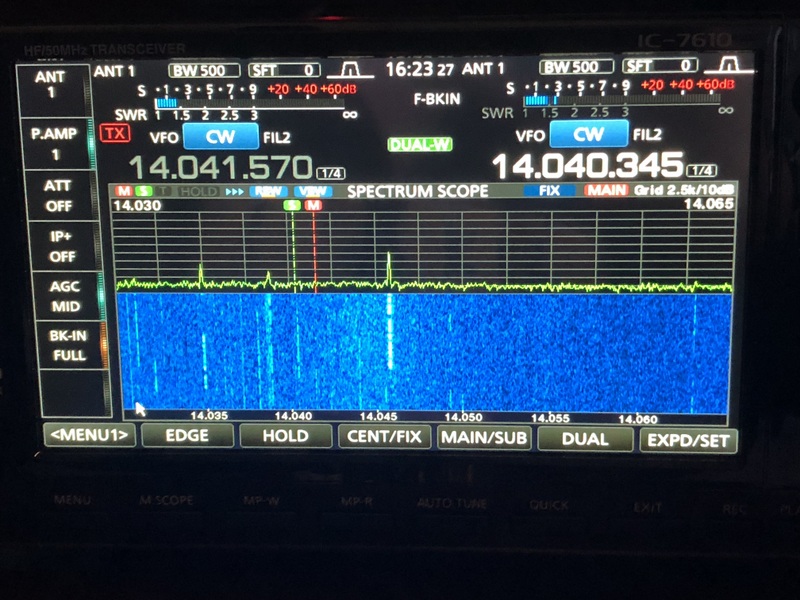
I was thrilled with the Icom 7610 I didn't as of yet get the time to set up N1MM+ contest software so during the contest I was old school with a paper and pencil. The audio was crisp and clean, I stayed with the 250Hz filter and had not even one issue with very close adjacent stations bothering my contact station. The touch screen is very responsive and an absolute joy to use. I took advantage of the 2 independent receivers, I turned on dual watch and had one VFO on an RAC station such as VE7RAC who was very popular and the other VFO I search and pounced. With one simple button push I muted the VE7RAC station and could unmute to check on the pileup. Once things slowed down I was able to put VE7RAC in the log.
 |
| Dual Watch on |
Phone Contesting Tips For DX Contests (AE6Y)
Proper use of a phonetic alphabet can be very helpful when working phone under marginal conditions. I’ve written a basic article on phonetics over at HamRadioSchool.com, so you might want to review that. I recently came across an article by Andy/AE6Y on some tips and tricks to use during contests. He does a super job of explaining why the ITU phonetic alphabet isn’t always the best choice. I don’t usually reprint other author’s work on this blog but somehow this article really got my attention. Reprinted here with permission. – Bob K0NR
Phone Contesting Tips For DX Contests
Andy Faber, AE6Y
3/29/18
This article is prompted by the recent WPX SSB contest, in which I worked thousands of guys from Aruba as P49Y, which engendered much reflection (and teeth-gnashing, to be sure) about how U.S. hams can be best understood from the DX end. I’m not addressing this to relatively clear-channel domestic contests but to the situation where you are trying to get through to a DX station that may be hearing a pileup, plus noise, ear-splitting splatter from adjacent stations and all of the other sonic annoyances that make many contesters prefer CW. If there is no pileup and you know the DX station can hear you completely clearly, then you’ll get through regardless, but if not, here are some suggestions:
First, be sure you are calling on his exact frequency. In CW contests, it can be helpful to separate yourself from the pack by calling off frequency, but that’s not true in SSB. Off-frequency stations sound distorted and are hard to understand. The DX station may well come back to a weaker, but more intelligible station that is on frequency, even if you are louder. In order to work you, he has to figure out which way to adjust the RIT, and then go ahead and do it. A tired operator on the other end may just not bother, until he has worked everyone else.
Second, make sure your audio is clean. It is so much easier to understand clear audio, even if it is weaker than a louder, distorted signal. KH7XS mentioned in his 3830 posting that this year there particularly seemed to be over-processed signals coming from South America, and I noticed the same thing. It used to be that the Italians who were the worst offenders, but they seem to be better now. This weekend, the Cubans were particularly hard to understand. The prize for the easiest audio to understand goes each contest to the hams from the British Isles. The G’s, M’s and their derivatives invariably have very clean (and usually nicely treble) audio that can be understood even when the signal doesn’t budge the S-meter. On several occasions I chose a weak but clear Brit over a loud, but distorted, competitor.
Ok, so you have a clean signal and are calling on frequency, now how do you get the information through, both your callsign and your contact number (for WPX)?
Here are some tips:
If you are loud enough and have an easily recognizable call, you can skip phonetics. So this weekend, when K1AR called, he was easy to pick out, same for K3UA, K3ZO, N6AA, and a few others. But for most guys, and when in doubt, use phonetics. Endless bandwidth has been expended on the subject of phonetics, and people have differing opinions on the topic, but here are my thoughts from being on the DX end:
The first thing to understand is that the standard, “recommended” international alphabet works dismally in marginal conditions. The words are too short, and some don’t have unique sounds. Generally speaking, the one-syllable words just get lost, while the two syllable words are better, and the longer ones are even better.
Thus, one-syllable words like “Fox”, “Golf” and “Mike” are horrible. Some of the two-syllable ones are OK (e.g., “Hotel” and “Quebec”), but others, such as “Alpha” and “Delta”, or “X-ray” and “Echo”, “Kilo” and “Tango” sound very similar, so are easily confused. I worked a guy with the suffix XXE, and had to get a number of repeats until he finally said “X-Ray X-ray Ecuador,” which did the trick.
There are two basic cures for these problems. The first is only to use these crummy phonetics the first time as a trial. If the DX station asks for a repeat, say your call twice, once with the standard phonetics and once with different ones. Don’t just keep repeating your call the same way. Something in either the way you say it or the way the DX hears it is creating ambiguity. If you keep repeating the call the same way it may well be that part of it is just hard to decipher, and it may not get any easier.
If the DX station is a good English speaker then custom phonetics may work, such as “King George Six…” In fact when I thought a KK4 station was a K4, he used a very effective phonetic, “King Kong Four…” WA2JQK uses “Jack Queen King” in domestic contests, but that won’t work well for non-native speakers. The Wyoming station N7MZW uses “Many Zebras Walking” sometimes domestically, but I noticed he was using normal phonetics in WPX.
The second approach is to switch to the geographical phonetic alphabet. This features longer and more distinctive-sounding words, which are much easier to understand. For example if your suffix is, say, HLF, then you can say “Hotel Lima Fox,” then try “Honolulu London Florida.” When I give my call with last letter “Yankee” and get asked for a repeat it works much better to say “Last letter Yankee, last letter Yokohama.” Many of the geographic phonetics work particularly well for speakers of Romance languages like Spanish and Italian (e.g., terms like “Guatemala”, “Nicaragua”, and “Santiago”). There are a few letters for which there are not good geographic equivalents. Obviously, “X-ray” is one of them. For “Echo”, “England” is sometimes used, but “Ecuador” is better. Although “London” and “Lima” are both geographic terms, “London” is much better. And “Denmark Mexico” is many times superior to “Delta Mike.”
Numbers in the callsign can also cause trouble. What if the station comes back to “K3” instead of “K6”? In general, just try to repeat the number, but if he still doesn’t get it, you can try counting, e.g. “Kilo Six, 1, 2, 3, 4, 5, 6.” Or for us West Coasters, “Kilo Six in California, West Coast” can be useful.
Which brings me to the subject of numbers in exchanges like WPX. I commented in a 3830 post a few years ago that the English numbers that everyone uses are just too ambiguous, most of them being plain too short. I recommended using some Spanish numbers, like “cuatro” and “ocho”, but that suggestion went nowhere, so I hereby drop it, unless you are trying to get through to a native Spanish or Italian speaker. In fact, In WPX, I just couldn’t understand a number from a CO8 station with terrible audio. I kept asking, “your number 424?”, “your number 242?”, “your number 224”, etc. Normally, one doesn’t confuse “two” and “four,” but this guy’s audio was driving me crazy and I wasn’t sure how well he was understanding me either. Finally I had the presence of mind to ask in Spanish, and when he said “dos cuatro cuatro,” he was in the log. If he had said that in the beginning I would have understood him in spite of his maladjusted audio.
One source of confusion for the DX station is not knowing how many digits there are, particularly later in the contest when a number can have 1, 2, 3, or 4 digits. There are a couple of ways to help. For example: suppose the DX station thinks he hears “[garble] six six” and he asks: ”your number six six?” If your number is just 6, you can say to be helpful “Negative. My number zero zero six, number six.” Adding the word “number” in front of the digit indicates there are no missing digits. If your number is 66, just say “Roger, roger.” If it’s 56, say “Negative, number five six, fifty–six.” If it’s 256, say, “Negative. Number two five six, two fifty-six (or even “two hundred and fifty-six”). I know we were taught that it is incorrect to say “two hundred and fifty-six,” and we should just say “two hundred fifty-six,” but using the “and” makes it more intelligible.
In general, it’s usually best to say your number twice, in two different ways. For example it’s often hard to discern, “two three” from “three three”. So you can say: “five nine, two three, twenty-three,” since “twenty” and “thirty” sound very different. Similarly if your number is 15 and you say “one five”, that might be confused with “one nine”, so say “one five, fifteen.” If it’s late in the contest and you might be expected to have a three-digit number you can say “zero two three, only twenty-three”. And if you have a one digit number late in the contest, it’s best to add zeros, saying, e.g., “zero zero nine, number nine”, not just “nine.”
I hope these tips from the DX end are helpful. They should be even more useful in the next few years, as declining sunspots forcing us increasingly into the QRM alleys of 20 and 40 meters.
The post Phone Contesting Tips For DX Contests (AE6Y) appeared first on The KØNR Radio Site.
ETH096 – School Club Roundup, Hamvention Update and More…Everything Ham Radio
Hello everybody! In this episode of the Everything Ham Radio Podcast, I am stuck by myself talk to yall. I unfortunately didn’t remember that I my next scheduled update was due until 4pm the day before. So I worked all afternoon, while at work, trying to figure out what I was going to talk about. When I got off work at midnight, I ran home and did my couple honey-dos and then went straight to recording the episode.
So what is in this episode?
First off, I made a mistake! Yea, I know, nobody is suppose to make mistakes right? Well, in my last episode I did. In last episode, my semi regular co-host Ian KM4IK and were talking about the big stink that was doing on with some things that the ARRL Board of Directors were going to be voting on. Neither one of us were really up to speed on the whole thing as much as we should be, but we did our best, and we even said that we weren’t. However, after the episode I did receive multiple emails saying that I said something wrong, so I corrected it in this episode.
With that out of the way, I went on to talk about an upcoming event called the School Club Roundup. It is this month only a few days away actually. The event run February 12-16, 2018. It is an event that is geared for school amateur radio clubs to get on the air and make some contacts. Even if you are not in a school club though you can still get on the air and make contact with the school clubs that are on the air and help them make the points.
After that, I moved on to Hamvention. Another correction from last episode. Well I say correction, this time it wasn’t me though. In last episode we talked about how a new building was going to be built and available by this Hamvention. However, this week, the Hamvention committee released that it wouldn’t be started on until later in the year due to a material shortage.
I wrap up the episode reading some emails that I have received over the past few weeks. The last episode of 2017, I told yall what my plans were for 2018 and asked what some of yalls were and also asked some questions about what were yalls opinions on how my show is. I got a few responses, wish I would’ve had more though.
Until Next Time Yall…
73 de Curtis, K5CLM
Everything Ham radio podcast Ep 93 – NASA On The Air(NOTA)

I’m sure that you have heard of NPOTA, National Parks On The Air, and SOTA, Summits On The Air, and probably even POTA, Parks On The Air, The US program for the World Wide Flora and Fauna, but have you heard of the latest event that starts on Sunday, Dec 11, 2017?
Starting at 0000 UTC time on December 11, 2017 the new year long event celebrating multiple anniversaries for the NASA program will start. It is called NOTA or NASA On The Air.
With several NASA clubs doing several special event stations of the coming year, they decided to make a year long event where you, as the end user, can contact the stations to earn points through the year. You can even gets points during other events like Winter Field Day, the ARRL Field Day and others.
Losten to my latest podcast episode where I talk with Rob Suggs about it:
Update: Propagation Forecasts for CQ WW (SSB and CW) DX Contest Weekends
Are you participating in this year’s CQ World-Wide DX Contest, either the SSB weekend (this coming weekend, October 28-29, 2017), or the CW weekend (November 25-26, 2017)? The CQ WW is the largest Amateur Radio competition in the world. Over 35,000 participants take to the airwaves on the last weekend of October (SSB) and November (CW) with the goal of making as many contacts with as many different DXCC entities and CQ Zones as possible.

Space Weather and Radio Propagation
I have updated my forecast on the expected propagation conditions during both the SSB and CW weekends of the 2017 CQ World-Wide DX Contest. I will publish a new update for the CW weekend, when we get closer to that November weekend.
The link to the latest update is: http://cqnewsroom.blogspot.com/2017/10/cqww-dx-contest-propagation-update.html
Good luck!
73 de NW7US dit dit













