Posts Tagged ‘Contests’
 Talking JT Modes with Ria Jairam, N2RJ – ETH085
 September 7th, 2017 |
  Author:
In this episode of the Everything Ham Radio Podcast, we talk again with Ria Jairam, N2RJ. This time we are talking about the different JT Modes, JT65, JT9 and the new FT8!
We talk about its uses, how to operate and what you need to operate the different modes.
Check out the show notes to listen to the episode as well as get links to all the different things that we talk about at:
System Fusion DR-2X Repeater, Solar Eclipse and More – ETH079

In this episode we talk about the Yaesu System Fusion DR-2X repeater, the upcoming Solar Eclipse and more.
There is some interesting new features on the DR-2X repeater over the DR-1X that came out a couple years ago, but there is also something that it doesn’t have. Some of these features, I wish that we had on our club repeater, but those features are not enough for us to go out and buy this version.
There are a lot of special event stations that are going to be on the air around August 21st this year when the full solar eclipse occurs. This is the first time since 1918 that a full solar eclipse has gone from one side of the US to the other. I unfortunately am to far south to the see the full eclipse, but I should get about a 75% one here in the DFW area.
We also talk about some other stuff, but you are going to have to check out the show notes and listen to the episode to find out what that is.
73s de Curtis, K5CLM
2017 June VHF Contest (K0NR)
 Last weekend, I was able to participate in the ARRL June VHF Contest, my favorite ham radio operating event. I thought conditions were pretty good…mostly I am satisfied if we have some decent sporadic-e propagation on 50 MHz, which we did. Once again, I entered in the Single Operator – 3 Band category with a claimed score of 34,969.
This is the first contest where I used WSJT modes and was successful but certainly not highly skilled. I know I blew a couple of MS144 contacts due to operator error on my part. As I prepared for the contest, I was really focused on getting the computer/radio connections sorted out in advance, which I did accomplish. I made some JT65 and MSK144 contacts a few days ahead of the contest, so I was good to go. The issue that I totally missed was thinking through the operating position so that I could switch modes/bands easily. Instead, I had lots of cable plugging and unplugging as I moved things around. More to learn and improve on next time.
K0NR Single Op - 3 Band
Band QSOs Mults
-------------------
 6:   254 110
 2:    29 10
 222:
 432:   3 1
-------------------
Total: 286 121
Total Score = 34,969
I made a dozen JT65 QSOs, all on the 6 meter band. These contacts were with very weak signals so I probably would have missed them on SSB. I have concluded that the main purpose of JT65 is to give bored operators something to fiddle with when band conditions are poor. It always seemed like there was just enough signal present for me to keep trying, sometimes with success, sometimes not.
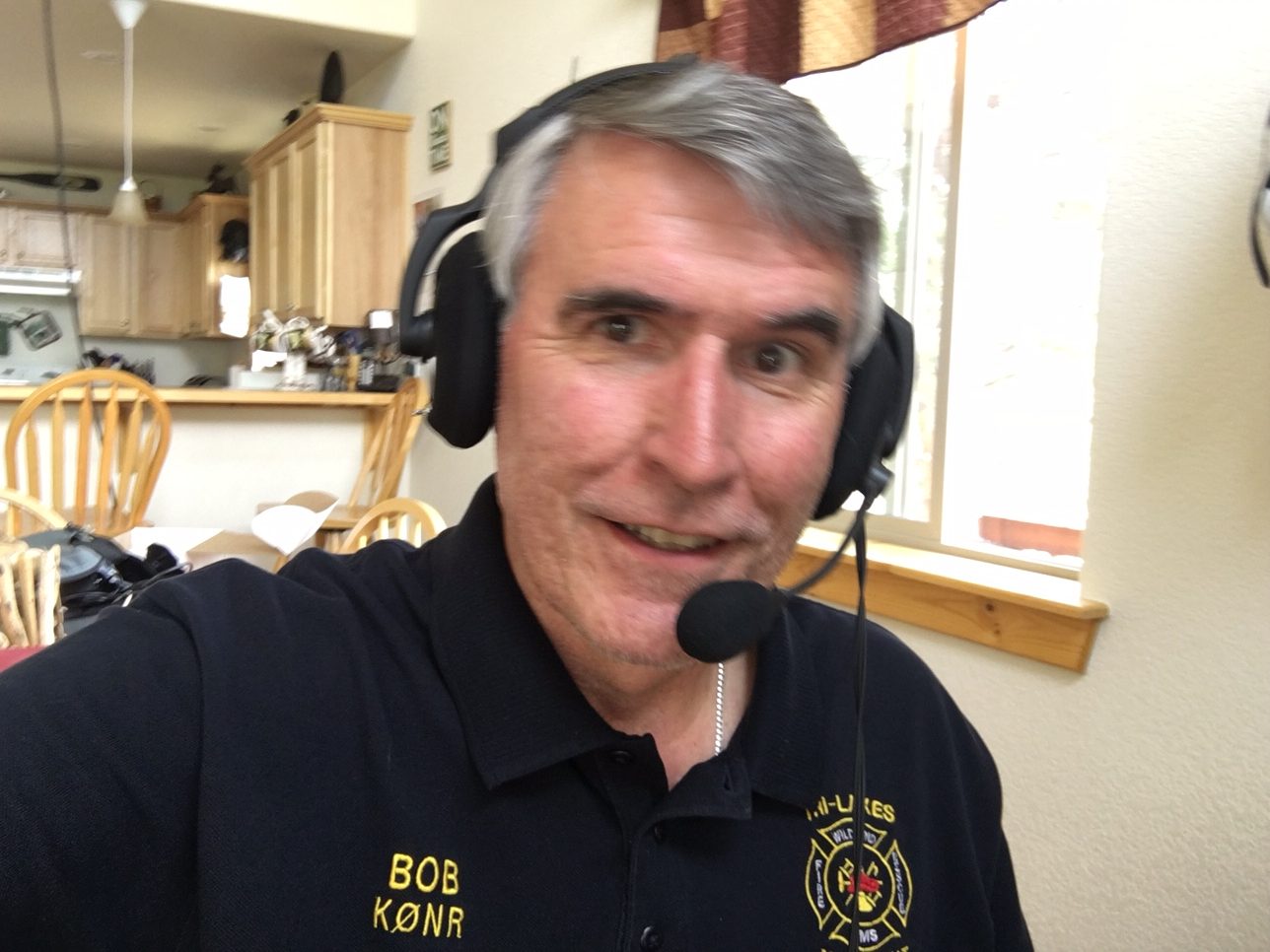 I was very pleased to work K5QE for my first 2m meteor scatter QSO (MSK144). My intent is to spend more time with this mode in the coming year and focus on chasing grids on 2 meters.
I looked back at my previous scores in the 3-band category. My best score (48,117) was back in 2013, the first year there was a 3-band category. Looking back at my blog posting from that year, at the time I didn’t think the band conditions were very good. I also came across this article by W0VG which indicates that stations from Colorado scored pretty well that year compared to other parts of the country. The results article in QST for that contest provides more detail.
So maybe propagation wasn’t that great this year after all. At least not in Colorado. (The DX spotting map looked really good in the eastern side of the US.) But I’ll go back to my earlier statement that any June VHF contest with some decent sporadic-e propagation on 50 MHz is a win.
Thanks to everyone that came out and played radio on the VHF bands.
73, Bob K0NR
The post 2017 June VHF Contest (K0NR) appeared first on The KØNR Radio Site.
Field Day 2017 with Ian Kahn, KM4IK – ETH071
 The biggest hamfest is over, but the biggest ham radio on the air event is quickly approaching! Yes I am talking about Field Day 2017! Back in episode 67, I had Ian on and we talked about PSK31. During that interview he mentioned that he was the Field Day Chair for his radio club, the North Fulton Amateur Radio League, so I asked him to come back and talk to us about Field Day.
We had a great conversation about what Field Day is, some general information about it, what its like to be the Field Day Chairperson and be in charge of planning the event for your club and wrap it up with things that his club does during Field Day and what goes on afterwards.
Check out the show notes of this episode for more information about things that we talk about, links that we mention and probably some that we didn’t. The show notes can be found at:
Pursue Radio Operating Goals
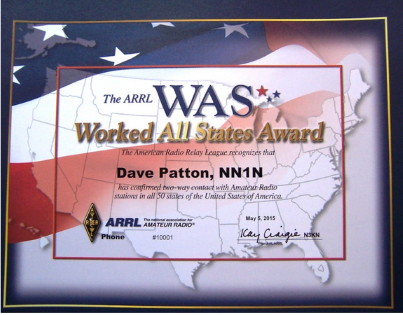 Operating goals or awards are a fun way to keep focused on accomplishing something via ham radio. Really, it’s a specific reason to get on the air and make radio contacts. I am not big on idle chit chat via the radio (“the weather here is 65 deg and raining”) so having a reason to make contacts helps me get on the air. I’ve tended to pursue awards in a serial manner…once I hit some level of accomplishment, I usually declare victory and move on to something else.
Way back in the wayback machine, the first award I pursued was Worked All States (WAS). It does take some effort but I was pretty active on the HF bands at the time, so many of the states just showed up in my log. But to really drive it home, I kept track of which states I still needed and actively looked for opportunities to work them.
Next up was Worked All Continents (WAC), which obviously requires working some DX. But then I decided that if I was going to have any DX cred at all, I needed to get DX Century Club (DXCC). This turned out to be a bit of a challenge with my modest station (100 watts and a dipole) but I found that working DX contests to be very helpful. The big hassle was collecting the QSL cards and getting them checked by the ARRL (back before the Logbook of the World days). Once I checked the box on DXCC at just over 100 countries, I was satisfied and went on to other things. Serious DXers chase all available countries/entities to get Honor Roll and other bragging rights.
The VHF and higher bands have always been a passion for me, so I pursued the VHF/UHF Century Club (VUCC) awards. First, it was 6 meter VUCC, the easiest one to get. A really good run during the ARRL June VHF contest can produce the 100 grids you need for the award in one weekend. For me, it took a few more contests than that after factoring in the fallout that occurs when trying to get confirmation QSLs. The 10 GHz VUCC only requires 5 grids which turned out to be not too difficult. My VHF collaborator at the time, Doug W0AH (now W4LY) and I took turns operating from Pikes Peak while the other guy went out and activated the required 5 grids. It helps to have a big honkin’ mountain nearby to use for 10 GHz operating. About this time, I got into working the LEO satellites and worked the required 100 grids for satellite VUCC. I don’t have very many grids confirmed on 2 meters, so that one is still calling to me.
Recently, I spent some effort going for the CQ WPX Award (worked prefixes award). This is an intriguing award structure because every new callsign prefix counts as a new one. For the basic mixed-mode award, you need to work at least 400 different callsign prefixes. I found this format to be a lot of fun because “everyone is DX” so to speak, but DX prefixes are also very valuable. The same approach is used for the WPX contests, which naturally brings out stations with less common callsign prefixes. A big motivator for me was when the ARRL announced Logbook of the World (LoTW) support for the CQ WPX awards. I mean, there was no way I was going to collect 400 QSL cards to submit for this award, but using LoTW made this very efficient. More on that story here: CQ WPX, LoTW and the End of QSL Cards.
Summits On The Air
Lately, I’ve been active in the Summits On The Air (SOTA) program, both activating and chasing summits. This is a natural fit for me as I’ve enjoyed mountaintop operating in various forms, mostly on VHF and UHF. (See my SOTA blog postings.) The SOTA program has a wide variety of awards, supported by a very powerful database used to record SOTA radio contacts and keep track of the scores. It is not really a competition but there is friendly rivalry between SOTA enthusiasts as they monitor each other’s posted scores.
I’ve been using VHF (and UHF) exclusively for SOTA and managed to qualify for the Shack Sloth Award using just those bands. (Shack Sloth is achieved with 1000 chaser points.) Shack Sloth is a bit of a misnomer for me as many of my SOTA chasing contacts were done while hiking, mobile or portable (not sitting at home in a shack). The Mountain Goat Award is taking a bit longer because I have to drag myself up enough summits to reach 1000 points as a summit activator.
Here’s the current scores for the Colorado (W0C) SOTA activators:
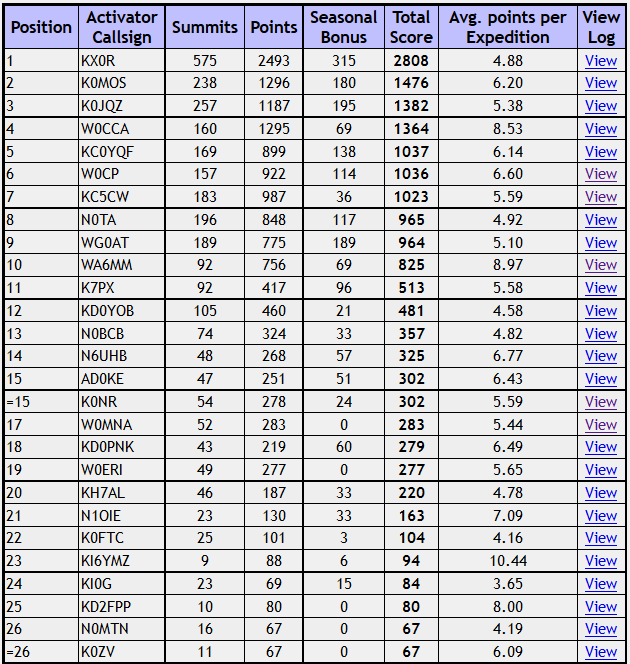 At the top of the list, we find Carey KX0R totally killing it with 2808 points. These folks have all reached the coveted Mountain Goat status: KX0R, K0MOS, K0JQZ, W0CCA, KC0YQF, W0CP, KC5CW. I am further down the list, tied with AD0KE at 302 points. Now, remember this is not a competition
  Honestly, I wish I were further along the path to Mountain Goat but I’ve decided to keep at it and enjoy the journey. Walt W0CP recently gave me some excellent advice: just keep making progress.
Other Goals
You may not find the awards and goals I’ve mentioned to be very interesting, but there are many other options. In 2016, the ARRL sponsored the National Parks On The Air (NPOTA) program, which created a lot of interest and activity. I did just three activations for NPOTA but many people really got into it.
You might also set your own personal goal, not associated with any award. I know one ham that decided his goal was to make a ham radio contact every day of the entire year. This sounds simple but if you have a full-time job and other responsibilities, it takes some persistence to make this happen. Perhaps you are public service oriented; you might set a goal for the number of ARES events you support this year. I challenge you to think about what it is you are trying to do with ham radio and set a goal that is consistent with that.
Those are my thoughts, what do you think?
73, Bob K0NR
The post Pursue Radio Operating Goals appeared first on The KØNR Radio Site.
ETH068 – Are You Weather Aware?

Photo by Curtis Mohr, K5CLM
While having access to your local RADAR wherever you are is great, you shouldn’t depend on it totally. You should be able to look at the sky, feel the wind, and see other clues to have an idea of what could be coming your way.
This brings up the question:
Are You Weather Aware?
In episode 68, we talk about this question and some things that you need to learn and do to help yourself be weather aware. Things like knowing what to look for in the clouds, why the wind suddenly changed directions, what to have in your emergency kit and having a plan with your family in case you need to vacate your home or seek shelter inside.
We dive into several weather events like tornadoes, flash floods, hail and even the event with the highest average of fatalities, which might surprise you.
We talk about W5KUB with the Amateur Radio Roundtable as he does his Hamvention coverage including the drive to and from. We also talk about some other hamfests that are coming up over the next two weeks.
If contesting is you thing, we talk about all the upcoming contests/on-the-air events for the next two weeks as well.
Check out the show notes and listen to the episode at:
ETH067 – I Think I Have The PSK31 Bug Thanks to Ian Kahn, KM4IK
Over the past 67 episodes of my podcast, there has been a couple episodes that have really peaked my interest and kind of lit a fire under me to do whatever that topic is myself. Things like APRS back in episode 6, and Broadband Hamnet in episode 29. However, neither of those got me back onto HF. My HF rig has basically gone unused for close to seven years or so and has been in a box for the last three years!!
I honestly have never been big on voice communications on HF. All of the times that I have operated on HF has either been at home calling CQ or looking for someone else calling it or during things like Field Day. At home I rarely got anyone to answer my CQ call; I think I was getting out. During field day it was, basically the exchange and on to the next contact. Neither of these things were very fun to me.
Digital modes, especially thing like PSK31, seem to be right up my alley! So I decided to look for someone that knew something about it, that I could learn from. I finally found Ian Kahn, KM4IK and he agreed to come onto my show and talk to me about it. We had a great conversation and I learned a lot. If you are interested in learning about PSK31, head over to the show notes of the episode, you can listen right on the page, or you can search for Everything Ham Radio on the major podcast directories.













