Posts Tagged ‘Contesting’
 Skeeter Hunt – NPOTA News
 December 30th, 2015 |
  Author:
 Several things:
First - The NJQRP Skeeter Hunt for 2016 is moving from the second Sunday in August to the third. So please mark Sunday, August 21st on your calendar for this year's Skeeter Hunt. There are two reasons for this. The most important is that yours truly has an outstanding monthly commitment each 2nd Sunday of the month. That's the Sunday I go help out at the soup kitchen in the next town over. I kind of blew that off the past couple of Augusts, and that's not right. There are some things more important than Amateur Radio, and this is one of those.
But hey, the organizer shouldn't go AWOL, right? (That's how I feel, anyway). So I have moved it back a weekend to the third Sunday in August, where it shall occur forever more. Another added benefit is that this makes the spacing between Flight of the Bumblebees, the Skeeter Hunt and QRP Afield and the Peanut Power Sprint a bit more even.
Second - I have gotten blessing from Sean Kutzko KX9X to incorporate NPOTA into the NJQRP Skeeter Hunt this year. Is that COOL or what? I'm not exactly sure how it's going to all work out. Maybe bonus points for activating an NPOTA unit for the Hunt - or possibly some special "memento" for activating an NPOTA unit during the Hunt. I'll have to ruminate on that one for a bit - but there's time.

Third - On a personal level, Sean announced some new NPOTA units the other day. This was a biggie for me, because in the Northeast, the Washington - Rochambeau Historical Trail was added. This is the route taken by General Rochambeau's French forces and General Washington's Continental forces as they both marched on towards the siege at Yorktown, which all but brought the American victory in the Revolutionary War.

The Washington - Rochambeau Historical Trail is within a stone's throw from my house - literally. To make this situation even better, there is the Frazee house located on the trail in Scotch Plains, NJ - the next town over. Rather than try and explain the significance of the Frazee house in my own words - allow me to post something from the official Website.

"As the legend holds, after the Battle of Short Hills, General Cornwallis and his troops passed by the house while marching toward the Watchung mountains, located a few miles to the north. Known to the locals as a prolific baker, Aunt Betty was baking bread at the time. Hungry and tired, the troops smelled the bread and Cornwallis approached her stating, "I want the first loaf of bread that next comes from that oven." Betty is said to have replied, “Sir, I give you this bread through fear, not in love.” Evidently impressed by her courage, Cornwallis is said to have stated, “Not a man in my command shall touch a single loaf.” While history offers evidence that Betty lived in the house and did, indeed, bake bread, the story of the actual conversation is not authenticated by primary source documents. The words allegedly spoken by the principals are found in the earliest authoritative source on the subject, F.W. Ricord's History of Union County, page 513, which is one of the sources cited in the National Register of Historic Places filing that led to the Frazee House being placed on the Register."

I'll have to look onto getting permission to operate from the property that the house is on. If that's not obtainable, there are plenty of other locations that can be operated from on the Trail, right in my local area. In fact, right in front of the Ashbrook Golf Course, is a monument to The Battle of Short Hills.
72 de Larry W2LJ
QRP - When you care to send the very least!
First - The NJQRP Skeeter Hunt for 2016 is moving from the second Sunday in August to the third. So please mark Sunday, August 21st on your calendar for this year's Skeeter Hunt. There are two reasons for this. The most important is that yours truly has an outstanding monthly commitment each 2nd Sunday of the month. That's the Sunday I go help out at the soup kitchen in the next town over. I kind of blew that off the past couple of Augusts, and that's not right. There are some things more important than Amateur Radio, and this is one of those.
But hey, the organizer shouldn't go AWOL, right? (That's how I feel, anyway). So I have moved it back a weekend to the third Sunday in August, where it shall occur forever more. Another added benefit is that this makes the spacing between Flight of the Bumblebees, the Skeeter Hunt and QRP Afield and the Peanut Power Sprint a bit more even.
Second - I have gotten blessing from Sean Kutzko KX9X to incorporate NPOTA into the NJQRP Skeeter Hunt this year. Is that COOL or what? I'm not exactly sure how it's going to all work out. Maybe bonus points for activating an NPOTA unit for the Hunt - or possibly some special "memento" for activating an NPOTA unit during the Hunt. I'll have to ruminate on that one for a bit - but there's time.
Third - On a personal level, Sean announced some new NPOTA units the other day. This was a biggie for me, because in the Northeast, the Washington - Rochambeau Historical Trail was added. This is the route taken by General Rochambeau's French forces and General Washington's Continental forces as they both marched on towards the siege at Yorktown, which all but brought the American victory in the Revolutionary War.
The Washington - Rochambeau Historical Trail is within a stone's throw from my house - literally. To make this situation even better, there is the Frazee house located on the trail in Scotch Plains, NJ - the next town over. Rather than try and explain the significance of the Frazee house in my own words - allow me to post something from the official Website.
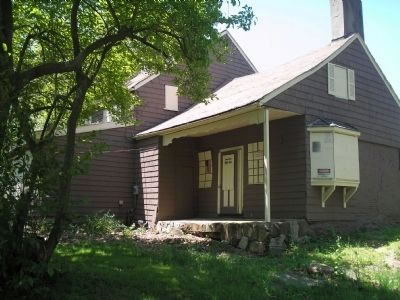
"As the legend holds, after the Battle of Short Hills, General Cornwallis and his troops passed by the house while marching toward the Watchung mountains, located a few miles to the north. Known to the locals as a prolific baker, Aunt Betty was baking bread at the time. Hungry and tired, the troops smelled the bread and Cornwallis approached her stating, "I want the first loaf of bread that next comes from that oven." Betty is said to have replied, “Sir, I give you this bread through fear, not in love.” Evidently impressed by her courage, Cornwallis is said to have stated, “Not a man in my command shall touch a single loaf.” While history offers evidence that Betty lived in the house and did, indeed, bake bread, the story of the actual conversation is not authenticated by primary source documents. The words allegedly spoken by the principals are found in the earliest authoritative source on the subject, F.W. Ricord's History of Union County, page 513, which is one of the sources cited in the National Register of Historic Places filing that led to the Frazee House being placed on the Register."

I'll have to look onto getting permission to operate from the property that the house is on. If that's not obtainable, there are plenty of other locations that can be operated from on the Trail, right in my local area. In fact, right in front of the Ashbrook Golf Course, is a monument to The Battle of Short Hills.
72 de Larry W2LJ
QRP - When you care to send the very least!
Stew Perry Topband Challenge
Last night saw another running of the winter Stew Perry Topband Challenge.
This contest is unique in that the usual density of activity on the eastern side of the continent does not necessarily provide an advantage ... contest scores are determined by the distances worked and each QSO will have a different point score, depending on its distance. The exchange is a simple one ... grid locators only ... and from these, the point score for each contact is calculated. From my way of thinking, and many others that I have discussed this with, the 'SP' is one of the fairest contests there is, putting everyone, no matter where they are located, on an even footing.
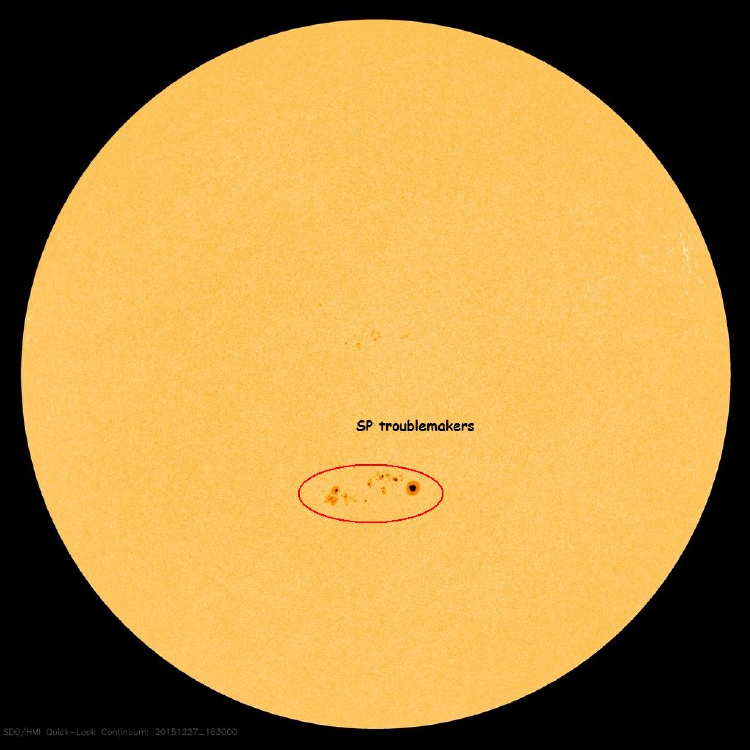 |
| Today's Sun (courtesy: http://sdo.gsfc.nasa.gov/) |
From here, operating in the 100-watt category, it was a struggle to work the normally easy single-hop stations, with no signs of the central states for several hours after sunset. Several east coast stations were worked towards midnight for the nice 12-point per QSO scores, but truth be told, almost all contacts were a struggle with many stations needing several repeats just to get the call or grid.
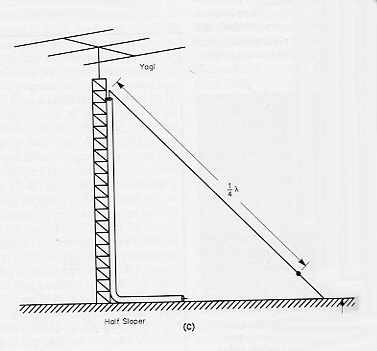
My half-sloper antenna and radial system is located right on the edge of the ocean, looking to the east, and its already low takeoff angle is enhanced with ~ 6db of sea (horizon) gain, making it a poor antenna for anything within the first-hop region ... after that it really seems to comes to life.
At 12:15 a.m., I pulled the plug, ending up with just 97 QSO's and 555 claimed points, way down from normal. Other claimed scores can be viewed on the 3830Scores.com website.
My best DX is usually JA but this time was KH6. The SP is always fun, but better conditions would have really made it a blast ... hopefully next year!
Win4K3suite added to shack.
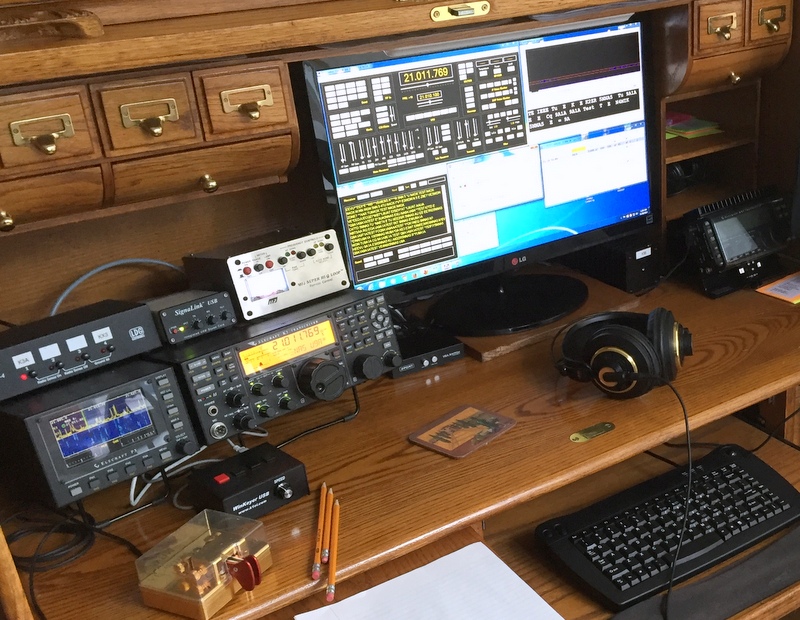 |
| Win4kSuite up and running |
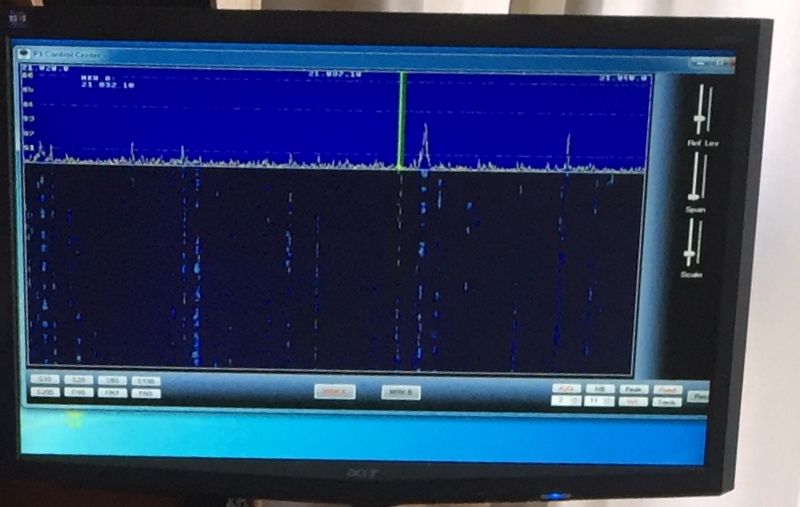 |
| P3 on the monitor |
Tri-Tet Fun
 |
| courtesy: VK5TR http://www.users.on.net/~endsodds/ |
I spent a few hours yesterday, operating in the 'RAC Winter Contest'.
Originally, this contest began back in 1932, when QST excitedly announced a 'Canada-U.S.A. Contact Contest' to run in mid-January of that year.

The contest turned out to be extremely popular and has been run, in one form or another, ever since ... gradually becoming known as the 'VE-W Contest', sponsored by the Montreal Amateur Radio Club, and eventually by its modern name, with one version in July and a second in December.
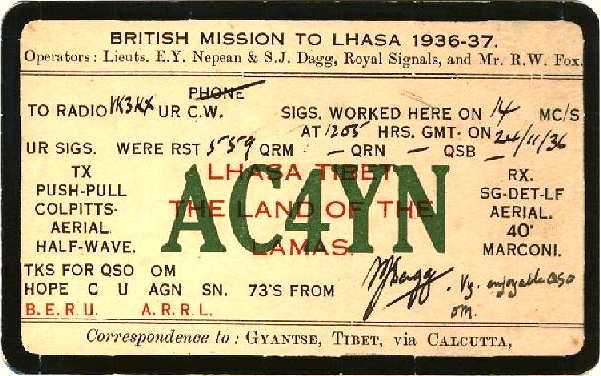
As a teen-aged ham, the 'VE-W Contest' was always the highlight of the year as the contest format, much as it is today, made anyone with a 'VE' call as sought-after as AC4YN ... not the one in North Carolina!
Old-timers and DXers will remember the call, as it represented the rarest of all possible contacts at the time and only a very lucky few made contact with the low-powered station, high in the Himalayan mountains at the British mission encampment in Lhasa, Tibet, in the late 30's. Having an 'AC4' QSL on the wall anointed you bragging rights for life.
Another great aspect about the contest back then, as in most, was that stations exchanged real RST's and not the meaningless '599' of today's contest operation. It was always interesting to learn how my little station, nestled in the upstairs attic, was really sounding at the other end.
I decided to set up my homebrew 'Tri-Tet-Ten', 6L6 crystal oscillator, and give the contest a short try. Being unable to conveniently move around the band meant that I would be reliant on stations answering my CQs ... not something that normally happens with the little transmitter in typical contest QRM ... but the magical 'VE' factor would change all of that, I hoped.
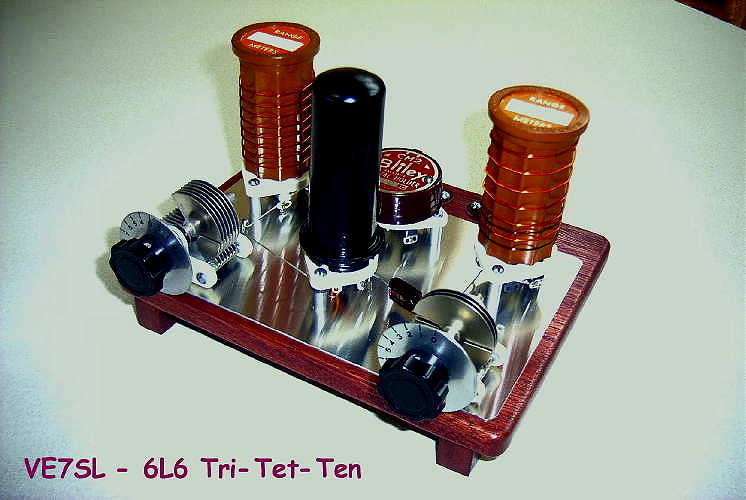
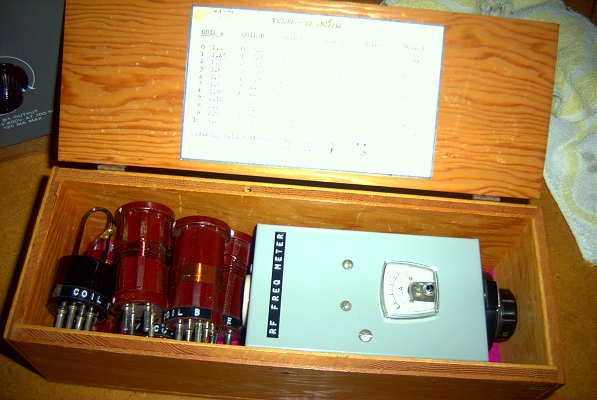
I plugged-in the 15/20m plate coil and got out my old homebrew RF-sniffer / wavemeter. It was the first piece of gear that I built, as a new 15 year-old ham, and the poor man's spectrum analyzer has been in constant use ever since. Using the 40m crystal's third harmonic, I have found the wavemeter is the easiest way to avoid mistuning and quickly found myself with just over 5 watts of RF ready to go. A tune-up for 20m later, found the second harmonic producing about 10 watts of pile-up generating madness.
Nowadays, the rules have changed a bit, and 'VE-to-VE' contacts are worth more than 'VE-to-W' QSO's but for 'W's, the goal is still to work as many 'VE's as possible ... and call they did.
Over the period of a few hours, the Tri-tet did not disappoint, generating 206 callers, including PY, PJ and HP ... frequently generating pileups 4 and 5 deep. I didn't try 10m as by the time I got started, it was falling off and the 6L6's 4 1/2 watts of fourth harmonic output on 10m requires really good conditions to be heard very well.
Due to conflicts with other activities, this was the first RAC VE-W Party that I have operated in many years ... it's nice to see that apparently not much has changed since 1932!
Ok you contesters (and non contesters) here is a question??

My CQ WW CW contest overview.
 |
| The QRP setup |

Since I am operating QRP and using small MFJ loop antenna on the balcony my operating style was as follows
- I Use my VFO B to save a strong DX station that at the time has a huge pileup going. This stops me from wasting time trying to break the pile. Better to come back when the crazy pileup is gone. This worked great when I came across a Senegal station.
- Even when a station is at an S2 level but is just calling and listening my 5 watts can and did many times make it through for a contact.
- I don't use a spotting network as I found most of these stations have a huge pileup but I do have an Elecraft P3. Using some hardware and software my P3 is seen on a 19 inch monitor and I am able to point and click on signals. My K3 then moves to that signal this allows me to see the activity on the band and Search and pounce these stations.
- When possible stay with a band such as 15m were my MFJ loop does not need to be retuned at all across the whole CW portion.
- Stick with my 250hz Inrad 8 pole CW filter so I can get between tight signals and only hear the op I want to contact.
In my post I am going to go into detail about my software I am now using and finding to be great for contesting and general QSO's It's now time to grab some eats and relax.
CQ contest this weekend.
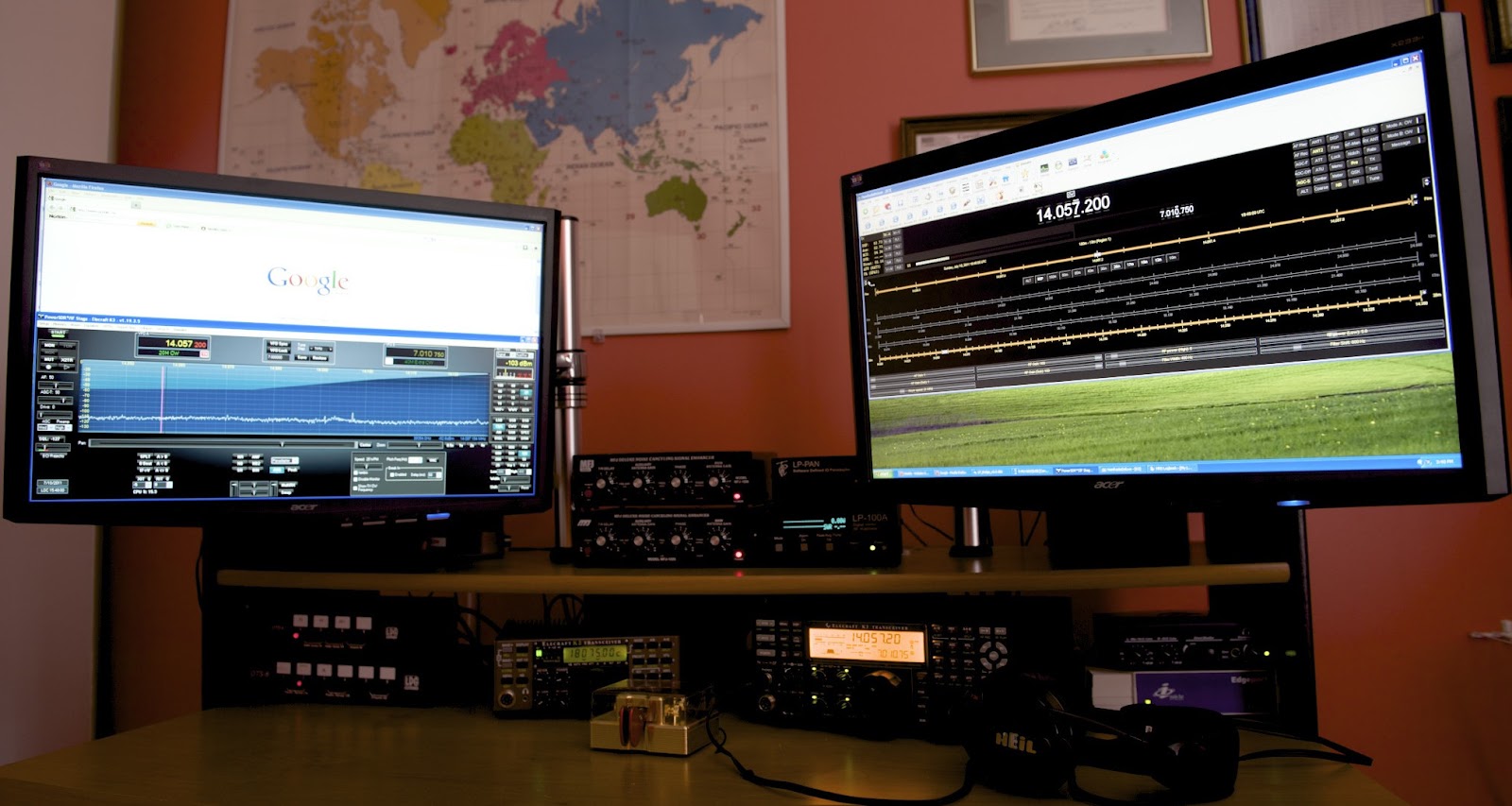 |
| Ahhh the old setup along with a great antenna............ |
1. Stay with the contest and not to get frustrated.
2. Try not to use the morse code reader and do most by ear....see how that works out.
3. Have fun and not worry about the score as with my setup placing anywhere for anything is most likely out of the question.
I will keep you posted as to how things go in the contest.....oh and the new setup as well....maybe I will hang some garlic close to the shack to keep Murphy away....:)













