Archive for the ‘radio’ Category
 New QSL card
 November 15th, 2010 |
  Author: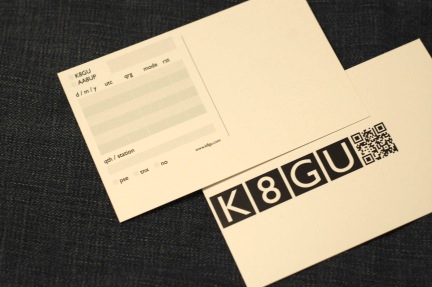
As I have bemoaned in the past, good QSL card designs are hard to come by. This is my attempt to remedy that situation. The front has my callsign, with a QR code linking the interested recipient to this web site. The reverse is postcard-friendly with space for six QSOs, corresponding to 1.8/3.5/7/14/21/28 or 50/144/222/432/903/1296 MHz. The address space can be used for a personal note if the card is mailed in an envelope. The card is also QTH-unaware. This means that I’ll have to write or sticker my way along, but I won’t be limited by my moves and travels. The font is Gil Sans everywhere. The cards were laid out using Adobe Illustrator CS4 and printed on 100-lb matte cover stock by Carlisle Printing, who printed my last cards as well.
One final note: one week after SS CW, I am already up to 43/50 states for my CW WAS from Maryland using LoTW. I’m not sure how many of these QSLs will actually make it into circulation at this rate. Be sure to work me so you can have your own copy of this rare collector’s item!
CW Sweepstakes 2010

(Image credit: via contesting.com)
After missing the two contests that I hoped would kick off my contest season, ARRL Sweepstakes was next on the list. I managed a decent showing that would have won the MDC certificate for A-power last year, provided the log-checkers don’t take too much.
Highlights (“Wins,” as we like to say on #wwyc):
- 80 meters was awesome. Good conditions and the K9AY helped me keep the noise under control.
- Everything worked for the most part and everything still works after the contest is over.
- SO2R CW with TRLog.
- Working lots of old friends from my time in MRRC, MWA, and SMC.
- Working lots of new friends from PVRC.
- Getting my receiver crushed on all bands when I tuned across W4EE who lives less than a mile away.
Lowlights (Fails):
- RFI to the CO detector waking Sarah up in the middle of the night. KA9FOX and AA9DY have had this problem.
- Not spending enough time on 15 meters and missing VY0JA and VY1EI there. Missed the sweep by 1.
- Not being able to answer people responding to my main radio CQ while working someone on the second radio. This only happened about five times. But, one of these was my Bureau sorter! Sorry!
- Getting confused for K1GU a few times.
Here are the numbers…thanks to all for the QSOs. See you again in two weeks on phone with a different callsign.
ARRL Sweepstakes Contest, CW

Call: K8GU
Operator(s): K8GU
Station: K8GU

Class: Single Op LP
QTH: MDC
Operating Time (hrs): 17
Radios: SO2R

Summary:
 Band  QSOs
------------
  160:
   80:  367
   40:  243
   20:  100
   15:    0
   10:
------------
Total:  710  Sections = 79  Total Score = 111,548

Club: Potomac Valley Radio Club
W3LPL-inspired 160/80 RX splitter
In an earlier post, I described my K9AY loop system. QRX for an update on the outdoor portion. But, after returning from a short and much-needed vacation at the beach yesterday afternoon, I whipped-up this little guy:
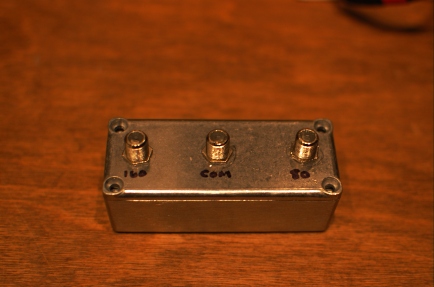
One of the big problems I have living in the city is overload from broadcast stations in the AM band. (This is especially true in the heavily-populated, full-of-hot-air DC area—Ed.) But, I digress. I also wanted to protect the preamp and receiver when I was transmitting on the higher bands into nearby antennas. So, some sort of filtering was in order.
I contemplated a number of topologies. But, the W3LPL filters were a good choice because they’re cheap and very good. A good reference on what I did is the NCJ article by K3NA and W2VJN about the VP6DX receiving antenna system. The Ducie Island system is considerably more complex than mine. But, they had more stringent requirements, more land for Beverages, and more money than I do.
Following the K3NA/W2VJN/W3LPL topology, I constructed a little diplexer filter for 160 and 80 meters that splits my K9AY to two receiver ports. This splitter is the first thing after the K9AY coax passes through the station ground bulkhead, requiring a preamp on each port. Since I don’t have a TX antenna for 160 yet, that port will go to the SoftRock-160.
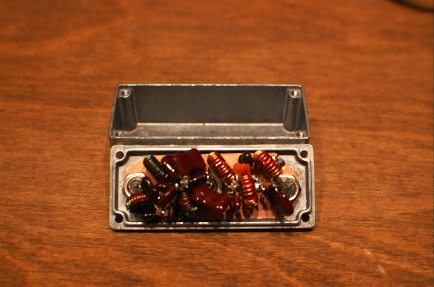
I’ve only tested the 80-meter portion (since I didn’t get the 160 portion done until this morning before work). But, it works like a champ and there is no overload from broadcast stations. Although there are some curious mixes coming from some of the big AM stations in the area that seem to be external to the receiver (this has been confirmed by N3OX—pretty amazing stuff); but, that might deserve its own post at a later date.
Keyboard Trays, QRP Rig, and SoftRocks
Time, as they say, has been of the essence of late. So, when I do have time to play radio, I rarely have a chance to write about it. Here are some photos of my latest tinkerings.
Keyboard Trays
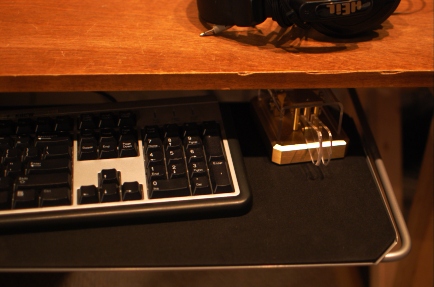
Sarah has always talked about using a keyboard tray at work as a part of an ergonomic workstation. Until recently, my work invovled enough variety of computer and non-computer time that I did not think about it. But, after coming home from work with stiff shoulders and wrists, I decided something should be done. While I was at it, I upgraded the HF and VHF/SDR operating positions at K8GU with pull-out trays, as well. These were $10 each at IKEA and pretty easy to install, although I told Sarah that I was grateful that she didn’t witness my contortions to hold them up with my knees while driving the first screws.
Liberating my inner QRPer
Back in high school, I built a Small Wonder Labs SW-40 that I had seen in a QST article. It lived in a variety of enclosures, but spent the last decade in the ugly PC board half-enclosure that looked like a redneck pickup truck at right. I decided to put it into a proper enclosure, being the diecast box at left.
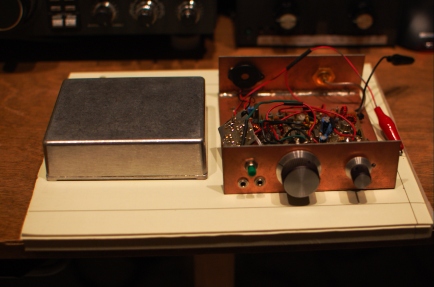
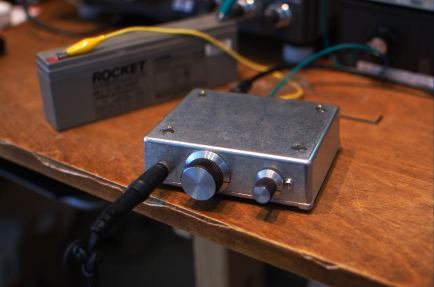
Despite the fact that I made the radio impossible (no room for front panel controls) to assemble the first time I drilled the board mounting holes, I’m pleased with the result. Four dabs of gray epoxy cover the errant holes. I probably could sand and polish those now. The power connector is a pair of Anderson Power Poles.
VHF Softrock and Enclosures
Readers of the blog have seen the screen capture from my new Softrock Ensemble II VHF. Tony does not advertise these on his site because they are not 100% supported with documentation yet. Robby, WB5RVZ has done a great service to the community by preparing step-by-step instructions for most of the SoftRock series. I’m not a step-by-step kind of guy, so I just used his photos showing the locations of the 0.1 uF and 0.01 uF chip capacitors and built the rest my way: mount all chip caps, all SMT ICs, all through-hole ICs and sockets, all through-hole resistors and diodes, all through-hole capacitors, all inductors, and all connectors. It worked right away.
I also have two v6.0 SoftRocks that I built a few years ago while I was in grad school. One of these (for 160) has been a bare board all these years and the other (for 40 and 80) has been living in an ugly little RadioShack black plastic project box. I decided to upgrade them to diecast boxes with external power connectors (also PowerPoles—I’m slowly switching the station over) and a switch for 40 and 80 meters. Here’s the happy family of little radios…
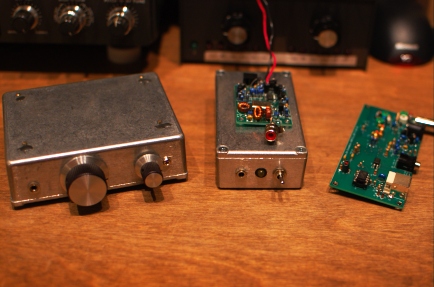
The 160-meter SR v6.0 is on top of the diecast box holding the SR v6.0 40/80. The Ensemble II VHF is on the right. It’s unfortunately too long for either size diecast box. I don’t like the commercially-available box for it. So, we’ll have to see…
Bureau Cards
If you have come to the site checking to see if I am still alive because you have not received a QSL card via the bureau system, you have come to the right place. I finally mailed about four years worth of CE/K8GU, KP4/K8GU, PJ2/K8GU, and K8GU bureau cards out this week. (Yes, it was a nice-sized pile, but not as big as it could have been.) There are a few recent requests that have not been filled because I ran out of CE/ and KP4/ cards. I will get some more soon.
144-MHz SoftRock
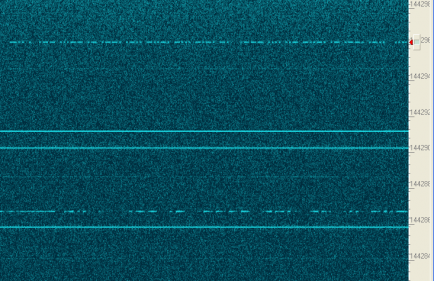
144-MHz SoftRock Ensemble II VHF by KB9YIG and VE3NEA Rocky 3.6. Yup, that’s W3APL/B (off the back of the beam) and WA1ZMS/B in the same waterfall. How cool is that?! More later… This has many implications for many projects!
Pin 1 and a Pound of Ferrite
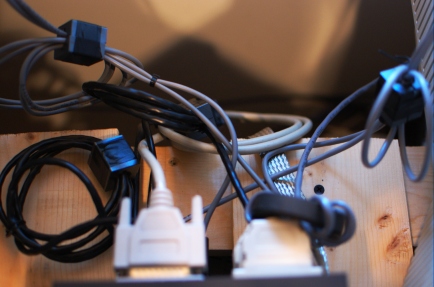
The commonly-held wisdom goes that an “ounce of prevention is worth a pound of cure.” As things typically go around the K8GU station, 50% of problems are solved by prevention and 50% by cure. Today, it was a cure. Readers of the blog are no doubt aware that I have a recently-discovered problem with QRM between my radios when they were on the 20- and 40-meter bands. (I didn’t notice this problem until I got both of the TS-930′s up and going again; so, it’s probably the result of the “new” station location and arrangement.)
I pulled the 20- and 40-meter W3NQN filters out of the circuit and measured them. They benefited from a little tweaking, but nothing that would have caused the problem. I put them back in and was rewarded with much lower VSWR in across both bands.
It didn’t matter which of the radios was on 20 and which was on 40, the interference, a popping hash that followed the leading edge of my keying, was there. The next step was to put a dummy load on the output of one radio, then both radios. Even when transmitting into the dummy load, the interference remained. This suggested to me that the problem was very close by. All of my gear is bonded together with heavy straps. So, I wasn’t too worried that it would be difficult to find. I noticed that the 40-meter LED flickered on my KK1L band decoder box following my keying. It became the prime suspect.
I found some split beads that AD8P and I bought from AA1K in the Dayton flea market a few years ago. I’m not sure what mix they are, probably 43 or possibly 77. Winding a few turns of the band data lines from each radio through the beads knocked down the interference a good bit. I slapped some more on the audio lines going to the Heil HCS that I use for SO2R audio and the interference disappeared. But, I was using the dummy load on one of the radios. As soon as I went back to the external antennas, the inteference came back.
Next, I dug out a couple of the 2.4-inch diamater mix-31 toroids that I purchased in the first K9YC “group buy” of these parts back in 2005 or 2006. I wrapped the DC power supply line to the KK1L box and the AC supply to the HCS. And, the problems pretty much disappeared. At least one of these is due to what K9YC calles “the pin 1 problem.” Basically, if the shield is brought through the metal enclosure to the circuit board, it conducts (noise) current that’s riding on it into the enclosure. So, I need to dissect the HCS and KK1L boxes to see if I can find a deeper fix than just slapping ferrite on the outside.
But, there’s hope for SO2R in this week’s NSL!













