Archive for the ‘radio’ Category
 VHF/UHF firepower
 September 16th, 2010 |
  Author: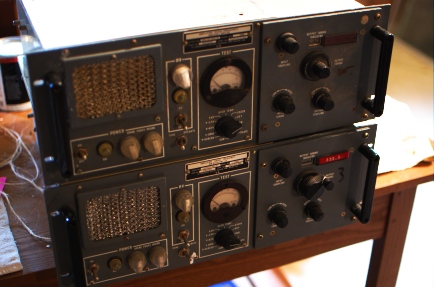
As if I don’t have enough projects already, I recently obtained these two surplus FAA AM-6155 amplifiers on, as usual, very attractive terms. I don’t have the equipment to properly test them at this point. But, that is coming. The FAA specified these to do 50 watts continuous duty AM. With modification, they will do about 300-400 clean watts with 10 watts of drive on 144, 222, and 432 MHz. Once I get the first two working (on 222 and 432), I plan to find two more of them and use them on 50 and 144 MHz. For 50 MHz, I plan to remove the VHF/UHF cavity and components and install an RF deck using the same Amperex DX393 or Eimac 8930 tube. Comments and ideas welcome. They’re a lot cheaper than bricks! One of my units appears to be at least partially converted already, but I’ve only had it open for a few minutes with my brother Seth, who got all of the mechanical aptitude in the family.
Note: Thanks to WY3X for catching my error on the tube type. He also notes that 300 watts would be a conservative maximum on 432. I plan to run the amps with very low drive after tuning so I can compete in the ARRL’s low power category at 100 watts on 222 and 432.
QRL for Sprint and September VHF
As I mentioned previously, I was planning to make the NCJ North American Sprint and the ARRL September VHF contests my kick-off to the Fall/Winter contest season. When a work trip was scheduled for that weekend, I assembled my portable station. But, Sarah convinced me not to take it since carrying the ham gear always complicates travel a little bit. Since the work trip was radio-related, I thought I’d share a couple of pictures and stories.
One of the projects in which I participate is the middle-latitude expansion of SuperDARN (Super Dual Auroral Radar Network). SuperDARN is a global HF radar network that is used to monitor plasma processes in the polar ionosphere/magnetosphere. It was recently highlighted on QRZ.com. Last year, we built a pair of radars near Hays, KS. This year, two radars are under construction in central Oregon. I went out to assist with the initial phases of the build.
The radars are installed on an old HF over-the-horizon-backscatter (OTH-B) radar transmitting site in Christmas Valley, OR.
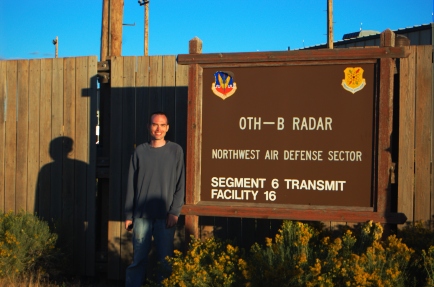
Two of these radars were constructed for the U.S. Air Force as an early-warning system for aircraft, one in Maine and one in Oregon/California. The western portion of the radar was only turned on briefly for testing before being relegated to “warm storage” and then decommissioning. Typical. None of the antennas or transmitters are still on site and a lot of the copper wiring has been looted. Everything left inside the building, including the backup generator, was in essentially mint condition. As an aside, the transmitters from the Maine site were recently installed at Arecibo Observatory. I have no idea what happened to the transmitters from this site. Despite the fact that the antennas and transmitters were missing, there were a number of interesting things to see.
This OTH-B radar was a megawatt class (output, not ERP) system split into three segments/sectors, facing NW, W, and SW, each fed by four transmitters. Each sector had a separate, dedicated 3-phase power line that came from a substation some 50 miles away—I found it on the way home. You could follow the poles straight to it if you knew what you were looking for. Each of the transmitting arrays was surrounded by a fence, for obvious reasons. The fence was made entirely of wood. Furthermore, almost all of the washers were a fiber material, not galvanized steel like the bolts.
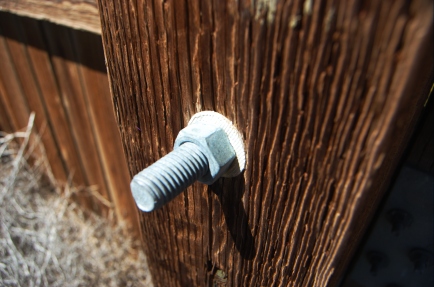
At first, I thought that the washers might have been an electromagnetic consideration, like the wooden fence, which might have distorted the antenna pattern in the best of cases or simply melted in the worst. But, I suspect now that it was a mechanical consideration to deal with dramatic changes in temperature and humidity in central Orgeon’s Great Sandy Desert.
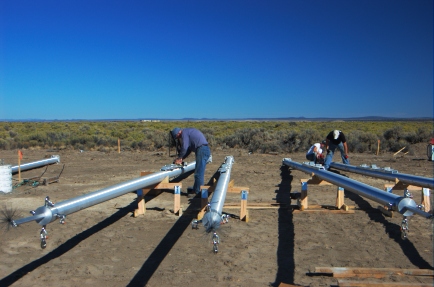
The actual construction of the SuperDARN radar is not that exciting at this point, but here are some of the 72 aluminum poles we dressed with cables for the two radars. Each radar has a 16-element phased-array of folded dipoles mounted in a corner reflector. I installed a lot of N connectors on LMR-600 and a lot of Preformed end-grips on Phillystran, in addition to some more cerebral tasks.
The site has good optical conditions, too. So, I’m looking forward to trying some of my optical instruments out there. Here’s a quick star-trail exposure I took with the camera propped up on a picnic table in the motel parking lot.
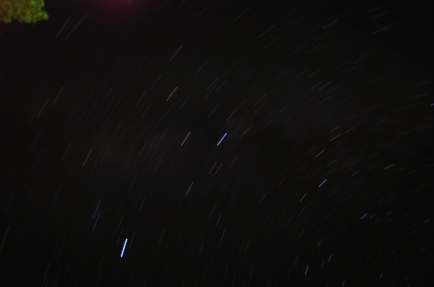
So, that’s what I was doing instead of Sprinting and grid hunting! I should be QRV in the NS Ladder tonight.

NS Ladder (3 September 2010)
Definitely unprepared this week and the score has gone down appropriately. I’ve been slowly working to combat RF gremlins in the station. 80 and 40 are now 100% clean for SO2R, but I still have problems on 20 and 40 (both ways). I think the 20-meter feedline is picking up (radiating) garbage. I had a number of SO2R QLF moments. The QRN was pretty nasty here (probably on account of the approach of Hurricane Earl) and I had to work hard to concentrate on the main radio. I ended up just going to one radio after I went for three minutes without a QSO.
For next week’s NS and the NA Sprint, I plan to be QRV from a different QTH. More on this when it happens.
NCCC Sprint Ladder - Sep 3

Call: K8GU
Operator(s): K8GU
Station: K8GU

Class: Single Op LP
QTH: MD
Operating Time (hrs): 0.5
Radios: SO2R

Summary:
 Band  QSOs  Mults
-------------------
  160:   0      0
   80:   8      5
   40:  12      9
   20:  10      6
   15:
   10:
-------------------
Total:  30     21  Total Score = 630

Club: Potomac Valley Radio Club
K9AY loops
When I lived on my parents’ farm in Ohio, I used to install Beverages. That was back when copper was cheap and I bought 500-ft rolls of #14 THHN for $10 each. N8ET gave me some ferrite toroids (of unknown mix, probably 77) and I added some parts from RadioShack to build some killer listening antennas. The best setup was three unterminated (bi-directional) ones that covered the compass. When I lived in Minneapolis, I went to W0AIH to operate the low bands. And, when I lived in Urbana, IL, I didn’t operate 160 and didn’t need the low-noise receiving antennas—or I went to NO9Z. Now, I live in the suburban wasteland between Washington and Baltimore. It was time to do something about the receiving situation.
Armed with my (autographed, no less) copy of ON4UN’s Low-Band DXing, I began thinking of what options I had. A small RX 4-square developed by K9UWA, W8JI, and others was appealing. But, it’s too large to fit comfortably on my lot. I considered a pair of short verticals with a phasing box (a project that has been in my queue longer than any—since 2003). But, I ended up settling on the K9AY “loops” because they are small and portable, having an integral ground radial and a single ground rod.
When I lived in Urbana, I had considered doing a set of K9AYs. So, I had purchased the parts to build a nice balanced preamp based on a QEX article by IK4AUY (this design is actually based on an even older Ulrich Rohde design). Note that the version of this preamp presented in ON4UN’s Low Band DXing, 4th edition, is wrong—if you see IK4AUY’s web site you shouldn’t miss it. Several months ago, I had assembled one on a perfboard (and tested it—so I thought). When I tried the preamp again over the weekend, it didn’t amplify the signals on the antenna side. The 2N5109 transistors are heat-sinked and so should get warm to the touch during operation. They did not. This suggested that they weren’t even being biased properly. So, armed with a DMM and the schematic, I started following the Vcc line. Megaoops. I failed to connect the collectors to Vcc. That fixed the problem and the preamp worked like a charm.
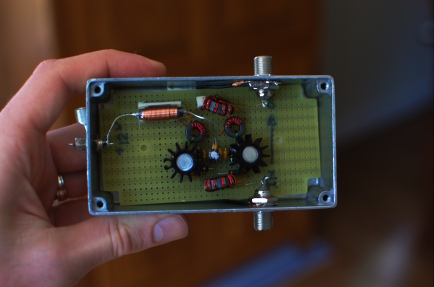
I built the classic K9AY crossed loops at 90 degrees for four-direction switching. Here’s my switchbox (built using 48-volt relays scavenged from the AT&T Long Lines system in the post “Resume of a Master Dumpster Diver“).
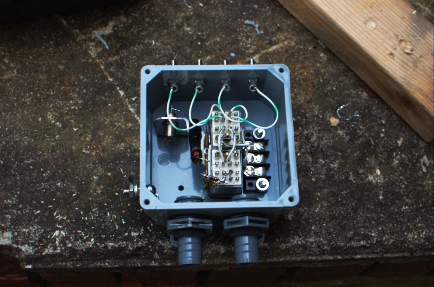
This box may have layout problems. If you’re an expert on K9AY loops, please weigh-in. The terminal strip at right is for the control wiring. I had originally planned to run Siamese RG-6 (scavenged from a DBS installation initiated by some lying, theiving, lazy, pot-head, good-for-nothing duplex neighbors we had in Urbana—they also discontinued our shared “free” Cable) so the loops could be independently switched and shared between two transceivers. But, when I suggested this idea to K9AY, he told me that the loops couple strongly with each other unless the unused loop was left floating. (If this idea actually did work, you could use two transformers on each loop, one in place of the termination, like a reversible Beverage…hmmm…for maximum flexibility.) Instead, I built the regular control box, with a scrap of CAT5 cable as the control cable.
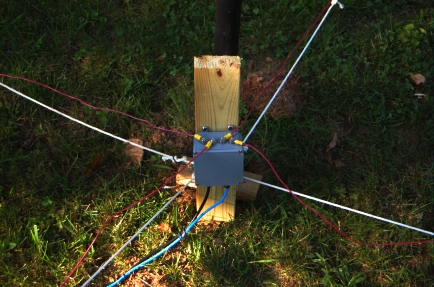
And, zoomed out…
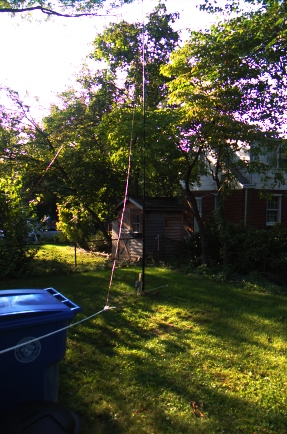
The loops are 80% of full size due to the amount of space (and wire) I had available. I terminated them with a 330-ohm resistor, although I’m having a hard time getting a null. Unfortunately, this is one of the best sites in my yard, yet it has a rusty metal fence (i.e., lots of little diodes on a big antenna) on two sides, a 30-ft mast and my 80-meter vertical on the other two sides. So, it’s not entirely unexpected that I’m not getting a null. I suspect that the neighbor would let me install it in his back yard, but I don’t want his landscape guys to hit the cables. This may become an option.
After conferring with N3OX, I tried putting a 500-ohm potentiometer on the termination point. But, that didn’t seem to help. I probably should bring a receiver out to the antenna when I do this…shouldn’t have sold that FT-817. I checked the potentiometer with my antenna analyzer and it looked pretty reactive. So, that could have been part of the problem. For now, I have the 330-ohm resistor in there and get 10ish dB F/B when I’m lucky…
Ohio QSO Party 2010
Ohio is my home state (hence the W8 callsign) and I thought I’d get on to work a few old friends. I was surprised and pleased to work former co-worker WB8JAY although I’ve changed callsigns since we worked together and I don’t think he recognized me. We had friends over for dinner, so I only got two and a half hours in.
The big bummer of the Qhio QSO Party is the RTTY contest. It seems like there’s a lot of bad blood between RTTY and CW ops. I think a lot of it comes from the fact that they can’t (as a CW op, I consider RTTY ops to be functionally-illiterate at CW because they’d be using CW if they weren’t) copy each other’s signals and therefore treat each other as just another interfering signal. One man’s signal is another man’s noise, as we like to say in the remote sensing business.
Anyhow, it was a good time and helped me identify some problems with the K9AY loops setup…
                    Ohio QSO Party

Call: K8GU
Operator(s): K8GU
Station: K8GU

Class: Single Op LP
QTH: MD
Operating Time (hrs): 2.5
Radios: SO2R

Summary:
 Band  CW Qs  Ph Qs
--------------------
   80:   24      4
   40:   42     12
   20:
   15:
   10:
--------------------
Total:   66     16  CW Mults = 38  Ph Mults = 11  Total Score = 7,252

Club: Potomac Valley Radio Club
NS Ladder (27 August 2010)
This score looks familiar, but the distribution by band is different. Need more practice!
NCCC Sprint Ladder - Aug 27

 Call: K8GU
 Operator(s): K8GU
 Station: K8GU

 Class: Single Op LP
 QTH: MD
 Operating Time (hrs): 0.5
 Radios: SO2R

 Summary:
 Band  QSOs  Mults
 -------------------
 160:
 80:  10     10
 40:   9      7
 20:  10      6
 15:
 10:
 -------------------
 Total:  29     23  Total Score = 667

 Club: Potomac Valley Radio Club













