Archive for the ‘dx’ Category
 Post-post Thanksgiving Leftover Leftovers
 December 12th, 2011 |
  Author:
 Post-Thanksgiving Leftovers
As most folks know, we had the Thanksgiving holiday here in the US last week. It’s a tradition to not only eat turkey with “all the fixin’s” but also have have some leftovers for a few days after that. I’ve got the same for my blog mostly with respect to things that were still around after Thanksgiving. So, in no particular order:
I did my usual “playing around” in the big CQ World Wide DX contest this past weekend. This is one of the “main events” in the ham radio contesting world, and while I didn’t really have time for more than just a few hours of making contacts, I did note a few interesting/amusing/annoying things. In this contest, you get points for working stations in other countries (not your own) with what’s called a “multiplier” based on the country and something called a zone. (The term “DX” refers to a station from another country.) Without going into too much detail, it’s relevant to know that there are 3 zones within the US. Your score is calculated by multiplying your points (number of contacts with stations outside your country) by the zone and country multipliers. You are allowed to work stations in your own country for the multiplier value, you just get zero points for doing so. It’s important to note that while you can get the 3 zone multipliers that are available for the US by working stations in Canada, if you want the country multiplier credit for working the US you must work a station in the US. Since it’s a zero-point contact, what I try to do is to find a US station that’s not busy and work them, since I don’t want to take them away from working their DX. Most operators understand this and have no problem with it, but on at least one occasion I called a US station who was CQing (repeatedly) with no responses only to have him respond “SRI ONLY DX”. In other words, he was telling me that he would not make a contact with me.
As noted, I only work US stations when they aren’t busy which was the case here. A complete contact with both stations exchanging information during a CW contest (which this was) takes around 20 seconds or less. So instead of helping me out by just completing the contact, he probably saved maybe 10 seconds by sending that other information. So much for good sportsmanship. (For what it’s worth, I noted his call and will avoid making contact with that station in the future, even in contests where non-DX contacts “count”.)
Also during the contest, I was working stations on 20 meters just calling stations and tuning up the band to find the next station. It’s not unusual, while doing this, to have another station that is doing the same as you are, and depending on what band you are on and the propagation conditions, you’ll sometimes be able to hear the other station. Sometimes, you wind up moving with that other station (sometimes more than one) and working the next station up the band either just before or just after that station repeatedly. Normally this isn’t a big deal, but I got stuck behind the equivalent of tractor-trailer truck on small road doing 20mph below the speed limit:
There was a station that would usually call the DX station before me and work him first. No problem. However, unlike the normal orderly contact sequence (which for this contest is very simple: a signal report, normally 599, then your zone, which is 5 for me, meaning my half of the exchange is send in CW as “TU 5NN 5”, with “TU” meaning Thank You, acknowledging that I got the contact information from the other station) he’d send something like “TU 5NN 4 4 4 TU DE (his callsign) (his callsign) (his callsign) 73″. You might send your callsign if you think the DX station didn’t get it, but the accepted way of doing it is prior to the other information and only if you think the other station might not have gotten it correctly. What wound up happening is that the DX station (who is normally working stations very quickly; remember that I mentioned it normally takes 20 seconds or less to complete a full contact) would hear the “TU 5NN 4 4” then assume that the other guy was through sending and send his “TU QRZ?” (meaning he got your info and is moving on), only to realize the guy was still sending. In one case I heard the DX start to send his final sequence 3 times “TU … TU … TU” before the other guy finished.
The problem with doing this is that you slow everyone down, and while it’s not against the rules to do this, it’s another example of poor sportsmanship. The station doing this had to know that he was slowing everyone down. (And before everyone jumps on me, this was definitely not a new contester, so it wasn’t a case of “not knowing better”.) I’m not sure why he was doing this, but finally I just gave up and jumped far enough up the band so that he was no longer “in front of me” anymore. (In fact, I went way up the band and started tuning down, meaning that while I might cross paths once more, it would be in opposite directions.
I’ve got a few more leftovers to go, but I think I’ll just put them back in the ‘fridge for next time.
The thrill of the hunt
I often think of amateur radio as if I’m on a hunting or fishing expedition. I know for younger and perhaps less patient individuals, this thrill may or may not be shared with the same excitement and enthusiasm. When I walk down the fourteen steps into my basement ham shack or drive up to the mountains for a few hours of portable, outdoors operating….I don’t always know what is waiting for me on the bands.
I’m reminded of an interview I did with Duncan McLaughlin, KU0DM back in episodes 28 and episode 29. I hope you’ll listen to those two older episodes. Duncan and I discussed the possible challenges of attracting todays youth into the hobby. The youth of today are growing up in the information age where everything is instant and immediate. Want to talk to someone on the other side of town? They probably have a cell phone. Want to talk to someone on the other side of the planet? They probably have Skype. Duncan believed the possible ice breaker was in the area of Radio Sport or contesting. Duncan described his philosophy as the difference between fishing and fish sticks. One can take a fishing pole to your favorite lake, pond or stream and may or may not catch a fish….but chances are the local grocery store will be well stocked in boxes of fish sticks. This simple, yet truly interesting way of looking at things is really what amateur radio is all about and in my opinion what makes it special.
While amateur radio requires a license in order to operate on the bands, what amateur radio gives us in return is a license to learn. What we learn might fall into the category of electronics, antennas, solar propagation etc. and these are all important. However, just as important, I enjoy learning more about the geography of those new DX stations I’ve been working.
Of course, when I see a station call sign such as a M0, ON or JA I do recognize them being geographically located in England, Belgium and Japan respectively. However, I’ve also really enjoyed learning more about the callsigns I’m not as familiar with such as UT, CT3 and my most recent DX entity of T32.
Yes our planet is large, but our wonderful hobby of amateur radio can make it much smaller if we let it. As most have probably heard, band conditions are getting better and better. Even for US technician class operators, the 10 meter band has been booming with lots of excellent DX opportunities. Go to your ham shacks and get those rigs fired up and enjoy the thrill of the hunt.
Until next time….
73 de KD0BIK (Jerry)
Radio Tirana
Propagation on 10m today is as good as I can remember. I made a few nice contacts using SSB including Japan, India and Bahrain. I heard several Chinese stations as well but have yet to work one.
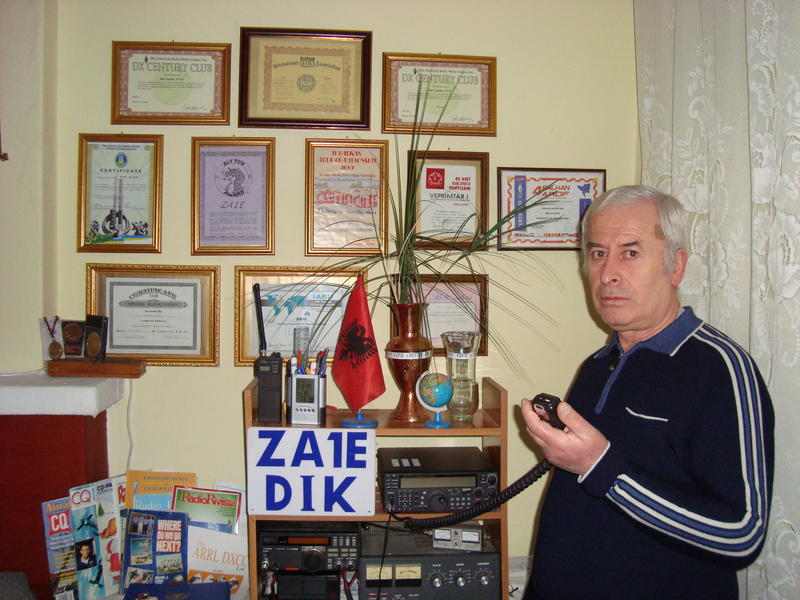
Not really DX but a new country for me was Albania, in the shape of Dik, ZA1E. Decades ago as a teenaged short wave listener I remember hearing Radio Tirana, a huge signal on 7.065MHz, smack in the middle of the 40m phone band. I wonder whether anyone ever listened to its broadcasts? They were pure anti-capitalist tirades read by a woman announcer who sounded like she had a beard and no sense of humour. They actually used phrases like “capitalist running dogs” if I remember correctly. At least Radio Moscow tried to make life on the other side of the iron curtain sound attractive.
I don’t think there was any ham radio activity in communist Albania and there still aren’t all that many hams there now so I was pleased to work Dik for a new one.

TI7/K2DBK officially approved, Part 2
Please read Part 1 for the beginning of the story and some background.
Based on the information that I’d previously described, I sent an email to the Logbook of The World (LoTW) desk at the ARRL in mid-June briefly explaining what I’d learned and asking what would be needed for them to issue a certificate so that I could upload my contacts. (Briefly, each contact is “signed” using a digital certificate to ensure that it’s valid. The ARRL issues a certificate to an operator when it is satisfied that the contacts were made legally.) I got a quick response back which referred me to the ARRL’s Reciprocal Operating page which gives the requirements needed to operate from different locations around the world. The information provided for that page links to OH2MCN’s terrific site that has details for hundreds of countries. The information on his site is largely provided by hams who have operated from those locations, but sometimes it’s not always completely up to date. (As an example, you can see my contribution to the entry for the Cayman Islands, which in turn has been updated since I wrote to Veke.) Unfortunately, the information for Costa Rica did not include the updated details regarding SUTEL (and still doesn’t as of the time that I’m writing this.) I responded back to both the LoTW desk and the DXCC desk (since the DXCC desk is ultimately responsible for determining if an operation is “legal”), but did not hear back from them prior to leaving for Costa Rica.
After I returned, I electronically requested a certificate for my operation. As with most operations from other that a home country, I was advised that I needed to contact the ARRL with the required supporting documentation. I sent another note to the DXCC desk in early August again explaining the situation but after a couple of weeks of no response, I sent a note to Joyce, KA2ANF, my Division Director who did whatever magic Division Directors do and got me a reply form the DXCC desk. Unfortunately, the reply was substantially the same as the initial responses that I’d gotten back (referring me to the Reciprocal Operation page) and didn’t address the changes in the licensing authority. It said that even though their information was outdated, that I’d need a license or some other documentation from the local licensing authority.
At this point, it occurred to me that many of the people who I’d emailed or spoken to had operated recently from Costa Rica, certainly within the last two years, and several had been issued LoTW certificates. Since there was precedent, I figured that the best way to find out how they had gotten their certificates was to ask, so I gathered up a list of email addresses, and sent out an email, that said in part:
…I noticed that you have recently uploaded contacts from a Costa Rica operation to LoTW, and I was wondering if you’d recently obtained a certificate without a paper license, or if you had a previously-issued license that was used to obtain your certificate. To be honest, I’m hoping that you might fall into the first category meaning that there is precedent for my certificate to be issued under the same conditions.
Over the next couple of days, I got back responses from pretty much everyone I wrote to (and some that I didn’t; my note got passed on to a few others who I hadn’t originally written) and the story from each of them was the same: No, SUTEL wasn’t issuing licenses but it was OK to operate from Costa Rica as long as you were in the country legally and had an appropriate US license. N0KE, AA8HH, N0SXX, and K4VAC (which is a club) all confirmed that they’d been issued LoTW certificates based on the “new” information about licensing. Better still, I received information from several hams that included emails between themselves, the ARRL, and in some cases, between Keko, TI5KD, the president of the Radio Club de Costa Rica where the licensing information was explained and accepted as valid by the ARRL.
I wrote another note to the DXCC desk and provided this information, and waited. After another couple of weeks, I sent a reminder note (I know those guys are busy, and my issue certainly wasn’t a big one) and got a response back. They’d started to investigate, and would be getting back to me. I felt that at least they were finally reading what I’d written and there was hope. Just a few hours later, and I got back another email telling me that my operation was accepted and a LoTW certificate would be issued shortly. (It was.)
I’d like to thank everyone that I mentioned here for their help in getting through all this. In particular, Keko, TI5KD was very patient in explaining the situation and helping me to be confident that I would eventually get through the red tape.
On a final note, I realized that in the spirit of “giving back” to the ham community, the best thing that I could do would be to get the information on OH2MCN’s site updated, so I’ll be writing to him shortly with the details that I’ve provided here (though in a more concise form).
TI7/K2DBK officially approved, Part 1
It was a lot more difficult than I’d expected, but I finally received official approval from the ARRL’s DXCC desk for my TI7/K2DBK operation earlier this year. I’ve been holding off writing about it until I had resolution, one way or another, hence the delay in writing this.The issue had to do with the licensing authority in Costa Rica. Here’s the story as I understand it.
A couple of years ago, the organization responsible for issuing all radio licenses in Costa Rica was reorganized. That organization, SUTEL, apparently revised the laws regarding all radio services in Costa Rica, but somehow they neglected to revise the rules pertaining to amateur radio. In fact, they didn’t include rules about amateur radio at all after the rules revision. As a result, they had no way to issue or renew any amateur licenses, regardless of whether those licenses were for residents of Costa Rica or for visitors. As I understand it, this was an oversight, not an intentional removal of the amateur service from Costa Rica. Previously, for a US amateur to operate from Costa Rica, you’d have to fill out some forms and pay a nominal fee at the SUTEL offices in the capital city of San José and you’d walk out with your license. Unfortunately, after the laws were revised, there simply wasn’t a way to get a license.
I didn’t know any of this earlier this year when I decided to operate from Costa Rica. My concern was that you had to physically go to the SUTEL office in San Jose to get your license.
The location where we stay in Costa Rica is in the northwest portion of the country near the city of Liberia, and it’s a pretty significant drive to San Jose. (The green marker is where I was staying, the blue is San Jose.) Although Costa Rica isn’t a very large country, a multi-hour drive through a country where I didn’t speak the language (and where were weren’t planning to rent a car) just didn’t seem very appealing. What I thought I would do is to post to a couple of the DX lists to ask if perhaps there was a way to get a license online, or perhaps to see if there was someone in Costa Rica who could do the paperwork for me in advance, and mail it to me either at home or where we were staying. I got back multiple responses, both from US hams who’d recently operated from there as well as a couple of hams who live in Costa Rica, all of whom told me about the situation with SUTEL.
Among those responses were a couple that said that based on conversations between the ARRL and the Radio Club de Costa Rica there was a working agreement in place so that for amateurs from countries that had reciprocal operating agreements in place with Costa Rica (the US does), that as long as the visiting amateur is in the country legally (a copy of a passport stamp can be used to prove this) and they held an appropriate US license (I hold an Amateur Extra class license). they can operate legally from Costa Rica. The only other requirement is to use the appropriate regional prefix, which for my operation was TI7, indicating the Guanacaste region. Based on that, I operated as I’ve previously described, and assumed that I’d have no trouble having my operation officially approved for DXCC credit (for others, of course) and getting a Logbook of The World certificate, necessary to upload my QSOs to that system. As I said, it turned out to be a bit more of a challenge than I’d expected.
To be continued…

Hidden DX Opportunities
Or…So this is where all the cool DX hangs out! But I thought that title was a bit too long and opted for the shorter version.
When I arrived home with my signed CSCE on Saturday, 28 August I did want to run downstairs and spin the dial into the extra class portion of 20m and work a station (contest or otherwise) as KD0BIK/AE. However, I also wanted to make sure I treated my #1 supporter in this hobby to lunch and spend the day with her doing some of the things she wanted to do. I’ve spent so much time over the past few weeks with my head in a book or on the PC, Laptop or iPad taking practice exams. So we went to lunch and then spent a few hours digging through antique shops.
After dinner and also somewhat tired/bored of watching Geraldo get blown around the streets of NYC, I decided I would head down and see what was happening on the ham bands. This was around 20:00 local (02:00 UTC). The 20m band was alive with activity with the Ohio and Hawaii QSO parties. I worked about three Hawaii stations and one Ohio station and then spent about 30 minutes trying to work W9IMS. While I had missed working them in May for the 500, I did work them in July for the Brickyard 400. Next year I’ll plan to try to score the Trifecta and work all three special event stations for that special certificate.
Anyway, I finally gave up on W9IMS and decided to see if the Yaesu FT-950 VFO would turn down past 14.225. I should have stopped by Ham Radio Outlet on the way home from the VE session to have them check the serial number on my 950 to determine if it had the pre-installed AE module installed. Ha ha ha
While I had occasionally turned the VFO down below 14.225, it was not something I did often. I do a lot more listening than I do talking on my radio, but I guess I just always thought I would just listen on the band segments I actually could operate on. Plus this was a built in safety net incase I heard a really rare DX calling and my excitement clouded by vision of double-checking what frequency I had been listening to. In any event, my FT-950 tunes down nicely below 14.225 and on Saturday evening, my ears were certainly surprised at all that I heard.
In just a matter of minutes I managed to work CT9/RW9JZ operating from Maderia Island, then I worked RJ3AA in Moscow, a few minutes later I worked RG4F in Kuznetsk, Russia. I closed my DX hunting down by adding CO6LC in Cuba. This was the first time I had worked Cuba on SSB phone.
Now I’m just wearing out the FCC ULS search watching for my upgrade to be noted. This VE Team did state it should appear within a few days so I’m sort of thinking Wednesday, Thursday or hopefully on Friday. It would certainly be nice to have that record showing as extra class prior to the Colorado QSO party coming up this weekend. But for now, I’ll continue to be KD0BIK/AE.
Until next time…
73 de KD0BIK/AE













