Archive for the ‘dx’ Category
 A day by the lake
 August 4th, 2011 |
  Author:
 The fine weather we have enjoyed for several weeks was forecast to change, so on Wednesday Olga and I decided to take the bus and go for a picnic lunch by Bassenthwaite Lake. For radio entertainment I took the UV-3R (in case of any SOTA or WOTA activations) and the FT-817ND.

HF conditions were pretty dire – WWV has been predicting blackouts – and I initially heard nothing above 20m. But even though I called the loudest stations that weren’t calling “CQ DX outside Europe” no-one even acknowledged my existence. (What’s wrong with working stations inside Europe, I’d like to know, especially when no-one is replying to your CQs anyway?)
The antenna I was using, the Wonder Wand L-Whip, could have been better. It does, however, have the advantage that it is small and light. At the moment I can’t carry much, needing one hand for my walking stick and the other for balance, so everything has to fit in a small shoulder bag. So I didn’t have anything else suitable.
The UV-3R produced a contact with Terry, G0VWP/P activating Walla Crag, the lowest Wainwright, prompting Olga to comment that the small radio was better than the big one!
After lunch I tuned around some more and heard some activity on 15m and 17m. And whilst tuning 17m I stumbled across this. Actually, that’s what I heard a couple of minutes later after I’d dug my smartphone out of my jacket pocket to make the recording using Voice Recorder. What I heard first was ZD8D (Ascension Island) calling CQ. Repeatedly. With no takers. He was not very strong – about S4 on the ‘817 S-meter – with some QSB, but perfectly clear. Clearer in fact than in the recording. I called, but needless to say he didn’t hear me.
As I’ve said before, I have little interest in working stations just to tick countries off a list. But I have a particular interest in the British colonies of Ascension Island and St. Helena as I visited both places during a “trip of a lifetime” in 1999 but have never worked either of them. Just my luck to come across a DX station calling CQ with no pileup when I’m surrounded by mountains and running just 5W to an extremely inefficient antenna!

TI7/K2DBK Post-event wrapup, part 2
This is part 2 of the series, click here to read part 1
It’s been another crazy week at work and at home and I’d hoped to have another entry or two posted by now, but I just haven’t had the time. I’ve finally found a few minutes, so I’d like to focus on things from a DX perspective and talk a bit about QSLing.
As I’ve previously noted, the weather kept the total number of contacts far lower than I’d hoped, with the total number of contacts ending up at 87 for the week (including one duplicate who I helped out with an antenna check). It looks like I worked 22 different countries though I believe that one of those will be a busted call: I logged a caller with a “DX” prefix which would correspond to the Philippines but at the time I was working into Europe and I suspect that it’s actually a “DL” call. In terms of “best DX”, I worked into European Russia (UA) and Ukraine (UT) a few times, with the majority of the countries being in central Europe such as Spain, Italy, France, Belgium, Germany, Hungary, and others in that area. I worked relatively few US states, though I don’t have good statistics on the because I didn’t get the state from all the operators that I worked. Most of the stateside contacts tended to be in the US Southwest although I did work up into Virginia and farther up the US East Coast for a few contacts.
As I mentioned in my last post, I did manage to get a full-blown pileup going a few times, and I can really understand how addicting this can be. I’d love to be able to operate from a “real” DXpedition, or even from a “primarily radio” vacation somewhere, but for now my vacation time is limited so I tend to squeeze in radio when I can. I hope that at some point over the next year or two I can get creative and find time away for a “radio” vacation.
Regarding QSLing, I got a question this week from a station asking me about whether the contacts would be uploaded to Logbook of The World. As regular readers of this blog know, I’m a big fan of LoTW, and would love to make the contacts available there. However, I’m having some issues getting a LoTW certificate issued and it’s not clear when (or if) that issue will be resolved. (This only applies to my operating from TI7.) In the meantime, if you need a card, please QSL via my home call the “old fashioned” way with a paper card. Because of the relatively few contacts made, I’m not going to have a bunch of card commercially printed but I will design and print a card specifically for this operation. My QSL information is always kept up to date at my entry on qrz.com.
If you want to check to see if you’re in my TI7 log, I’ve uploaded that to the Clublog website which you can search here. If you think you worked me and you can’t find your entry in the online log, please drop me a note and I’ll check for you as it’s entirely possible that I busted a call or two.
TI7/K2DBK Post-event wrapup, part 1
It’s been a very busy week for me both at work and at home following my vacation, so it’s taken me a while to find the time to start writing this. I’d hoped to provide a few more updates while I was in Costa Rica but I never found the time so I’ll do my best to try to remember what happened. I’m going to try write a number of shorter postings so hopefully I can get them all out over the next couple of days.
In my last posting, I’d talked about how it had been rainy all week. That weather continued, but I finally did figure out a way to get on the air for more than 10 minutes at a time.
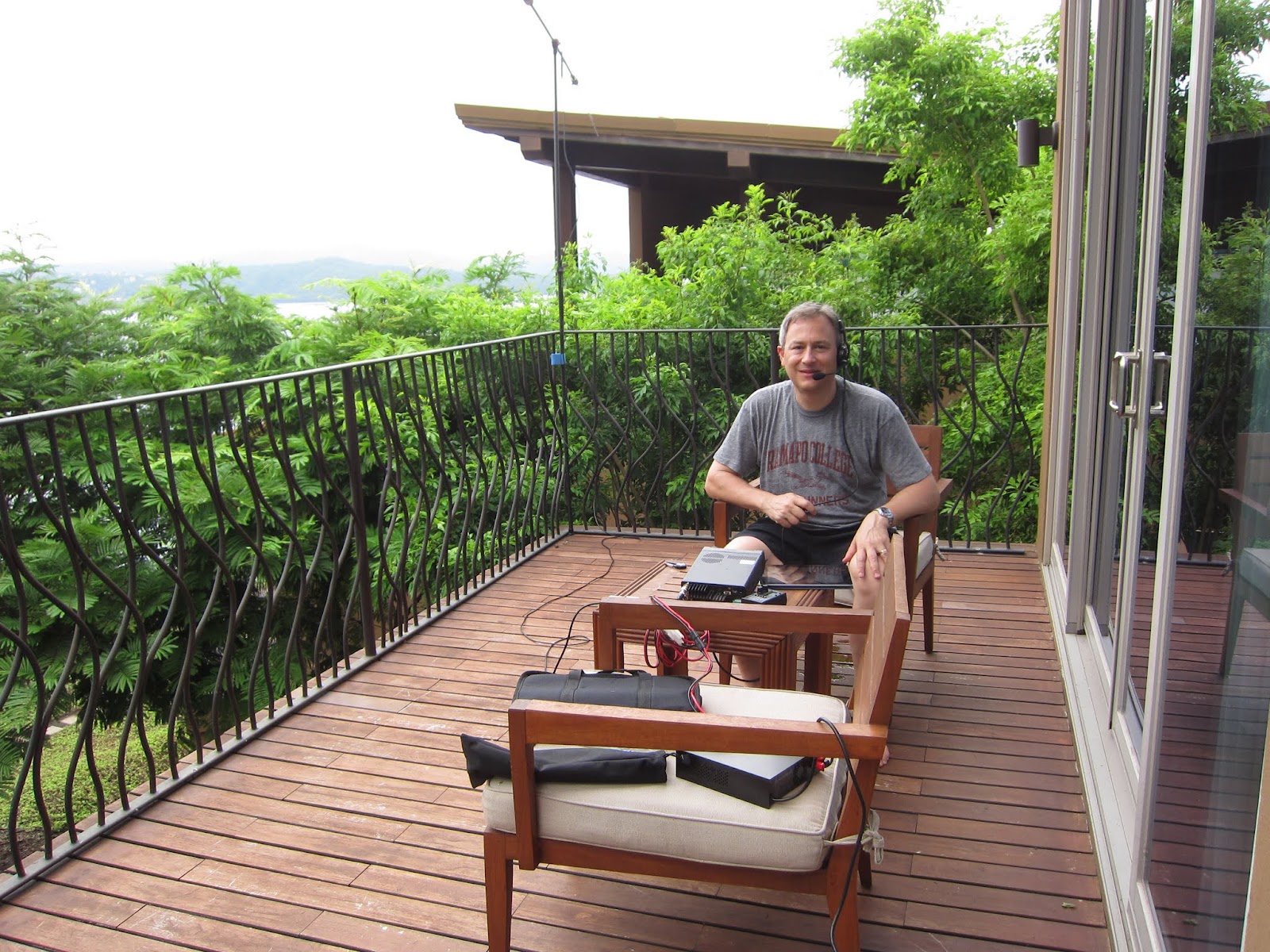
The problem was that my initial setup was on part of the outdoor deck with everything exposed to the elements. I would have been happy to bring the feedline inside, but the air conditioning system in the house we were staying at has sensors such that you can’t leave the sliding doors open even a little without the system shutting down. Considering the temperature and humidity, that wasn’t a realistic option, so I had to operate outside and hope for the best. In the picture, you can see the antenna in the background and I’ve got the power supply sitting on the chair with the radio on a little table. As long as it was dry, this worked out fine. Unfortunately, it didn’t stay dry long enough for me to spend any significant time on the air.
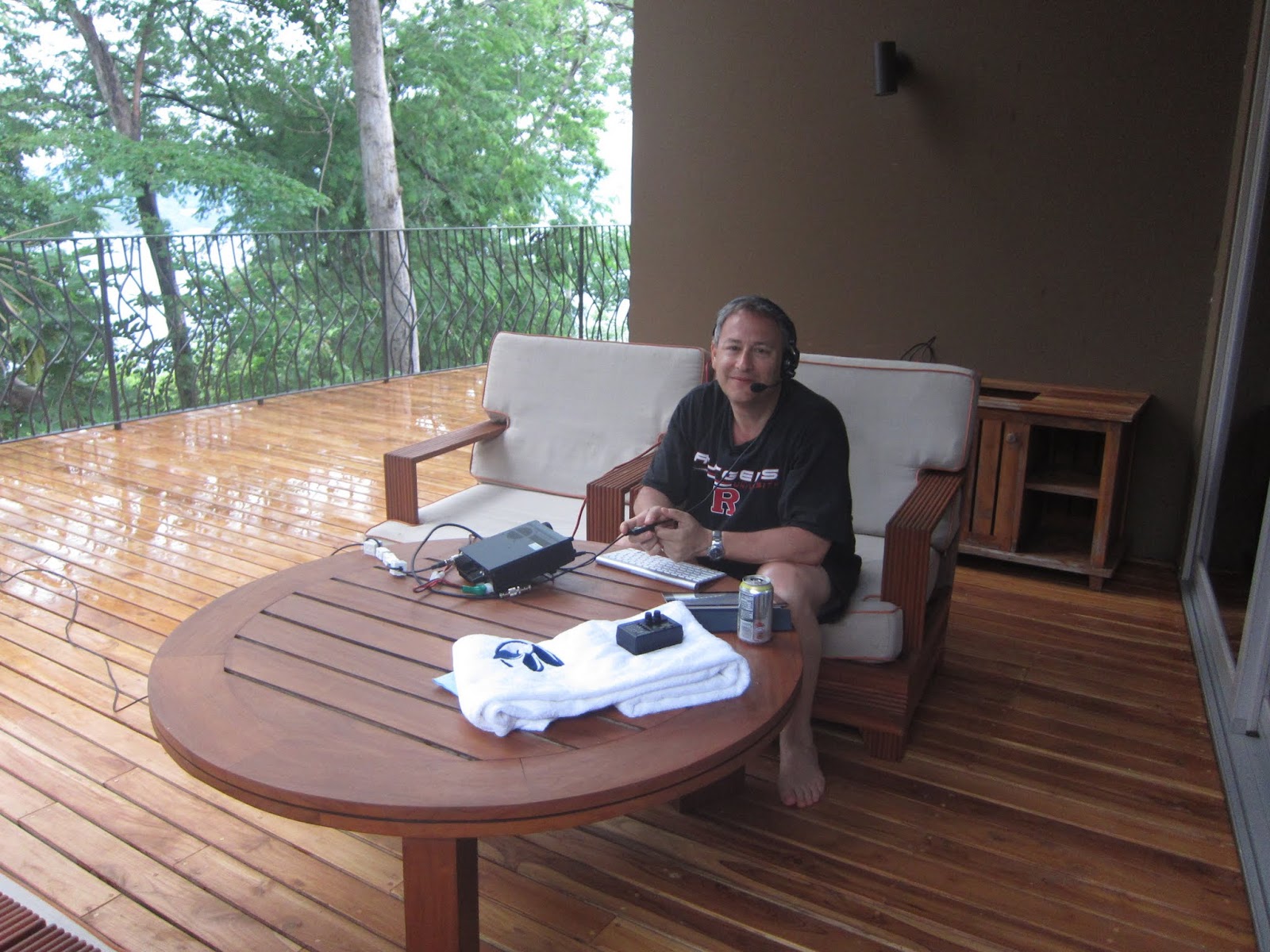
On Friday afternoon, the weather was once again uncooperative, and I was starting to think that I’d wind up leaving Costa Rica with only about 5 QSOs. However, Sharon pointed out that the deck next to the common area of the house had a pretty big overhang, and I realized that even with some of the really torrential downpours we’d had that area had stayed dry. I moved down to that location and set up the antenna there, configured for 15m, and brought out the rest of the gear to the new location.
Sure enough, after a few minutes of respite the skies opened up again, but although the antenna was getting wet, the radio, power supply, and my iPad (used for logging) were dry. (As you can see from the photo, I did have a towel ready, just in case.) I got on 15m at just about 21:00Z and called CQ and was answered by a station in Brazil. Being in Costa Rica, that wasn’t quite the DX that I was hoping for, but very shortly after that I got spotted on the DX Clusters and started getting a lot of calls from Europe. All told, I was on the air for about 40 minutes (we had plans and I had to get ready) and worked 33 stations that day. (I’ll have some details about the countries I worked in a future posting.) Although I’ve worked from a DX location before (as ZF2DK), this was the first time that I ever had what I would consider to be a full-blow pileup. I think that I did fairly well in managing things, managing to at least get enough of a partial call so that I could respond back with “the station ending in xyz only please” on almost every call. I don’t have enough experience yet to be able to pull full callsigns out of a pileup every time, but I know that’s something that comes with experience. By the second day of running stations, I could tell that I was doing better.
Part 2 of this series continues here.
Rainy season in Costa Rica
Unfortunately, Mother Nature has not been cooperating. I’m writing this from Costa Rica and we’ve have a lot of rain here. I was able to get on the air very briefly after arriving on Sunday, making a single contact on 20m mostly just to make sure that the gear was working. I got a little bit of RF into the radio (which I’d seen while testing at home) but the ferrites that I’d brought cleared that up.
The next time I was about to get on the air was Tuesday afternoon, also relatively briefly. I set up for 15m and the antenna behaved very well there, easily tuning the whole band. I worked a few stations in the US southeast (Georgia & Florida) and a relative local in Venezuala. But as the title of this post indicates, rainy season has started here and it’s been raining a lot since then.
Obviously a Buddipole will work in the rain, but the way things are set up here it’s not practical to leave the antenna up and run out in a near-monsoon to make an adjustment to a whip. Of course, trying to do that when there’s lightning around, which there has been, was an even worse idea.
Wednesday was pretty much a complete rainout, though my friends and I were able to go out on the water and jet ski for a couple of hours. (No, I did not attempt to operation TI7/K2DBK/MM). Did I mention that it rained constantly during that whole time?
Today (Thursday) started off looking bad again, raining for most of the early morning, but it did clear up for the majority of our day which included a sightseeing tour to the Rincon de la Vieja volcano. Right at the end of that trip it starting pouring yet again, and while there was a very brief respite after we got back to our residence here, it’s been raining steadily ever since along with a lot of lightning. Needless to say, no radio.
The weather forecast for the next couple of days calls for more of the same, although our touring plans are done and since we’ll be around more I hope that if we get a break from the rain for a few hours I’ll be able to get on the air.
I am disappointed that I haven’t been able to get on the air more, but I’m trying to stay positive and see if I can get on the air for at least a few more hours before it’s time for us to leave.
Quick update on TI7/K2DBK
I just wanted to post a very quick update regarding my TI7/K2DBK operation that’s coming up in a few days. I see that my announcement to the various DX Publicity sources that I’ve collected has done the job, as I’ve been mentioned in most of the major DX announcement lists. As mentioned, this is a “holiday-style” operation which means that operating will take place when I’m at the QTH where I’m staying (as opposed to sightseeing, etc.) and not otherwise occupied with other important things, like working on my suntan, swimming, or consuming the occasional “adult beverage”. (Come to think of it, I could do at least some of those while operating, but I think I’ll skip trying to operate from the swimming pool.)
Although I wasn’t home to take advantage, I noted that 6m was open today and if that happens again while I’m there, I’ll try to get on the air on that band. However, unless there’s some indication of a band opening I probably won’t spend much time just CQing since the lower bands should be more productive overall.
I had intended to post several updates this week, but as luck would have it this was an extremely busy week at work and I got home significantly later than usual and just haven’t had the time to update. I may post a few updates from Costa Rica when I’m there at which point I may have a better idea of when I’ll actually be on the air.
Until then, I’ve got to get back to packing.
Planning for Costa Rica
The possible operation to Costa Rica that I mentioned a few weeks ago is now on. I’ll be operating from the north-west part of the country near the city of Liberia from the 10th to the 17th of July 2011. You can see the approximate location in this map although the aerial photos were taken before the house were built. (No, we’re not sleeping on a golf course.) We’re going as guests of our good friends Barry and Stephanie who took us along to Grand Cayman in 2007 when I operated as ZF2DK. (For those of you who haven’t been reading this blog that long, that link goes to a whole pile of blog posts about my trip there.) This time, I’ll be operating as TI7/K2DBK, with the TI7 indicating that I’ll be operating from the Guanacaste region of Costa Rica.
As I mentioned previously, the location is wonderful, overlooking the water from a house that’s basically built onto the side of a cliff. The location where I plan to mount the antenna is a 2nd story balcony (which is actually more like 3 stories high) and the ground falls away very rapidly so the antenna height will effectively be more than high enough to get into the free-space radiation zone. (I hope.)
Although I initially planned to bring my Buddistick antenna, which is a muti-band vertical, I decided to upgrade to it’s “big brother” the Buddipole, which is a multi-band dipole that’s easier to tune and has some directivity and more gain. (I actually decided to go with the mini-Buddipole, which is the same size antenna but breaks down smaller for traveling.) I also picked up an 8′ shock-corded mast which collapses down to just 11″. I’ll secure that to the balcony railing with some bungee cords and I’ll be all set.
I did a little testing of the antenna this past Sunday during Field Day and made contacts on 10m, 15m, and 20m just to do a “smoke test” of the setup. Unfortunately, at the time I started testing the band conditions weren’t very good for DX so all my contacts were domestic, but I had no trouble working a few west coast stations. I think that with the added height plus the fact that I’ll be DX I should do just fine from Costa Rica. What’s that expression? Being DX adds how many dB to your signal strength? (For anyone who doesn’t get that joke, drop me a note and I’ll explain.)
I haven’t had as much time to prepare for this trip as I did for my trip to Cayman, but fortunately since then I’ve made a few more trips to Florida and pretty much have the gear situation down, though obviously I can’t run to Radio Shack if I discover that I’ve forgotten an adapter when I’m in Costa Rica. I did send out a note to some of the DX publicity contacts that I collected when I went to Cayman and I’ve started to see my operation show up in a few of the DX bulletins. The next thing I’ll be doing is to start going through the checklist I developed previously to make sure that I have all the equipment that I need before the trip. I’ll be doing that during this week and will probably do a bit more antenna testing over the upcoming July 4 holiday weekend.
One other thing that I did over the weekend was to test the software that I found for the iPad to see how suitable it was for use. I found a program called HamLog and while it’s not nearly as full featured as my regular DX logger (DX4Win) I think it will work out well enough. There were a couple of issues when logging Field Day contacts, since it’s not really set up too well when there is a piece of info (other than time, date, and callsign) that changes each contact, but as DX I expect (or at least hope) that I’ll be able to just sit on a single frequency and only have to change the callsign for each contact I log. (The program logs the time of each QSO and can be set up so that all other fields, such as the frequency, signal report, and mode stay the same for each QSO). I’m pretty confident that this will work, but I know that I can always fall back to paper logging if necessary.
I’ll be posting more updates over the coming days, stay tuned.
Now that’s service
Saturday afternoon I was going through my QSO logs in preparation for a long-overdue bureau mailing. One of the things I do prior to doing a mailing is that I validate that I still need the card (sometimes I’ll get a confirmation for that band/mode from another operator, or sometimes it’ll get confirmed via Logbook of The World [LoTW] since I initially flagged it) and I also check to make sure that I’m not sending to a bureau that doesn’t exist, or sending via the bureau when I could send direct to a US manager.
In going through the log, I discovered that I had an unconfirmed QSO with Joel, V44KAI on 6m from 2009. That was my only contact with V4 on 6m so I definitely wanted to confirm it. I noticed that I had two other contacts with him (on different bands) which had been confirmed via LoTW, but not the 6m contact. Joel’s qrz.com page explain that because he sometimes encounters QRM/QRN that it’s a good idea to contact him before asking his manager, W5TFW. I emailed Joel who replied that some of his older logs were on paper and hadn’t been put into electronic form so that they could be uploaded to LoTW.
On Sunday morning I got another email from Joel who told me that he found the (valid) QSO in his logs and had emailed his manager to give him the details so that it could be uploaded to LoTW. I checked and probably within 10 minutes of my seeing that email I found that the matching QSL record was in the LoTW system, confirming V4 on 6m for me.
The reason that I wrote this is because to me this exemplifies the ham radio spirit. Joel is clearly an active ham (try a search for V44KAI on the DX-Summit search page and you’ll see what I mean) and as Joel says on his qrz.com page, his manager obviously keeps busy keeping the records up to date. The fact that both of these guys took the time to quickly respond to my question and do the work necessary to provide me with the confirmation I needed helps remind me that despite some of the less-altruistic hams floating around, there are still plenty of good guys. Thanks to both of them for that reminder.
Edit: I was asked what a “manager” is, so by way of explanation:
A manager is a person who handles someone else’s QSLing duties for them. There are all kinds of reasons to have managers, including having the manager in a country with a better mail system to reduce mail theft, or simple because the DX station handles a large volume of cards and can’t keep up with it themselves.













