Archive for the ‘dx’ Category
 CALLING ALL RADIO AMATEURS – THIS IS W1AW IN NEWINGTON, CT
 July 11th, 2014 |
  Author:
 I would suspect that if you have done even a bit of tuning around the HF dial in the last few months, you have probably heard W1AW/0-9 making contacts. This week W1AW, the ARRL mothership in Newington, CT, has been on the air as W100AW in celebration of the ARRL anniversary.
As busy as that sounds, W1AW is consistently on the air with a great variety of activities. Yesterday I took the opportunity to copy their digital modes broadcast. http://www.arrl.org/digital-transmissions
ARRL has various means of promulgating a great deal of information. The primary way I usually receive a good portion of it is via email. I thought it would be interesting if I could try and copy their digital transmission of their bulletin, which I was able to do yesterday.
Every weekday, W1AW sends out a bulletin twice a day on multiple bands while rotating through three different digital modes: Baudot (RTTY), PSK31, MFSK16. The first broadcast kicked off at 5pm (local) which I was able to copy of 17M (18.105 MHz). It appears to be ARRL’s propagation bulletin. Here is what I copied:

Please find my full copy here.
Later in the evening (8pm local), I copied the next broadcast which looks like their DX bulletin:

…. and the complete text is here.
During the 8pm transmission, I was able to copy the bulletin on 10M, 15M, 17M, and 20M. I could not find it on 40M or 80M.
Although these bulletins are easily obtainable via email or from ARRL’s website, I enjoyed copying the broadcast from here in eastern Kansas.
Check out the sunspots!
Just before the 4th of July, several sunspot regions rotated into view. Today, they are significant players in elevating the solar output of Extreme Ultraviolet energy — the energy helpful in ionizing the F-region of our Earth’s ionosphere. That, in turn, means better propagation conditions, even on higher shortwave frequencies.

As seen by the Solar Dynamics Observatory, the Sun is sporting quite a few sunspots, today. These are helping elevate the 10.7-cm flux, which is a proxy for solar output that strengthens the ionospheric propagation of higher frequencies in the shortwave spectrum. Expect good conditions on HF, this weekend.
73 and best DX!
Space Weather, HF Radio Propagation – The Interview on ‘Ham Radio Now’
Why would an amateur radio operator be interested in space weather? Is it worth the time and resources to forecast propagation, in the daily operation of a typical ham radio station?
Gary, host of the popular ‘Ham Radio Now’ video podcast, talks with Tomas Hood (NW7US), propagation and space weather columnist for CQ Amateur Radio Magazine (and in the late ‘Popular Communications Magazine’ as well as ‘CQ VHF Quarterly Magazine’) and The Spectrum Monitor Magazine. Gary discusses with Tomas how scientists forecast space weather, and how the average ham radio operator can also make predictions, and what propagation forecasting can bring to the daily operations of an amateur radio enthusiast.
Watch on YouTube: ‘Ham Radio Now’ Episode 156: Propagation…

Tomas, NW7US, talks about radio propagation on shortwave (HF) as well as space weather.
Hello Kuwait

Atlas 210X
After living here in the new house since January, I haven’t had a lot of chances to use the radios, even though I now have a room for my hobby (shared, of course with KD2CHE’s sewing). The shack has been piled with things to sort through, requiring some digging and re-arranging to get to the Atlas 210X. A few days ago, I finally went through the pile and did some major organizing. I now have a nice work surface, and all of the radios set up and working (including a recent flea-market find, a snazzy FRG-7). Tonight after tuning around on 20 meters I answered a couple of calls. The second call was from 9K2UU in Kuwait. This contact is now my second-best distance since I got my license (about 6800 miles), and the best from home (the no 1 was Namibia from my 10 meter mobile here at the beach). Barrak gave me a 5-7, and he got a 5-9 from me. All of this with an old Atlas 210X, and a 35 foot end-fed sloper into a 9:1 UnUn. I’m happy with that.
Radio propagation and space weather course
As the propagation columnist for several amateur radio magazines, I hear from a diverse group of interested people that find space weather and the propagation of radio waves fascinating. I admit: I am a space weather and radio propagation nut, and it is always good to correspond or meet with other interested folks. This is an aspect of our hobby that never grows old, as there is so much that we don’t yet know–we communicators are in a perfect space to make discovery and to make improvements to our understanding of this science. Over the years, I’ve heard a lot from readers of my columns, expressing their fascination with the science of radio and solar phenomenon.
Are you interested in learning about the Sun and the Sun-Earth connection (space weather), including topics of sunspots, solar flares, coronal mass ejections, and so on? Do you want to delve deeper into topics including the ionosphere, the magnetosphere, and how radio waves propagate from transmitter to receiver?

The critical frequency (foF2) for mornings during June 2014.
You might consider a time-proven “course”–material that is very comprehensive–that you can self-study, to become well-versed in this information. The course (one that has been used in professional disciplines) is offered either stand-alone, or bundled with the ray-tracing PropLab PRO software.
Some may say, “But, I like the magic of just getting on the air and trying my luck! If I learn all this stuff, then it becomes science, and not a hobby.” It is true that there’s a joy at being dazzled with the magic of radio; buy a super cool transceiver, and a factory-made antenna with coax already fitted with connectors, adding the necessary accessories to make it come alive, then begin exploring the shortwave frequencies. Magical, indeed! But, there are many in the hobby that wish to learn how all of that works. Some even begin learning how to build antennas, radio kits, and discover the joy of the “science” of radio. A few eventually take the step with gained “scientific” knowledge of electronics, and they design and build equipment for their hobby. The course is part of that mix: learning how the Sun affects getting a radio signal from point A to point B, and how to leverage their time and efforts, is a joy, indeed.
Interested? Here’s the web page: http://hfradio.org/swp_course/

PropLab PRO creates ray-traced radio wave analysis
If any disclosure is necessary, here you go: The proceeds from a purchase of this course go to the funds I use to keep cw.HFRadio.org, swl.HFRadio.org, and other resources at HFRadio.org, plus http://SunSpotWatch.com up and running. There are monthly fees, yearly fees, and software licensing to cover, as well as the purchase of hardware from time to time. These operating and maintenance funds are mostly covered by me, Tomas, NW7US, out of my personal funds. Any donations and sales helps out. Haters and Hecklers can send their comments to the bit bucket.
73 de NW7US
Sunspots and HF conditions
Today the sunspot count is 155 (good) but 20-30MHz conditions are expected to be poor. Mind you they were meant to be poor yesterday yet CX2ABP was a decent signal on 10m WSPR last evening.
So far this morning 6m has been disappointing with just locals spotting me and no Es seen, as yet. It was quiet on 6m yesterday , which was why I spent most of the day on 10m.
We are now in basically summertime conditions so we can expect F-layer DX to be mainly N-S with fewer E-W openings on 15, 12 and 10m. Of course Es livens the summer months and some quite exceptional DX is possible on rare days. This is one of the pleasures of summertime DXing, you can never be sure, even on 6m or even 4m. The latter is band I’ve rarely used.

Always keep twiddlin’ that dial
even when it seems like there’s nothing out there. You never know what might come up!
It’s a beautiful sunny day here in Central NJ, so as per my custom, I headed out to the Jeep, the KX3 and the Buddistick at lunchtime. From the get go, it seemed very disappointing. There wasn’t a whole heckuva a lot of DX activity. What I was hearing were stations I have worked before and you don’t want to keep pestering guys on the same bands, just to get a contact in the log.
I started calling CQ at the 20, 17 and 15 Meter QRP watering holes with no takers. I was slightly discouraged (Momma said there’d be days like this), and was ready to pack it in and head on back to my desk, slightly early. That’s when I decided to give 17 Meters just one extra twiddle before coming in.
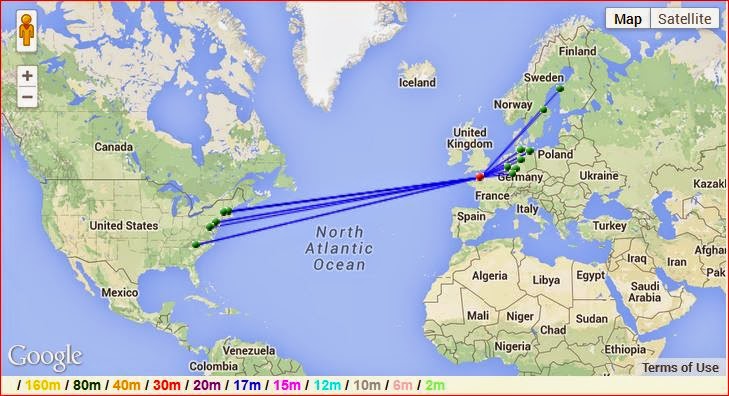
Bam! There was TM70UTAH loud as all get out! This is a Special Event station, commemorating the 70th anniversary of the Allied landing at Utah Beach on D-Day in 1944. First call and they were in the books! I have to admit, I was so excited when I heard them that I had to send my call a few extra times as I fumbled it in my eagerness to work them. I did hear a confirmation of W2LJ come back to me and I was smiling ear to ear. Next, just a few KHz down, I heard SP3DOF calling “CQ DX”. One call and I was in Jerzy’s logbook.
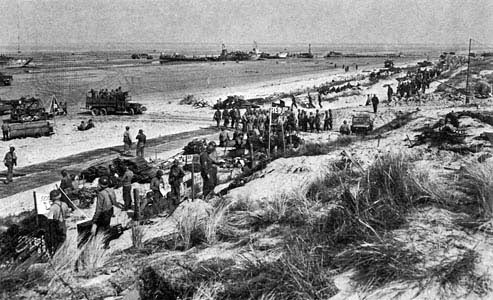
Wow! A WWII Special Event station and a Polish DX station worked within a few minutes of each other – a red letter day as far as I’m concerned. And all this was after I was tempted to throw in the towel for the day. So it’s a good reminder (to myself included) to keep throwing that fishing line back into the water. You never know what’s going to land on the hook.

The funny thing is, that TM70UTAH wasn’t even mentioned in that ARRL article on D-Day Special Event stations that I posted from the ARRL just a few days ago. So in addition to TM70JUN, keep an ear open for TM70UTAH. I would like to work both of them!
72 de Larry W2LJ
QRP – When you care to send the very least!













