Archive for the ‘dx’ Category
 The bands are slipping
 July 21st, 2014 |
  Author:
 Band conditions seem to have vastly deteriorated from what they were just a few months ago. It’s not that propagation is non-existent, it’s just that it seems to have left us in a bigger hurry than I would have thought.
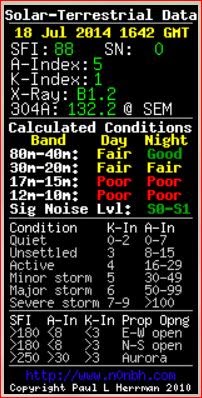
I went out at lunchtime today (around 1730Z) to find activity on 15 Meters to be nil. A quick scan of 17 Meters revealed not so much. Just a few months ago, both these bands were hopping with all kinds of DX. It wasn’t all that rare to hear Europe, South America and Asia all at the same time! It wasn’t all that rare to hear a good amount of activity on 12 and 10 Meters just a few short months ago.
Since 15 and 17 seemed inactive, I went to 14.061 MHz and called CQ after QRLing to make sure the frequency was dead. I was answered by fellow New Jerseyan, QRPer and blogger, Chris KQ2RP who gave me a 559 from Maine.
After that, I worked fellow Polar Bear, Ken WA8REI who is having a hard time enduring the heat and humidity in Michigan. It’s hard to put up with the Temperature Humidity Index when you have so much fur! 😉 Ken was a good solid 579 here when the QSB wasn’t wreaking havoc. We had a nice little chat and then it was time for Ken to go, and my available lunchtime minutes were growing short, too.
Before heading in, I decided to check out 17 Meters one more time. There, blasting in at 599+ was GA14CG, the Special Event Station for the 2014 Commonwealth Games in Scotland. There was a bit of a pileup, but he was so loud that I figured that I could work him, if only I could place myself correctly.

With time running short, I was able to eventually find the right spot. GA14CG was using the ol’ racetrack pattern scheme. Start at a frequency, move a bit higher after each call, reach a high point and then continue to work stations, moving a bit lower after each QSO until arriving at starting point and starting the process all over again. Essentially, he was doing laps, which I guess was appropriate considering it’s the Commonwealth Games. I placed myself correctly on the return trip home and got into the log. They’re on the air until August 3rd, so you have plenty of time to work them.
72 de Larry W2LJ
QRP – When you care to send the very least!
SOTA
I worked three stations this lunchtime. It takes me a little bit longer (about a minute or two) to get out to the car in the parking lot wearing this orthopedic boot on my foot. Common sense tells me that I should stay inside and go find a quiet place to sit down and read, rather than walking on this. But I was never accused of having an overabundance of common sense, so ……… out to the parking area I went.
I worked two stations on 17 Meters and one on 20 Meters. DL2DX, Joe was coming in like gangbusters on 17 Meters. He was calling CQ over and over with no takers. I just couldn’t let him think that he wasn’t being heard. I told Joe that he was 599+ and got a 569 back in return.
I also worked W1AW/4 in South Carolina. That took a bit of doing as there was quite the pileup and my 5 Watts was being drowned out by European stations. But I stuck with it and got in the log after I figured out their “listening pattern” and conveniently plopped myself down in the middle of it.
The coolest QSO of the session was on 20 Meters with George WB5USB who was on SOTA peak W5N/PW-019 in the Pecos Wilderness of New Mexico. (Turns out that was probably a 2X KX3 QSO, to boot!)
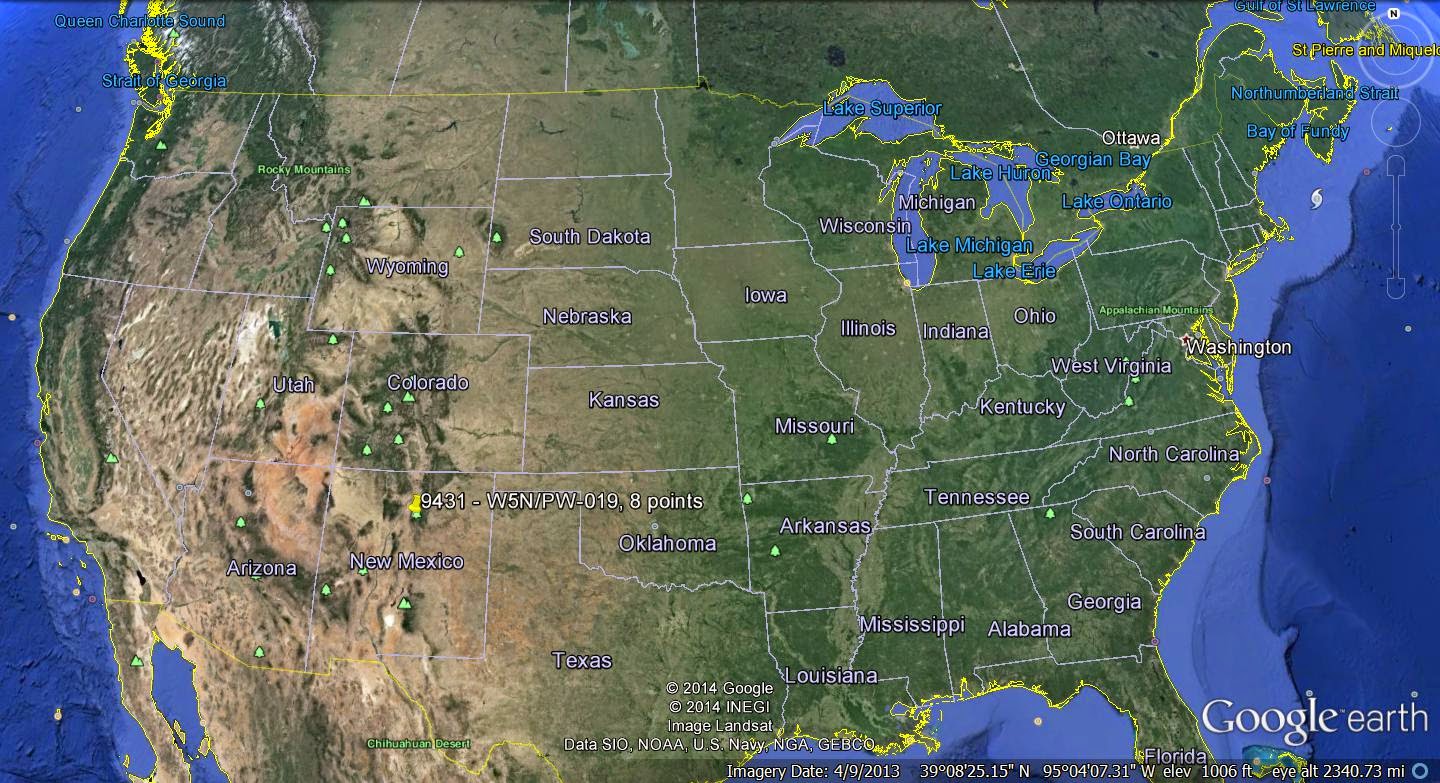
I gave George a 449, which he was when QSB was at a minimum. When the fading was the worst, George was about 339. I got a 529 in return.
I am fascinated by SOTA and the process of going to activate a mountain. Maybe it’s because of growing up here in New Jersey and not really having a lot of mountains in the area to go to. I have always lived on the Piedmont. What we do have of bonafide mountains lay in the northwest corner of the state, where the Appalachians run through New Jersey. They’re about an hour or so from my house, by car.
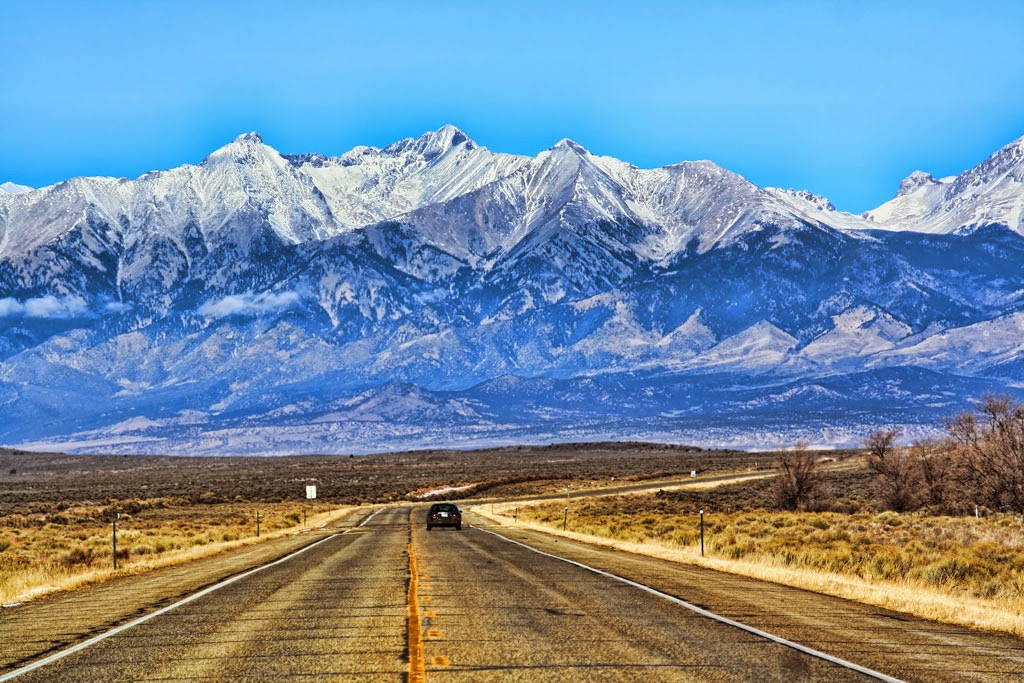
Years ago when I worked for Sinar Bron, I had the opportunity to visit the Art Center College of Design in Denver to do some maintenance on their view cameras and studio strobes. While we were there, we took a ride out into the surrounding countryside and the mountains. Now the Rockies are what you would call REAL mountains – to the folks out there, the Appalachians would really be just huge, gigantic hills by comparison. Having seen both, I’d have to agree. That doesn’t take anything away from the grandeur of the Appalachians, but they’re just different from the Rockies. The Appalachians are a lot older, from a geophysical standpoint, and they’ve had lots more time to erode into a smaller (altitude-wise) mountain range. To illustrate my point, Mount Mitchell in North Carolina is the tallest Appalachian Mountain. At it’s peak, you are at an altitude of 6,684 feet (2,037 Meters). The mountain that George was on today? 9,431 feet (2,875 Meters) – and that’s nowhere near the highest Rocky Mountain.
I’ve been fortunate to have seen the Alps while in Switzerland, they’re a whole different story and they just take your breath away!
Someday, when I’m through with this rat race we call the work world, I would really love to operate from a SOTA peak (out West), even if it’s just one time.
72 de Larry W2LJ
QRP – When you care to send the very least!
17 Meters was decent
I managed to hobble out to my car at lunch time today. The weather was decent, but my right foot isn’t. Seems I aggravated the same tendons and ligaments that I had a few years ago – so now I’m wearing “the boot” for the next week or so. Sigh.
Anyway, after the past couple of days of torrential rain, the skies were blue and sunny today. The temperatures were downright pleasant and 17 Meters seemed to be hopping.
I worked CT8/DL5NUA, CR5W, and J79BH. So – I reached the Azores, Portugal and Dominica – not terrible.
In other news, we have 118 Skeeters signed up for the Hunt on August 10th. Still plenty of time to sign up. We could use more participation from the West Coast states – HINT, HINT, HINT!
I also attended a meeting of SPARC, the South Plainfield Amateur Radio Club. We reviewed our Field Day effort and claimed score before officially sending our entry off to the ARRL. We also started making some basic plan changes for next year. It’s so nice to know that my fellow club members had a good enough time with a QRP Field Day that they want to do it again next year!
By the way, if you want to read the local newspaper’s account of our Field Day – here’s the link: http://tinyurl.com/ls56z6u. I think they did a very good job, even though they did get some of the details wrong (like our callsign, for example). But on the whole it was an excellent article which put Amateur Radio in a very positive light.
72 de Larry W2LJ
QRP – When you care to send the very least!
Sailing into a DX Sunset
The Cass Award encourages DXpeditions to maximize the number of DXers worked with a $1000 prize for the single-operator that works the most unique call signs within a specified interval. This award honors the wisdom and spirit of Cass, WA6AUD (SK), whose stories in the West Coast DX Bulletin taught a generation of DXers that DX IS!
It rewards simplicity in DX operations and ironically, had the award existed back in the early 1960’s, one particular fellow might have won it several years in a row…
Don Miller, ex-W9WNV and now AE6IY was in Dayton this year and spent time pressing the flesh at the DX Banquet and making noise about returning to Thailand for one final, grand, DX operation. That bit of news has gone mostly unreported — at least I’ve not seen anything about it.
Maybe he wasn’t serious, but I doubt it. I think he’s making plans to go…
Miller came along during a golden age for DXpeditioning. In those halcyon days, a fellow might get into a small sailboat and circumnavigate the globe with amateur radio along for the ride. Compare sailing into a Pacific sunset on a small skiff with a modern DX operation where 100 tons of equipment are delivered by helicopter on some island location while a team of twenty operators set it all up and run the show from an air-conditioned quonset hut. I think you get my point…
By all accounts, Don Miller was a phenomenal operator, capable of sending CW with one hand and logging with the other – using pencil and paper. A sharp mind, keen memory, and wizard-like skills with the radio made him a legend.
But W9WNV took a few shortcuts on certain operations and may not actually have operated from all the places he claimed. And he may have legitimately operated from some locations that were not legal places for him to be. This was in the days before the DXCC rules had been made rigid like they are today — mostly thanks to Don Miller.
The ARRL defamed him, he sued them and they settled out of court. It became an ugly season for amateur radio. Miller might have made a comeback and fixed his reputation with time and trust me, you hand out Q’s from a rare one, and the DX community would rally in support. But a few years later Miller was accused of hiring someone to kill his wife and he ended up doing more than twenty years in prison.
He became ham radio’s “bad boy” who cheated on DX and took a sizable chunk of League money in the settlement. Unable to defend himself from a prison cell, his reputation tanked. When he finally got out in the early part of the 21st century, his first move was to take, and pass, the Extra class exam. He was issued the call AE6IY. That same year he visited the Dayton Hamvention where he offered an apology to the DX Community at one of the most popular DX forums.
I was there. I saw it happen.
Now Don Miller is a decade older and has entered the “winter” of his life. Who knows if he will actually be able to mount one last notable operation. But he wants to try. And who are we to hold back the dreams of a legend?
There’s a whole lot more to the W9WNV story, way more than I could ever relate here. Fortunately, he was interviewed soon after his release from prison and those recordings tell his story, in his own words and voice better than anyone else ever could. You really should download them and have a listen someday when the bands are quiet and your mind is still. It’s a compelling tale of ham radio adventure unlike any other and it deserves to be heard.


CALLING ALL RADIO AMATEURS – THIS IS W1AW IN NEWINGTON, CT
I would suspect that if you have done even a bit of tuning around the HF dial in the last few months, you have probably heard W1AW/0-9 making contacts. This week W1AW, the ARRL mothership in Newington, CT, has been on the air as W100AW in celebration of the ARRL anniversary.
As busy as that sounds, W1AW is consistently on the air with a great variety of activities. Yesterday I took the opportunity to copy their digital modes broadcast. http://www.arrl.org/digital-transmissions
ARRL has various means of promulgating a great deal of information. The primary way I usually receive a good portion of it is via email. I thought it would be interesting if I could try and copy their digital transmission of their bulletin, which I was able to do yesterday.
Every weekday, W1AW sends out a bulletin twice a day on multiple bands while rotating through three different digital modes: Baudot (RTTY), PSK31, MFSK16. The first broadcast kicked off at 5pm (local) which I was able to copy of 17M (18.105 MHz). It appears to be ARRL’s propagation bulletin. Here is what I copied:

Please find my full copy here.
Later in the evening (8pm local), I copied the next broadcast which looks like their DX bulletin:

…. and the complete text is here.
During the 8pm transmission, I was able to copy the bulletin on 10M, 15M, 17M, and 20M. I could not find it on 40M or 80M.
Although these bulletins are easily obtainable via email or from ARRL’s website, I enjoyed copying the broadcast from here in eastern Kansas.
Check out the sunspots!
Just before the 4th of July, several sunspot regions rotated into view. Today, they are significant players in elevating the solar output of Extreme Ultraviolet energy — the energy helpful in ionizing the F-region of our Earth’s ionosphere. That, in turn, means better propagation conditions, even on higher shortwave frequencies.

As seen by the Solar Dynamics Observatory, the Sun is sporting quite a few sunspots, today. These are helping elevate the 10.7-cm flux, which is a proxy for solar output that strengthens the ionospheric propagation of higher frequencies in the shortwave spectrum. Expect good conditions on HF, this weekend.
73 and best DX!
Space Weather, HF Radio Propagation – The Interview on ‘Ham Radio Now’
Why would an amateur radio operator be interested in space weather? Is it worth the time and resources to forecast propagation, in the daily operation of a typical ham radio station?
Gary, host of the popular ‘Ham Radio Now’ video podcast, talks with Tomas Hood (NW7US), propagation and space weather columnist for CQ Amateur Radio Magazine (and in the late ‘Popular Communications Magazine’ as well as ‘CQ VHF Quarterly Magazine’) and The Spectrum Monitor Magazine. Gary discusses with Tomas how scientists forecast space weather, and how the average ham radio operator can also make predictions, and what propagation forecasting can bring to the daily operations of an amateur radio enthusiast.
Watch on YouTube: ‘Ham Radio Now’ Episode 156: Propagation…

Tomas, NW7US, talks about radio propagation on shortwave (HF) as well as space weather.













