Archive for the ‘dx’ Category
 Magic Band And The DX Window
 June 3rd, 2016 |
  Author:
Late May and early June always sees 6m come to life ... sometimes slowly and sometimes with a 'bang'. Last year's good early start soon flickered-out into what was the poorest sporadic-e season that many could recall. This year's 'start' has almost been a no-show, with just a very few short openings to the south eastern states (Colorado, Utah) and one 'blink and you've missed it' opening to the Great Lakes.
Hopefully the 6m propagation gods are just having some fun with us and things will really spring to life shortly. Once we do get into some periods of good propagation, there are always new arrivals to the band, as most transceivers these days include the 6m band. Every season I hear of newcomers getting their knuckles wrapped for, probably unknowingly and in all innocence, operating inside the 'DX Window'.
If you're new to the band or perhaps not sure how the window should work, here's a short section taken from my Magicband web page, that explains the concept:
Don't Be A 'DX-Window' Lid!
One of the quickest ways to get the 6m community saying nasty things about you behind your back is to mess-up in the DX Window. The DX Window (50.100 - 50.125 kHz) has long been established for one type of contact only, that being a legitimate DX QSO.
The DX Window can only be of value if everyone follows these basic 'rules':
If you are in the U.S.A. or Canada, DO NOT WORK ANY OTHER U.S.A. or CANADIAN STATIONS INSIDE THE WINDOW. The window is NOT for North America - North America contacts.
Do not answer the "CQ" of U.S.A. or VE stations if you are in North America. This creates unnecessary QRM and chances are, they will not respond to your answer anyway. Calling or answering other North Americans in the DX-Window only reinforces bad operating habits, encouraging newcomers to do the same. If you want to work U.S.A. or CANADA, do it outside the DX Window!
Work or call only stations outside of North America inside the DX Window.
The only legitimate exception to these rules, that will not get you in the naughty-corner, is working a KL7, VE8, XE or some other such fairly rare North Americans.
I hate to say it, but some of the worst offenders to the successful function of the DX Window are my fellow VE's, many of whom don't know or don't understand the simple concept of how it works. Now that you know, pass it on!
Now, you may or may not agree with the concept of a DX window, so please don't shoot the messenger. What I do know however, is that if everyone does their best to adhere to the window's concept, it works well. Problems arise when those that should know better, and probably do, decide that for some reason, the concept doesn't apply to them or that it won't hurt, 'just this once'. Others, particularly newcomers, see it and think it's all OK and soon the window is full of domestic QSO's, effectively killing its usefulness.
As conditions slowly improve, hopefully we can work on six this summer. I usually hang out on CW, just below 50.100. As one long-time 6m diehard would often say to me, the newcomer over 40 years ago ... 'We'll see you, all of a sudden!"
Bureau QSL Batch
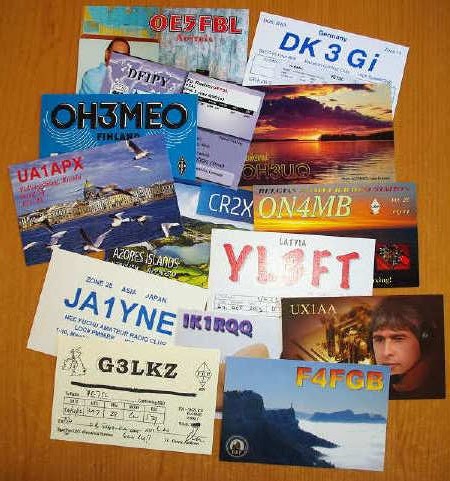
The batch of bureau cards last week included several cards from Europe and were probably the last I'll get for my Cycle 24 10m fun, using the homebrew Tri-Tet-Ten.
As mentioned previously, this rig was the culmination of wondering, for many many years, if I could get a single 6L6 to work well enough on 10m CW, using a 40m crystal ... quadrupling to 10m ... and still have enough useful output to work Europe! As well, the note would have to be 'acceptable' as I realized that any crystal chirping would be multiplied four times, during the quadrupling process.
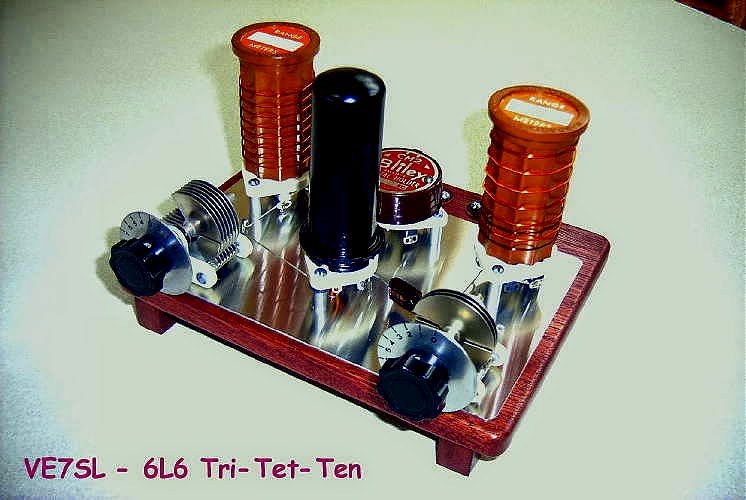
The evolution of my eventual transmitter, is described in more detail here, where you can also hear what the tone sounds like. Suffice to say, the results were much more than I had ever hoped for and during the peak years of this past cycle, many enjoyable hours were spent on 10m CW with my one tube tri-tet crystal oscillator.
I guess I could always move down to 20m CW but, for me, this just doesn't have the same appeal or sense of satisfaction as using it on 10m or what I like to call, "the other magic band". Who knows what Cycle 25 will bring to 10m? I may get another chance yet, if the solar prognosticators are all wrong!
VK4YB Lights Up West Coast On 630m
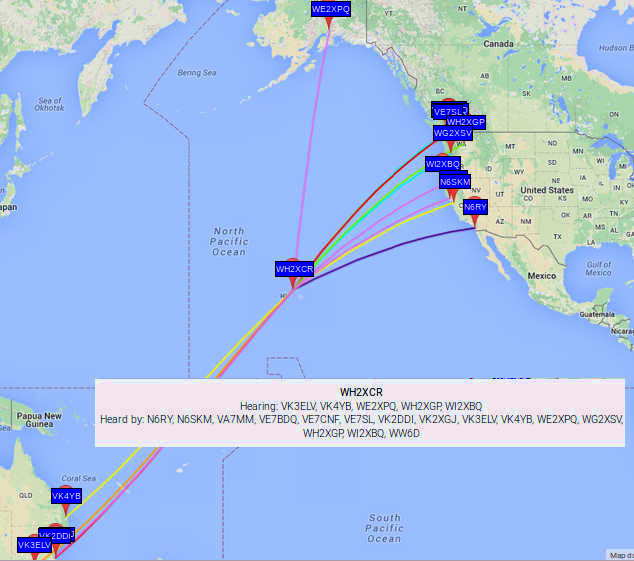 The past few weeks have seen many of the VK 630m WSPR stations making it into North America's west coast and points east. VK2DDI, VK2XGJ, VK3ELV and VK4YB have been the signals most often seen. Particularly dominant is the signal from Roger, VK4YB, the northern-most station, located in Moorina, Queensland, near the Pacific Ocean.
Roger's signal has been decoded locally by myself as well as VE7BDQ and VA7MM, creating excitement over the more normal nightly spots from the central states.
2016-04-13 11:10 VK4YB 0.475646 -28 QG62ku 5 VA7MM CN89og
2016-04-13 11:20 VK4YB 0.475647 -29 QG62ku 5 VA7MM CN89og
2016-04-13 11:28 VK4YB 0.475647 -28 QG62ku 5 VA7MM CN89og
2016-04-13 11:28 VK4YB 0.475644 -23 QG62ku 5 VE7BDQ CN89la
2016-04-13 11:36 VK4YB 0.475644 -26 QG62ku 5 VE7BDQ CN89la
2016-04-13 11:52 VK4YB 0.475643 -25 QG62ku 5 VE7BDQCN89la
2016-04-13 11:56 VK4YB 0.475643 -28 QG62ku 5 VE7BDQ CN89la
2016-04-07 08:54 VK4YB 0.475643 -25 QG62ku 5 VE7SL CN88iu
2016-04-07 09:36 VK4YB 0.475644 -29 QG62ku 5 VE7SL CN88iu
2016-04-07 10:08 VK4YB 0.475644 -29 QG62ku 5 VE7SL CN88iu
2016-04-07 10:18 VK4YB 0.475644 -29 QG62ku 5 VE7SL CN88iu
2016-04-07 11:04 VK4YB 0.475644 -29 QG62ku 5 VE7SL CN88iu
2016-04-13 11:06 VK4YB 0.475644 -24 QG62ku 5 VE7SL CN88iu
2016-04-13 11:10 VK4YB 0.475644 -23 QG62ku 5 VE7SL CN88iu
2016-04-13 11:20 VK4YB 0.475644 -23 QG62ku 5 VE7SL CN88iu
2016-04-13 11:28 VK4YB 0.475644 -28 QG62ku 5 VE7SL CN88iu
2016-04-13 11:32 VK4YB 0.475644 -25 QG62ku 5 VE7SL CN88iu
2016-04-13 11:52 VK4YB 0.475643 -18 QG62ku 5 VE7SL CN88iu
2016-04-13 11:56 VK4YB 0.475643 -22 QG62ku 5 VE7SL CN88iu
2016-04-13 12:16 VK4YB 0.475643 -27 QG62ku 5 VE7SL CN88iu
2016-04-13 12:28 VK4YB 0.475643 -26 QG62ku 5 VE7SL CN88iu
2016-04-13 12:32 VK4YB 0.475643 -25 QG62ku 5 VE7SL CN88iu
2016-04-13 12:54 VK4YB 0.475644 -24 QG62ku 5 VE7SL CN88iu
2016-04-13 12:58 VK4YB 0.475643 -24 QG62ku 5 VE7SL CN88iu
2016-04-13 13:10 VK4YB 0.475643 -25 QG62ku 5 VE7SL CN88iu
2016-04-13 13:24 VK4YB 0.475643 -27 QG62ku 5 VE7SL CN88iu
2016-04-13 13:28 VK4YB 0.475643 -27 QG62ku 5 VE7SL CN88iu
Roger has sent the following information to me regarding his well-planned system:
My QTH is atop of a stony ridge on 10 acres. The previous owner said there was some soil somewhere, but I haven't found it yet! Ground conductivity is very poor, I think. If you drive in two stakes about six inches apart, an ohmmeter says infinity. That's if you can drive in a stake. Because after the first quarter inch you hit shale rock. Interestingly the shale layers are at about 60 degrees to the horizontal. There are some quartz inclusions. Yes, I have tried crushing the quartz and panning it - no gold!
Getting back to my story, I needed to put up a 630m antenna in a hurry. The idea of winding a big loading coil with the rotatable inner coil was a bit daunting. And putting down ground radials or an earth mat was out of the question. So, using only some wire, string and a bow and arrow, this is what I came up with:
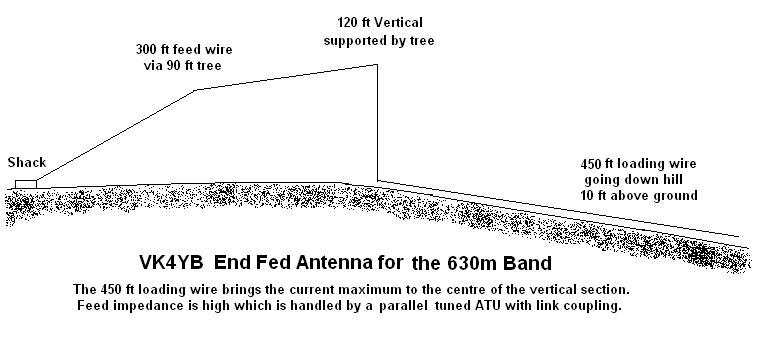
I estimate the feed point impedance is about 3000 ohms. The ATU has 48 turns on the secondary, tuned by fixed capacitors of 960 pF in parallel with a 500 pF variable which is about two thirds meshed. The primary is 5 turns fed by the transverter having a 50 ohm nominal output. The impedance at the top of the secondary should be near 5000 ohms, but the antenna feed wire is tapped about two thirds of the way up the secondary coil, which gives 1.03 : 1 SWR. The earthy end of the coil is connected to the mains earth and the metal work of the shed. I haven't tried terminating the far end. I did think about connecting it to the fence wire that runs round the property but I thought that might be a bit dangerous. There would be high voltage points in places. The transverter output is nominally 50 watts, but it is giving about 90 watts in reality.
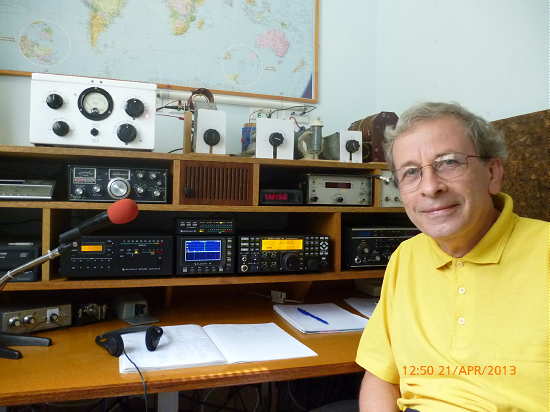 |
| Roger - VK4YB |
Thirty Minutes of Dazzle: The Sun in UHD 4K by SDO (NASA)
Take a front-seat view of the Sun in this 30-minute ultra-high definition movie in which NASA SDO gives us a stunning look at our nearest star.
This movie provides a 30-minute window to the Sun as seen by NASA’s Solar Dynamics Observatory (SDO), which measures the irradiance of the Sun that produces the ionosphere. SDO also measures the sources of that radiation and how they evolve.
SDO’s Atmospheric Imaging Assembly (AIA) captures a shot of the sun every 12 seconds in 10 different wavelengths. The images shown here are based on a wavelength of 171 angstroms, which is in the extreme ultraviolet range and shows solar material at around 600,000 Kelvin (about 1 million degrees F.) In this wavelength it is easy to see the sun’s 25-day rotation.
The distance between the SDO spacecraft and the sun varies over time. The image is, however, remarkably consistent and stable despite the fact that SDO orbits Earth at 6,876 mph and the Earth orbits the sun at 67,062 miles per hour.
Scientists study these images to better understand the complex electromagnetic system causing the constant movement on the sun, which can ultimately have an effect closer to Earth, too: Flares and another type of solar explosion called coronal mass ejections can sometimes disrupt technology in space. Moreover, studying our closest star is one way of learning about other stars in the galaxy. NASA’s Goddard Space Flight Center in Greenbelt, Maryland. built, operates, and manages the SDO spacecraft for NASA’s Science Mission Directorate in Washington, D.C.
Charged particles are created in our atmosphere by the intense X-rays produced by a solar flare. The solar wind, a continuous stream of plasma (charged particles), leaves the Sun and fills the solar system with charged particles and magnetic field. There are times when the Sun also releases billions of tons of plasma in what are called coronal mass ejections. When these enormous clouds of material or bright flashes of X-rays hit the Earth they change the upper atmosphere. It is changes like these that make space weather interesting.
Sit back and enjoy this half-hour 4k video of our Star! Then, share. 🙂
73 dit dit
Seven To Go

Confirmed DXCC entity #332 arrived in the mail last week. With a total of 339 active DXCC entities, this leaves just seven to go.
Although I had worked Tunisia a couple of years ago on 15m, I was never able to get the contact confirmed. In spite of sending an SAE and green stamps for postage, 3V8HQ's several promises of his card 'soon to be mailed', proved to be hollow.
The contact with 3V8HQ was my first and only one with Tunisia, since being licenced in 1963. The low level of ham radio activity from 3V8 combined with the challenges of VE7 to Meditteranean Africa propagation, made it a difficult one to work.
 |
| courtesy: https://www.google.ca/maps |
My present confirmed list sitting at 332, combined with my 10 confirmed 'deleted' entities, brings the overall confirmed total to 342. The seven remaining entities will be very difficult, if not impossible, unless I live to be 150. They are:
FT/G, TO - Glorioso
HK0 - Malpelo Island
KP5 - Desecheo Island
P5 - N. Korea
SV/A - Mt. Athos
Z8 - S. Sudan
ZL9 - Auckland / Campbell Islands
A couple of these have been active in past recent years ... for some, I was asleep at the switch and for others, I was away travelling at the time. With solar conditions heading downhill quickly, and possibly staying there for many many years, the prospects of working these last seven is looking pretty bleak.
On the other hand, my favorite winter band (160m) should continue to improve. Last week also brought a new DXCC QSL for me on that band, A35T in Tonga, bringing my confirmed total on that band to 157.
Getting new entities from here on out will be increasingly challenging ... I guess I need to remember, that if it was easy, it just wouldn't be any fun!

DX, Artificial Scarcity and The List
 Economists see scarcity, supply and demand as fundamental forces in a market. Items that are scarce demand a higher price while items that are easy to obtain tend to have a lower price. A diamond is an example of something that is relatively scarce (and in demand) so it commands a high price. In contrast, wood is generally available and is much less expensive than diamonds.
Then there’s the concept of artificial scarcity. If some items can be made scarce (or even just appear scarce), the price will tend to increase. For example, if I own all of the banana trees on an isolated island, I could reduce the available supply of bananas and command a higher price from all of the banana eaters there. Or maybe I start screening bananas for quality and I put a special sticker on them to brand them as special.
 We have a case of artificial scarcity in ham radio, called the DXCC list. This list defines what is considered a separate country when chasing DX. (Actually, the correct term is entity, not country.) For example, Hawaii (KH6) and Alaska (KL7) are considered separate entities even though they are part of the United States. (See Is Alaska a Country?) For someone chasing DXCC entities, because Alaska is on The List, a radio contact with Alaska becomes more desirable. It’s kind of like putting a “premium sticker” on a banana to indicate that it is special.
In my imagination, the DXCC list resulted from a bunch of hams sitting around drinking beer and bragging about how many countries they had worked. One guy, Larry says he just worked Hawaii, bringing his total to 125 countries. His buddy Leroy says, “You can’t count Hawaii because it’s part of the US of A.” To which Larry says, “You bet I can count Hawaii…and Texas too. It’s a whole ‘nuther country.” Clearly, we are going to need an official list to keep track of what counts as a country. A more credible version of how the list got established is captured in this article from the October 1935 QST.
Of course, the two main factors that drive scarcity of DXCC entities is the ham radio population and ease of access. Radio contacts are easy to make with entities that have an active ham population. If an entity doesn’t have many active hams but is easy to get to, someone will probably put that location on the air once in a while. On the other hand, some locations are unpopulated and really difficult to get to. These are not only on The List, they are on The Most Wanted List.
Kingman Reef (KH5) was just deleted from The List, instantly changing it from one of the most desired contacts in amateur radio to a big giant Why Bother. You see, there used to be 340 countries on the list but now there’s only 339. Kingman Reef will now be considered part of Palmyra/Jarvis, so it still has value for DXCC, just a lot less.
As I write this article, there is a major DXpedition (VKØEK) operating from Heard Island, an unpopulated island near Antartica. The only reason those guys are there is that Heard Island is on The List. Take a look at their web site and you’ll see how much time and energy has gone into activating this lonely island. Drop it from the list and suddenly a radio contact with this location is a lot less in demand.
So try to keep this all in perspective. There are lots of radio contacts out there to be made, some more interesting and desirable than others. It is appropriate and necessary that we have the DXCC list, to provide consistency in how we count countries, I mean entities. But really, it all traces back to Larry and Leroy arguing about who worked the most countries.
Thanks to the dedicated DXpeditioners that put these rare locations on the air.
73, Bob K0NR
The post DX, Artificial Scarcity and The List appeared first on The KØNR Radio Site.
TIS DX
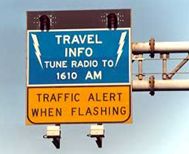 Have you ever wondered where those odd stations found at the ends of the AM broadcast band might be located and what they're all about? These are 'Traveller Information Stations' or 'TIS's and, 'Highway Advisory Radio' (HAR) stations. Because of their low power (100mw - 10W), they make challenging DX targets if you can catch the ID on their continually- repeated audio loop.
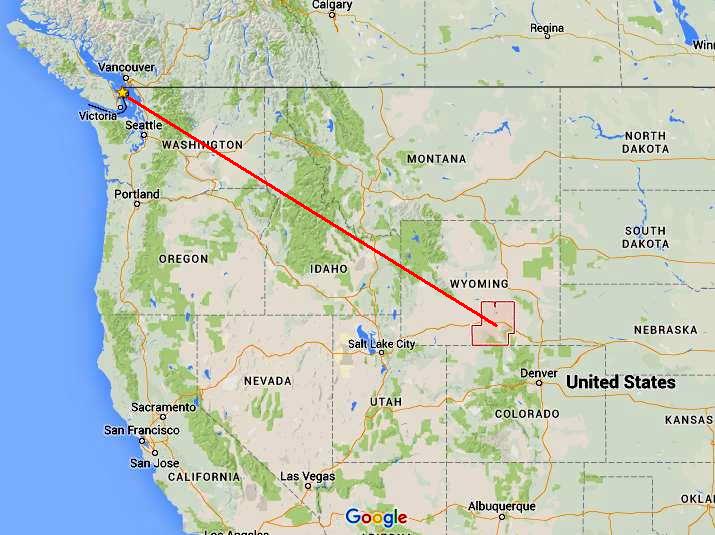
These stations are located throughout Canada and the USA at places such as highway intersections, border crossings, ferry terminals, airports and parks ... just about any place that needs to advise travellers (vehicles) with up-to-date directions or information. From here on Mayne Island, the farthest TIS I have been able to identify was WPTC509, located in Carbon County, Wyoming.
 |
| courtesy: https://www.google.ca/maps |
IRCA TIS/HAR LIST (Winter 2016)
The IRCA TIS/HAR LIST lists all US and Canadian TIS/HAR stations, by frequency, including call letters, state (province,) city, county, licensee, address, coordinates, expiration date and dates of DXM/DXN reports/sources. It has been updated with FCC data, DXM, DXN and DXer reports, and on-line listings through March 1 2016.
The 2016 IRCA TIS/HAR LIST is posted on the IRCA website for all to download. The link is: http://www.ircaonline.org/TIS_2016.pdf.
For those preferring a hard copy, one can be ordered from the IRCA.
As well, this page on regulations, permitted content and TIS history has some interesting info.
IRCA is one of the oldest clubs dedicated to DXing the broadcast bands and members receive a monthly journal of members loggings as well as other relevant articles. A trip to the IRCA website might get you hooked on this part of the radio hobby as it's probably the way that most amateurs discovered the 'magic of radio', on late winter nights! Just in case you need it, the mwlist will help you identify any stations heard in the AM broadcast band, worldwide.













