Archive for the ‘dx’ Category
 Seven To Go
 April 12th, 2016 |
  Author:
Confirmed DXCC entity #332 arrived in the mail last week. With a total of 339 active DXCC entities, this leaves just seven to go.
Although I had worked Tunisia a couple of years ago on 15m, I was never able to get the contact confirmed. In spite of sending an SAE and green stamps for postage, 3V8HQ's several promises of his card 'soon to be mailed', proved to be hollow.
The contact with 3V8HQ was my first and only one with Tunisia, since being licenced in 1963. The low level of ham radio activity from 3V8 combined with the challenges of VE7 to Meditteranean Africa propagation, made it a difficult one to work.
 |
| courtesy: https://www.google.ca/maps |
My present confirmed list sitting at 332, combined with my 10 confirmed 'deleted' entities, brings the overall confirmed total to 342. The seven remaining entities will be very difficult, if not impossible, unless I live to be 150. They are:
FT/G, TO - Glorioso
HK0 - Malpelo Island
KP5 - Desecheo Island
P5 - N. Korea
SV/A - Mt. Athos
Z8 - S. Sudan
ZL9 - Auckland / Campbell Islands
A couple of these have been active in past recent years ... for some, I was asleep at the switch and for others, I was away travelling at the time. With solar conditions heading downhill quickly, and possibly staying there for many many years, the prospects of working these last seven is looking pretty bleak.
On the other hand, my favorite winter band (160m) should continue to improve. Last week also brought a new DXCC QSL for me on that band, A35T in Tonga, bringing my confirmed total on that band to 157.
Getting new entities from here on out will be increasingly challenging ... I guess I need to remember, that if it was easy, it just wouldn't be any fun!

DX, Artificial Scarcity and The List
 Economists see scarcity, supply and demand as fundamental forces in a market. Items that are scarce demand a higher price while items that are easy to obtain tend to have a lower price. A diamond is an example of something that is relatively scarce (and in demand) so it commands a high price. In contrast, wood is generally available and is much less expensive than diamonds.
Then there’s the concept of artificial scarcity. If some items can be made scarce (or even just appear scarce), the price will tend to increase. For example, if I own all of the banana trees on an isolated island, I could reduce the available supply of bananas and command a higher price from all of the banana eaters there. Or maybe I start screening bananas for quality and I put a special sticker on them to brand them as special.
 We have a case of artificial scarcity in ham radio, called the DXCC list. This list defines what is considered a separate country when chasing DX. (Actually, the correct term is entity, not country.) For example, Hawaii (KH6) and Alaska (KL7) are considered separate entities even though they are part of the United States. (See Is Alaska a Country?) For someone chasing DXCC entities, because Alaska is on The List, a radio contact with Alaska becomes more desirable. It’s kind of like putting a “premium sticker” on a banana to indicate that it is special.
In my imagination, the DXCC list resulted from a bunch of hams sitting around drinking beer and bragging about how many countries they had worked. One guy, Larry says he just worked Hawaii, bringing his total to 125 countries. His buddy Leroy says, “You can’t count Hawaii because it’s part of the US of A.” To which Larry says, “You bet I can count Hawaii…and Texas too. It’s a whole ‘nuther country.” Clearly, we are going to need an official list to keep track of what counts as a country. A more credible version of how the list got established is captured in this article from the October 1935 QST.
Of course, the two main factors that drive scarcity of DXCC entities is the ham radio population and ease of access. Radio contacts are easy to make with entities that have an active ham population. If an entity doesn’t have many active hams but is easy to get to, someone will probably put that location on the air once in a while. On the other hand, some locations are unpopulated and really difficult to get to. These are not only on The List, they are on The Most Wanted List.
Kingman Reef (KH5) was just deleted from The List, instantly changing it from one of the most desired contacts in amateur radio to a big giant Why Bother. You see, there used to be 340 countries on the list but now there’s only 339. Kingman Reef will now be considered part of Palmyra/Jarvis, so it still has value for DXCC, just a lot less.
As I write this article, there is a major DXpedition (VKØEK) operating from Heard Island, an unpopulated island near Antartica. The only reason those guys are there is that Heard Island is on The List. Take a look at their web site and you’ll see how much time and energy has gone into activating this lonely island. Drop it from the list and suddenly a radio contact with this location is a lot less in demand.
So try to keep this all in perspective. There are lots of radio contacts out there to be made, some more interesting and desirable than others. It is appropriate and necessary that we have the DXCC list, to provide consistency in how we count countries, I mean entities. But really, it all traces back to Larry and Leroy arguing about who worked the most countries.
Thanks to the dedicated DXpeditioners that put these rare locations on the air.
73, Bob K0NR
The post DX, Artificial Scarcity and The List appeared first on The KØNR Radio Site.
TIS DX
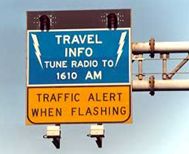 Have you ever wondered where those odd stations found at the ends of the AM broadcast band might be located and what they're all about? These are 'Traveller Information Stations' or 'TIS's and, 'Highway Advisory Radio' (HAR) stations. Because of their low power (100mw - 10W), they make challenging DX targets if you can catch the ID on their continually- repeated audio loop.
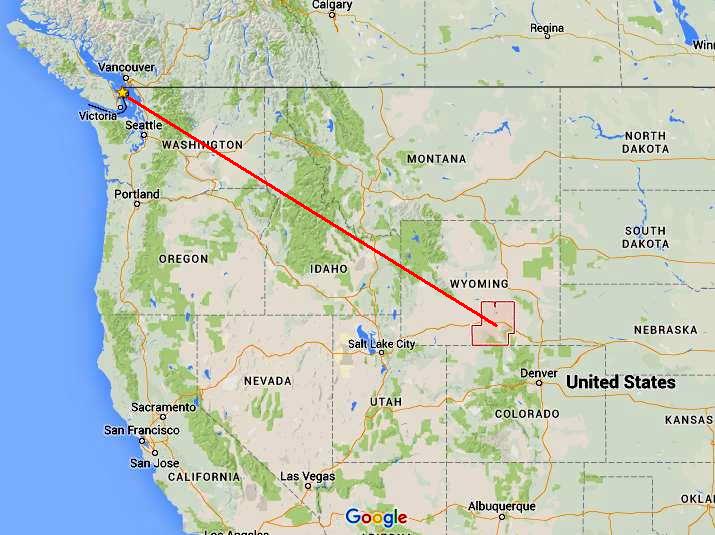
These stations are located throughout Canada and the USA at places such as highway intersections, border crossings, ferry terminals, airports and parks ... just about any place that needs to advise travellers (vehicles) with up-to-date directions or information. From here on Mayne Island, the farthest TIS I have been able to identify was WPTC509, located in Carbon County, Wyoming.
 |
| courtesy: https://www.google.ca/maps |
IRCA TIS/HAR LIST (Winter 2016)
The IRCA TIS/HAR LIST lists all US and Canadian TIS/HAR stations, by frequency, including call letters, state (province,) city, county, licensee, address, coordinates, expiration date and dates of DXM/DXN reports/sources. It has been updated with FCC data, DXM, DXN and DXer reports, and on-line listings through March 1 2016.
The 2016 IRCA TIS/HAR LIST is posted on the IRCA website for all to download. The link is: http://www.ircaonline.org/TIS_2016.pdf.
For those preferring a hard copy, one can be ordered from the IRCA.
As well, this page on regulations, permitted content and TIS history has some interesting info.
IRCA is one of the oldest clubs dedicated to DXing the broadcast bands and members receive a monthly journal of members loggings as well as other relevant articles. A trip to the IRCA website might get you hooked on this part of the radio hobby as it's probably the way that most amateurs discovered the 'magic of radio', on late winter nights! Just in case you need it, the mwlist will help you identify any stations heard in the AM broadcast band, worldwide.
March’s QRP EME Window
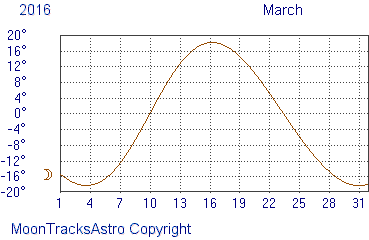 |
| Lunar declination track for March courtesy: http://www.moontracks.com/moon-declinations.html |
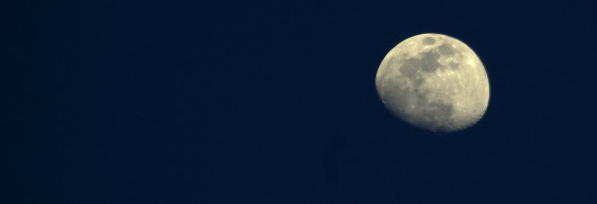
My minimal system (single 9el Yagi and 140w) makes it very easy to see the day to day changes in EME conditions due to various causes such as local geomagnetic conditions, Faraday rotation and libration fading ... or combinations of each! One of the days was particularly good, with numerous signals heard throughout the session while the next day was just the opposite, with only a few very weak signals and no contacts. On that particular day, I was being heard well by several European stations but was unable to hear any of them ... a true 'one-way' path and not uncommon on EME.
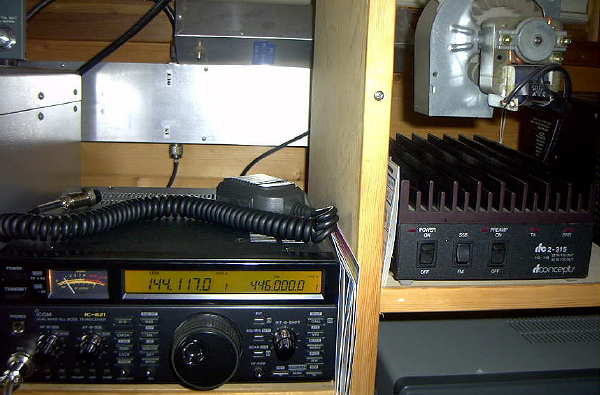 |
| My small EME station. Note old microwave oven blower on the 'brick' amplifier. |
Several smaller 4-Yagi stations were worked during the week, re-enforcing the benefits of having a moonrise over the ocean. As mentioned previously, the extra 6db of horizon gain allows my single 9el Yagi to perform more like a stack of four 9el Yagis. One of the fellows that I worked, DK5EW in Germany, asked if there was anything 'special' about my location that would make my very small station sound so strong at his end ... the ocean is clearly doing its job!
Altogether, 12 new stations were worked during March's window, bringing my total to 70 "initials". From the looks of the amount of activity, there are still many stations yet to work, that should be within range of my system.
Stations worked this week were:
I2FAK, UA3PTW, RZ3BA/1, SK5AA, PA2CHR, ES3RF, YO3JR, PA5Y, DK5EW, SM7GVF, EA4CYQ and W5ZN.
Three of these stations were using relatively compact antenna systems, consisting of 4x8el or 4x9el arrays, while the rest were larger. I have yet to tally up my DXCC or states total on 2m, but I know that W5ZN, in Arkansas, was a new state.
Up until this past week, the highest moon elevation that I have completed a QSO was with the moon at 18 degrees above the horizon. This week it was extended, at what is probably the limit of my fixed antenna, to 19.6 degrees when working ES3RF. At the other end of the scale, IK2FAK was worked with the moon at only .87 degrees high!
This month also provided my first glimpse of a 2m DX 'pileup', when J8/WW2DX in the Grenadine Islands showed up, calling CQ via the moon. My screen shot below shows at least 12 different stations calling him during his one-minute listening period ... some not yet 'warmed-up' as seen by their drifting oscillators.With several of the signals audible, it was an amazing thing to observe.
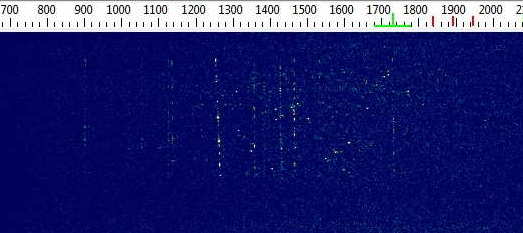 |
| 2m pile up on J8/WW2DX |
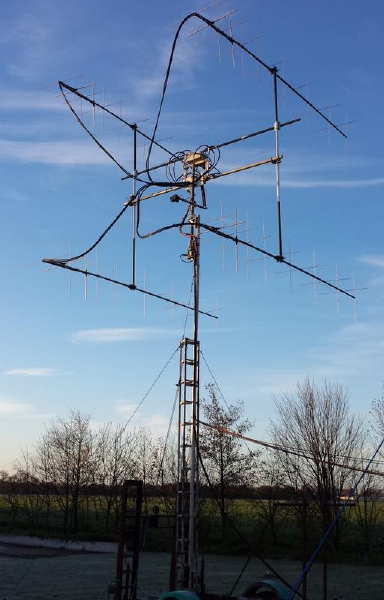 |
| The 4 x 8 el cross-polarized array of PA5Y |
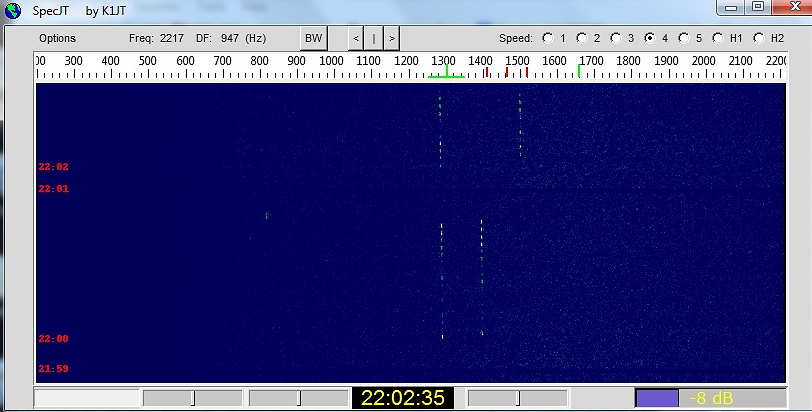 |
| YO8JR sending his 'RR' followed by '73' |
V29RW: Slacker DXpedition to Antigua
Recently, I had another opportunity to take ham radio along on vacation to a Caribbean island, this time to Antigua. This was not a super-gonzo turbo-charged DXpedition. I just worked in some radio action in between snorkeling and beach walking. This is referred to as a “holiday style” DXpedition, or maybe it’s just the slacker approach.
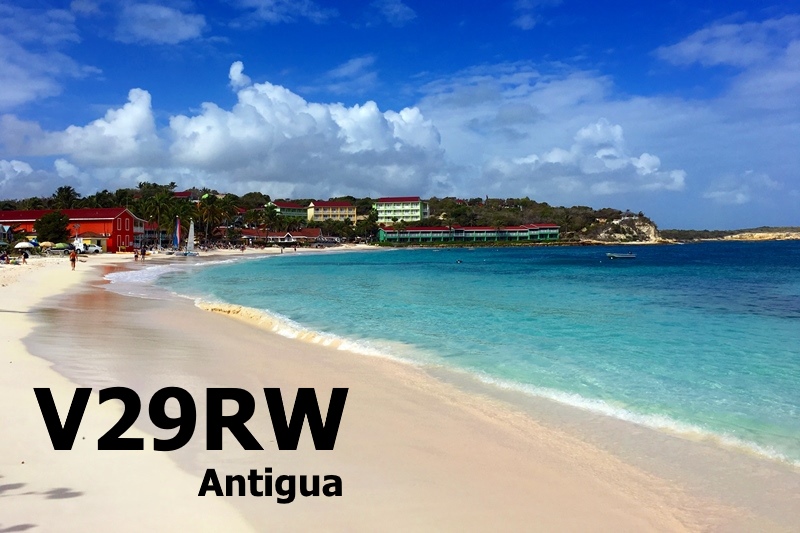
Radio Equipment
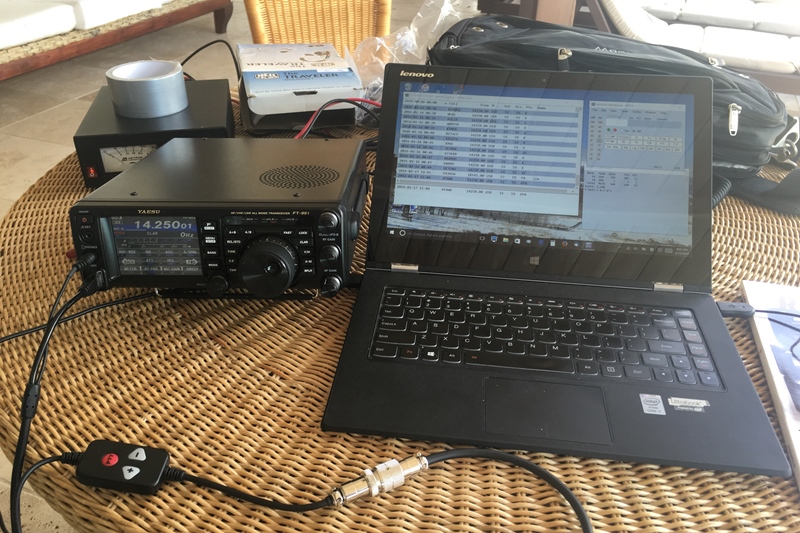
The radio gear needed to fit easily into my luggage. After all, we’ve got snorkel gear to take along. I wanted to put out a healthy signal from the island, so I rejected the idea of running QRP, opting instead for a 100W transmitter. Ultimately, I chose to take a Yaesu FT-991 which is full-power and full-featured but still relatively compact. It easily fit into my carry-on bag along with some other items. Having a built-in antenna tuner was a real plus and it was also good to have the 2m and 70 cm bands.
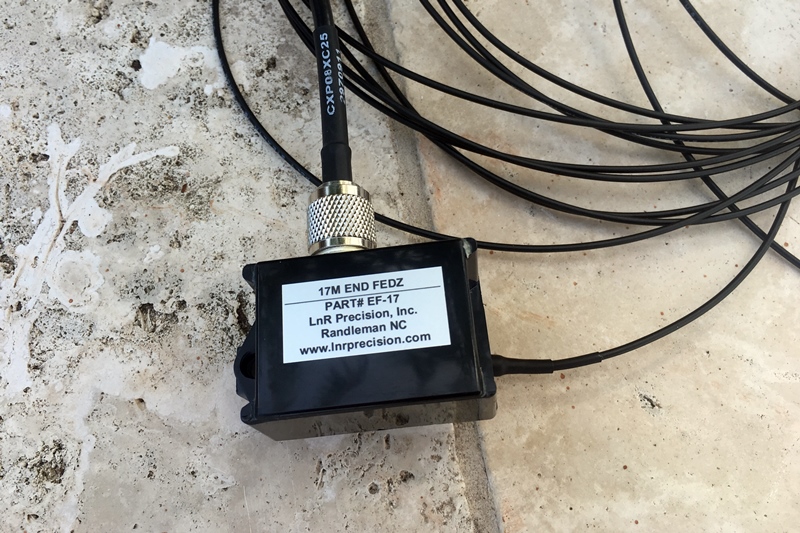
Choosing an antenna was a critical item. My first thought was to take my Buddistick antenna which covers the HF bands I was interested in working: 20m, 17m, 15m and 10m. I used that antenna from the Virgin Islands and it was really handy for taking to the beach. This time I wanted something bigger under the theory that size does matter. On the other hand, I wasn’t going to take full size yagis for each of the bands. I finally settled in on using End-Fed Half Wave (EFHW) antennas for the 4 bands (from LNR Precision). This gave me a simple half-wave antenna on each band with no coils, no traps, nothing funny going on. These antennas radiate well and have decent bandwidth…any SWR degradation can be tweaked up quickly using the FT-991 antenna tuner.
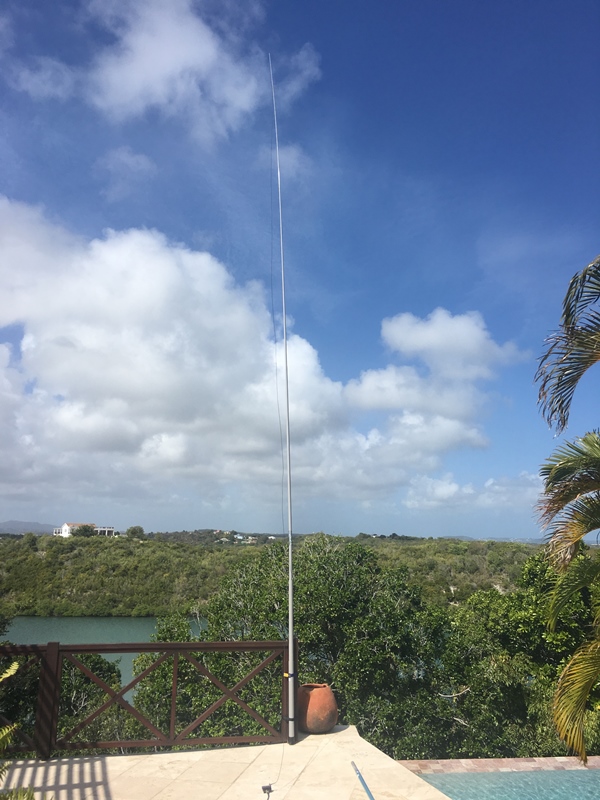
Steve WGØAT suggested I use the SOTABEAMS 30-foot mast to support the EFHW antennas. It is an incredible mast that collapses to 26.5 inches, small enough to fit into my bag. This antenna set up is common with the SOTA activators: EFHW supported by some kind of lightweight pole. I also tossed in a 19-inch magmount antenna for 2m and 70cm. (I did find a good repeater on on 147.0 MHz but did not spend much time on it.)
Rounding out the kit was an Astron switching power supply, a 25-foot length of RG-8X coaxial cable, a Heil Traveler headset and a few patch cords. I found it tempting to keep throwing more stuff in the bag so I adopted the backpacker mentality of taking just what I needed and not much more. For computer logging, I chose N1MM Plus software, set to log type to “DX”.
I have to confess that I did manage to break the 30-foot mast early in the trip. The house was on a hill and we always had a strong breeze coming through. One day it flexed the mast enough to break it. This was quickly repaired with duct tape. After that, I did not use the 2 top sections of the mast which reduced the amount of sway in the wind (and stress on the mast).
On The Air
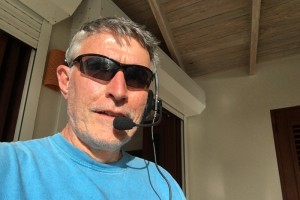
My operating time was a bit sporadic and my operating strategy was simple: work the highest band (of 20m, 17m, 15m and 10m) that had some decent propagation to somewhere. Antigua is not extremely rare but it seemed to attract attention. Typically, I called CQ, worked a few stations and then a big pileup would develop. I made lots of QSOs with stations in North America, South America and Europe. I also made a few contacts into Africa but none with Asia. Signal reports were generally good (S9 +), so the antennas were doing the job.
All in all, I was pleased with the contacts I made, given the slacker effort. I especially enjoyed working 17m, a band I have not spent that much time on. The propagation is similar to 20m but noticeably less jammed with signals.
  Band  QSOs DXCC
    14   309   36
    18   162   13
    21    21   10
    28    91    6
 Total   583   65
QSLs for V29RW should be sent to my home callsign: KØNR (direct or via the bureau). Logbook of the World contacts have already been confirmed. Instant gratification, baby!
73, Bob KØNR, V29RW
Licensing info: It was relatively easy to get a ham radio license in Antigua, based on my US license (fees were $30 US). See this web page.
The post V29RW: Slacker DXpedition to Antigua appeared first on The KØNR Radio Site.
Hunting For NDBs In CLE 204
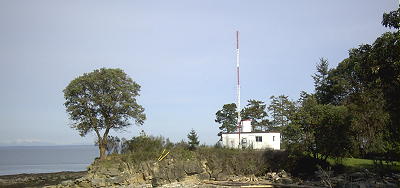 |
| 'AP - 378' - Mayne Island, BC |
This coming weekend will see another CLE challenge, this time in the 15 kHz slice from 370.0 - 384.9 kHz.
'CLE's are 'Co-ordinated Listening Events, and NDB DXers around the world focus their listening time on one small slice of the NDB spectrum.
This is a somewhat dreaded range for me since my local blowtorch NDB, 'AP' (378 kHz), sits right in the middle of the range. 'AP' is located at the entrance to Active Pass, the main ferry route to Vancouver Island, and the antenna is about 3/4 of a mile from my location. Needless to say, the beacon is about 40db over S9! With careful loop nulling, I can reduce this by about 25db but it's still an enormous signal to deal with.
Hopefully you can put 'AP' in your own log this weekend but its 25-watt signal will be much weaker for you. It's been logged as far east as Illinois and with your receiver in the CW mode, can be found on 378.399 kHz.
From CLE coordinator Brian Keyte (G3SIA), comes the following reminder:
Hi all,
Please join us in our 204th Co-ordinated Listening Event which starts
this Friday. All are very welcome.
CLEs are not contests - if you enjoy taking part you will be a winner!
51 of us from 31 radio countries joined in CLE188 back in Nov. 2014
when we listened on these same frequencies.
Days: Friday 26th - Monday 29th February
Times: Start and end at midday, your LOCAL TIME
Range: 370 - 384.9 kHz
Just log all the NDBs that you can identify with their nominal (listed)
frequencies in the range (it includes 370 kHz, but not 385 kHz)
plus any UNIDs that you come across there.
Please send your CLE log to the List in a plain text email if possible
(not in an attachment) with 'CLE204' at the start of its title.
Show on each log line:
# The date (e.g. 2016-02-26, etc., or just 26) and UTC.
(the date changes at 00:00 UTC)
# kHz (the nominal published frequency, if known)
# The Call Ident.
Show those main items FIRST - other optional details such as Location
and Distance go LATER in the same line.
If you send interim logs, please also send a 'Final' (complete) log.
As always, tell us your own location and brief details of the equipment
that you were using during the weekend.
I'll send the usual 'Any More Logs?' email at about 18:00 UTC on
Tuesday - you can check from it that your log has been found OK.
All logs must arrive on the list by 09:00 UTC on Wednesday 2nd
March at the very latest.
I hope the combined results will be completed on that day.
To help your listening, seeklists are available via the CLE page
http://www.ndblist.info/cle.htm
Good listening - enjoy the CLE
Brian
----------------------------------------------------------
From: Brian Keyte G3SIA ndbcle'at'gmail.com
Location: Surrey, SE England (CLE co-ordinator)
----------------------------------------------------------
(If you wish you could use any one remote receiver for your loggings,
stating the location and owner - with their permission if required.
A remote listener may NOT also use another receiver, local or remote,
to make further loggings for the same CLE).
These listening events serve several purposes. They:
- determine, worldwide, which beacons are actually in service and on-the-air so the online database can be kept up-to-date
- determine, worldwide, which beacons are out-of-service or have gone silent since the last CLE covering this range
- will indicate the state of propagation conditions at the various participant locations
- will give you an indication of how well your LF/MF receiving system is working
- give participants a fun yet challenging activity to keep their listening skills honed
Final details can be found at the NDB List website, and worldwide results, for every participant, will be posted there a few days after the event. If you are a member of the ndblist Group, results will also be e-mailed and posted there.
The very active Yahoo ndblist Group is a great place to learn more about the 'Art of NDB DXing' or to meet other listeners in your region. There is a lot of good information available there and new members are always very welcome.
If you are contemplating getting started on 630m, listening for NDBs is an excellent way to test out your receive capabilities as there are several NDBs located near this part of the spectrum.
You need not be an ndblist member to participate in the CLEs and all reports, no matter how small, are of much value to the organizers. 'First-time' logs are always VERY welcome!
Reports may be sent to the ndblist or e-mailed to either myself or CLE co- ordinator, Brian Keyte (G3SIA), whose address appears above.
Please ... give the CLE a try ... then let us know what NDB's can be heard from your location! Your report can then be added to the worldwide database to help keep it up-to-date.
CQ 160m CW Weekend
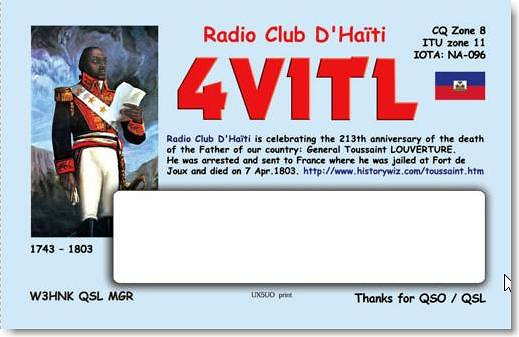
This past weekend's CQ 160m CW Contest saw the normally quiet band bursting to life with signals stacked up, one atop the other, from 1800 -1870 kHz.
At times it was very difficult to find a clear frequency to send 'CQ' and much of the contest was spent in the 'search and pounce' (S&P) mode. When a clear frequency was found I was able to have several short runs but running for any length of time while in the low power category is not realistic. I think my best hourly rate peaked at '60' for a short time as propagation would improve momentarily ... often, ten or more CQ's would go unanswered and then the next one would have two or three responses, continuing on for several minutes until the propagation would shift. These sudden 'holes' in the D-layer absorption seem to occur when conditions are marginal and it's as if the propagation switch is suddenly thrown from 'poor' to 'really good' for a few short minutes.
Overall, conditions from western B.C. were poor on Friday night and much improved on Saturday night. Although several DX stations were heard and called on Friday night, none were worked. These same stations came right back when called, on Saturday evening.
My 160m antenna is very simple, consisting of a 'half-sloper' and about fifty in-ground radials. Since the tower and antenna are mounted right at the ocean's edge, this year I threw two extra radials into the ocean ... whether or not these made any difference is difficult to say but they certainly wouldn't make things worse.

Because of the proximity to the ocean and the half-sloper producing vertical polarization, my antenna always seems to favor stations at the ends of the single-hop F2 distance ... those along the east coast and into the Caribbean as opposed to mid-continent signals. I often find myself sending several repeats to stations in the central states while those on the far coast will reply on the first call ... even stations that I can barely copy, will often come right back, which seems puzzling.
Overall, about 10 hours were spent in the contest ... ending up with 223 contacts in 51 sections and 9 DX entities. Some of the DX stations worked were PJ2, HK1, ZF2, C6, KP2 and 4V1. Checking my 160m DXCC list after the contest, I was surprised to see that 4V1TL in Haiti was a new country for me, making the contest time well worth it. Claimed scores for this, and any contest, can be viewed on the 3830 Scores website.
As the solar cycle continues to decline, 160m conditions should only get better and better, with the next few years hopefully producing a few Europeans in the 160m log once again.













