Archive for the ‘dx’ Category
 Hunting For NDB’s In CLE 210
 August 23rd, 2016 |
  Author:
  |
| 'VR' - 266kHz |
This coming weekend will see another CLE challenge, this time in the MF band from 260 - 269.9 kHz plus 440 - 1740 kHz.
'CLE's' are 'Co-ordinated Listening Events', and NDB DXers around the world focus their listening time on one small slice of the NDB spectrum ... but this time around, the range has been expanded.
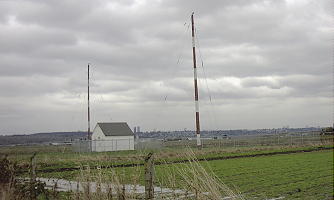
The lower frequency range covers one my very strong locals, 'VR' on 266 kHz. 'VR' is an outer marker approach to Vancouver International's 'two-sixes' and is located a few miles east of the main runways in a farmer's field. Although running just 50 watts, it is widely reported (as far east as North Carolina), probably due to the excellent soggy ground beneath its somewhat unusual delta-shaped loop.
From CLE coordinator Brian Keyte (G3SIA), via the Yahoo ndblist Group, comes the following reminder:
Hello all,
Our end-of-August Co-ordinated Listening Event will soon be here.
We'll be hunting for normal beacons in two contrasting frequency ranges
and there is also the possibility of hearing several amateur beacons.
As always, first-time CLE logs will be extra welcome.
Days: Friday 26 August - Monday 29 August
Times: Start and end at midday, your local time
Frequencies: 260.0 - 269.9 kHz
plus: 440.0 - 1740.0 kHz
These are interesting frequencies, the same ones that we last used for
CLE191 in February 2015 when 45 of us joined in.
Many of us should be able to hear beacons in both ranges, though Europe
only has a handful in the '260s'. From 440 onwards, North America has a
few, mostly around 520 kHz, while Eastern Europe has several beacons
and some regular UNIDs. Some of the NDBs can also be found among
Europe's Medium Wave Broadcast Stations.
Many of us are within range of amateur beacons on frequencies mainly
around 474 - 478 kHz. We'll be listening for ANYTHING OPERATING IN
BEACON MODE, preferably with normal speed Morse.
(We ask operators who sometimes use QRSS, PSK, WSPR, etc.,
which need software to receive them, to PLEASE CHOOSE THE
SIMPLER MODE during the CLE so that we shall all be able to
receive them and make reports).
Please look out for my final details with advice about log-making, etc.
in a few days.
73
Brian
----------------------------------------------------------
From: Brian Keyte G3SIA ndbcle'at'gmail.com
Location: Surrey, SE England (CLE co-ordinator)
----------------------------------------------------------
These listening events serve several purposes. They:
- determine, worldwide, which beacons are actually in service and on-the-air so the online database can be kept up-to-date
- determine, worldwide, which beacons are out-of-service or have gone silent since the last CLE covering this range
- will indicate the state of propagation conditions at the various participant locations
- will give you an indication of how well your LF/MF receiving system is working
- give participants a fun yet challenging activity to keep their listening skills honed
Final details can be found at the NDB List website, and worldwide results, for every participant, will be posted there a few days after the event. If you are a member of the ndblist Group, results will also be e-mailed and posted there.
The very active Yahoo ndblist Group is a great place to learn more about the 'Art of NDB DXing' or to meet other listeners in your region. There is a lot of good information available there and new members are always very welcome. As well, you can follow the results of other CLE participants from night to night as propagation is always an active topic of discussion.
If you are contemplating getting started on 630m, listening for NDBs is an excellent way to test out your receive capabilities as there are several NDBs located near this part of the spectrum.
You need not be an ndblist member to participate in the CLEs and all reports, no matter how small, are of much value to the organizers. 'First-time' logs are always VERY welcome!
Reports may be sent to the ndblist or e-mailed to either myself or CLE co- ordinator, Brian Keyte (G3SIA), whose address appears above.
Please ... give the CLE a try ... then let us know what NDB's can be heard from your location! Your report can then be added to the worldwide database to help keep it up-to-date.
6m Es – Is It Changing?

With the summer Sporadic-E season now approaching its midpoint, it looks as though this year may be another poor one. Having been operating on 6m every summer since the early 70's, I'm beginning to believe that we may be seeing some changes in what was once the normal summer pattern.
This summer, I can count on one hand, the number of good solid openings ... openings lasting for several hours. Over the past forty plus years, summers on 'six' for me, here in southwestern BC, were usually very predictable. The last week of May would usually see the start of regular band openings that would quickly escalate to almost daily openings through June and July. It was not uncommon to see the band open all day, into the very late hours and then still be open the next morning. Intense Es from California predominated the 70's and 80's ... much different than the past several summers here. The stronger openings now, when they occur, seem to be more to the southeast, favoring Colorado and other nearby central states. At times, this will turn into double-hop to the southeastern states, usually favoring the 'EM' grids.
Really long-haul openings have also taken on a different flavor. For more than two decades, openings to Japan on Sporadic-E almost always occurred late at night, near midnight ... late afternoon for the JAs'. The openings rarely favored anything other than the west coast. Openings to Europe from the west coast were, for the most part unheard of, and any claims of summer-time EU contacts were often dismissed as 'wishful thinking' and not taken too seriously.
A huge shift in long haul Es over the past decade has pretty much re-written the rules of what we have always taken to be 'normal'. Summertime openings to Europe, from the west coast, have now become a regular expectance and, although still rare and usually short-lived, somewhat dependable. Our midnight openings to Japan have largely disappeared ... replaced by hour-long, mid-afternoon or dinner-hour JA runs, and more often than not, right over our west coast heads to any U.S. call district fortunate enough to be in the propagation's hot-spot. All of this is so very different than the 70's and 80's!
So why are things different now? Is it subtle influences from our ever-changing sun?

We are now heading into our sixth straight day of a spotless sun, but in reality, solar activity has been slowly winding down for the last several years. Long term studies tend to show that the solar cycle has little effect on summertime Es, but maybe not.
Is it climatic change ... global-warming? The e-layer is supposedly high above any weather influence yet there is evidence pointing to Es being associated with lightning storms and high altitude plasma-driven sprite activity. Maybe global-warming includes ionospheric changes as well and perhaps weather plays more of a role than previously thought.
 |
| Courtesy: http://www.astrosurf.com/luxorion/qsl-perturbation.htm |
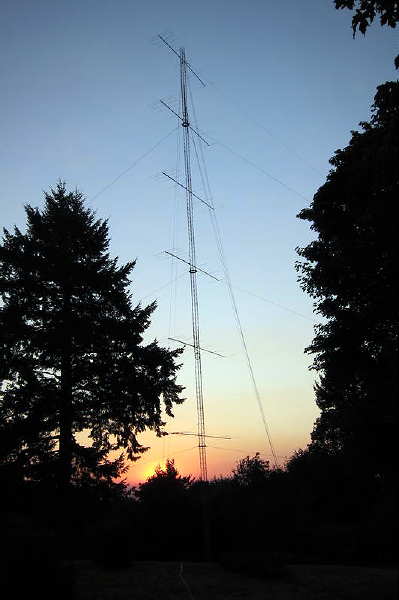
Is it changes in equipment, with an ever-increasing number of 6m stations sporting huge antenna systems and higher ERPs' than ever before?
 |
| Six 7-el Stacked Yagis At W7EW |
Maybe it's the influence of the Internet on operating practices? There is no doubt that having the ability to watch and follow realtime propagation paths, by the very minute, has made a huge difference in operating strategies ... along with big payoffs when it comes to catching those fleeting openings that would likely otherwise have gone unnoticed. On more than one occasion, I have worked Europeans on a seemingly 'dead band', with no propagation indicators at all ... just an announcement on the Internet that said station was calling 'CQ' at the time. Perhaps nowadays, there are just more savvy operators with good stations and a much better understanding of the DX possibilities ... slowly wringing out the best of what 6m has to offer. Maybe it's a combination of several factors.
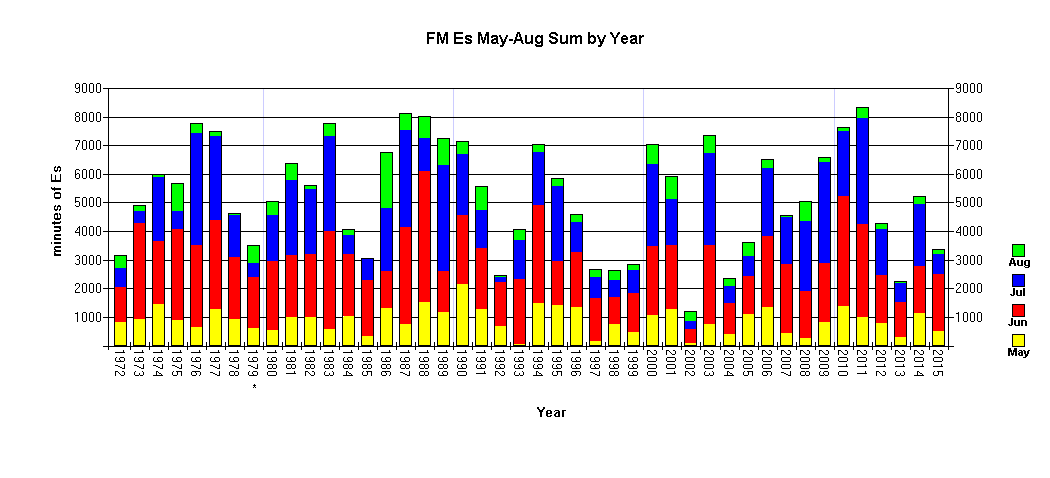
Let me qualify my observations by saying that these have been my experiences and perhaps unique to the PNW and southwest VE7 only. Longtime Es data-collector, WA5IYX (Pat) in Texas, graphically shows the yearly Es variance in his region. The pattern appears somewhat sinusoidal in nature over the past few decades, but except for the occasional 'stinker', the variances from one summer to the next are not huge.
 |
| Annual Es At WA5IYX courtesy: http://www.qsl.net/wa5iyx/ |
Are my observations similar to what you may have observed over the past many years? Are the changes real or only imagined? As with most global events being driven by mother nature and continually dynamic, I see no reason why 6m propagation should remain constant from decade to decade ... but I'd sure like to see a little more of it.
Now, usually when I voice complaints about our bad 6m propagation, it seems that things often flip from terrible to amazing soon after. The best Es of the summer often peaks in or close to the first week of July, now fast approaching. Let's hope that this is one 'constant' that hasn't changed as well!
**********************************
Wouldn't you know it. I put above blog together on Tuesday evening, intending to publish it on Wednesday. Early Wednesday morning, before 0900 local time, several Europeans were worked on CW ... perhaps the propagation gods were looking over my shoulder?
As is so often the case with these relatively new types of openings between EU and the west coast, there were no particular propagation clues from this end, other than a brief reception of the KØGUV/b in Minnesota. I was only alerted by the EU propagation reaching as far west as Colorado (KØGU) and a posting on the ON4KST 6m propagation logger that K7RWT in Oregon was hearing the VA5MG/b, sometimes a precursor to PNW propagation over the pole. The propagation map at the time shows no real indicators out this way ... once again, the value of realtime prop-watching via the Internet seems to have played a big role in finding these types of openings.
 |
| courtesy: http://www.on4kst.org/ |
Deceptive Sun
 |
| courtesy: http://sdo.gsfc.nasa.gov/data/ |
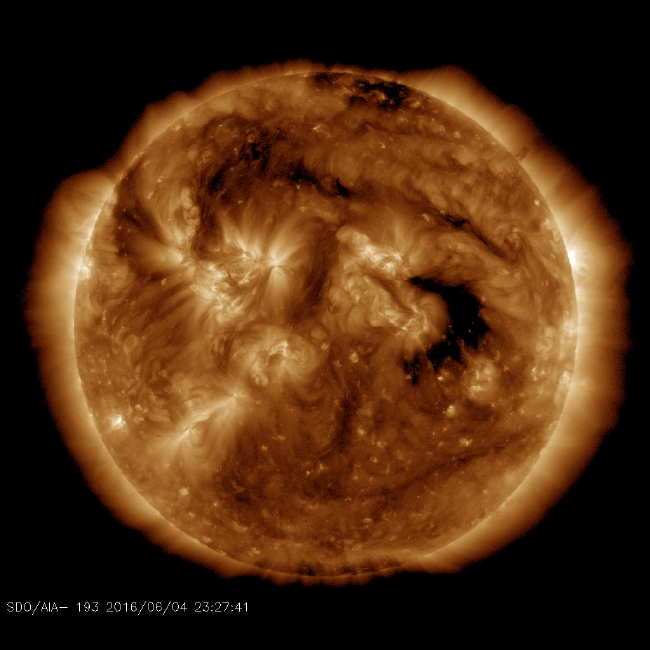
A quick glance at Sunday's sun reveals a spotless environment, something we will likely be seeing more often in the years to come as the Solar Minimum arrives around 2020. The last minimum in 2009 saw a total of 260 days of spotless suns and long periods of very little geomagnetic activity.
Incredibly, during the minimum in the 28 year period between 1672 and 1699 there were 50 sunspots total. That's not a week or a month but two 11 year cycles worth. The normal expectation would be 40,000 - 50,000 spots within a 28-year period.
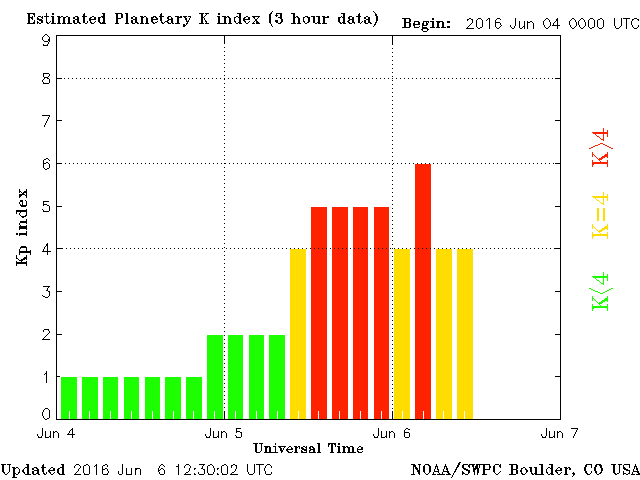
But the present, apparently quiet-looking sun, is not all as it appears as a look at today's satellite data and magnetometer readings indicate we are in the midst of a pretty good disturbance, driving the planetary K-index to level 5.
 |
| courtesy: http://www.swpc.noaa.gov/ |
 |
| courtesy: http://sdo.gsfc.nasa.gov/data/ |
With the vast array of solar instrumentation available to us online, much of the mystery involving propagation has been removed, making the tracking and even the predicting of geomagnetic activity, very much easier nowadays.
 |
| Kiruna Magnetometer: http://www.irf.se/maggraphs/ |
From my location on the west coast of North America, my main 6m interest over the past several summer seasons has been focused on the short-lived and exciting sporadic-e openings over the pole to Europe ... but today's sun is not helping. Most of these fleeting openings seem to require undisturbed fields in the polar regions ... geomagnetic quiet. Once CH738 rotates out of view, hopefully the polar activity will subside and maybe, just maybe, the magical 6m polar path to Europe will tease us once again.
 |
| The July 8th, 2014 magic - West Coast to Europe on 6m |
Magic Band And The DX Window
Late May and early June always sees 6m come to life ... sometimes slowly and sometimes with a 'bang'. Last year's good early start soon flickered-out into what was the poorest sporadic-e season that many could recall. This year's 'start' has almost been a no-show, with just a very few short openings to the south eastern states (Colorado, Utah) and one 'blink and you've missed it' opening to the Great Lakes.
Hopefully the 6m propagation gods are just having some fun with us and things will really spring to life shortly. Once we do get into some periods of good propagation, there are always new arrivals to the band, as most transceivers these days include the 6m band. Every season I hear of newcomers getting their knuckles wrapped for, probably unknowingly and in all innocence, operating inside the 'DX Window'.
If you're new to the band or perhaps not sure how the window should work, here's a short section taken from my Magicband web page, that explains the concept:
Don't Be A 'DX-Window' Lid!
One of the quickest ways to get the 6m community saying nasty things about you behind your back is to mess-up in the DX Window. The DX Window (50.100 - 50.125 kHz) has long been established for one type of contact only, that being a legitimate DX QSO.
The DX Window can only be of value if everyone follows these basic 'rules':
If you are in the U.S.A. or Canada, DO NOT WORK ANY OTHER U.S.A. or CANADIAN STATIONS INSIDE THE WINDOW. The window is NOT for North America - North America contacts.
Do not answer the "CQ" of U.S.A. or VE stations if you are in North America. This creates unnecessary QRM and chances are, they will not respond to your answer anyway. Calling or answering other North Americans in the DX-Window only reinforces bad operating habits, encouraging newcomers to do the same. If you want to work U.S.A. or CANADA, do it outside the DX Window!
Work or call only stations outside of North America inside the DX Window.
The only legitimate exception to these rules, that will not get you in the naughty-corner, is working a KL7, VE8, XE or some other such fairly rare North Americans.
I hate to say it, but some of the worst offenders to the successful function of the DX Window are my fellow VE's, many of whom don't know or don't understand the simple concept of how it works. Now that you know, pass it on!
Now, you may or may not agree with the concept of a DX window, so please don't shoot the messenger. What I do know however, is that if everyone does their best to adhere to the window's concept, it works well. Problems arise when those that should know better, and probably do, decide that for some reason, the concept doesn't apply to them or that it won't hurt, 'just this once'. Others, particularly newcomers, see it and think it's all OK and soon the window is full of domestic QSO's, effectively killing its usefulness.
As conditions slowly improve, hopefully we can work on six this summer. I usually hang out on CW, just below 50.100. As one long-time 6m diehard would often say to me, the newcomer over 40 years ago ... 'We'll see you, all of a sudden!"
Bureau QSL Batch
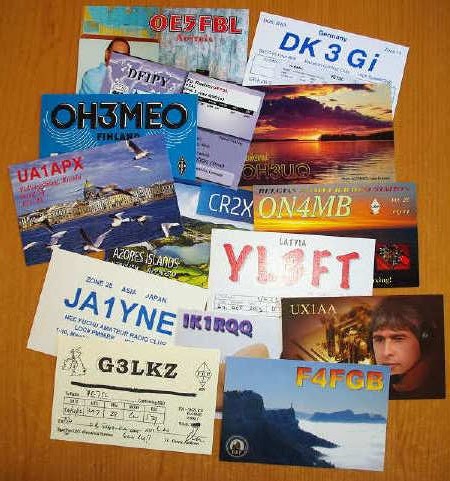
The batch of bureau cards last week included several cards from Europe and were probably the last I'll get for my Cycle 24 10m fun, using the homebrew Tri-Tet-Ten.
As mentioned previously, this rig was the culmination of wondering, for many many years, if I could get a single 6L6 to work well enough on 10m CW, using a 40m crystal ... quadrupling to 10m ... and still have enough useful output to work Europe! As well, the note would have to be 'acceptable' as I realized that any crystal chirping would be multiplied four times, during the quadrupling process.
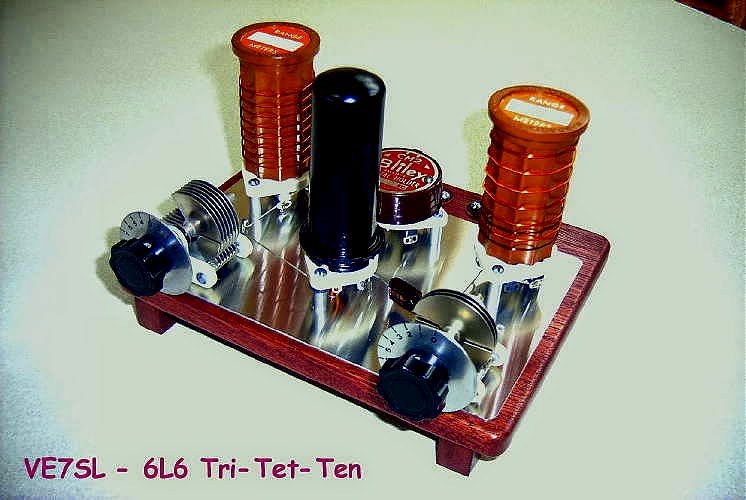
The evolution of my eventual transmitter, is described in more detail here, where you can also hear what the tone sounds like. Suffice to say, the results were much more than I had ever hoped for and during the peak years of this past cycle, many enjoyable hours were spent on 10m CW with my one tube tri-tet crystal oscillator.
I guess I could always move down to 20m CW but, for me, this just doesn't have the same appeal or sense of satisfaction as using it on 10m or what I like to call, "the other magic band". Who knows what Cycle 25 will bring to 10m? I may get another chance yet, if the solar prognosticators are all wrong!
VK4YB Lights Up West Coast On 630m
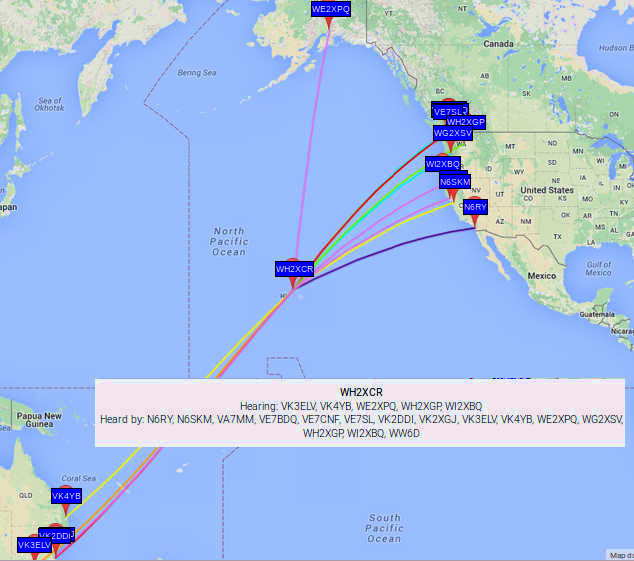 The past few weeks have seen many of the VK 630m WSPR stations making it into North America's west coast and points east. VK2DDI, VK2XGJ, VK3ELV and VK4YB have been the signals most often seen. Particularly dominant is the signal from Roger, VK4YB, the northern-most station, located in Moorina, Queensland, near the Pacific Ocean.
Roger's signal has been decoded locally by myself as well as VE7BDQ and VA7MM, creating excitement over the more normal nightly spots from the central states.
2016-04-13 11:10 VK4YB 0.475646 -28 QG62ku 5 VA7MM CN89og
2016-04-13 11:20 VK4YB 0.475647 -29 QG62ku 5 VA7MM CN89og
2016-04-13 11:28 VK4YB 0.475647 -28 QG62ku 5 VA7MM CN89og
2016-04-13 11:28 VK4YB 0.475644 -23 QG62ku 5 VE7BDQ CN89la
2016-04-13 11:36 VK4YB 0.475644 -26 QG62ku 5 VE7BDQ CN89la
2016-04-13 11:52 VK4YB 0.475643 -25 QG62ku 5 VE7BDQCN89la
2016-04-13 11:56 VK4YB 0.475643 -28 QG62ku 5 VE7BDQ CN89la
2016-04-07 08:54 VK4YB 0.475643 -25 QG62ku 5 VE7SL CN88iu
2016-04-07 09:36 VK4YB 0.475644 -29 QG62ku 5 VE7SL CN88iu
2016-04-07 10:08 VK4YB 0.475644 -29 QG62ku 5 VE7SL CN88iu
2016-04-07 10:18 VK4YB 0.475644 -29 QG62ku 5 VE7SL CN88iu
2016-04-07 11:04 VK4YB 0.475644 -29 QG62ku 5 VE7SL CN88iu
2016-04-13 11:06 VK4YB 0.475644 -24 QG62ku 5 VE7SL CN88iu
2016-04-13 11:10 VK4YB 0.475644 -23 QG62ku 5 VE7SL CN88iu
2016-04-13 11:20 VK4YB 0.475644 -23 QG62ku 5 VE7SL CN88iu
2016-04-13 11:28 VK4YB 0.475644 -28 QG62ku 5 VE7SL CN88iu
2016-04-13 11:32 VK4YB 0.475644 -25 QG62ku 5 VE7SL CN88iu
2016-04-13 11:52 VK4YB 0.475643 -18 QG62ku 5 VE7SL CN88iu
2016-04-13 11:56 VK4YB 0.475643 -22 QG62ku 5 VE7SL CN88iu
2016-04-13 12:16 VK4YB 0.475643 -27 QG62ku 5 VE7SL CN88iu
2016-04-13 12:28 VK4YB 0.475643 -26 QG62ku 5 VE7SL CN88iu
2016-04-13 12:32 VK4YB 0.475643 -25 QG62ku 5 VE7SL CN88iu
2016-04-13 12:54 VK4YB 0.475644 -24 QG62ku 5 VE7SL CN88iu
2016-04-13 12:58 VK4YB 0.475643 -24 QG62ku 5 VE7SL CN88iu
2016-04-13 13:10 VK4YB 0.475643 -25 QG62ku 5 VE7SL CN88iu
2016-04-13 13:24 VK4YB 0.475643 -27 QG62ku 5 VE7SL CN88iu
2016-04-13 13:28 VK4YB 0.475643 -27 QG62ku 5 VE7SL CN88iu
Roger has sent the following information to me regarding his well-planned system:
My QTH is atop of a stony ridge on 10 acres. The previous owner said there was some soil somewhere, but I haven't found it yet! Ground conductivity is very poor, I think. If you drive in two stakes about six inches apart, an ohmmeter says infinity. That's if you can drive in a stake. Because after the first quarter inch you hit shale rock. Interestingly the shale layers are at about 60 degrees to the horizontal. There are some quartz inclusions. Yes, I have tried crushing the quartz and panning it - no gold!
Getting back to my story, I needed to put up a 630m antenna in a hurry. The idea of winding a big loading coil with the rotatable inner coil was a bit daunting. And putting down ground radials or an earth mat was out of the question. So, using only some wire, string and a bow and arrow, this is what I came up with:
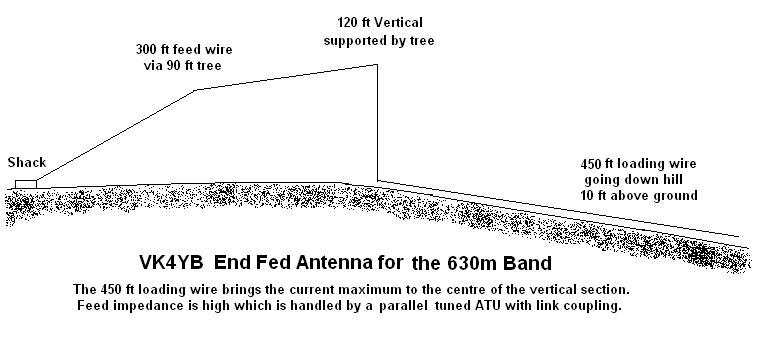
I estimate the feed point impedance is about 3000 ohms. The ATU has 48 turns on the secondary, tuned by fixed capacitors of 960 pF in parallel with a 500 pF variable which is about two thirds meshed. The primary is 5 turns fed by the transverter having a 50 ohm nominal output. The impedance at the top of the secondary should be near 5000 ohms, but the antenna feed wire is tapped about two thirds of the way up the secondary coil, which gives 1.03 : 1 SWR. The earthy end of the coil is connected to the mains earth and the metal work of the shed. I haven't tried terminating the far end. I did think about connecting it to the fence wire that runs round the property but I thought that might be a bit dangerous. There would be high voltage points in places. The transverter output is nominally 50 watts, but it is giving about 90 watts in reality.
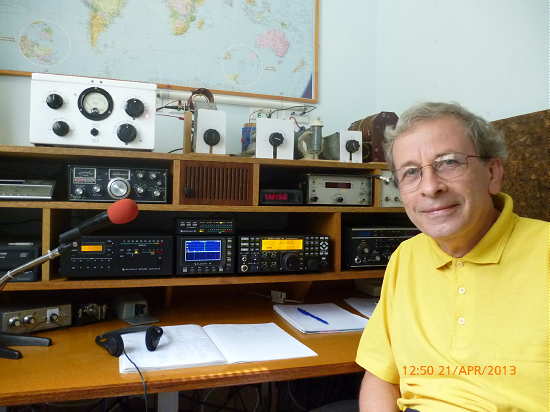 |
| Roger - VK4YB |
Thirty Minutes of Dazzle: The Sun in UHD 4K by SDO (NASA)
Take a front-seat view of the Sun in this 30-minute ultra-high definition movie in which NASA SDO gives us a stunning look at our nearest star.
This movie provides a 30-minute window to the Sun as seen by NASA’s Solar Dynamics Observatory (SDO), which measures the irradiance of the Sun that produces the ionosphere. SDO also measures the sources of that radiation and how they evolve.
SDO’s Atmospheric Imaging Assembly (AIA) captures a shot of the sun every 12 seconds in 10 different wavelengths. The images shown here are based on a wavelength of 171 angstroms, which is in the extreme ultraviolet range and shows solar material at around 600,000 Kelvin (about 1 million degrees F.) In this wavelength it is easy to see the sun’s 25-day rotation.
The distance between the SDO spacecraft and the sun varies over time. The image is, however, remarkably consistent and stable despite the fact that SDO orbits Earth at 6,876 mph and the Earth orbits the sun at 67,062 miles per hour.
Scientists study these images to better understand the complex electromagnetic system causing the constant movement on the sun, which can ultimately have an effect closer to Earth, too: Flares and another type of solar explosion called coronal mass ejections can sometimes disrupt technology in space. Moreover, studying our closest star is one way of learning about other stars in the galaxy. NASA’s Goddard Space Flight Center in Greenbelt, Maryland. built, operates, and manages the SDO spacecraft for NASA’s Science Mission Directorate in Washington, D.C.
Charged particles are created in our atmosphere by the intense X-rays produced by a solar flare. The solar wind, a continuous stream of plasma (charged particles), leaves the Sun and fills the solar system with charged particles and magnetic field. There are times when the Sun also releases billions of tons of plasma in what are called coronal mass ejections. When these enormous clouds of material or bright flashes of X-rays hit the Earth they change the upper atmosphere. It is changes like these that make space weather interesting.
Sit back and enjoy this half-hour 4k video of our Star! Then, share. 🙂
73 dit dit













