Archive for the ‘dx’ Category
 What a Zoo!
 August 10th, 2017 |
  Author:
 The question I raised in my article about JT65’s success (“Who’s next?”) has already been answered: Joe Taylor. The same guy that brought us the JT mode of families has devised the mode FT-8, developed together with Steven Franke (K9AN). It’s basically turbo charged JT65, with a message length of only 12.64 seconds and transmission beginnings synced to the next 15 second interval. It’s not as sensitive as JT65, but that might change when a priori information is added at a later stage.
My version of WSJT-X was automatically updated to 1.8.0-rc1 on July 11th and just for fun I decided to check out if there was any FT-8 activity. There was: a couple of VKs and JAs. I was a bit surprised, because I had been monitoring FSQ which has been around for a while already and I couldn’t find any activity. FT-8 had only just been introduced so that was a good sign. It got even better when I noted some European stations popping up in the local evening. I tried my hand at making a QSO, but couldn’t get through, so my first ever FT-8 QSO was with HS7WMU from Thailand. The reason why I couldn’t get through became clear later: the delta loop for 6 meters was still hooked up to the rig! After switching to a proper antenna if became apparent that even my modest verticals didn’t have any problem in getting through to Europe. Even better, stations from the east coast of the US were also coming in fine early evening and I also had no problem working them. (Over here in Taiwan the eastern US is one of the more difficult regions of the world to work).
Over the course of the next few weeks I noticed a steady increase in the number of stations I could receive. The statistics page of pskreporter.info backs this up. As I write this the number of FT-8 spots over the last 2 hours outnumber the JT65 spots 2 to 1. JT9 has already been relegated to the margins, so it seems Amateur Radio’s new favourite mode has become FT-8.
I have always been critical of the JT modes, mainly because they reduce QSOs to a 599 exchange with no possibilities to engage in a more meaningful conversation. Plus, JT65 is boringly slow. So, how do I feel about FT-8? Well, it’s not slow at all. In fact, you don’t even have time to push the appropriate macro buttons on the screen, so let WSPR-X do all the work for you. Even answering a reply to your own CQ can be handled automatically, which frees your hands into doing something else (In my case practising guitar. I’m working on Lindsey Buckingham’s “Never Going Back Again“, but don’t expect any performance soon). Arm chair DXing but still no possibility to start a real conversation with the other party. Not great in my book.

Screen capture of WSJT-X with my first ever FT-8 QSO. Notice the checks with “Auto Seq” and “Call 1st”. Keep these on if you want smooth, automatically sequenced QSOs.
Still, I’ve been playing with FT-8 a lot and it is kind of fun. I normally only log some four hundred QSOs a year and in the last two years that has been reduced to forty or less. Honestly, till July 14 I only had 22 QSOs in my log for 2017. Now I’m way over 240 of which 212 are FT-8 QSOs. July 8th was the highlight so far: SSN of 11 and the K index only 1, so pretty good ionospheric conditions. Within 4.5 hours I worked 50 stations from 19 DXCC entities, working from the east coast to the west coast of the US (I added four new states for my WAS), then into Europe. I hardly had any time to put out CQs, because the next station was already calling me before the previous QSO was finished. The pass band on the scope was filled to the brim, when one anonymous ham sent out the cry that became the title of this post: “What a Zoo!”

Screen capture of pskreporter with all the stations I received on August 8 in the span of 4.5 hours.
He may have found it a zoo, but I like zoos, a lot. All joking aside, the one thing that really attracts me to FT-8 is the fact that you can do real time ionospheric observations. WSPR was meant for this, but the number of WSPR stations is too small and signals are too infrequent to be very accurate in my opinion. By constantly monitoring the FT-8 pass band I already noted a couple of sudden ionospheric disturbances and even a complete black out. Sometimes it only takes minutes for conditions to change from favourable to abismal and as a self reliant ham FT-8 is then a nice monitoring tool to have.
So apart from Antenna Summer, this has also become FT-8 Summer. Until the end of August (summer break) I will be active from 05 to 15 UTC most days, calling CQ a lot. I’m on 20 meters only, so if you see me on your waterfall there give me a call.
ETH081 – Flying Around the World with Brian Lloyd

I’m sure that all of you have heard about Amelia Earhart and how she wanted to become the first woman to fly solo around the world. On June 1, 1937, she and her navigator took off from an airport in Florida and attempted to do just that. She however didn’t make it, but she came close. Her plane disappeared somewhere in the Pacific ocean.
Eighty years later, Brian Lloyd, WB6RQN, decided that he would attempt to fly around the world solo following(for the most part) her historic flight. Thankfully, Brian made it home back here to Texas, however it wasn’t without it’s problems.
In this episode of the Everything Ham Radio Podcast, we talk with Brian about his trip We talk about all the highs and lows, about all the awesome people that helped him along the way and generally about his adventure.
Give this episode a listen, I had a great time talking with Brian and I hope that you enjoy listening in on our conversation. You can find the show notes for the episode as well as listen to it at:
Field Day 2017 with Ian Kahn, KM4IK – ETH071
 The biggest hamfest is over, but the biggest ham radio on the air event is quickly approaching! Yes I am talking about Field Day 2017! Back in episode 67, I had Ian on and we talked about PSK31. During that interview he mentioned that he was the Field Day Chair for his radio club, the North Fulton Amateur Radio League, so I asked him to come back and talk to us about Field Day.
We had a great conversation about what Field Day is, some general information about it, what its like to be the Field Day Chairperson and be in charge of planning the event for your club and wrap it up with things that his club does during Field Day and what goes on afterwards.
Check out the show notes of this episode for more information about things that we talk about, links that we mention and probably some that we didn’t. The show notes can be found at:
That’s Not Real Ham Radio
 Things had been pretty quiet on the ham front lately but then I ran into a string of “That’s Not Real Ham Radio” discussions. This happens from time to time…I usually ignore it…but this time I got sucked into the topic.
It started with some HF enthusiasts I know talking about how “digital modes” are just not very satisfying. Their point is that with CW and SSB, there is an audio connection to your ear that makes you an integral part of the radio communication. The extreme-DSP modes such as JT65 insert serious signal processing that essentially removes the human connection. This can quickly lead to the generalization that these digital modes “aren’t real ham radio.”
I think its fair to say that most hams think of the HF bands as the center of the hobby…getting on the air, bouncing signals off the ionosphere to talk to someone over the horizon. Some hams will go even further and say that CW is the only way to go. Anything less is just phone. FM and repeaters? Forget that stuff…not enough skill required. And certainly, don’t get stuck on 2 meters.
In a previous post, I argued we should not confuse religion with modulation. I do occasionally make snarky comments about the continued use of AM (AKA Ancient Modulation), but I’ve tried to tone that down in recent years.
What About DMR?
Just last week, I was playing around with a DMR hotspot on the Brandmeister network. It really struck me that people on the system were having a blast talking to each other across North America and around the world. But then that nagging little voice in the back of my head said “hey, wait a minute…this is not real DX…the RF signal might only be traveling 20 feet or so from an HT to a hotspot.”
This caused me to put out a plea for insight on twitter:
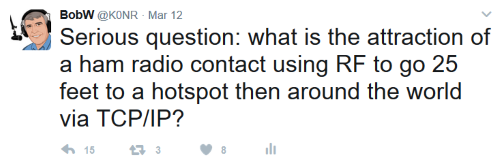 I received a lot of good replies with the answers tending to clump into these three categories:
- I don’t know (“That’s Not Real Ham Radio”)
- It’s fun, new technology
- It’s a digital network that brings ham radio operators together
My interest seems to fall into the second category: this is fun, new technology. Which does make me wonder how long this new technology will remain interesting to me. Well, that is difficult to predict but I’ll invoke the principle of try not to overthink it. The idea that DMR is a digital network that brings ham radio operators together makes some sense. In the past, I have argued that amateur radio is not for talking. In other words, if you just want to talk someone, there are much more convenient ways of doing that. Still, there is something attractive about this ham-radio-only digital network.
It really is important to not overthink this kind of stuff. Ham radio is supposed to be fun, so if you are having fun, you are probably doing it right. If you are not having fun, then you might want to examine what you are doing. See my post on the Universal Purpose of Amateur Radio.
Sometimes hams can get a little spun up about those other guys that don’t appreciate our way of doing ham radio. What the heck is wrong with them anyway? I’ve always been inspired by the Noise Blankers Mission Statement:
Do radio stuff.
Have fun doing it.
Show people just how fun it is.
If your preferred form of ham radio is so superior, it ought to be easy to show other hams how cool it is. If not, then maybe you aren’t doing it right. Conversely, as long as other hams are having fun and operating legally, don’t knock what they are doing. In fact, encourage them. We need more people having fun with ham radio, even if it’s not your favorite kind of fun.
That’s my opinion. What do you think?
73, Bob K0NR
The post That’s Not Real Ham Radio appeared first on The KØNR Radio Site.
The Don Miller Enigma
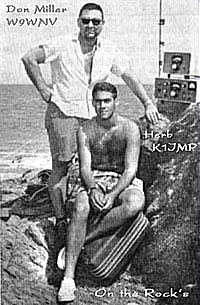
A mention in the KE9V weekly 'CALLING CQ' e-mail letter brought back more memories of my teen DX years. The article pointed to a YouTube interview of legendary DXer Dr. Don Miller, W9WNV, conducted by another DX legend, Martti Laine, OH2BH. The fascinating interview was conducted in December 2016 and is broken into five parts.
For those old enough to remember, Don spent a few years in the late 60's providing DXers with one rare country after another ... dozens of them. He was a superb operator and the originator of the now ubiquitous "5NN" shortened signal report, after trying unsuccessfully with "FNN". He was also one of the very first to operate 'split', requiring stations to call up or down instead of the then prevalent one frequency pileup! Don was really instrumental in shaping much of what we see today as 'standard ops' when it comes to DX'pedition operations. To hear Don handle a pileup was something else. Often when the pile became very large, he would listen to the calling crowd for a couple of minutes and then respond with a list of calls and signal reports ... nothing like the individual exchanges we see today.
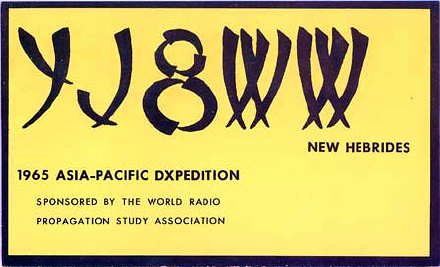
My little DX-20 and VF-1 were only able to work Don at one of his stops ... YJ8WW on 40m CW. He was all about giving the little guy, those running modest stations, an opportunity to work some rare countries.
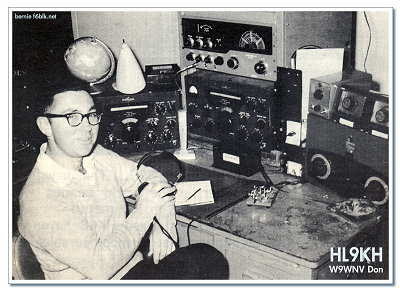 |
| courtesy: F6BLK |
As bad as things had become for Don, it got much worse, when in 1980, rightly or wrongly, he was convicted of conspiring to have his estranged wife killed and was sentenced to 25 years to life.
Don Miller is one of those 'larger than life' personalities whose presentations at DX clubs and conventions would bring the large crowds to their feet with his DX stories and expedition accomplishments.
The YouTube interviews show a somewhat contrite, remorseful man, compared to the one we met in the 60's but there's still a hint of that young mischief-maker and a twinkle in his 80 year old eyes as he teases of putting another rare one on-the-air, one last time.
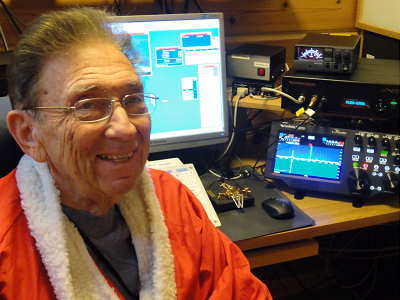 |
| courtesy: OH2BH |
[See also: "The Don Miller Story As Told By Hugh Cassidy, WA6AUD]
The Don Miller Enigma
A mention in the KE9V weekly 'CALLING CQ' e-mail letter brought back more memories of my teen DX years. The article pointed to a YouTube interview of legendary DXer Dr. Don Miller, W9WNV, conducted by another DX legend, Martti Laine, OH2BH. The fascinating interview was conducted in December 2016 and is broken into five parts.
For those old enough to remember, Don spent a few years in the late 60's providing DXers with one rare country after another ... dozens of them. He was a superb operator and the originator of the now ubiquitous "5NN" shortened signal report, after trying unsuccessfully with "FNN". He was also one of the very first to operate 'split', requiring stations to call up or down instead of the then prevalent one frequency pileup! Don was really instrumental in shaping much of what we see today as 'standard ops' when it comes to DX'pedition operations. To hear Don handle a pileup was something else. Often when the pile became very large, he would listen to the calling crowd for a couple of minutes and then respond with a list of calls and signal reports ... nothing like the individual exchanges we see today.
My little DX-20 and VF-1 were only able to work Don at one of his stops ... YJ8WW on 40m CW. He was all about giving the little guy, those running modest stations, an opportunity to work some rare countries.
|
| courtesy: F6BLK |
As bad as things had become for Don, it got much worse, when in 1980, rightly or wrongly, he was convicted of conspiring to have his estranged wife killed and was sentenced to 25 years to life.
Don Miller is one of those 'larger than life' personalities whose presentations at DX clubs and conventions would bring the large crowds to their feet with his DX stories and expedition accomplishments.
The YouTube interviews show a somewhat contrite, remorseful man, compared to the one we met in the 60's but there's still a hint of that young mischief-maker and a twinkle in his 80 year old eyes as he teases of putting another rare one on-the-air, one last time.
|
| courtesy: OH2BH |
[See also: "The Don Miller Story As Told By Hugh Cassidy, WA6AUD]
Topband Trifecta

It was a week of 'threes' when it comes to the 'gentleman's band'. The first was last weekend's CQ 160m CW Contest ... exciting as always, with propagation from VE7 land favoring the southeast. At times, signals from the Caribbean were exceptionally strong while it was a struggle on both nights to work eastern W1's. As usual, I entered in the low power division with a power limit of 150 watts, spending 8 hours in total and finishing with 249 contacts in 51 sections / 8 countries. Other than the odd State QSO Party, the 160m contests are about the only ones I enter these days.
The mail brought my next two Topband delights. The first being a copy of Jeff Brigg's (K1ZM / VY2ZM) spanking new "DXing on the Edge - The Thrill of 160 Meters". This is the second edition of Jeff's original classic which was published twenty years ago in 1997.
The new second edition carries all of the original content (except for the CD) along with four new added chapters. Although the original material is dated, it is still just as valuable and informative as it was when first published. Highlights of the book include chapters on:
- Propagation
- The Stew Perry Era (1930-1982)
- 160m DX Chronology 1930 - Present (8 Chapters)
- Notable Achievements
- Simple and Effective DX Transmitting Antennas
- Simple and Effective Receiving Antennas
- Tips From DXers
- Photographic Potpourri
- Off-The-Shelf Transmitting Antenna Solutions (new)
- Modern RX Solutions For Small Properties (new)
- Cycle 24 & A View Forward (new)
- 160m Achievement Levels As Of 2016 (new)
If you have any serious interest in DXing on 160m, you will find much inspiration in Jeff's book. The descriptions of many stations, from the simple to the extreme, highlight the fact that almost anyone can achieve DX success on the 'Topband' with a little perseverance and some thoughtful station design.
When it comes to Topband DXing, things have changed a lot since 1997 ... as Jeff indicates in the new section, his main reason for releasing a second updated version:
" ... was to publicly review the technical advances that are now available to the modern 160M DX'er. In this way, everyone - old timers and newcomers alike - would have the time to "get ready" for some great years that will be coming soon on Topband. So get going ... gear up ... start making plans now to be part of the action. It is probably going to be a wild ride ahead and a lot of DX'citement for those who are up to the challenge!"
If the coming solar low years are anything like the last previous low, we are indeed in for some fun times!
Jeff's book can be purchased through numerous outlets including Amazon and Chapters, often with free-delivery.
The third Topband event, again via the mail, was the arrival a new 160m QSL.
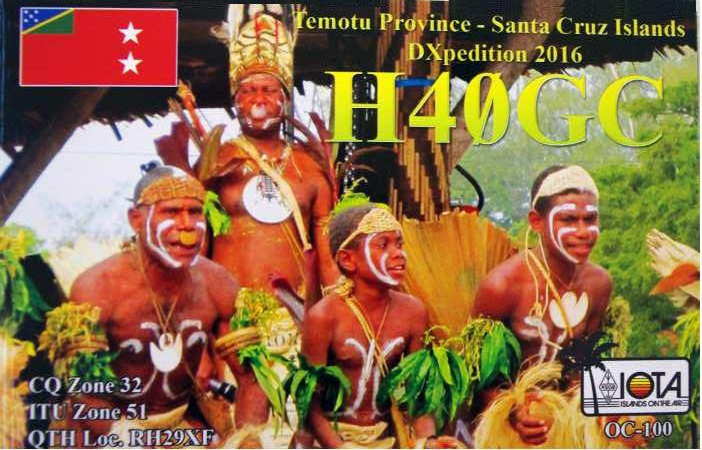
The sunrise 160m CW contact with H4ØGC, Temotu, was confirmed country #159 for me on Topband, with most of these being worked from here on Mayne Island using a half-sloper and an aging 500 watt amplifier with a pair of original 572Bs.
If you've not been on 160m and are keen on new operating challenges, Topband may be the place to begin ... along with a copy of Jeff's inspirational 'Topband handbook'.













