Author Archive
 Another Black Mountain SOTA (W0C/FR-031)
 August 5th, 2017 |
  Author:
 There are (at least) 20 different summits named “Black Mountain” just in the state of Colorado. I’m sure there are many more nationwide. It seems to be a popular, if unimaginative, name. This is why we have a numbering system for Summits On The Air, else we would forever be talking about “which Black Mountain was that anyway?” Or Deer Peak or Sheep Mountain or …
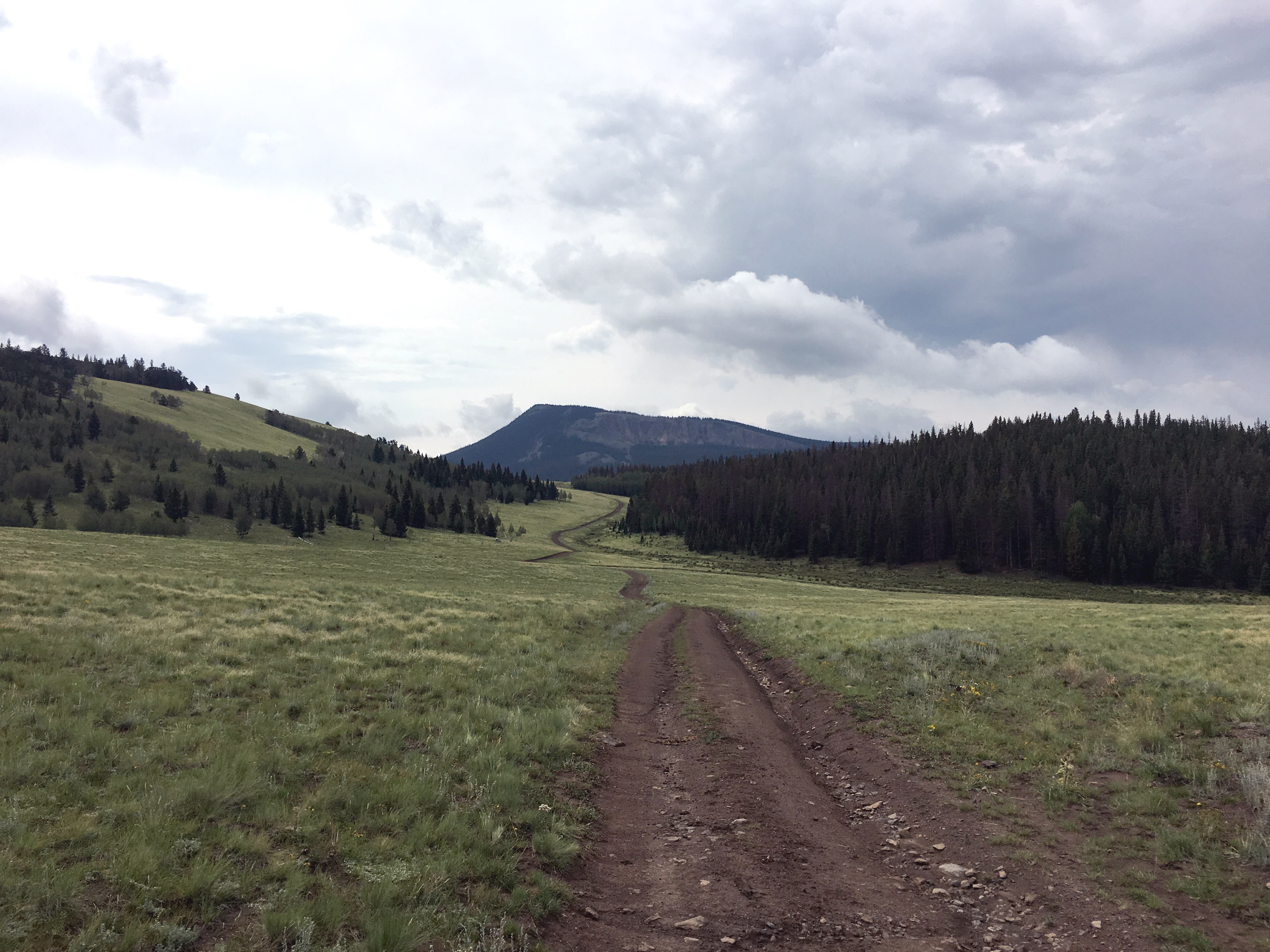
On Thursday, Joyce K0JJW and I activated another Black Mountain, this one with Summits On The Air (SOTA) designator: W0C/FR-031. I’m not sure why it has an FR or Front Range designation, as the summit is actually in the South Park region of the state. I can tell you that it is an awesome summit with great views.
To get to Black Mountain, take Highway 9 south out of Hartsel, CO (or come north on Highway 9 from the south). The Pike National Forest map is very helpful with getting into the vicinity of the mountain. Turn west on FS 108. (This is the same road that leads to Dicks Peak W0C/FR-041.) This road has a sign that indicated “Dicks Peak” and “Black Mountain”. Follow FS 108 S/SW and then take FS 107 to the south (right turn). Follow FS 107 to FS 268, then follow FS 268. About this time, you should have an excellent view of Black Mountain to the south. The roads were muddy and rutted, definitely 4WD. Our Jeep Wrangler had no problem but a AWD crossover/Subaru may be challenged to get through.
Black Mountain has a steep vertical rock face to the north, which is very visible. At this point, we wondered if we signed up for a difficult climb…but not so. FS 268 turns west, kind of parallel to Black Mountain, then heads away from it. At this point, we wondered if we were on the wrong road. Not so. At this point, the Pike National Forest map failed us…it seems to be incomplete in this area. Instead we used the gaiagps.com app on my smartphone which had a representation of the terrain and roads. As we headed west on FS 268 we saw a road heading off to the south. (I don’t recall if it is marked, but see map below.) Take this road south for about one and a half miles…looking for an unmarked road heading off to the east. The intersection with this road is easy to miss as it is not that distinct. But the road is very visible heading off to the east, so you’ll probably spot it later if you miss the turn and can circle back.
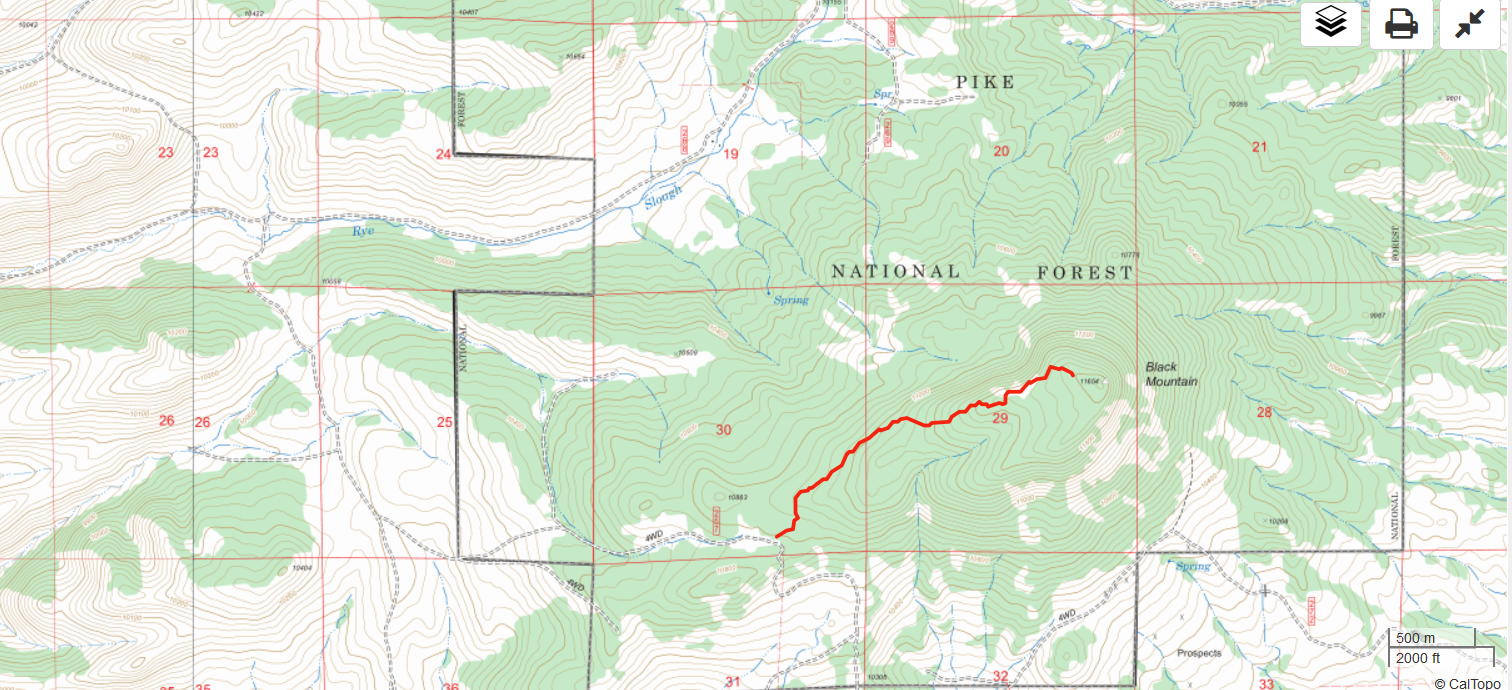
We took the unmarked road east until it deadended at a camping spot. We parked there and started the climb up to the summit. There are only random bits of a trail here and there, so we mostly just followed the GPS towards the summit. The route is forested with some downed timber but not difficult to navigate. The steep north side of Black Mountain provided some nice views. The hike is about 1.5 miles and 1000 feet vertical.
On top, we worked stations on 2m and 70cm fm without much trouble. It is an excellent VHF/UHF site and we found a number of locals hanging out on 146.52 MHz. We reversed our route on the way down and drove the Jeep out.
W0C/FR-222
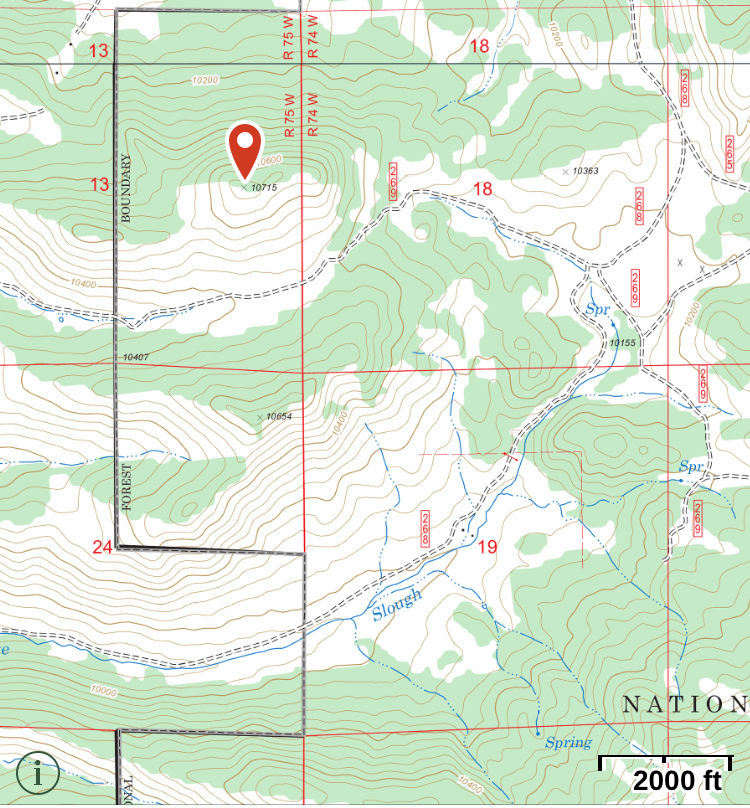
Steve WG0AT suggested that we could do an nearby unnamed peak (W0C/FR-222) on the same day. This is an excellent idea and we did just that. We headed back north and took FS 269 west, parking just south of FR-222. FR-222 is not shown on the Pike National Forest map but the Gaiagps.com app and other maps show it. The summit is easily seen from the road and a short hike gets you to the top (about 1/3 mile and 500 vertical feet).
73, Bob K0NR
The post Another Black Mountain SOTA (W0C/FR-031) appeared first on The KØNR Radio Site.
First SOTA Activation for W0C/SP-055
For several years, I’ve had my eye on an unnamed summit (12132) in the Buffalo Peaks Wilderness Area (W0C/SP-055). No one had activated it for Summits On The Air (SOTA) probably because the summit is somewhat remote. I originally thought I would have to do many miles of bushwhacking from the north to get to get to the top. After studying a few maps and trail descriptions, I eventually found a route from the east that is not too difficult.
My hiking partner Joyce/K0JJW and I started at Lynch Creek Trailhead, which is about 9 miles west of Highway 285 on FS 431, also known as Buffalo Peaks Road. The USFS Pike National Forest map is a good reference for finding the trailhead. We followed Salt Creek Trail #618 for about 1 mile to connect to the Tumble Creek Trail #617. These are well-used and well-maintained trails and a joy to walk on. We had been doing too much off-trail hiking lately, so this was a very nice change. The trails are marked by signs at the junction and are easy to follow.
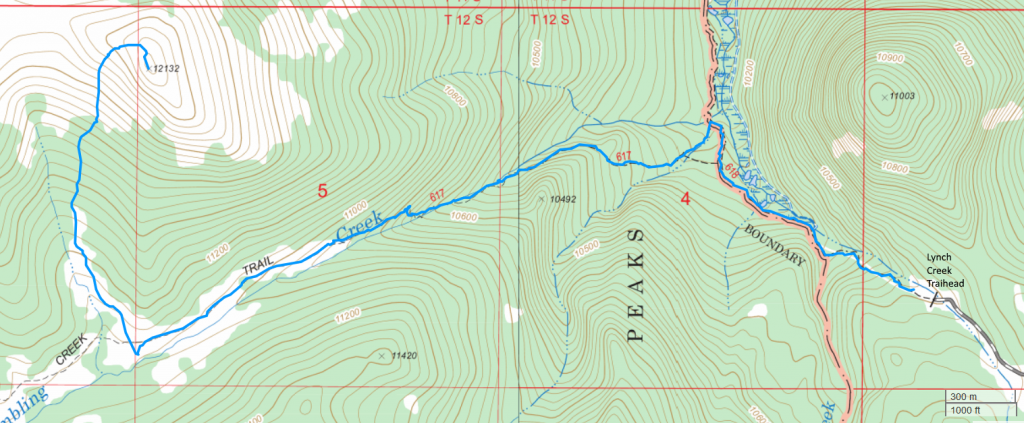
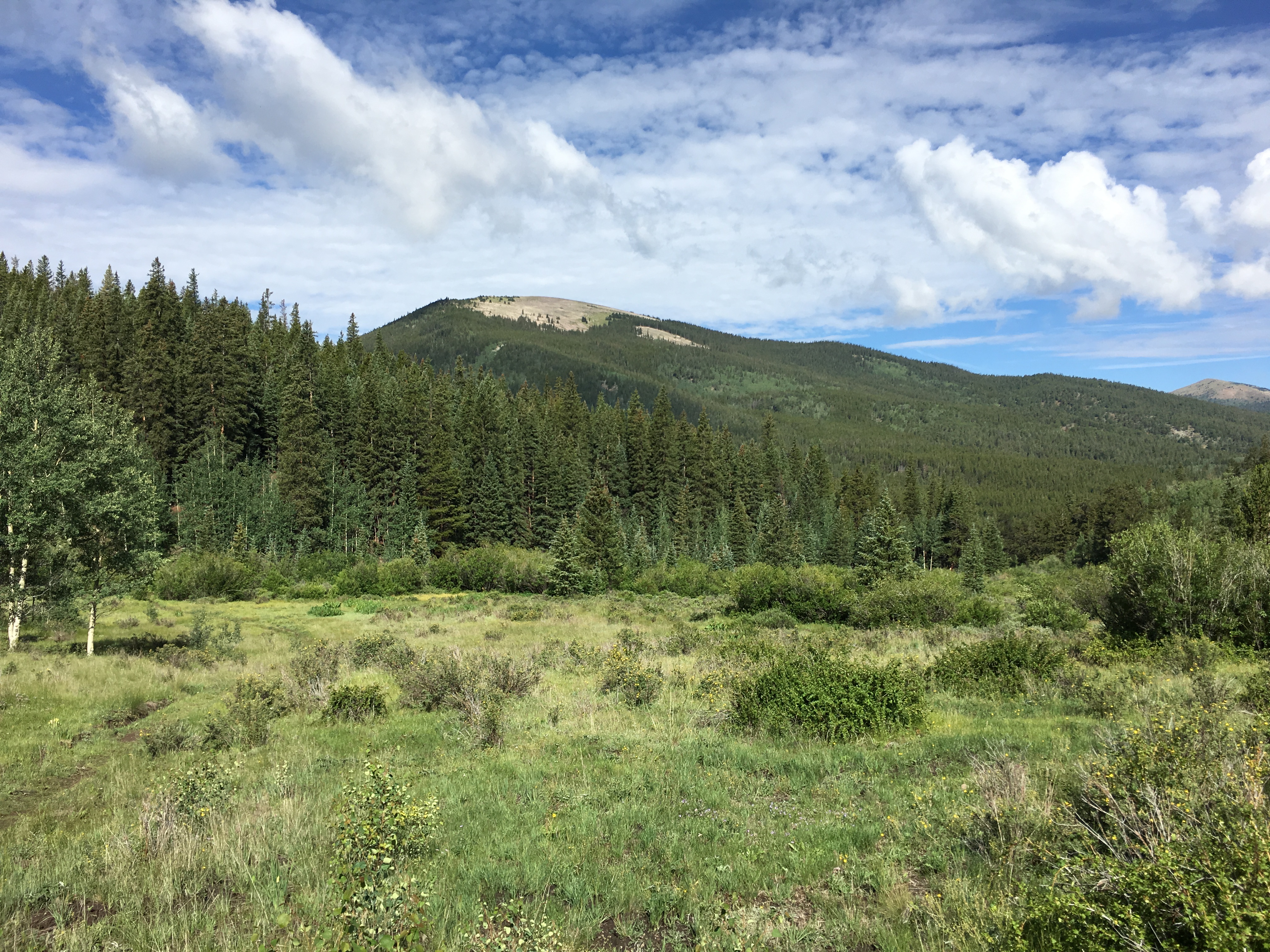
We considered ascending the east side of the mountain but concluded that we’d end up hiking through some dense forest, which usually means downed timber and slow progress. Instead, we approached the summit from the south, leaving Trail 617 about three miles in from the trailhead, and heading uphill through a grassy meadow. There is a large beaver pond to the south at the point where we left the trail, so that makes for a good landmark. You can’t completely avoid the trees on this path but they are sparse enough to easily walk through. Near the summit, the easiest path hooks around to approach the summit from the west, avoiding some steep rocks on the south side of the summit. (Actually, we went straight up the rocks on the ascent and decided to avoid them on the descent.)
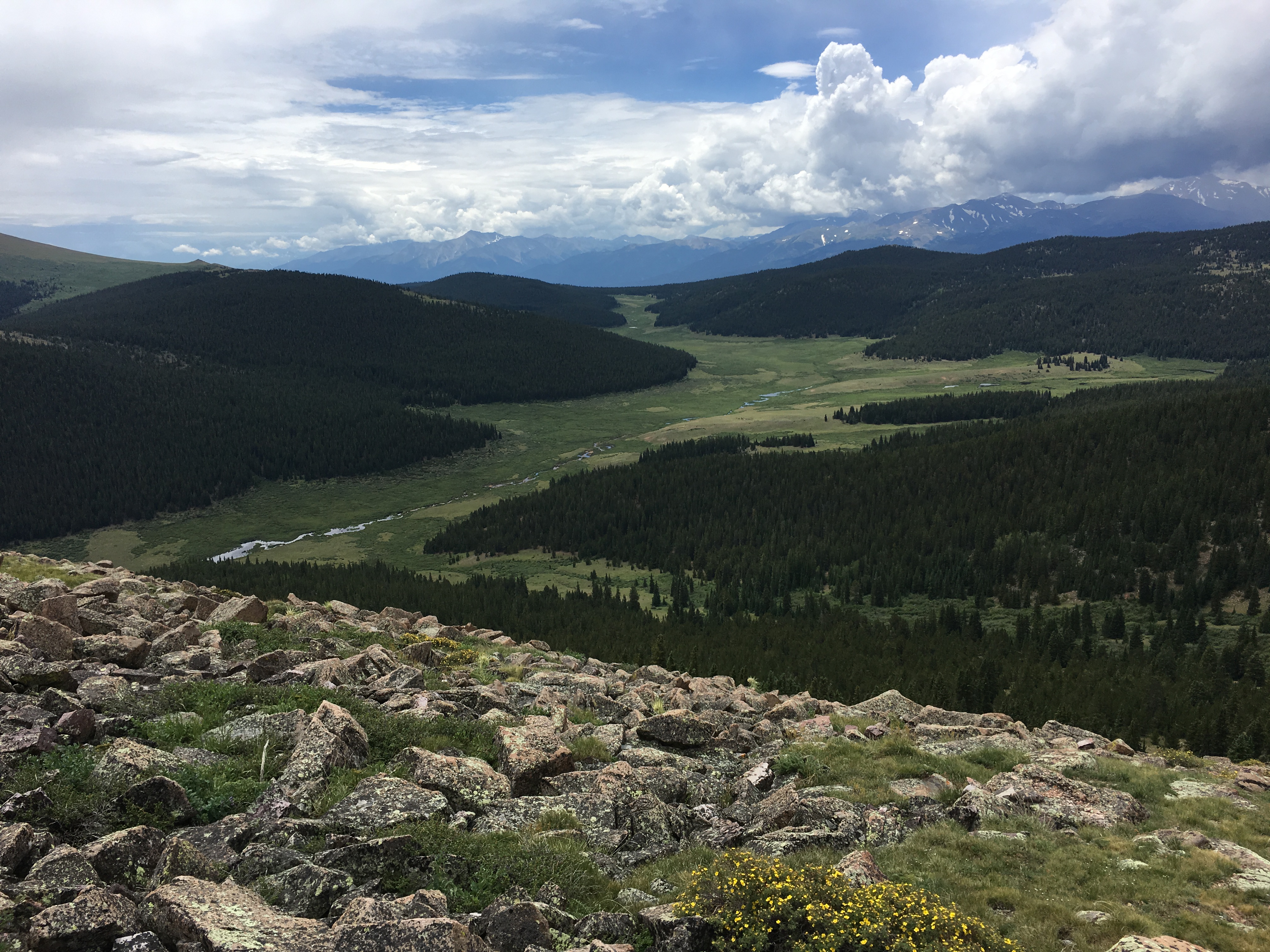
The summit is above treeline and relatively flat, offering excellent views in all directions.
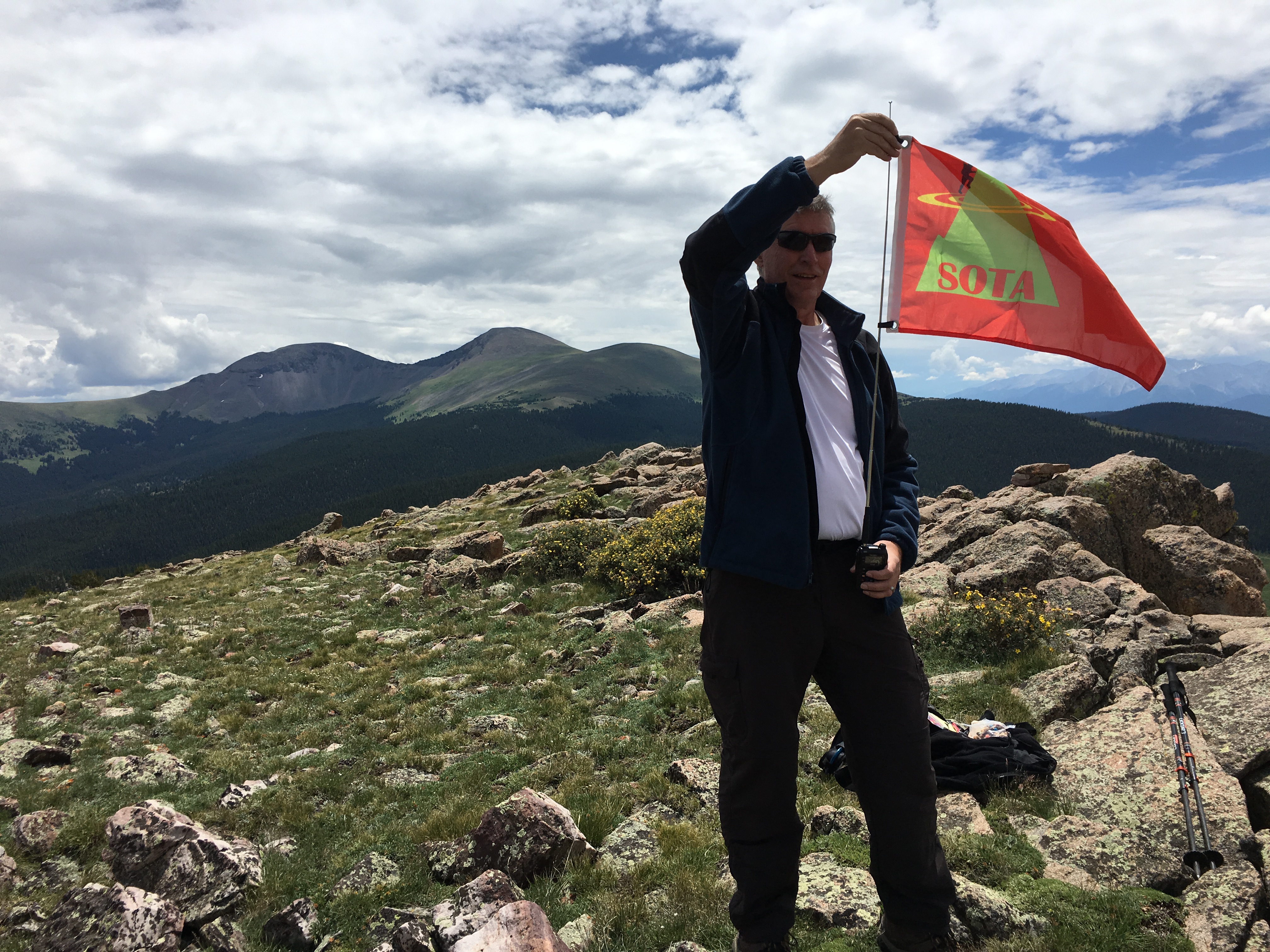
Joyce and I both got on the air and made calls on 146.52 and 446.00 MHz using handheld VHF/UHF radios. We just used vertical antennas and didn’t bother to assemble the yagi antennas. Thanks to these stations that we worked that day: W0BV, W0DLE, N0VXE, K0RCW, K9LNH and KD0VHD.
The GPS app on my smartphone indicated the one-way distance at just under 4 miles, with an elevation gain of 2000 feet. The actual elevation gain may be slightly more than that due to some ups and downs on the trail. This is one of those hikes that we’ll probably do again in the future. It has an enjoyable mix of good trails, rolling streams, green meadows, great views and a pleasant summit.
73, Bob K0NR
The post First SOTA Activation for W0C/SP-055 appeared first on The KØNR Radio Site.
Using 1.2 GHz for SOTA
One of the cool things about the Summits On The Air program is that it has many different awards available. The SOTA database records the QSOs of everyone involved in the program and is used to qualify for the awards. QSL cards are not required. The most coveted awards are Shack Sloth (reaching 1000 points as a “chaser”) and Mountain Goat (reaching 1000 points as an “activator”). There are so many SOTA activators on the air these days, reaching Shack Sloth is not too difficult. Just get on the air and make the contacts. (Last year, I completed Shack Sloth using VHF and higher frequencies only.) Mountain Goat is much more of a challenge because you have to physically go out and activate each summit, one at a time. Currently, there are 9 radio hams that achieved Mountain Goat status in Colorado. I have a long way to go for Mountain Goat.
 Most of my SOTA contacts have been on the 2 meter band (144 MHz) using FM, SSB and CW. Recently, I put additional emphasis on making QSOs on two of the UHF bands: 70 cm (433 MHz) and 23 cm (1.2 GHz). With the SOTA scoring system, there are no extra points or credit for working the same station on additional bands. Still, I’ll often check with the other station on 2m to see if they want to make a QSO on one of the other bands…just because. The SOTA database does keep track of these QSOs separately so you can go in and look at your results on, say, just the 70 cm band.
For some unexplained reason, 1.2 GHz has my interest right now and I’ve been trying out my capabilities on that band. The 23 cm amateur band is one huge hunk of spectrum: 1240 to 1300 MHz (US allocation). To put this in perspective, this 60 MHz swath of spectrum is 171 times the size of the 20m amateur band. (Yeah, I grant you, the propagation on 20m is usually a lot more interesting.) So the first thing I ran into on this band is the lack of commercially available equipment. I think the number of radios that will do 1.2 GHz has actually declined in the last decade. I ended up buying a pair of Alinco DJ-G7T handheld tranceivers that put out 1W of RF power on 1.2 GHz.The second thing I ran into is the lack of other hams that have 1.2 GHz gear. But when you do find them, they usually are interested in making a contact! (I suppose it gets lonely on that band.)
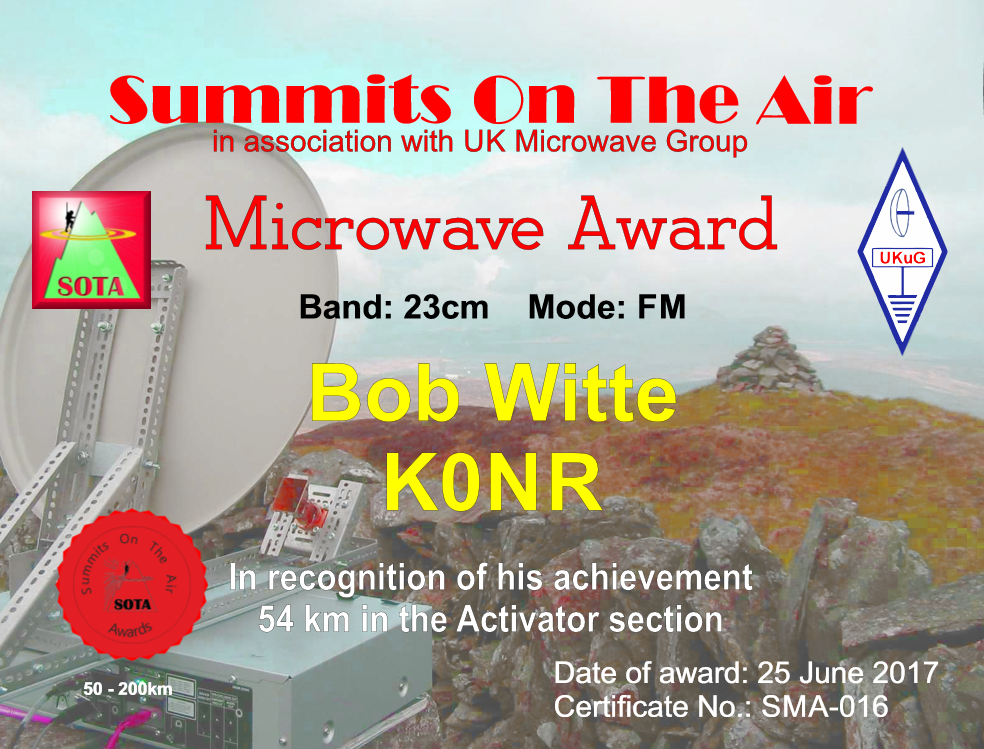
Initially, Joyce K0JJW and I made some short-range SOTA contacts on 1.2 GHz using the two handheld radios, on the 1294.5 MHz FM calling frequency. Then I started looking for DX contacts from local stations that have 23 cm gear. To provide some additional antenna gain, I used a 4-foot yagi antenna (Comet CYA-1216E), specified as 16.6 dBi. One of the cool things about UHF and higher is that compact antennas can provide some serious gain. My best DX so far is 54 km (33.5 miles) but I expect to be able to do distances 3 to 4 times that. The SOTA awards system considers the 23 cm band to be “microwave” so my 54 km QSO just barely qualifies me for the 50 km award. (The microwave awards are based on distance worked, unlike the other SOTA awards.)
Just another fun thing to do on the ham bands, pursuing the Universal Purpose of Amateur Radio.
73, Bob K0NR
The post Using 1.2 GHz for SOTA appeared first on The KØNR Radio Site.
Easy SOTA: Blue Mountain (W0C/SP-123)
Joyce K0JJW and I were preparing to drive back home from the mountains and began to consider what Summits On The Air (SOTA) peaks might be on the way and easy to access. I consulted with Steve WG0AT, who had a number of good suggestions but we ultimately decided on Blue Mountain (W0C/SP-123). This is an easy summit to get to and an easy summit to hike.
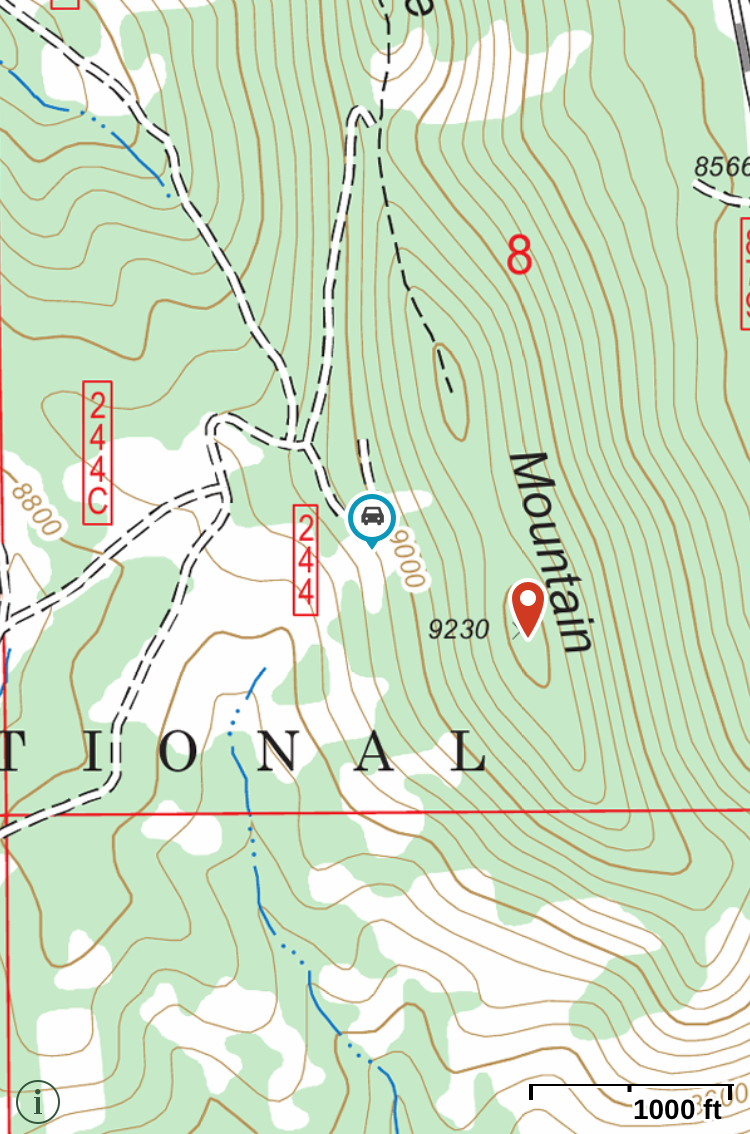 I found Carey’s (KX0R) trip report to be helpful, so I suggest reading that information. To get to Blue Mountain, just get on Blue Mountain Road (CR 61) heading south out of Lake George. Looking at your Pike National Forest map (you do have a National Forest map, right?), you’ll see that this road passes by Blue Mountain on the east side and then turns west. Take forest service road FS 244 to the right (north), which takes you up to the west side of Blue Mountain.This road turns into easy 4WD (challenging 2WD with high clearance). We just kept going on FS 244 (ignoring the side roads) and parked at the very last turn, as shown on the map (38.93108N, 105.35597W). At this point, you can just take aim at the summit (40.33530N, 105.28100W) and hike your way up. Approaching the slope at an angle makes it not quite so steep.
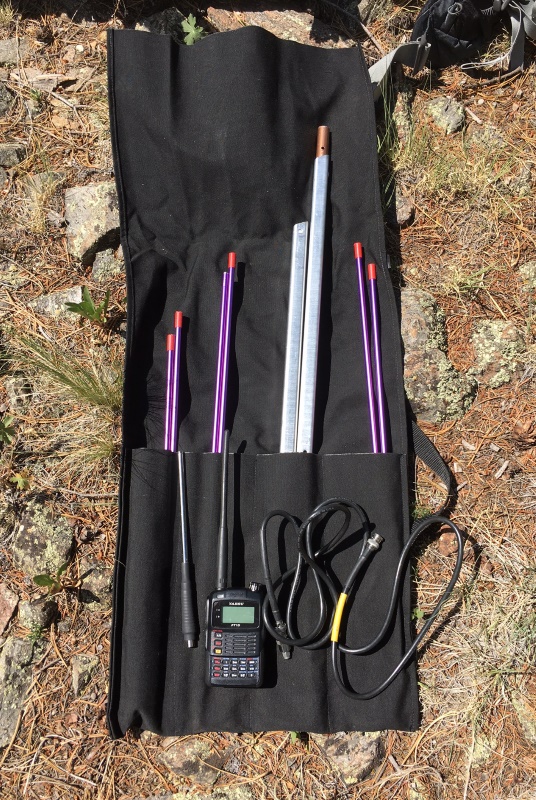 For this activation, we took along gear for 2m, 70cm and 23cm, FM only. Basically, this amounts to a pile of HTs and a few compact antennas. All of our contacts were on 2m FM except I did work Paul W0RW on Wilkerson Pass using 1.2 GHz (23 cm). At an elevation of 9230 feet, this location does pretty well on VHF and higher, so we easily worked stations in Buena Vista (W0BV), Woodland Park (WA6TTY) and Como (KD0VHD). We also worked a hiker (Jim, KD0MRC) on the side of Mount Yale, about 50 miles away.
The photo on the left shows my portable 2m FM station: Yaesu FT-1DR handheld transceiver, 1/2-wave Flex antenna (Smiley Antenna), and the dismantled 3-element Yagi (Arrow Antenna). I recently started using the Smiley halfwave antenna because it flexes on the connector end, making it more resilient to on trail use.
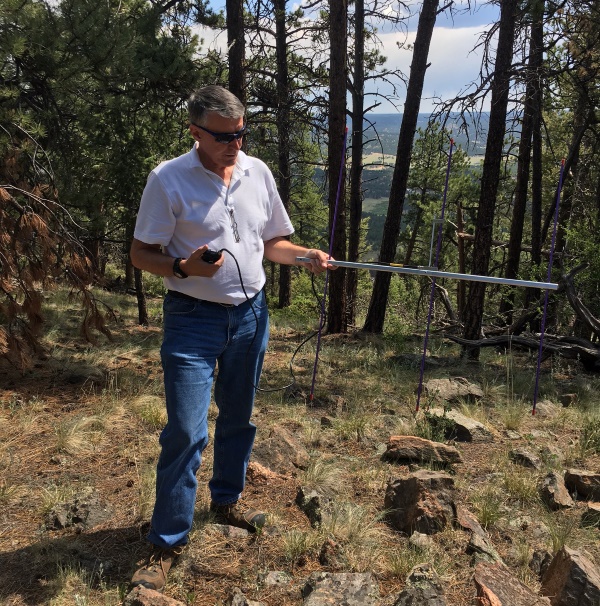 In the photo to the left, I’ve got the yagi antenna assembled and I’m using it to make contacts. With a little practice, the Arrow antenna screws together quickly and provides some nice gain over the halfwave vertical (about 6 dB).
We had excellent weather today so that helped make for a fun day. If you are in the Lake George, CO area consider Blue Mountain for an easy and fun activation.
73, Bob K0NR
The post Easy SOTA: Blue Mountain (W0C/SP-123) appeared first on The KØNR Radio Site.
2017 June VHF Contest (K0NR)
 Last weekend, I was able to participate in the ARRL June VHF Contest, my favorite ham radio operating event. I thought conditions were pretty good…mostly I am satisfied if we have some decent sporadic-e propagation on 50 MHz, which we did. Once again, I entered in the Single Operator – 3 Band category with a claimed score of 34,969.
This is the first contest where I used WSJT modes and was successful but certainly not highly skilled. I know I blew a couple of MS144 contacts due to operator error on my part. As I prepared for the contest, I was really focused on getting the computer/radio connections sorted out in advance, which I did accomplish. I made some JT65 and MSK144 contacts a few days ahead of the contest, so I was good to go. The issue that I totally missed was thinking through the operating position so that I could switch modes/bands easily. Instead, I had lots of cable plugging and unplugging as I moved things around. More to learn and improve on next time.
K0NR Single Op - 3 Band
Band QSOs Mults
-------------------
 6:   254 110
 2:    29 10
 222:
 432:   3 1
-------------------
Total: 286 121
Total Score = 34,969
I made a dozen JT65 QSOs, all on the 6 meter band. These contacts were with very weak signals so I probably would have missed them on SSB. I have concluded that the main purpose of JT65 is to give bored operators something to fiddle with when band conditions are poor. It always seemed like there was just enough signal present for me to keep trying, sometimes with success, sometimes not.
 I was very pleased to work K5QE for my first 2m meteor scatter QSO (MSK144). My intent is to spend more time with this mode in the coming year and focus on chasing grids on 2 meters.
I looked back at my previous scores in the 3-band category. My best score (48,117) was back in 2013, the first year there was a 3-band category. Looking back at my blog posting from that year, at the time I didn’t think the band conditions were very good. I also came across this article by W0VG which indicates that stations from Colorado scored pretty well that year compared to other parts of the country. The results article in QST for that contest provides more detail.
So maybe propagation wasn’t that great this year after all. At least not in Colorado. (The DX spotting map looked really good in the eastern side of the US.) But I’ll go back to my earlier statement that any June VHF contest with some decent sporadic-e propagation on 50 MHz is a win.
Thanks to everyone that came out and played radio on the VHF bands.
73, Bob K0NR
The post 2017 June VHF Contest (K0NR) appeared first on The KØNR Radio Site.
Pursue Radio Operating Goals
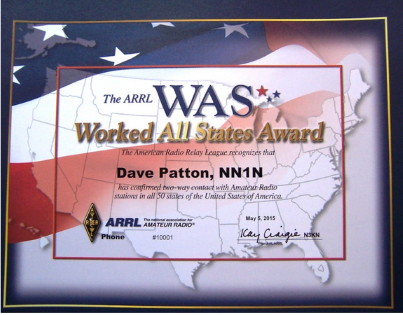 Operating goals or awards are a fun way to keep focused on accomplishing something via ham radio. Really, it’s a specific reason to get on the air and make radio contacts. I am not big on idle chit chat via the radio (“the weather here is 65 deg and raining”) so having a reason to make contacts helps me get on the air. I’ve tended to pursue awards in a serial manner…once I hit some level of accomplishment, I usually declare victory and move on to something else.
Way back in the wayback machine, the first award I pursued was Worked All States (WAS). It does take some effort but I was pretty active on the HF bands at the time, so many of the states just showed up in my log. But to really drive it home, I kept track of which states I still needed and actively looked for opportunities to work them.
Next up was Worked All Continents (WAC), which obviously requires working some DX. But then I decided that if I was going to have any DX cred at all, I needed to get DX Century Club (DXCC). This turned out to be a bit of a challenge with my modest station (100 watts and a dipole) but I found that working DX contests to be very helpful. The big hassle was collecting the QSL cards and getting them checked by the ARRL (back before the Logbook of the World days). Once I checked the box on DXCC at just over 100 countries, I was satisfied and went on to other things. Serious DXers chase all available countries/entities to get Honor Roll and other bragging rights.
The VHF and higher bands have always been a passion for me, so I pursued the VHF/UHF Century Club (VUCC) awards. First, it was 6 meter VUCC, the easiest one to get. A really good run during the ARRL June VHF contest can produce the 100 grids you need for the award in one weekend. For me, it took a few more contests than that after factoring in the fallout that occurs when trying to get confirmation QSLs. The 10 GHz VUCC only requires 5 grids which turned out to be not too difficult. My VHF collaborator at the time, Doug W0AH (now W4LY) and I took turns operating from Pikes Peak while the other guy went out and activated the required 5 grids. It helps to have a big honkin’ mountain nearby to use for 10 GHz operating. About this time, I got into working the LEO satellites and worked the required 100 grids for satellite VUCC. I don’t have very many grids confirmed on 2 meters, so that one is still calling to me.
Recently, I spent some effort going for the CQ WPX Award (worked prefixes award). This is an intriguing award structure because every new callsign prefix counts as a new one. For the basic mixed-mode award, you need to work at least 400 different callsign prefixes. I found this format to be a lot of fun because “everyone is DX” so to speak, but DX prefixes are also very valuable. The same approach is used for the WPX contests, which naturally brings out stations with less common callsign prefixes. A big motivator for me was when the ARRL announced Logbook of the World (LoTW) support for the CQ WPX awards. I mean, there was no way I was going to collect 400 QSL cards to submit for this award, but using LoTW made this very efficient. More on that story here: CQ WPX, LoTW and the End of QSL Cards.
Summits On The Air
Lately, I’ve been active in the Summits On The Air (SOTA) program, both activating and chasing summits. This is a natural fit for me as I’ve enjoyed mountaintop operating in various forms, mostly on VHF and UHF. (See my SOTA blog postings.) The SOTA program has a wide variety of awards, supported by a very powerful database used to record SOTA radio contacts and keep track of the scores. It is not really a competition but there is friendly rivalry between SOTA enthusiasts as they monitor each other’s posted scores.
I’ve been using VHF (and UHF) exclusively for SOTA and managed to qualify for the Shack Sloth Award using just those bands. (Shack Sloth is achieved with 1000 chaser points.) Shack Sloth is a bit of a misnomer for me as many of my SOTA chasing contacts were done while hiking, mobile or portable (not sitting at home in a shack). The Mountain Goat Award is taking a bit longer because I have to drag myself up enough summits to reach 1000 points as a summit activator.
Here’s the current scores for the Colorado (W0C) SOTA activators:
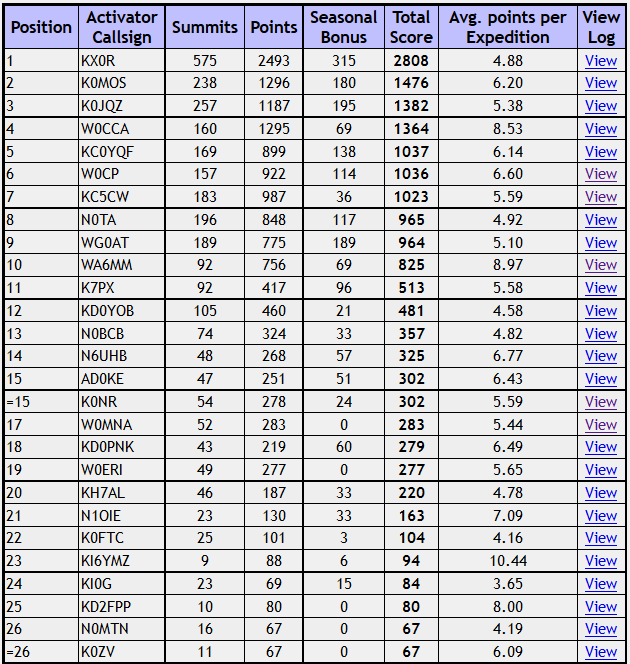 At the top of the list, we find Carey KX0R totally killing it with 2808 points. These folks have all reached the coveted Mountain Goat status: KX0R, K0MOS, K0JQZ, W0CCA, KC0YQF, W0CP, KC5CW. I am further down the list, tied with AD0KE at 302 points. Now, remember this is not a competition
  Honestly, I wish I were further along the path to Mountain Goat but I’ve decided to keep at it and enjoy the journey. Walt W0CP recently gave me some excellent advice: just keep making progress.
Other Goals
You may not find the awards and goals I’ve mentioned to be very interesting, but there are many other options. In 2016, the ARRL sponsored the National Parks On The Air (NPOTA) program, which created a lot of interest and activity. I did just three activations for NPOTA but many people really got into it.
You might also set your own personal goal, not associated with any award. I know one ham that decided his goal was to make a ham radio contact every day of the entire year. This sounds simple but if you have a full-time job and other responsibilities, it takes some persistence to make this happen. Perhaps you are public service oriented; you might set a goal for the number of ARES events you support this year. I challenge you to think about what it is you are trying to do with ham radio and set a goal that is consistent with that.
Those are my thoughts, what do you think?
73, Bob K0NR
The post Pursue Radio Operating Goals appeared first on The KØNR Radio Site.
2017 Hamvention Report (K0NR)
After missing it for several years, I managed to attend the Dayton Hamvention this year. This is the largest amateur radio event in the world, so definitely an event to attend if you are into ham radio. I had some concern about going the first year in the new Xenia location, but frankly I was never a fan of Hara Arena so I figured I’d give it a try. I met up with best budd Denny (KB9DPF) in Fort Wayne and we drove down Friday night, attending the event on Saturday and Sunday.
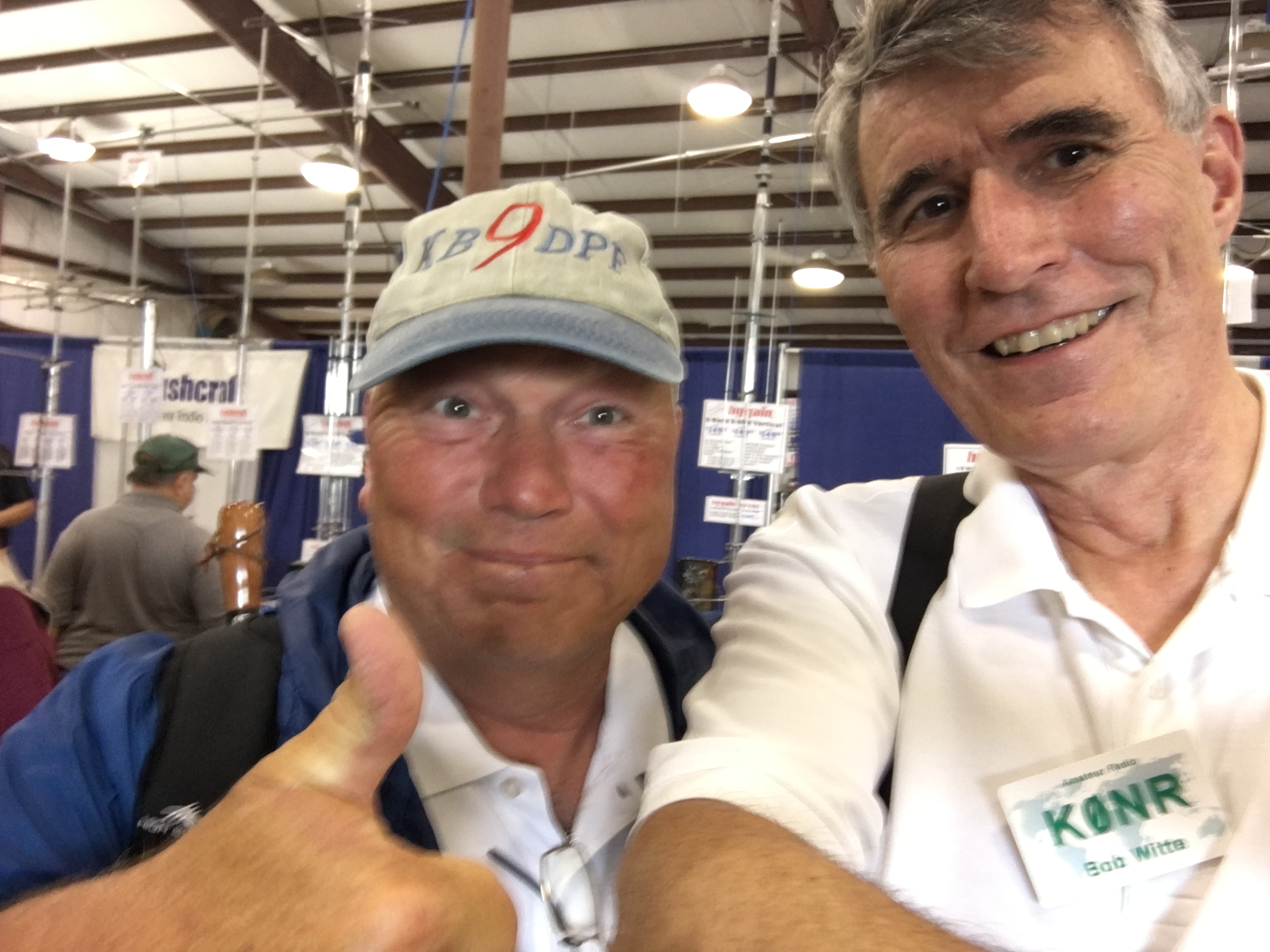
The short story is that we had a blast and the new location is an improvement over Hara (which is, of course, an easy compare).
We went early on Saturday morning, arriving at the fairgrounds around 8 AM (for a 9 AM start time). No traffic issues, easy access to parking. On Sunday we left a little later, arrived at 8:30 AM, again no traffic issues. (I suspect the traffic problems we’ve heard about were associated with arriving from the west, coming from Dayton. Also, that problem seemed to be mostly on Friday morning.)
Positives:
- Most of the buildings were in good shape [insert disparaging comment about Hara].
- Most of the buildings are not air conditioned but it seemed to be comfortable enough.
- The usual vendors were there…I couldn’t think of any didn’t show.
- The food selection was very good…basically “county fair style” vendors. For example, I had Louisiana style chicken, red beans and rice for lunch on Saturday.
- The forum rooms were pretty decent, as in large and convenient [insert disparaging comment about Hara]
- I attended a few forums (all good): contesting, AMSAT, NPOTA
- Parking was convenient and no charge.
Negatives:
- The flea market was a muddy mess, so we skipped that completely. Those that went out there came back with shoes covered with mud. (I saw one guy that came prepared with 18-inch high rubber boots. Smart move.) I’ve seen lots of comments on the web about “well, you can’t control the weather so you just have to deal with the mud.” Yes, you can’t control the weather but even Hara had a paved parking lot for the flea market. Read: no mud.
- All of the food vendors were outside and there was little to no sheltered seating. If the rain had hit around lunch time, I am not sure where people would have eaten.
All in all, not too bad.
I’m sure they’ll be getting lots of feedback and will be working on the problem areas. I think you have to accept the fact that on a weekend in May in Ohio, you will get some rain. So something has to be done about the flea market, else its mud city most years.
Seriously, I think the Dayton Amateur Radio Association (DARA) pulled off a minor miracle getting Hamvention moved to a new location without a major problem. They had a well-oiled machine that knew how to make it happen at Hara but everything had to be reworked this year.
People often ask “well, why do they even hold such a major event in Dayton?”
The answer: because that’s where DARA is.
73, Bob K0NR
The post 2017 Hamvention Report (K0NR) appeared first on The KØNR Radio Site.













