Posts Tagged ‘Training’
 The 10 Essentials for Hiking (and SOTA Activations)
 August 17th, 2015 |
  Author:
  Most backcountry hikers are familiar with the Ten Essentials that you should take with you whenever you head into the wilderness. Over the past few years, I noticed that I was getting a bit sloppy with regard to what is actually in my pack when I head out on the trail. This hit home one day when my GPS battery went dead. I fumbled around to find my compass which was supposed to be in my pack. Well, it was in my pack, the other one that I left at home.
This caused me to review the list of ten essentials to make sure I had the right stuff in my kit. A search on the internet revealed that the classic list of ten has been modified and augmented by various people to make it better. (Innovation runs rampant on the interwebz, you know.) One of the better resources I found was this page on the REI web site, which explains how the Classic Ten Essentials have been updated to the Ten Essential Systems:
- Navigation (map and compass)
- Sun protection (sunglasses and sunscreen)
- Insulation (extra clothing)
- Illumination (headlamp/flashlight)
- First-aid supplies
- Fire (waterproof matches/lighter/candles)
- Repair kit and tools
- Nutrition (extra food)
- Hydration (extra water)
- Emergency shelter
Read through the REI web page to get the fine points of this system approach. I won’t repeat that information here. They also include a Beyond the Top Ten list which calls out the need for:
Communication device: Two-way radios, a cell phone or a satellite telephone can add a measure of safety in many situations.
Of course, what they really mean is an amateur radio transceiver and antenna but they probably can’t say that in print due to licensing issues. (Not everyone in the backcountry has an FCC ham license. I know, they all should have an amateur license but many don’t…very hard to understand.)
So how are you doing with your Ten Essentials list? Are you consistent in taking along the right stuff in your pack? Any tips to share with hiking hams?
73, Bob K0NR
The post The 10 Essentials for Hiking (and SOTA Activations) appeared first on The KØNR Radio Site.
Long night
Description:
This class is designed for those auxiliary emergency communicators and groups who volunteer to provide backup emergency radio communications support to public safety agencies. Typically, this includes amateur radio and Radio Emergency Associated Communications Team (REACT) communicators, but may include other volunteer emergency communicators.
Volunteer emergency communications operators/groups, using amateur radio, have been providing backup communications to public safety for nearly 100 years. Event planners, public safety officials, and emergency managers at all levels of government utilize their services. Often, amateur radio services have been used when other forms of communications have failed or have been disrupted. Today, nearly all the states/territories have incorporated some level of participation by amateur radio auxiliary communication operators into their TICPs and SCIPs.
This course focuses on auxiliary communications interoperability, the relationship between the COML and the volunteer, emergency operations center (EOC) etiquette, on-the-air etiquette, FCC rules and regulations, auxiliary communications training and planning, and emergency communications deployment. It is intended to supplement and standardize an operator’s experience and knowledge of emergency amateur radio communications in a public safety context.
It's a two day event, held over the weekend of October 24th and 25th at the Middlesex County Fire Academy. Looks to be interesting. My registration was received and accepted pending my sending in the certificates of completion, which I sent in this morning.
The FEMA courses were comprehensive in scope. Each was designed to be completed in about 3 hours and I came in slightly under that amount of time - maybe two and a half hours or two hours and forty five minutes each.
I crammed two in last night (which wasn't wise) as each evening for the rest of this week is booked with other activities. I was pretty bleary eyed for that last exam, but was pleased when I got the e-mail that I passed.
FEMA offers a lot of free, on-line independent study courses. You can look them up at https://training.fema.gov/is/crslist.aspx?all=true
72 de Larry W2LJ
QRP - When you care to send the very least!
Announcing: Oct 2015 WØTLM Technician License Class
 Ham Radio Two-Day License Class
Sat Oct 3 and Sat Oct 10 (8 AM to 5 PM) 2015
Location: Black Forest Fire Station 1, Black Forest, CO
The Technician license is your gateway to the world-wide excitement of Amateur Radio …
- Earn your ham radio Technician class radio privileges
- Pass your FCC amateur radio license exam right in class on the second day
- Multiple-choice exam, No Morse Code Required
- Live equipment demonstrations
- Learn to operate on the ham bands, 10 Meters and higher
- Learn to use the many VHF/UHF FM repeaters in Colorado
- Find out how to participate in emergency communications
There is a non-refundable $25 registration fee for the class.
In addition, students must have the required study guide and read it before attending the two-day class: HamRadioSchool.com Technician License Course $20.95
(make sure you get the most recent edition of this book, updated for the new FCC exam questions)
Advance registration is required (no later than one week before the first session, earlier is better! This class usually fills up weeks in advance.)
To register for the class, contact: Bob Witte KØNR
Email: [email protected] or Phone: 719 659-3727
Sponsored by the Tri-Lakes Monument Radio Association
For more information on amateur (ham) radio visit www.arrl.org
The post Announcing: Oct 2015 WØTLM Technician License Class appeared first on The KØNR Radio Site.
We Call It “Tech Field Day”
For Field Day this year, the Tri-Lakes Monument Radio Association (WØTLM) is planning a one day event that combines our Tech Day training activities with normal Field Day radio operating. This Tech Field Day will have a strong emphasis on radio education and training, including an opportunity to make contacts on the HF bands under the supervision of an experienced radio ham.
click to expand
Sat June 27th, 2015 (8:00 AM to 5 PM)
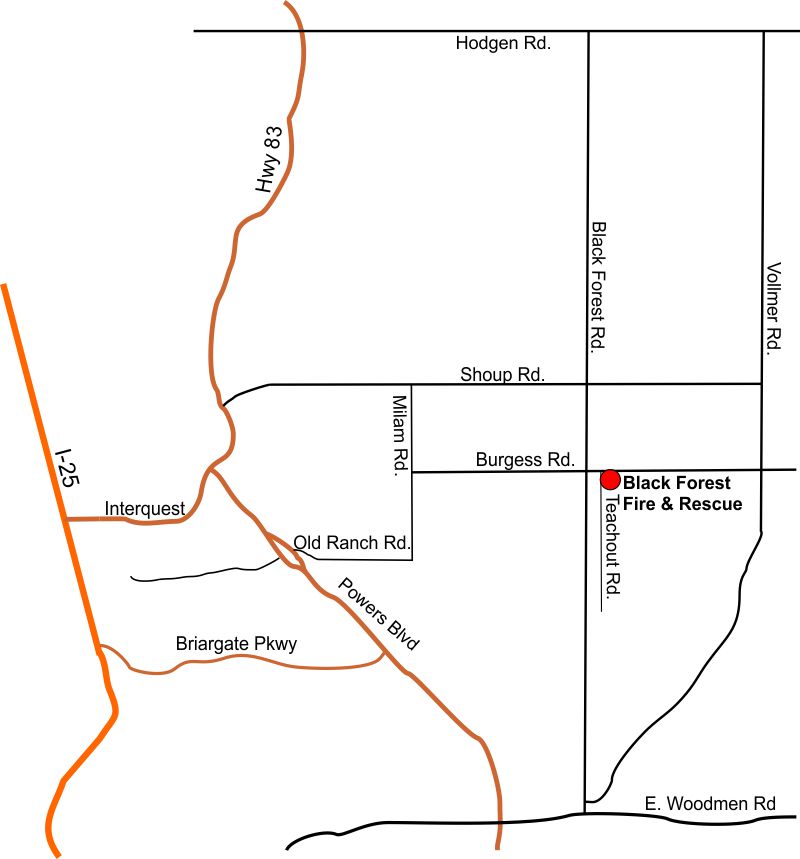
Location: Black Forest Fire Station 1
11445 Teachout Road, Colorado Springs
Come to our one-day education and radio operating event and learn from informative presentations of amateur radio topics. Operate a high frequency (HF) radio station with the helpful guidance of an experienced radio ham. Learn about emergency communications and public service. Most of all, have a bunch of fun messing around with ham radio stuff!
| Time | Activity | Presenter |
| 8:00 | Setup starts | |
| 8:30 | FM Simplex and Repeaters | Bob Witte, KØNR |
| 9:30 | Operating SSB on the HF Bands | Stu Tuner, WØSTU |
| 10:30 | Construction of Dipole Antennas | Larry Kral, NØAMP |
| 11:30 | Summits On The Air (SOTA) | Steve Galchutt, WGØAT |
| 12:00 | Start Field Day Operating | |
| 13:30 | Copper pipe antennas | Al Andzik, WBØTGE |
| 14:30 | Emergency Power for Ham Radio | Mike Hoskins, WØMJH |
| 15:30 | Ask an Elmer Panel | Bob Witte KØNR and crew |
| 17:00 | End of operations – tear down |
For more information, visit the W0TLM web site.
73, Bob K0NR
The post We Call It “Tech Field Day” appeared first on The KØNR Radio Site.
Three Common Mistakes When Using Metric Units
 A while back, I had someone point out a few errors I made concerning the use of metric units. This caused me to review the SI system to make sure I had it correct. (I am sure I’ll continue to screw up a few things but, hey, life is a journey.)
The International System of Units, universally abbreviated SI (from the French Le Système International d’Unités), is the modern metric system of measurement. For a thorough treatment of the topic, take a look at the National Institute of Standards and Technology (NIST) publication: Guide for the Use of the International System of Units (SI). A shorter and easier-to-read document was written by Charles Poynton: Writing SI units and symbols.
But more to the point, here are three common mistakes I often see occurring in ham radio literature:
- Using mHz instead of MHz to indicate megahertz (one million hertz). Upper case M indicates mega, while lower case m indicates milli (one thousandth). In ham radio usage, we rarely speak of frequencies in mHz. Note that I wrote mega with a lower case m even though the abbreviation has a upper case M. The unit of hertz is with a lower case h but when abbreviated as Hz, it should be upper case.
- Using KHz or khz instead of kHz to indicate kilohertz (one thousand hertz). Lower case k should be used for kilo but upper case H is used for hertz. It is common to see upper case K used to indicate 1024 in digital systems.
- Using M instead of m to indicate the unit of meter. The proper way to refer to the wavelength of the 144 MHz ham band is 2m, not 2M. Similarly, the abbreviation for kilometers is km, not kM or KM. The abbreviation for centimeter is cm.
Units that are based on a person’s name use an upper case letter in the abbreviation. For example, ampere, volt, watt and hertz are abbreviated as A, V, W and Hz respectively. When the unit is spelled out, it is left lower case (go figure).
While the world does keep on turning when we make these mistakes, accuracy and understanding is improved by proper usage. Did I miss any other common SI errors?
73, Bob K0NR
The post Three Common Mistakes When Using Metric Units appeared first on The KØNR Radio Site.
Explaining Standing Waves
When we teach the Technician License Class, we provide a simple explanation of Standing Wave Ratio (SWR) that emphasizes the concept of impedance matching. An SWR of 1:1 is a perfect match; anything higher is less than perfect.
SWR is an important amateur radio concept, one that is not that easy to explain so I am always on the lookout for training materials. HamRadioNow just republished this video of excellent standing wave demonstration by Bill Hays, AE4QL. Bill actually goes well beyond just standing waves and shows some antenna and transmission line theory as well.
If you just want to learn about standing waves and basic antenna radiation, view the first 35 minutes. After that, it starts to get a little deep.
Grab a cup of your favorite beverage, settle in and get ready to learn from this video.
73, Bob K0NR
The post Explaining Standing Waves appeared first on The KØNR Radio Site.
ARRL Field Day: Season To Taste
 I’ve written before about the flexibility of Field Day and the need to season to taste to make it your own. I have always thought that one of the great things about Field Day is that it can be tuned to whatever interests you or your club. It can be a serious radio contest (well, almost); it can be an emcomm drill. It can be a radio campout; it can be a foodfest, it can be a beer-drinking party. Insert your idea here.
This year, our local club, the Tri-Lakes Monument Radio Association is going to try a new approach that we call Tech Field Day. We previously have held a one-day educational event that we call Tech Day, that featured a series of presentations and hands-on demonstrations. The main theme of Tech Day was to help the Technician level hams gain more knowledge and help them move on up to General class operating.
We are taking the basic idea of Tech Day and combining with a shortened one-day version of Field Day. So on Saturday June 27th, we’ll offer a series of educational presentations along with some classic Field Day radio operating. The operating emphasis will be on giving newer hams a chance to get on the air, probably on both HF and VHF. (Our plans are still coming together.) We will also promote the theme of emergency communications, operating off a emergency power source, etc.
There are a number of things that we are intentionally leaving out. We won’t operate the entire 24 hour period…in fact, we’ll probably just be on the air Saturday afternoon. We won’t worry about making a lot of contacts or running up the score. Our stations will be relatively simple (no towers, no amplifiers).
So that’s our idea of a fun Field Day. What are you planning to do?
73, Bob K0NR
The post ARRL Field Day: Season To Taste appeared first on The KØNR Radio Site.













