Posts Tagged ‘SOTA’

My Backpack Progression

A lot is written in the SOTA Blogosphere about backpacks and which one is the ultimate one for treks into the wilderness to operate portable. What can be quickly be deduced from these articles is that the ultimate backpack is a matter of taste and philosophy. Will you want to account for every possibility or have a quick exit strategy should something go wrong? Your philosophy can be driven by the circumstance, e.g., if I live in the mountains I am quick to abandon a summit attempt as I can always do it tomorrow. However, if I am in the mountains on a vacation or otherwise limited schedule, I might be prepared to endure more in-climate weather to get a summit activation in. Each philosophy dictates a different approach.

As with any activity the more experience you get, the more refined your approach becomes and so it has been with me. My first activation was last March. I took my KX3 with an FT-817 as backup, an Alexloop, a Buddistick, several coax jumpers (BNC - PL-259, BNC - BNC and other combinations just in case), a pound of trail mix and several bottles of water. All this for a 3.5 mile round trip. I didn't even want to weigh it.
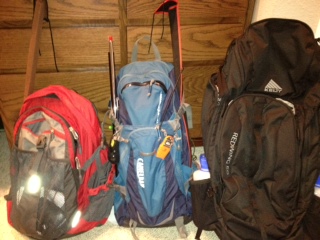
Pack Evolution
I started with the black Kelty, then the red North Face
and finally I've progressed to the CamelBack Fourteener in the middle

I started with a big pack and I filled it up, which is a big mistake. So I realized maybe I should downsize a little. So I began to rationalize what I carried. I realized that the KX3, while a very nice radio, is a lot to carry in both weight and bulk. I am really more of a CW guy, so I was carrying around a lot of capability that I didn't need. I owned an ATS-4 which weighs a few ounces and is a CW only rig with 5 bands. Also, the Alexloop is an effective antenna, but it's bulky and takes a lot space in a pack. For relatively long hikes, it's too much. The problem with bulk is that it makes you get a bigger pack and human nature dictates that you fill it up, so you unconsciously take more stuff. For an antenna I went to a trail friendly EFHW 40/20/10 supported by a carbon fiber fishing pole that telescopes to 21 feet.

If I am on a drive-up/walk-up summit, I might carry some of the bulky stuff because it's easy. I recently used the Alexloop on Mt. Locke because I didn't have to carry if far, sot the situation can dictate a different configuration.

The other consideration is water. You should get a pack that allows you to insert a water bladder with a drinking tube accessible to you while you are hiking. This not only allows you to drink on the go, it is a better way to carry water and eliminates the need for bulky water bottles.

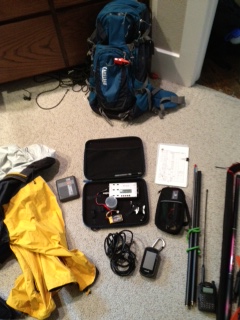
As you can see above I have continually downsized my pack. The CamelBack Fourteener is about 1/3 the capacity of the Kelty that I started with. Below is what I carry.

Typical Activation Load

My radio is in an iPad portfolio along with the power supply, paddle and ear phones. I carry two antennas, a modified Buddi-stick and a carbon fiber telescoping fishing pole with an EFHW antenna, VHF radio, coax, GPS, log, first aid kit and rain gear. The pack above weighs about 9 lb. The bladder in this pack holds 100 ounces of water (gallon ~ 128 ounces). I been on an activation in the heat that was 9.5 miles round-trip and I had water left over, so you don't have to fill it up every time. Without water and without any food/snacks the above weighs, including the pack,  about 9 lbs. I do have a redundancy with the antennas, but that is to allow for different conditions and what I have time for on the summit. If I lived in the mountains, I would only take one antenna.

I have climbed Mt Sherman, 14,036 feet and Emory Peak, 9.5 mile round trip using this pack and I haven't lacked anything that I needed.

However the game continues, I am still looking for ways to cut back.


Emory Peak Activation

Emory Peak (7,825 ft) is the highest point in Big Bend National Park in Texas. As previously posted I had activated Mount Locke  in the Davis Mountain the day before. Mt. Locke was a relatively easy activation , but I would earn my points and more on Emory Peak.

 For those not familiar with the Summits on the Air (SOTA) program there are bonus points added for activating a summit either during the winter in cold climates or during the summer in hot climates. West Texas is definitely a hot climate. Emory Peak is a 10 point summit (maximum), but activating in the summer months is worth 3 extra bonus points. On the drive from Mt. Locke to the Big Bend area temperatures hovered between 99 F to 101 F. The temperatures would moderate a little at the Chisos basin where we were staying, although not a lot. The Chisos Mountain Lodge is around 5500 feet in elevation, but the high temperatures during this time of year are in the low 90's.

The Chisos Mountain range within Big Bend National Park is a beautiful place. Emory peak may be the only peak that is climbable, but even then, you must climb the last 35 feet using some, not so easy, rock climbing techniques. I would not recommend it if you aren't experienced.

The trail to the summit of Emory Peak is a very nice trail. It is well marked and maintained. The only issue is that the round trip is 9.4 miles and there is 2,500 feet of elevation gain. Given that distance the elevation gain is not particularly difficult, if you are accustomed to mountain hikes, but it is a long way.

Emory Peak Trail 
The Peak is in the background

We started relatively early, 7:30 am.  I wanted to start sooner, but my XYL was nervous about the warning about hiking too early. The Big Bend National Park and the Chiso's Mountains in particular have Mountain Lion and Black Bear populations. Both are sighted quite often, but Mountain Lions in particular are active in the early morning. We had to check out of our hotel room at the Chisos Mountain Lodge by 1:00, so we needed to depart the summit by 10:30 by my calculation to get back in time. I figured 2.5 hours up, 30 minutes to operate and then 2 hours back down. If my calculations were correct, 7:30 was the latest we should start. My wife and I are in relatively good shape, so I felt 2 miles an hour was a doable pace considering we were gaining 2,500 feet.

Cris, my XYL, just below the summit
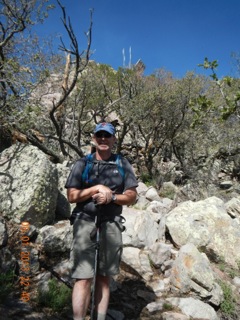
AD5A just below the Summit
VHF Antenna above are on the Summit
The hike up wasn't too bad. Most of it is in the shade as the sun comes up over the mountains. It is a nice hike through a mostly forested trail. The last mile up was exposed to the sun, but there were still patches of shaded forest and the temps were bearable. We reached the summit around 10:00 am, right on schedule.

From my research I know that there weren't any tall trees on the summit, so getting an End Fed Half Wave antenna high enough would be an issue. I also know that time would be short with a hike this long, in the heat, so I needed to be able to deploy quickly. I decided on the Buddi-stick vertical. I only planned to operate on 20m, given the short time, so the vertical made sense.
Emory Peak Shack
You can see the Buddi-stick if you look closely
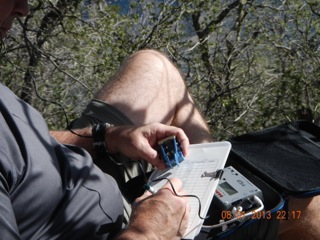
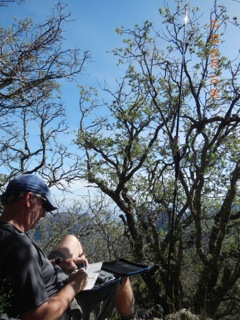
So I quickly deployed the station knowing that I would only have a short time to operate. I propped he vertical against a tree limb and then extended the counter poise over another limb. I took out my SOTA notebook station, seen above, plugged in the LIPO battery to ATS-4 QRP radio, grabbed my Porta-Paddle and I was ready to go. I called my first CQ at 10:13 am CDT. My good friends from Santa Fe, NM, Doc, K7SO and John, K1JD were monitoring my advertised frequency of 14.061. Doc answered my QRL? :-) John quickly followed. What then happened was SOTA bliss. The vertical was working well and in the next 15 minutes I made 21 QSO's. I wished that I had more time, but we needed to get off the mountain, both to beat the heat and to avoid an additional day's charge on our hotel room. So I took the station down as quickly as it went up, packed it all up and Cris and I headed down the mountain. We didn't get away until 10:45, a little behind schedule.

The trip down was uneventful, just long and the last mile or so, the heat was getting just a little on the uncomfortable side. However we were fully prepared, we carry 100 oz Camel Back water bladders in our pack, so we stayed hydrated. We made it back to our room at 12:55 pm. The good people at the Chisos Mountain Lodge let us shower and clean up before check out without an additional charge. I personally think it was self serving on their part as they didn't want us eating in their restaurant smelling like we just came off the trail:-)

This was a challenging hike, but completing it left us feeling good that we can still do it. The radio portion of the adventure came off without a hitch, so it was a good day in the Chisos.

SOTA Activation, Locke Mountain, Davis Mountains, TX


This was fun activation today. Locke Mountain is the home of the McDonald Observatory and you can drive most of the way to the top. There is a short climb to the summit from the parking lot.  Locke Mountain is in the Davis Mountains which this time of the year is like an oasis in West Texas. Everything is green and the mountains are beautiful. The only problem with this area is that so many of the peaks are on private property. I need to do a little more research to find ways to get on them. I tried to get permission to do Guide Peak, another 10 pointer close to Locke Mountain, but the owner said no, this time.

Today,because of a potentially crowded summit, it wasn't, I used an Alex Loop for the first time. Very pleased with the results, ~30 QSO's on 4 bands with my ATS-4. I actually did two stints on the summit. After lunch in Fort Davis I went back up to try to work a few more guys while my wife shopped in town. Fort Davis is a very nice town.

Tomorrow I will try Emory Peak in Big Bend National Park, W5T/CI-009. This is a 9 mile round trip. I will be on the trail early, but if it gets too hot, I will call it a day. Check out www.sotawatch.org for spots. I will try to summit between 1400-1500z on 2 Aug.

A Little Mountaintop Video

While digging through the archives, I came across some previously unseen video from the 2012 Colorado 14er Event. Joyce KØJJW and I operated from Mount Sneffels (SOTA W0/UR-001) and this video shows a radio contact with Mark KTØAM on Mount Shavano.

The 2013 event will be held August 4th, see www.14er.org.

Summits On The Air (W0/SP-112) – Castle Rock

There is a very jagged peak just east of Buena Vista, CO called Castle Rock (not to be confused with the city by the same name). I knew this was a SOTA summit (W0/SP-112) and I had my eye on it for a while now. It is extremely rocky and jagged near its summit, so I was not sure if it could be ascended without a technical climb. A little research revealed that it was climbable but quite steep near the top. SummitPost.org has a good description of how to ascend this peak.
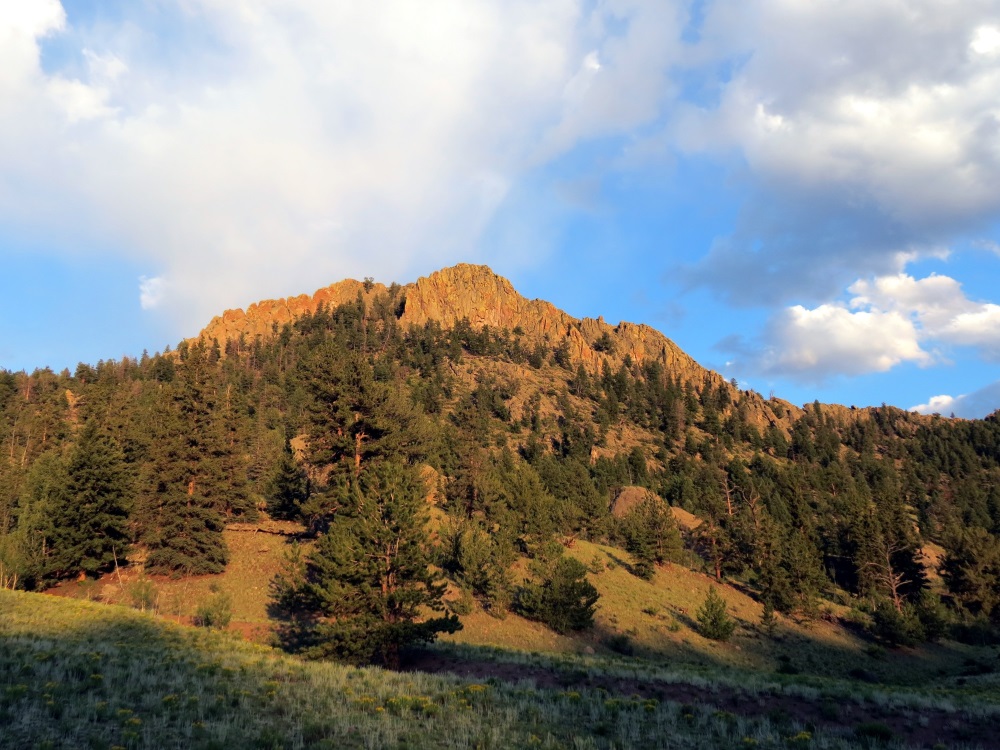
Castle Rock

Castle Rock

My hiking partner and wife, Joyce K0JJW, joined me on the climb. We managed to get off the preferred route and got into some very steep rock scrambling. Good judgment prevailed and we regrouped and found a more reasonable path but probably cost us an extra hour of hiking. As advertised, it did get very steep at the top. (Study the SummitPost information more carefully than I did.)
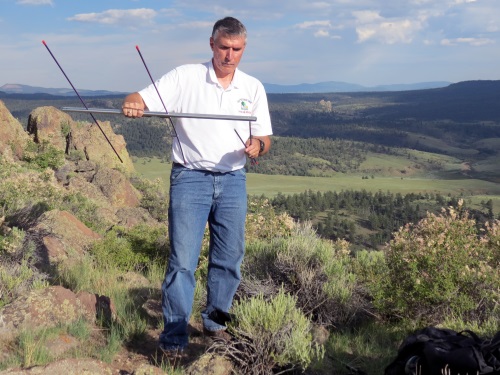
Assembling the Arrow 2-Meter antenna

Assembling the Arrow 2-Meter antenna

Recently, I picked up an Arrow 3-element Yagi antenna for 2 Meters  (Model 146-3). This antenna can be dismantled and carried inside a reasonable size daypack (or strapped on externally). The boom has two threaded holes for mounting the antenna on a camera tripod. I used a MountainSmith trekking pole that can double as a camera monopod and mounted the antenna on it.
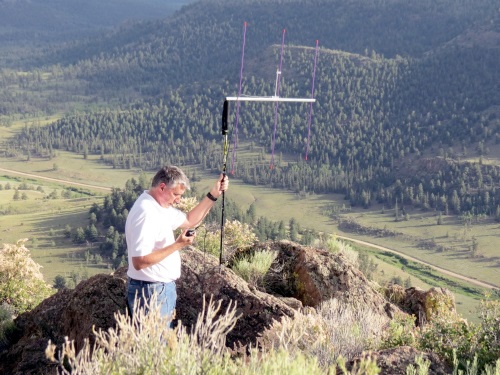
Operating with the Arrow antenna mounted on the trekking pole

Operating with the Arrow antenna mounted on the trekking pole

For this SOTA activation, I kept it simple and just used my Yaesu FT-60 to work 2 Meter FM. Accordingly, I configured the Yagi antenna for vertical polarization. (There are two mounting holes on the boom, so you can choose vertical or horizontal orientation.)

The trekking pole is not self-supporting and does not provide much additional antenna height but it makes the antenna a lot easier to point for extended periods of time. I like to use a trekking pole for hiking, so this is a good way to get a little extra utility out of it. I am pleased with how this antenna system performed and will use it again.

73, Bob K0NR

Mountain to mountain QSO.

My lunchtime QRP session had that ominous look, like it was going to end up being a bust.  The bands were nowhere near as hearty and robust as they were the past few days.  15 Meters had one strong signal, HA9RT booming in.  I’ve worked Jozsef several times in the past, and even though he was coming in like gangbusters, I figured I’d let him get some new stations in his log.

20 Meters was a ghost town and 17 Meters seemed to be the liveliest of the three bands.  Still, there wasn’t much activity and the signals I was hearing weren’t the strongest.  I didn’t feel like going back into the building, so I decided to call CQ on 17 Meters.

Much to my surprise, I was answered by George KX0R who was the first place finisher in last year’s NJQRP Skeeter Hunt. George had a nice 579 signal into New Jersey. He was using an ATS3B at 5 Watts into an inverted “L” on a mountain in Colorado.  Bald Mountain, SOTA peak W0/FR174, to be exact. 9,190 feet above sea level to be even more exact.
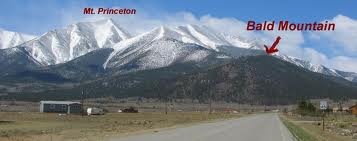
If you really, really, really, REALLY want to stretch the truth ….. you could say we had a mountain to mountain QSO.  But that would be stretching the truth almost to the point of breaking it!

Warren, the town where I work, is located on the second ridge of the Watchung Mountains here in New Jersey. My height above sea level there is all of about 500 feet or so.  Not much, by mountain standards, but since most of New Jersey is coastal plain and Piedmont, 500 feet is pretty high up there for a relatively flat state.
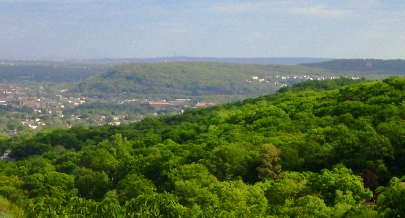
Now, according to geologists, if we went back in time, say about 200 million years or so, the Watchungs were about as tall as the present day Rockies or even the Alps. Just goes to show what time, rain, ice and wind can do to you, eh?  So in essence, compared to the Rockies, and even the farther western Appalachians, the Watchungs are more or less just “hills”.  But they’re our hills and the original settlers of New Jersey called them mountains, so who are we to argue?

72 de Larry W2LJ
QRP – When you care to send the very least!

Lighter, Easier to Pack, Telescoping Pole

I've been busy with day job, rock band and some of my other hobbies, but I've been meaning to write about this subject for a while. As I have been analyzing my approach to portable QRP SOTA operations I have been tweaking and lightening my load. One of the major advances is the telescoping pole that I use. As most of you know, Locktite has a very nice set of poles, up to 33 feet as does SOTA Beams. However, the issue is that when collapsed they are still close to 4 feet in length and 2 -3 lbs in weight. This means the pole is fine to carry in your car, but it is awkward to carry up a 14,000 mountain. So what to do?

I found, through KT5X, a supplier of Japanese made carbon fiber, telescoping fishing poles. It telescopes to 21 feet, weighs 7 oz. and collapses down to 25 inches. Brilliant. Now, these are a little pricey, from $75 -$120, but if you are carrying it for a few miles, the price amortizes nicely:-).
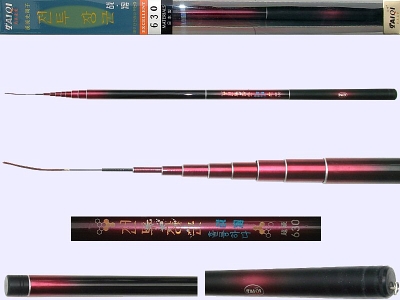

Carbon Fiber Telescoping Poles

There are a couple of caveats with these poles. There is no tip guide and the ends are a little flimsy. However if you wrap the top three sections with rod guide thread and coat it to strengthen the tip, it should suffice. You will also need to add very small rod guides, I used 3 mm guides, or buttons, yes buttons, to route the antenna wire down the pole. The buttons, two hole buttons, will need to be of varying sizes so that each will go further down the pole. The second hole of the button is what you thread the antenna wire through. If you use rod guides they should be mounted at the top of the last 3 or 4 sections so that the pole will still collapse. Once you start pondering this, while looking at a pole, it will make more sense. More on this in a later post.

 I've found the best way to deploy an EFHW, where there are trees is to use the pole to place the end of the antenna, wrapped around a winder, over the highest branch you can reach with the pole. Let the winder fall to the ground and tie it off. So now the end of your antenna is 20+ feet high over the branch that you selected. Then thread the other end of the antenna wire down your pole and extend the antenna until the end of the antenna is a couple of feet off the ground, threaded down the pole. Use a velcro wrap to secure it, attach your matching device and you're good to go. I often prop my pole on the limbs of another tree, so there is no need to guy the pole.

So to sum up, this lightens the load considerably and the deployment approach eliminates the need to throw a line or use a sling shot to try to get it over the right branch.

I will post some pictures of my pole in a later post. The poles are available at http://www.allfishingbuy.com/
in a variety of lengths and wall thicknesses.

Subscribe FREE to AmateurRadio.com's
Amateur Radio Newsletter

 
We never share your e-mail address.


Do you like to write?
Interesting project to share?
Helpful tips and ideas for other hams?

Submit an article and we will review it for publication on AmateurRadio.com!

Have a ham radio product or service?
Consider advertising on our site.

Are you a reporter covering ham radio?
Find ham radio experts for your story.

How to Set Up a Ham Radio Blog
Get started in less than 15 minutes!


  • Matt W1MST, Managing Editor