Posts Tagged ‘SOTA’

Three Summits in the Wichita Mountains

This trip to the Wichita Mountains in SW Oklahoma was not a firm plan. Unlike many of my SOTA expeditions, I only carried my radio gear in case I was able to use. Unfortunately, I was in Ft. Worth, Texas to attend the funeral of my Aunt and as always, at funerals and weddings, there are always lots of family and friends to catch up with. I figured that the reunion might last through the weekend. However, after the funeral on Friday most of my relatives dispersed back to their busy lives.  I suggested to Cris, my XYL, that we sneak off to the Wichita Mountains for a SOTA date. She agreed, so we set out for Lawton, Oklahoma, which is a 2.5 hour drive from where we were. Upon arriving in Lawton around 10:00p.m., I opened up my iPad and put together a plan.

I had lived in Duncan, Oklahoma for eight years in the '80's and early '90's and had visited the Wichita Mountains multiple times with my family and our Boy Scout Troop, but never with summits in mind. So the must do summits in the Wichitas are Mt. Scott and Elk Mountain. Mt. Scott is a drive up and Elk Mountain is a nice 1.1 mile hike, one way. I knew if I started early, three summits were doable, maybe even four. But which one would be the third? I remembered KC5CW and KD5ZZK operating from a four point summit not far from Mt. Scott, so after a little research, Mount Cummins was added to the list. Below is a report on the trip.

For this trip I used an MTR 20/40, 500 mah Lipo battery, 21 foot collapsible carbon fiber pole and a LNR 10-20-40 "trail friendly" End Fed Half Wave antenna.

Mount Scott W5O/WI-002

This is an easy summit. The weather was on the chilly side with temps in the mid-30's when we started out. Upon arriving on the base of the mountain, there was a squad of army soldiers getting ready for a run up the mountain, something that would appeal to Fred, KT5X, but I was happy to drive up this one. At the summit, there was only one other car, so I had a pick of operating sites. I elected to get out of the wind and down a ways from the summit.
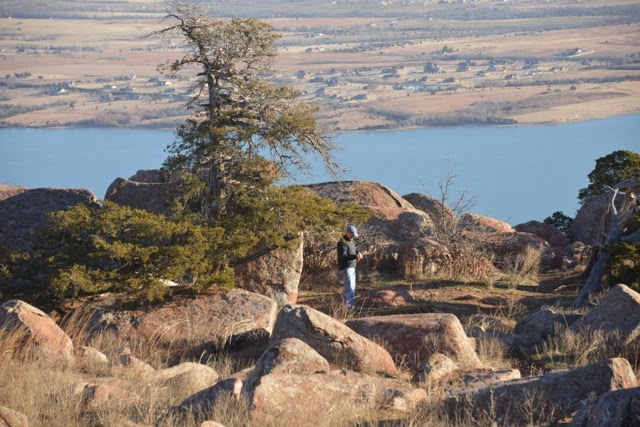
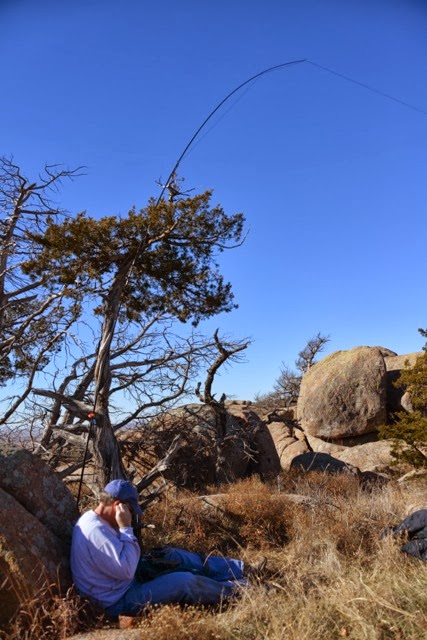
Operating Site on Mt. Scott

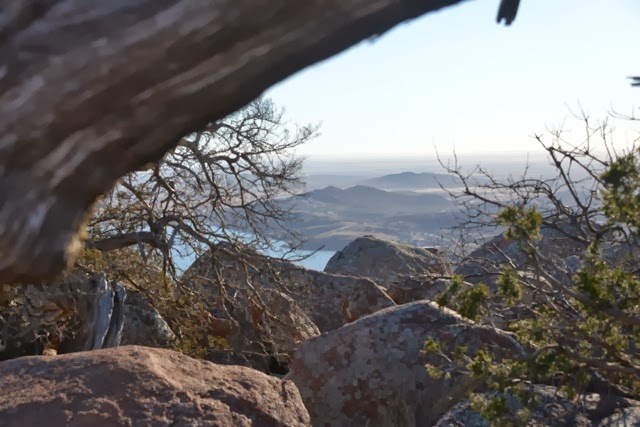
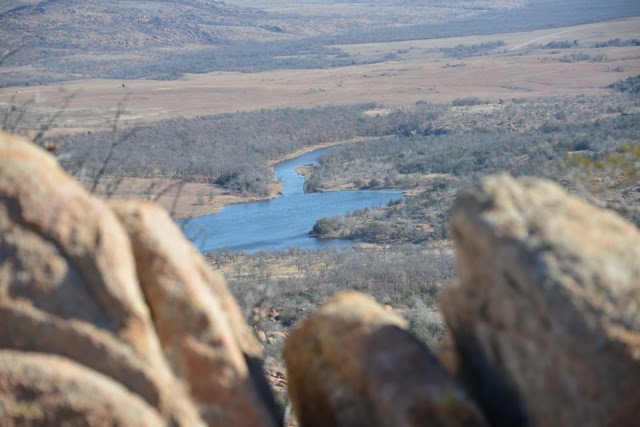
The views from Mt. Scott are fantastic, mainly because the mountain rises above the relative flat plain of grasslands. Lake Lawtonka is part of the backdrop. But it was a little chilly. The tree in the foreground of the picture is what I used to support the end of my antenna which I then brought to the operating position down my carbon fiber fishing pole.

Operating on Mt. Scott with MTR

Signals were good and I made 18 QSO's on 20 meters. When I QSY'ed to 40m I didn't get spotted by RBN so I self spotted. Nothing. I wrote it off to poor propagation. However, as I figured out on the next summit, changing bands on the MTR requires changing three switches, I had only switched two and wasn't putting out a signal, so my apologies to the 40m chasers.

View From Mt. Scott

While I was operating I heard some cadence based singing. I thought my wife was listening to something on her iPhone, but it was the army squad. Not looking as fresh as when we saw them at the bottom, but the worst was over. 

Elk Mountain W5O/WI-007

Elk Mountain 8 or 9 miles west of Mt. Scott and it is a great SOTA summit. It has an easy to follow trail that isn't too long (1.1 miles one way) and great views at the top. This would be a great summit to practice on to get prepared for higher elevation, longer climbs. My wife and I made the climb in 30 minutes.

The trail head is at the Sunset Picnic Area and begins where the bridge crosses the creek. By the time we got on the trail the temps had warmed to the upper 40's and the sky was clear, a beautiful day. The climb is straight forward and the summit is large so you have a lot of room to set up. However there no substantial trees on the summit, so this necessitated a different set-up for the antenna. I set up a little below the summit and used an inverted L configuration, running the wire up the pole and then letting it slope down from the top of the pole.

Operating on Elk Mountain

Propagation was good and signals were strong. I received several reports greater than 559 and several 599, so everything was working. I made 22 QSO's on 20m and 4 QSO's on 40m. Included in the log was S58AL.

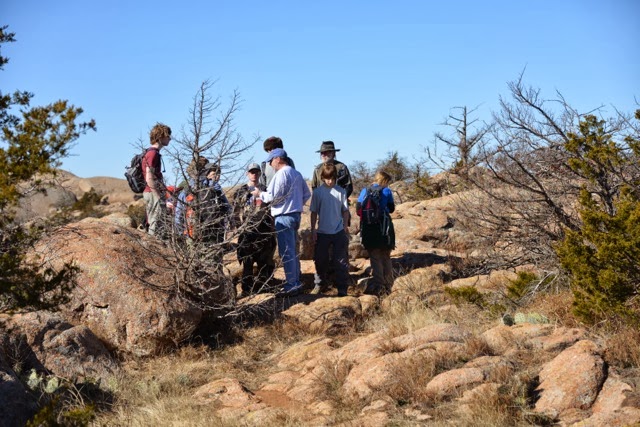
Toward the end of the activation, a group of boy scouts gathered to watch. I gave them an impromptu lecture on ham radio in general and SOTA in particular. They were very attentive. I told them that the internet was hard wired, but ham radio was magic.

Cris captured my impromptu talk with the Scouts

View from Elk Mountain

Mount Cummins W5O/WI-031

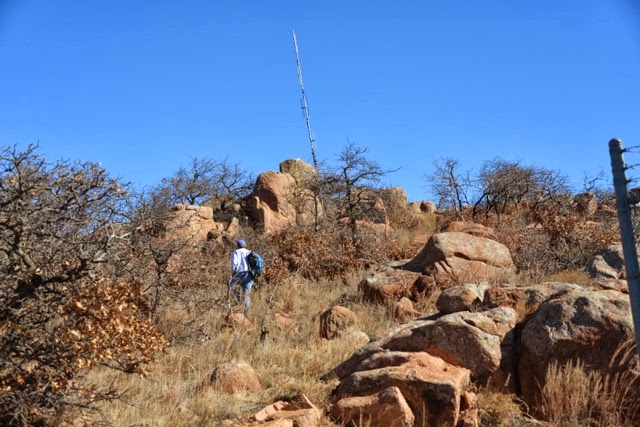
Mount Cummins is also a relatively easy summit, however finding the way to the top was a little more of challenge than I expected. My GPS took me to the wrong side of the mountain. The cell phone tower is the landmark, so I kept driving until I found the road to the tower. The cell tower site is in the activation zone, however, I wanted to get up on the summit to get the antenna deployed, so I did  a little bushwhacking.

On my way up Mount Cummins

There is a lot of scrub oak on the mountain that makes getting to the top a little more challenging than you would think. In the picture above, the cell tower fence can be seen in the right. The antenna above me in the picture must be a repeater antenna. The summit is relatively large, I set up on the summit ridge.

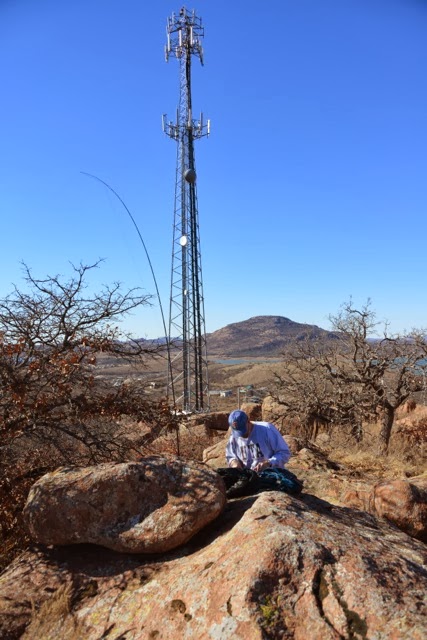
Operating Position on Cummins

You can see the beautiful day, with clear skies, temps now in the lower 60's. I made a total of 27 QSO's with all but four on 20 meters.
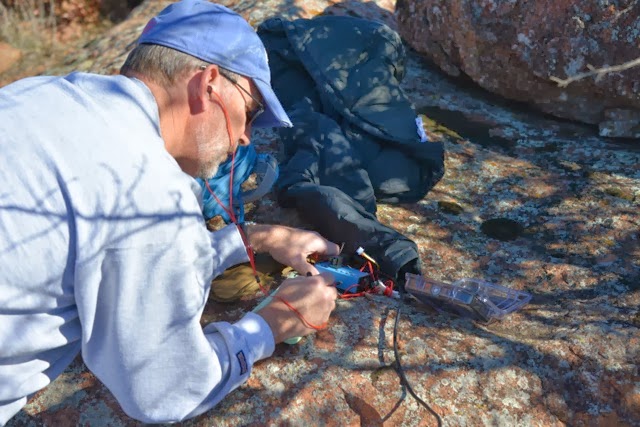
Running the Pile with the MTR

This was a fantastic day of SOTA fun. I earned 22 Activator points, enjoyed a beautiful day outdoors and enjoyed a SOTA date with my wife Cris. She loves photography, so this trip gave her some material and a good excuse to use her camera.

This is the first time I've done three summits in a day. My equipment performed well and I received better than average signal reports. I don't know if it was simply propagation or the inverted L/sloper configuration was better. At any rate, it was fun.

I had planned on maybe doing a fourth summit or maybe getting up early Sunday to do one more before driving home to San Antonio. However we received news that our daughter-in-law, who is six months pregnant, was having an emergency appendectomy, so we made the 7.5 hour drive home instead. Both mom and baby are fine.

Thanks to all the chasers. This SOTA stuff is fun.

A Christmas Eve Summit Activation

My wife, Cris, and I are staying in New Mexico for the holidays and our kids don't arrive until Christmas Day. So what better time for a SOTA activation than Christmas Eve, right. This time of  year, the higher elevation peaks and thus the higher point value peaks have too much snow on them to make access practical. So in Santa Fe that means some of the peaks in the 7,000 - 8,000 ft ASL are much more accessible this time of year.

The Sierra De Las Valles Range, west of Santa Fe, feature many peaks in the mid 7,000's. The range is located in the Caja del Rio (Spanish: "box of the river"). Caja Del Rio is a dissected plateau, of volcanic origin, which covers approximately 84,000 acres of land in northern Santa Fe County, New Mexico. The drainage from this region empties into the Rio Grande River. The center of the area is approximately 15 miles west of Santa Fe. Most of the Caja is owned by the U. S. Forest Service and managed by the Santa Fe National Forest.  Access is through New Mexico Highway 599, Santa Fe County Road 62, and Forest Service Road 24.

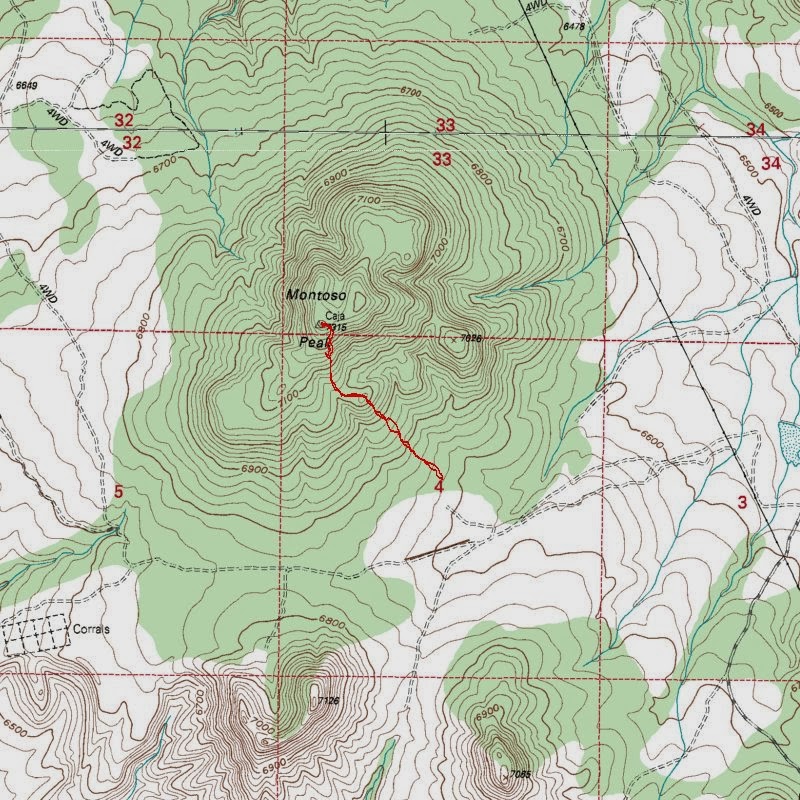
 I decided to climb Montoso Peak, which at 7,315 ft. ASL is one of the tallest peaks in the Caja and Cris decided to come along for the hike. The climb is not particularly tough, other than there are no trails. The climb is 100% bushwhack and volcanic boulders and cactus are the primary obstacles. From where we parked our Jeep, we had a 640 foot vertical ascent over a one mile hike. It took us about 40 minutes to get to the top.
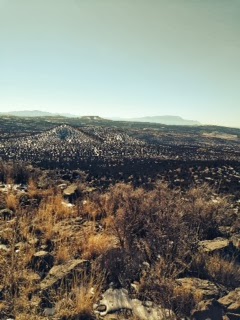
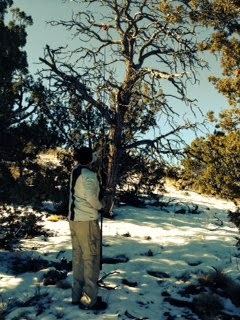
View from the Top
 
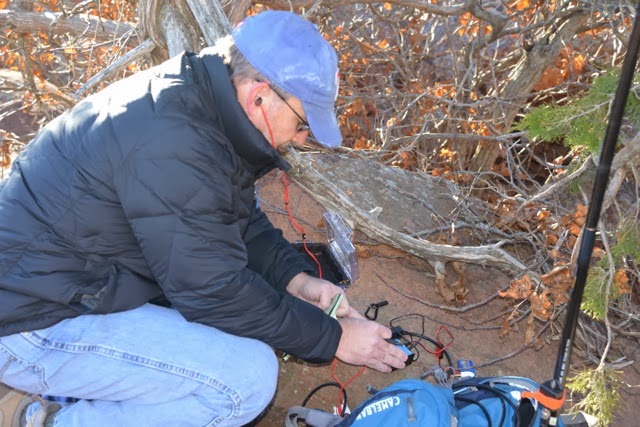
Once on top I set up the station, a KD1JV designed ATS4-B, a 4 band CW only QRP rig and a 20m/40M End Fed Half Wave.  I hang one end of the antenna over a tree branch, usually about 20 feet up, and run the antenna wire to a 21 foot carbon fiber, telescoping, pole. Below you see a photo of me deploying the antenna by elevating the end of the antenna (on an orange winder just visible in the picture) over a limb using the fishing pole. The winder, once over the limb, falls to earth, I secure the end, then attach the antenna wire to my fishing pole, running the wire down to within 6 feet of the ground. I anchor the matching device to the pole, hook up the coax and away I go. The wire is an L configuration with the shortest leg coming down the pole. I usually just prop the fishing pole on one of the evergreen trees if available, rather than guy it..


Deploying the Antenna
 
 
Once set up, the chaser pile-up was great. Signals were good, I got good reports and even squeezed in a little DX, working EA2LU on 20m. I ended up with 36 QSO's, 29 on 20m, 5 on 40m and 2 on 15m in a little over 30 minutes on the air. Below you see my operating position. The orange Velcro wrap, just up the pole is where the antenna matching device is anchored.


My Operating Position
 
It was a beautiful day for a hike. Not a cloud in the sky and the temps were in the mid 30's with very little wind, warming into the 40's by the end of the activation. We did not see any wildlife, however we saw lots of Elk tracks. The local name for the peak is Bear Mountain, however we saw no bears or bear prints on this trip. I wisely did not inform Cris of this "local" name until we were descending the mountain.
 
As Cris and I drove down the long dirt roads and then the 4WD roads, we agreed, if it weren't for Summits on the Air, there is now way we would ever have climbed this summit or explored this area. But thank goodness for SOTA, what a great day in the Mountains.


The Route up Montoso Peak

Say Hello to Acorn and Barley

After losing Rooster, the alleged brains of the WG0AT SOTA team, we have great news from Steve, WGØAT.

Two new goats have joined the herd, getting trained up for more Summits On The Air (SOTA) action.

Meet Acorn and Barley, or is it Barley and Acorn? Watch out, Peanut, you’ve got company.

FT-817 Radio Pack

When I do long SOTA hikes at high elevation, I usually take along a very light weight radio, that is, on the order of 6 -7 ozs. Usually that means my Steve Weber, KD1JV, designed ATS-4 or an MTR. The radios are CW only and have limited band selections. These radios light and efficient. However, there are times when I don't mind carrying a slightly heavier load if I want more flexibility with bands/modes. While I have a KX-3, I find the FT-817 to be my radio of choice. It's easier to pack, takes less space than the KX-3, even with a T1 Tuner, and just feels a little more rugged.

There is a company called AMP-3 that has developed a very nice pack/bag to efficiently transport the FT-817, power supply, cables, connectors, log, etc..  I used this bag in a recent activation in New Mexico and was impressed with it's practicality. I have no financial interest in AMP-3, other than I've sent them a lot of money for their products.

Below is a link to a video of how the pack works.

http://www.youtube.com/watch?v=c_pUIzlqzKU

Also he web site address is:

http://stores.amp-3.net/-strse-73/Custom-Made-Yaesu-817/Detail.bok

SOTA Activation in the Snow

I did my first SOTA activation in March of this year. Since then I have accumulated 195 activator points. I am driven by goals, and I really wanted to have more than 200 points by the end of the 2013, but time is running short. As I have mentioned in the past the closest SOTA summit is a 7 hour drive for me from my home QTH. However, this summer I acquired a "get away" QTH in Santa Fe, NM and try to get out there as often as possible and when I do, I try to activate a summit or two. So since I am off work all of next week I thought the time was perfect to come out to Santa Fe for a few days and try to get an activation or two in. I desperately wanted to cross the 200 point threshold at a minimum.

Enter the weather. The forecast for my entire stay was for snow. The higher elevation peaks are out of the question, but there might be some possibilities for some the peaks in the 7,000 ft ASL range. Saturday had the best forecast, only 1-2 inches accumulation, but Sunday was for 2-4 inches.

So based on some advice on local summits from Fred, KT5X (aka WS0TA), Ortiz Mountain (W5N/SE-043) was my choice. Better yet, it was a 6 point summit which would move my Activator score to 201 points. I had to do it on Saturday or risk being snowed out.

This would be an opportunity to work on my winter approach to activations, from clothing to equipment to hiking in the snow. Cris, my XYL agreed to join in the fun.
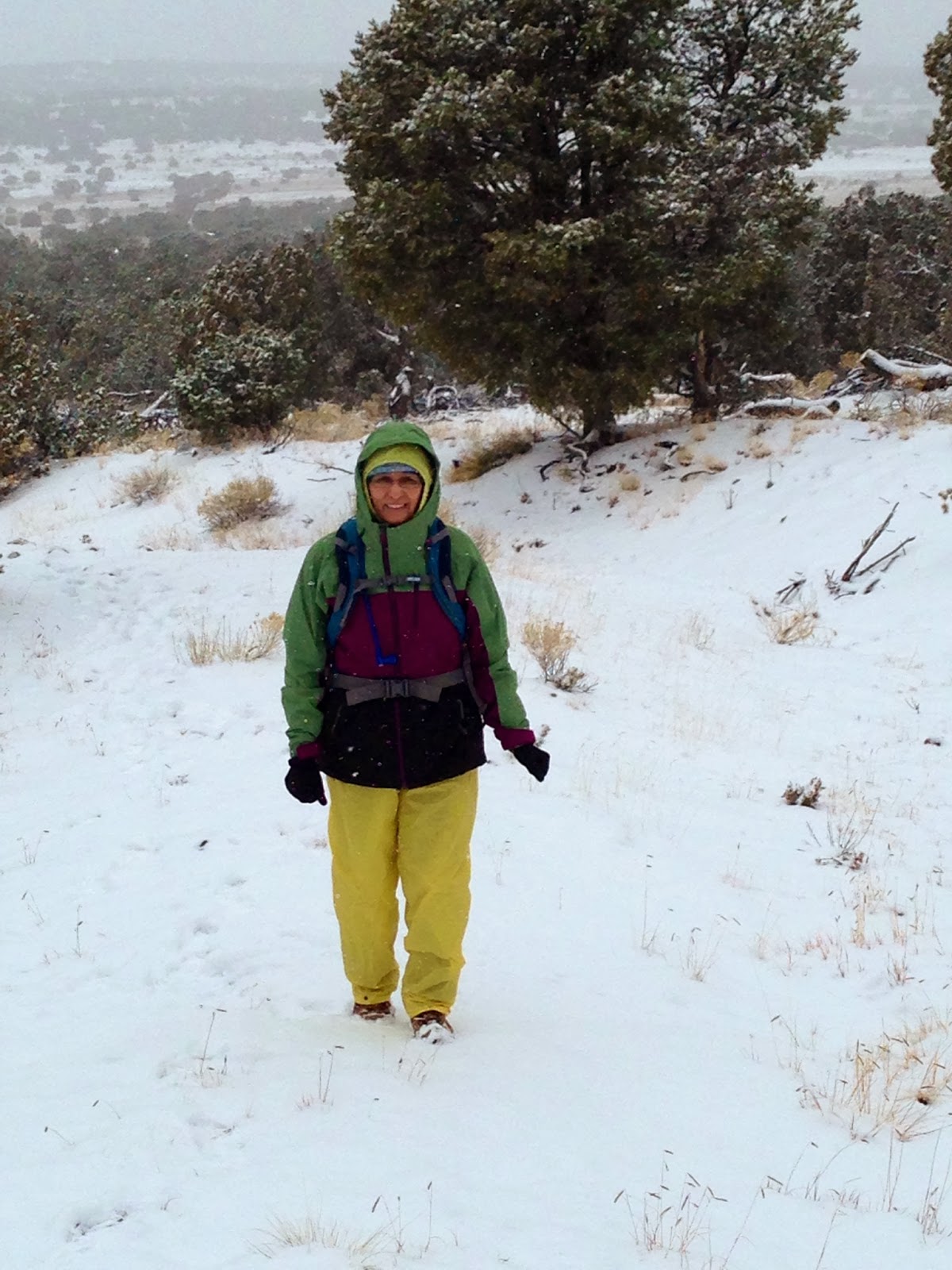
Cris headed up the mountain
As we approached the mountain it started to snow. I had hoped to get the activation done before the snow started, but that wasn't going to happen. It wasn't a heavy snow, but steady.

We found our way to the base of the mountain and quickly learned that finding 4WD roads in the snow isn't that easy, however we managed to navigate our way to within 600 vertical feet of the summit and from there packed our gear and headed up the mountain.

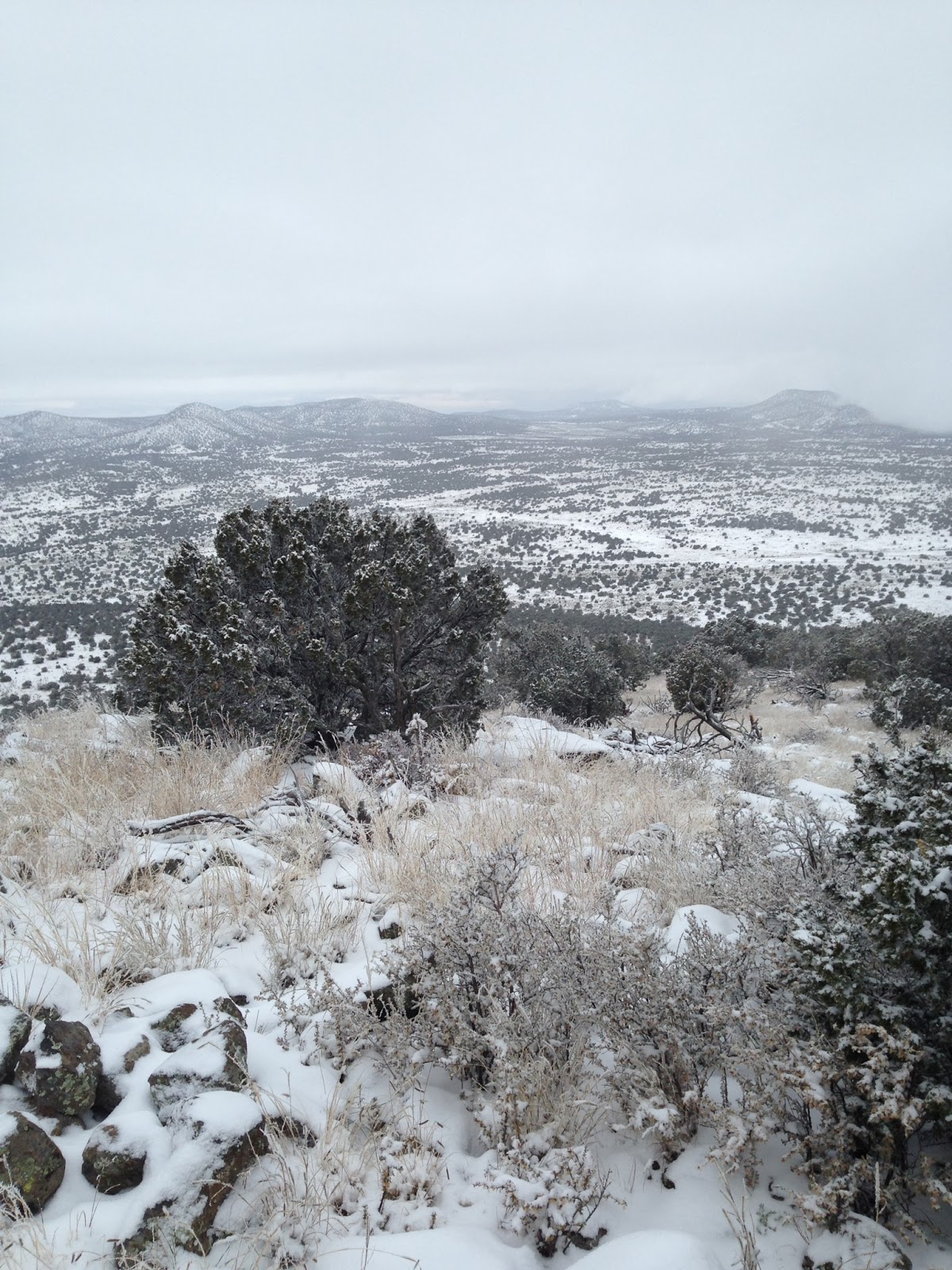
The hike wasn't bad, hiking up a 4WD road to the shoulder and then up to the summit. The summit probably had 4 inches of snow and more was falling. I quickly found a decent operating location and began the set-up. This day I was using my FT-817, the trail friendly LNR 10-20-40 EFHW with a T1 tuner.
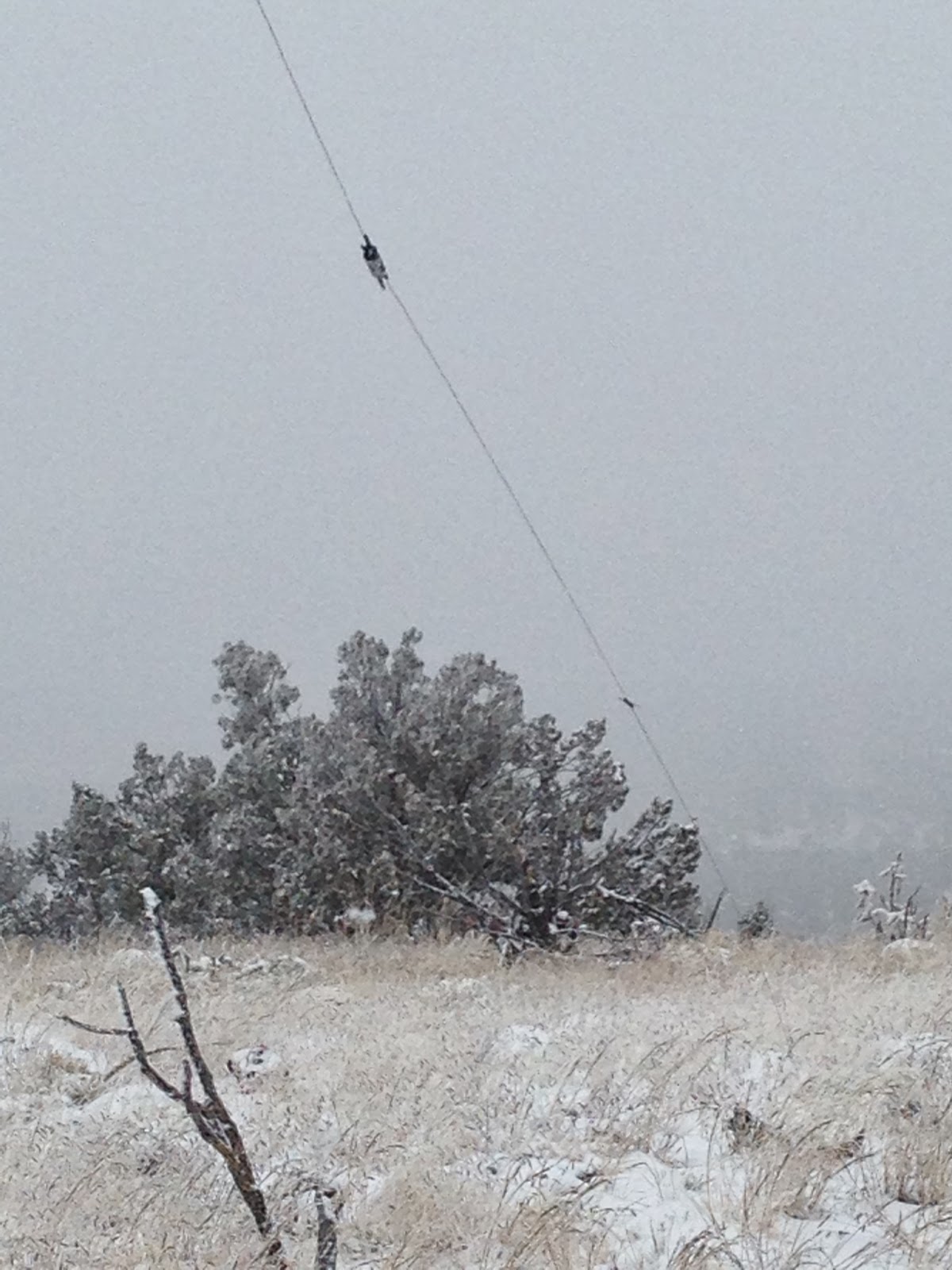

Antenna Deployed
The set-up went well and when I finished I tuned the radio to 14.061 to look for an open spot to call CQ and realized this was a major contest weekend. Thank goodness I brought the tuner.

So I set up on 17 meters and called CQ. After finally getting a spot for my frequency, my paddle decided to only send dits, I brought out my trusty micro-key, but had to remove my gloves to operate it. The temperature was 27 F, so my hands got a little cold.

My wife in the mean time had found warmth by getting the Bothy Bag we brought along. Bothy Bags are mini-shelters that are excellent for getting out of the cold or rain.

I made my requisite QSO's, working both coasts with my QRP signal, plus a few more and decided to declare victory and head back down the mountain. The snow had stopped for the trip down which we managed at a comfortable pace.
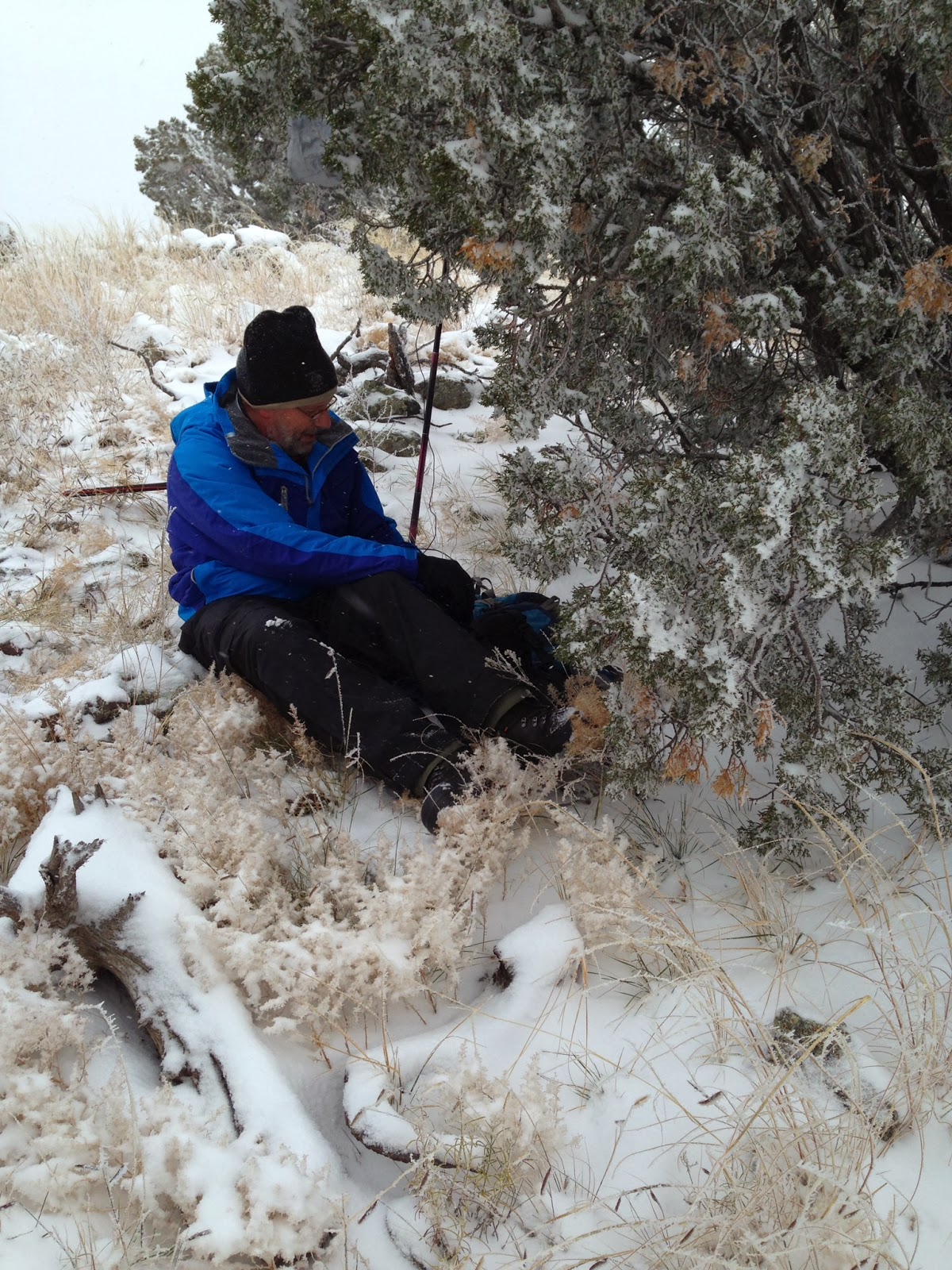

Operating
It was a fun day. Enduring the elements, summiting a mountain and getting 6 SOTA points. We felt accomplished when we were done and celebrated with some Mexican food in Santa Fe.


View from the Top


Desk stand for an Elecraft KX3

A surprise package dropped through the door yesterday afternoon. (I do like surprises!)  It was a SOTA Beams desk stand for the Elecraft KX3, customised with my callsign.
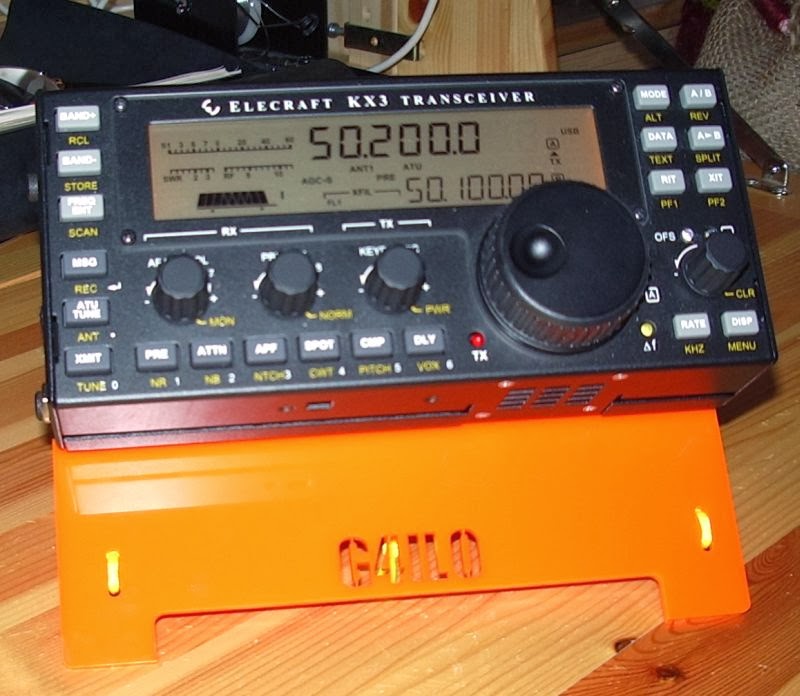
SOTA Beams desk stand for Elecraft KX3

In the absence of instructions and with the aid of a couple of the photos on the SOTA Beams website it took my poor brain a couple of minutes to work out how it went together. Actually there are a couple of self adhesive rubber feet and a length of edge trim the purpose of which are still not entirely clear to me.

The stand is robustly made from a laser cut  perspex type material and holds the KX3 at the perfect angle for desktop use.  (I’m not sure how that would be with the KXPD3 paddle. I didn’t try it as with my shaky hands I can only send dits at the moment. 🙂

This stand is exactly what I have been looking for to hold the KX3 when operating sitting on the ground with the rig beside you. The viewing angle is just right for that too – much better than standing your nice radio on the damp and dirty ground. The bright orange of the one SOTA Beams sent me  (they are also available in black or red apparently) makes the stand highly visible and so less likely to be accidentally left behind on the summit or other operating spot.
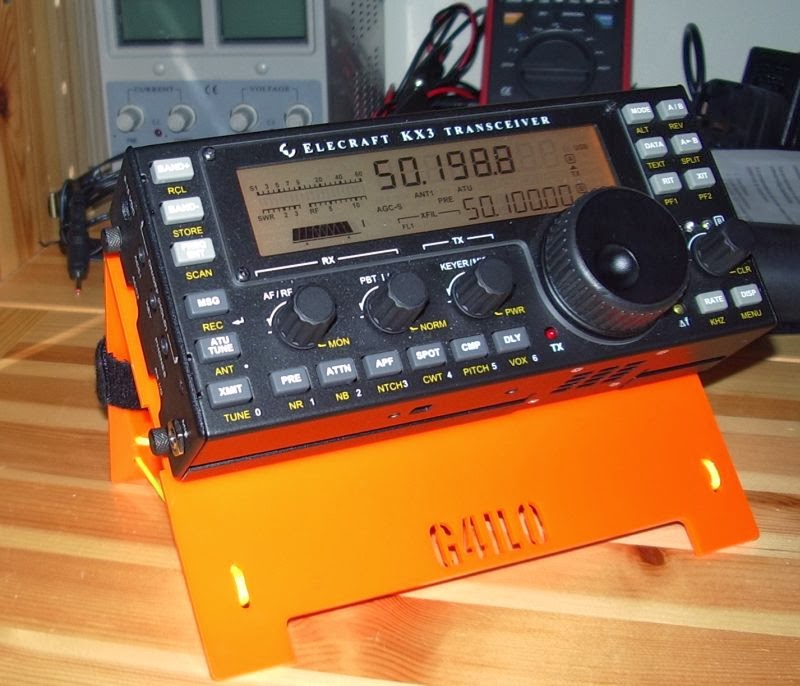
The perfect angle for desktop or portable operation

Thanks, Richard! This is definitely going in the case with the Alex Loop ready forwhen  my health improves enough for me to take a radio into the Great Outdoors again.

A Great Bag for the FT-817

One of my favorite rigs is the Yaesu FT-817, the QRP transceiver that covers HF through 70 cm. I use it for mountaintop VHF, including Summits On The Air (SOTA) activations.

At Pacificon, I came across this bag by AMP-3 which is custom designed for the FT-817. David KF7ETX did a great job designing this bag, which he explains in this video.

There are cheaper solutions out there but this is the best one I’ve seen.

73, Bob K0NR


Subscribe FREE to AmateurRadio.com's
Amateur Radio Newsletter

 
We never share your e-mail address.


Do you like to write?
Interesting project to share?
Helpful tips and ideas for other hams?

Submit an article and we will review it for publication on AmateurRadio.com!

Have a ham radio product or service?
Consider advertising on our site.

Are you a reporter covering ham radio?
Find ham radio experts for your story.

How to Set Up a Ham Radio Blog
Get started in less than 15 minutes!


  • Matt W1MST, Managing Editor