Posts Tagged ‘Mountains’
 A Soggy Mount Herman SOTA Activation (W0/FR-063)
 September 15th, 2013 |
  Author:
 Although I’ve operated a number of VHF contests from the summit of Mount Herman, I had not yet activated it as a Summits On The Air (SOTA) peak. Mount Herman is a 9063 foot mountain just to the west of Monument, Colorado, pretty much in ”my back yard.” Steve WG0AT did the first SOTA activation of Mount Herman, back in May 2010, chronicled here in one of his famous videos. There is a sometimes rough Forest Service Road 320 that leads to the trailhead, then it’s a little more than a one mile hike to the top with 1000 feet of elevation gain. I call it a tourist hike, since it has just enough challenge to make it feel like a climb and there’s a great view at the top. At least on most days.
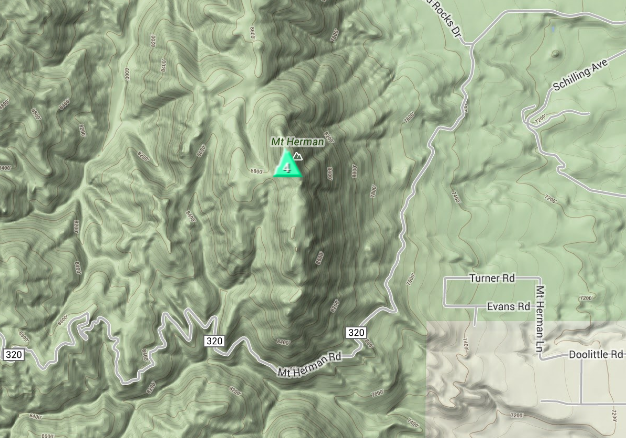
I was not expecting much of a view today since low rain clouds were dominating the sky. I was just hoping I would not get completely drenched by rain. The weather was definitely marginal but from my house I saw the clouds lift a bit, so I thought it was worth a try. The ARRL September VHF Contest is also this weekend, so it was a great combo opportunity: SOTA + VHF Contest.
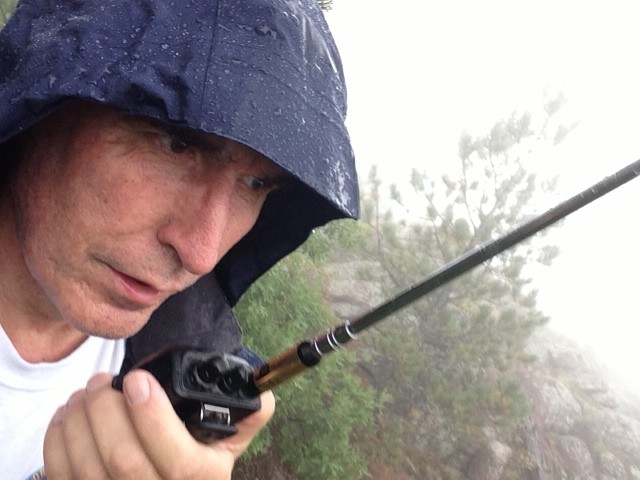
I hopped in the Jeep and quickly made the drive to the trailhead. Then I scooted on up the trail, making it to the summit in about 30 minutes. Just as I reached the summit, the rain really kicked in. I set my gear down under a tree, got out my HT, attached the 1/2-wave antenna and started calling on 147.42 MHz. I wanted to bag my four SOTA qualifying contacts in case the weather turned worse. I quickly worked Frank K0JQZ and Steve WG0AT. Then George AB0YM, operating as a rover in the VHF contest called me from grid DM78, so I worked him as well.
I had my trusty Arrow Yagi antenna with me but I didn’t want to bother with assembling it in the rain. I got out the FT-817, put a vertical antenna on it and called on 144.200 USB. I found stations working the VHF contest and completed QSOs with them: WB0RRU and K3ILC.
The rain intensified so I abandoned the summit and headed back down. All in all, it was not a great hike but I was successful in activating Mount Herman.
73, Bob K0NR
Two SOTA Activations: W0/SP-099 and SP-115
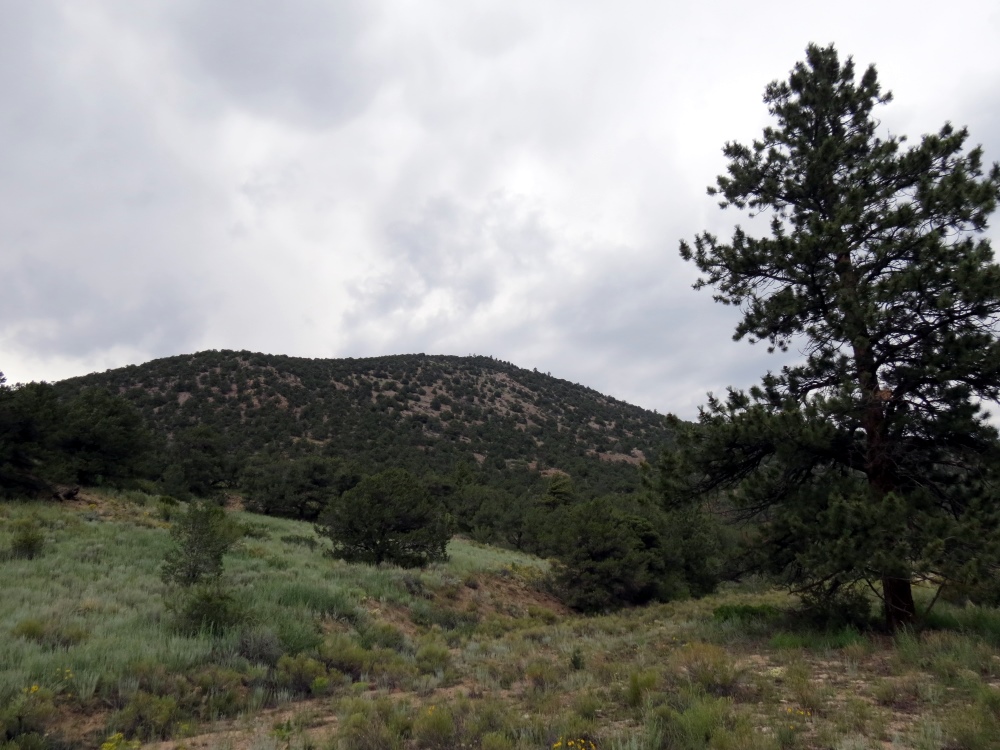
Bald Mountain (W0/SP-115)
Lately, I have been focusing on activating the SOTA (Summits On The Air) peaks near our cabin in the mountains. The basic idea is to identify a SOTA summit, hike to the top and make a few contacts on VHF. On Friday, my spousal unit (Joyce, K0JJW) and I decided to head out to an unnamed peak (W0/SP-099), southeast of Buena Vista, CO. By no coincidence, this summit had not been activated yet, so we’d get the esteemed honor and glory of being the first.
For lesser known summits, a bit of research is required to figure out the route. My first stop is to check the SOTA database for basic information on the summit. I’ll usually have to dig further using ListsOfJohn and SummitPost. ListsOfJohn is an incredible database of topographical information, listing every summit along with information such as elevation, lat/lon, rise, etc. (The Colorado SOTA information was gleaned from ListsOfJohn.) SummitPost will usually have more detailed information on a summit but only for the more popular ones. The SOTA Mapping Project is another excellent resource with very useful interactive topo maps. And, of course, I also dig out the US Forest Service map for the area, which often gives the best view of access roads.
We drove the Jeep to within a mile of the summit and started hiking up. I posted our route information on ListsOfJohn, so take a look there for that information. The summit is unnamed, so it is referred to by its elevation: 10123. I had my Yaesu VX-8GR burping out APRS packets which were plotted on aprs.fi when we reached the summit.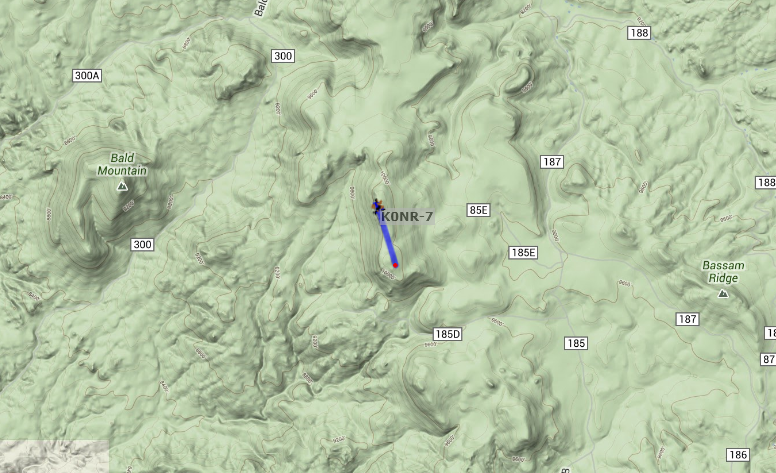
When we reached the summit, I spotted myself on the SOTAWatch web site using the SOTA Goat app on my smartphone. More importantly, the night before the hike, I sent an email to some of the radio amateurs that were likely to be within VHF range. That paid off and I worked Jim KD0MRC, Walt WZ0N and John K3NOQ on 146.52 MHz FM. Jim was hiking to Harvard Lakes above 10,000 feet, so it was special to be able to contact him on the trail. A little later, I caught KV4AL who was mobile near the top of Mount Evans. While only one contact is required to “activate” a summit, four contacts are needed to earn SOTA points, so I was happy to make these four QSOs. My gear was a Yaesu FT-60 driving a 3-element Arrow yagi antenna.
In addition, Joyce and I generally work each other on the SOTA the summit. The SOTA rules say that “QSOs with others within the same Activation Zone do not count towards the QSO total” which means that one of us needs to hike down a bit to get outside of the activation zone (75 feet vertical feet from the summit). We take turns doing this so that each of us activates the summit and makes a contact with the summit.
We took a round about path back to the Jeep and headed for Bald Mountain. At this point, we were both very tired and the thunderstorms were moving in. We decided to at least check out the access to Bald Mountain (Wo/SP-115) even if we didn’t climb it that day. It turns out that there is a 4WD road that goes to the top of the mountain, so we drove to the summit. The road is very rough in a few spots but the Jeep handled it nicely. At the top, we hiked back down a bit to meet the non-motorized ascent requirement for SOTA. We also did our “work each other” technique while on the mountain so that we each had a contact. I was not able to raise anyone on 146.52 MHz but I did catch Carl K5UK on the 146.745 MHz repeater and worked him on simplex. By this time, it was raining with lightning getting closer, so we abandoned the summit and headed back to the cabin.
Thanks to the guys that took the time to contact us on the two summits.
73, Bob K0NR
A Little Mountaintop Video
While digging through the archives, I came across some previously unseen video from the 2012 Colorado 14er Event. Joyce KØJJW and I operated from Mount Sneffels (SOTA W0/UR-001) and this video shows a radio contact with Mark KTØAM on Mount Shavano.
The 2013 event will be held August 4th, see www.14er.org.
Summits On The Air (W0/SP-112) – Castle Rock
There is a very jagged peak just east of Buena Vista, CO called Castle Rock (not to be confused with the city by the same name). I knew this was a SOTA summit (W0/SP-112) and I had my eye on it for a while now. It is extremely rocky and jagged near its summit, so I was not sure if it could be ascended without a technical climb. A little research revealed that it was climbable but quite steep near the top. SummitPost.org has a good description of how to ascend this peak.
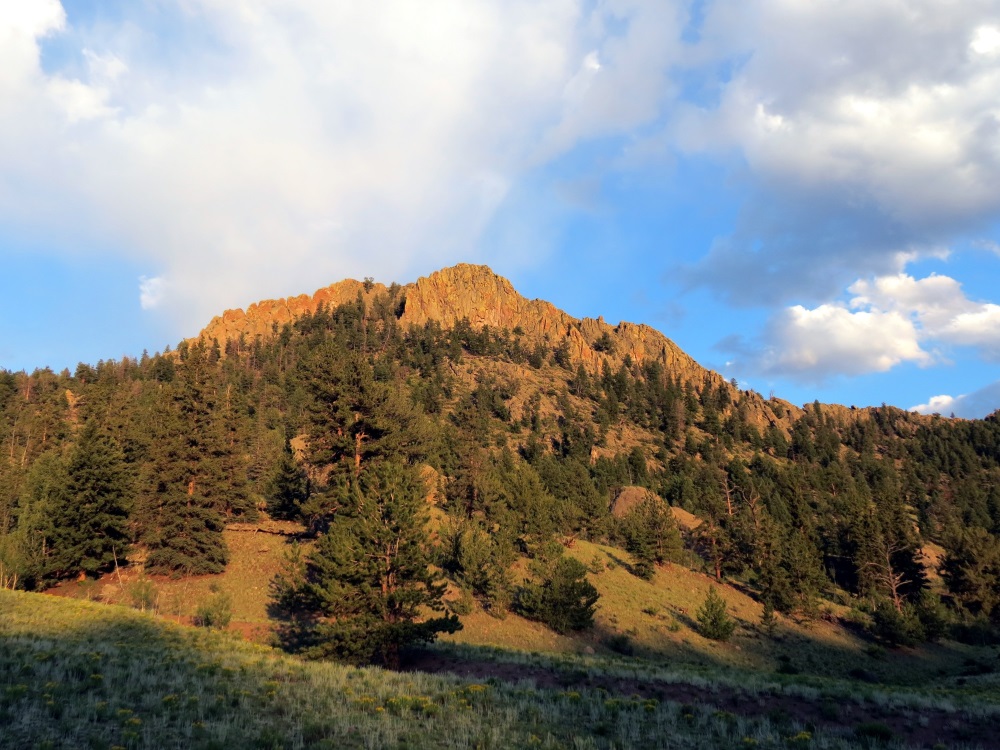
Castle Rock
My hiking partner and wife, Joyce K0JJW, joined me on the climb. We managed to get off the preferred route and got into some very steep rock scrambling. Good judgment prevailed and we regrouped and found a more reasonable path but probably cost us an extra hour of hiking. As advertised, it did get very steep at the top. (Study the SummitPost information more carefully than I did.)
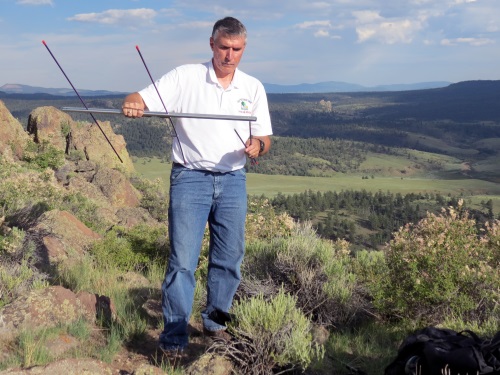
Assembling the Arrow 2-Meter antenna
Recently, I picked up an Arrow 3-element Yagi antenna for 2 Meters (Model 146-3). This antenna can be dismantled and carried inside a reasonable size daypack (or strapped on externally). The boom has two threaded holes for mounting the antenna on a camera tripod. I used a MountainSmith trekking pole that can double as a camera monopod and mounted the antenna on it.
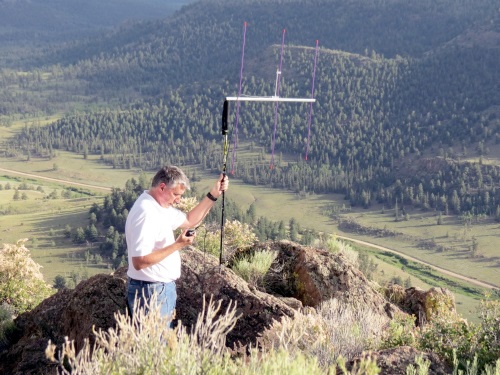
Operating with the Arrow antenna mounted on the trekking pole
For this SOTA activation, I kept it simple and just used my Yaesu FT-60 to work 2 Meter FM. Accordingly, I configured the Yagi antenna for vertical polarization. (There are two mounting holes on the boom, so you can choose vertical or horizontal orientation.)
The trekking pole is not self-supporting and does not provide much additional antenna height but it makes the antenna a lot easier to point for extended periods of time. I like to use a trekking pole for hiking, so this is a good way to get a little extra utility out of it. I am pleased with how this antenna system performed and will use it again.
73, Bob K0NR
The WG0AT List of SOTA Resources
Here’s a great set of Summits On The Air (SOTA) links from Steve WG0AT:
| Name: | Medium: | Source: | Description: |
|---|---|---|---|
| Official SOTA Site | Web | SOTA UK | Gateway to all official SOTA resources |
| Rules & Guidelines | SOTA UK | General Rules & Guidelines for SOTA | |
| WØ SOTA Site | Web | WØ Assoc.Mgr | A good place to start for SOTA info for the WØ region |
| WØ Association Reference Manual (ARM) | WØ Assoc.Mgr. | Defines all summits and rules for the WØ Association | |
| SOTA Activator Guidelines | SOTA UK | The rules summarized on one page  | |
| SOTAwatch: Alerts | Web | SOTA UK | Create activation alerts for the world to see (You have to sign-up for a free account) |
| NA SOTA (Yahoo Group) | Web | 3rd party: Yahoo | The NA-SOTA Group on Yahoo is a great place to meet fellow Chasers/Activators, announce activations and share experiences. You have to submit a ‘join’ request before getting access |
| Results & Summits Database | Web | SOTA UK | Submit activation logs, search for summits, view results etc. |
| Adventure Radio: Mapview | Web | 3rd party: Mario/DC7CCC | Google map overlay. Allows to search for SOTA summits based on Assoc./Region or grid locator. |
| How to Activate a SOTA Peak | 3rd party: Guy/N7UN | Guy/N7UN’s helpful 4-page summary of the steps involved from planning, posting an activation Alert, conducting the activation itself and post-activation activities. | |
| WØ Summits | Web | WØ Assoc.Mgr. | Find a summit in your WØ region |
| Colorado 14er Event | Web | 14er Event | The web site for the Colorado 14er Event (includes SOTA activations) |
| SMS Gateway | Phone | SOTA UK: Andy | SMS gateway for selfspotting. You have to register with Andy: mm0fmf_sota (at) intermoose dot com |
| SOTA Goat iPhone appy | iTunes | iTunes | Spotting app for your iOS device at the iTunes store |
| SOTA Spot Monitor App | web | Eric KU6J | SOTA spotting app for Windows PCs |
New Colorado 14er Event Shirt
 Thanks to Steve WG0AT, we now have a new design for the Colorado 14er Event Shirt. Steve gen’d up a new logo that has the Colorado 14er Event blended with Summits On The Air (SOTA), that is available on a variety of t-shirts, a coffee mug and maybe a few other items. The logo, shown to the left, is a fantastic graphic featuring Ham Radio at Altitude.
Go to Cafepress to view and purchase the items that are available.
73, Bob K0NR
A Simple Wilderness Protocol: 146.52 MHz
 “The Wilderness Protocol” (ref. June 1996 QST, page 85), recommends that stations (fixed, portable or mobile) monitor the primary (and secondary if possible) frequency(s) every three hours starting at 7 AM local time, for five minutes (7:00-7:05 AM, 10:00-10:05 AM, etc.) Additionally, stations that have sufficient power resources should monitor for five minutes starting at the top of every hour, or even continuously.” The primary frequency is the National Simplex Calling Frequency…146.52 MHz. The secondary frequencies are 446.0, 223.5, 52.525 and 1294.5 MHz.
Here in Colorado, the summer months mean that many people head for the mountains. Mobile phone coverage has improved in many parts of the high country but is still not reliable in all areas. Amateur radio VHF/UHF repeater coverage is extensive but also does not cover the entire state.
The Wilderness Protocol is a good idea but is overly complex for practical use. Here’s my proposal to make it much simpler for practical backcountry use:
Principle #1: Don’t ever rely on a radio or mobile phone to get you out of trouble in the backcountry. Your primary strategy must be self-sufficiency. Avoid trouble. Be prepared for the unexpected.
Principle #2: Know what repeaters are available in your area. We have many wide coverage repeaters available but you need to know the frequency, offset and CTCSS tone (if any). The Colorado Connection is a linked repeater system that covers many remote parts of the state.
Principle #3: In remote areas, monitor 146.52 MHz as much as possible. This applies to backcountry travelers, mobile stations and fixed stations.
I’ve been making it a habit to monitor 146.52 MHz in the backcountry. I often come across hikers, campers, fisherman, 4WD enthusiasts, SOTA stations, mobile operators and others monitoring that frequency. It is fun to chat with other radio amateurs having fun in the mountains.
Just my opinion.
73, Bob K0NR
Note: This is a repost of an older article with minor edits.













