Posts Tagged ‘Contests’
 Don’t Mess With The Field Day Rules
 April 6th, 2020 |
  Author:
  Given the Chinese/Wuhan/COVID virus situation, many hams are anticipating a change to their ARRL Field Day operation. I’ve also seen a number of proposals to modify the FD rules to allow for a different kind of operation. I appreciate that kind of thinking outside the box but I think it is misguided. One of the strengths of FD is it already has a set of flexible rules and operating classes, so you can adapt it to what you or your club wants it to be. See my post: ARRL Field Day – Season to Taste
Some Ideas
What are some of the proposals? The first one I noticed is a proposal to allow all Class D stations (home station with commercial power) to work other Class D stations for points. The FD rules do not currently allow this. Class E stations (home station with emergency power) are allowed to any class station. Obviously, this rule is to encourage people to develop emergency power capability (and use it) for their home station. This is perfectly aligned with the emcomm focus of Field Day.
Another proposal is to allow a “backyard operating” class, where you set up a portable station in your backyard. Of course, this is already allowed under the rules as a Class B station.
One of the more innovative ideas I’ve heard is to allow multiple stations (not colocated) to operate under one club callsign, coordinating their operation via the internet. This approach emulates a “normal” Class A FD operation, while everyone is locked down at home. This is not allowed as a Class A station: “All equipment (including antennas) must lie within a circle whose diameter does not exceed 300 meters (1000 feet).” This is roughly equivalent to a group of Class D or E stations working together towards a common score. Why not just operate as independent Class D and E stations, which is more like a real emergency situation?
Adapt and Innovate
Our local radio club is considering different ways to adapt, seeing this as a training and learning opportunity. We will probably encourage our members to get on the air individually, with emergency power. We will likely encourage members to work other members, providing some kind of incentive or award. So our FD may look more like a local operating event, in addition to working distant stations. VHF/UHF will probably play an important role so that we include Technician licensees. Not sure just yet.
We are all experiencing some serious challenges this year and Field Day is not going to be the same. I am a bit surprised that the first thought about Field Day is to change the rules to make it easier or somehow better. I think we just need to adapt and innovate within the existing format. Existing Field Day Rules have plenty of flexibility.
That’s what I say. What do you think?
73 Bob K0NR
The post Don’t Mess With The Field Day Rules appeared first on The KØNR Radio Site.
ARRL DX CW contest.
Score breakdown:
A Notable 2m Radio Contact
For the 2019 CQ Worldwide VHF Contest, I did a modest effort on 6 meters and 2 meters using mostly SSB and FT8. I operated from our cabin (DM78av). We had some good sporadic-E propagation on 6m which enabled some long-distance contacts to the east. Then I noticed that 2 meters was also open so I quickly turned my attention to that band. While it’s common to have some sporadic E on 6 meters during July, having it on 2 meters is a lot less common. I was thrilled to snag 5 contacts to the eastern US on 2 meters.
 One of the 2m contacts was with Jay/W1VD in Connecticut. Shortly after the contest, I got an email from Jay asking about my exact location for the contact, which I supplied using the 6-character grid locator (DM78av). He told me that it is very difficult to work Colorado on e-skip from Connecticut…the general belief among VHF enthusiasts is that they have to use another propagation mode to work the state. Well, apparently that is not true!
Jay also worked Ken/W0ETT in Parker, CO so this turned into a three-way email discussion. Ken is located about 80 miles to the east of our cabin, so my QSO with W1VD was at a greater distance. Jay investigated the ARRL records and found that these two 2m contacts were notable enough to “make the list” at the ARRL but they are not new distance records. See the ARRL records list here.
Here’s a snippet from the ARRL list, with my W1VD QSO shown as 2793 km (1735 miles). The W0ETT QSO is also shown on the list as 2674 km (1662 miles).

You can see W1VD’s station information on the QSL card above. Obviously, a nice setup. I was using a Yaesu FT-991 driving a Mirage amplifier with 150W output to a 2M9SSB Yagi antenna. My antenna mast is only 25 feet above the ground but I benefit from an excellent radio horizon to the east from 9630 feet in elevation.
73 Bob K0NR
The post A Notable 2m Radio Contact appeared first on The KØNR Radio Site.
How Did You Fare in CQ WW CW Contest Weekend?
Man, lots and lots of Morse code on the ham bands, this weekend. The CQ Worldwide CW Contest weekend was hopping with signals!
How did you do this weekend? How were conditions on the various contest bands?
Comment here and your report may make it into the propagation column in an upcoming edition of the Radio Propagation column in CQ Amateur Radio Magazine.
Here are a few moments as heard at the station of the CQ Amateur Radio Magazine propagation columnist, in Lincoln, Nebraska (yeah, that’s me, NW7US).
[embedyt]https://www.youtube.com/watch?v=eWCbtIOJmLI[/embedyt]
Here are the results of my dabbling with the Icom rig and this contest:
 NW7US's Contest Summary Report for CQ-WW
 Created by N3FJP's CQ WW DX Contest Log
 Version 5.7  www.n3fjp.com

 Total Contacts = 55
 Total Points = 8,979

 Operating Period: 2019/11/24 10:23 - 2019/11/24 22:51

 Total op time (breaks > 30 min deducted): 3:58:46
 Total op time (breaks > 60 min deducted): 4:45:17

 Avg Qs/Hr (breaks > 30 min deducted): 13.8


 Total Contacts by Band and Mode:

 Band       CW   Phone     Dig   Total       %
 ----       --   -----     ---   -----     ---
   80        8       0       0       8      15
   40        7       0       0       7      13
   20       25       0       0      25      45
   15       15       0       0      15      27
            --   -----     ---   -----     ---
 Total      55       0       0      55     100

 Total Contacts by State \ Prov:

 State       Total     %
 -----       -----   ---
                52    95
 HI              3     5

 Total = 1


 Total Contacts by Country:

 Country                      Total     %
 -------                      -----   ---
 Canada                           6    11
 Brazil                           5     9
 USA                              5     9
 Argentina                        3     5
 Costa Rica                       3     5
 Hawaii                           3     5
 Bonaire                          2     4
 Cayman Is.                       2     4
 Chile                            2     4
 Cuba                             2     4
 Japan                            2     4
 Mexico                           2     4
 Aruba                            1     2
 Bahamas                          1     2
 Barbados                         1     2
 Belize                           1     2
 Curacao                          1     2
 Dominican Republic               1     2
 French Guiana                    1     2
 Haiti                            1     2
 Honduras                         1     2
 Martinique                       1     2
 Montserrat                       1     2
 Nicaragua                        1     2
 Senegal                          1     2
 St. Kitts & Nevis                1     2
 St. Lucia                        1     2
 Suriname                         1     2
 US Virgin Is.                    1     2
 Venezuela                        1     2

 Total = 30


 Total DX Miles (QSOs in USA not counted) = 151,407
 Average miles per DX QSO = 3,028


 Average bearing to the entities worked in each continent.
 QSOs in USA not counted.

 AF =  83
 AS = 318
 NA = 124
 OC = 268
 SA = 137


 Total Contacts by Continent:

 Continent   Total     %
 ---------   -----   ---
 NA             32    58
 SA             17    31
 OC              3     5
 AS              2     4
 AF              1     2

 Total = 5


 Total Contacts by CQ Zone:

 CQ Zone   Total     %
 -------   -----   ---
 08           13    24
 03            7    13
 09            7    13
 07            6    11
 11            5     9
 13            3     5
 31            3     5
 04            2     4
 05            2     4
 06            2     4
 12            2     4
 25            2     4
 35            1     2

 Total = 13
CQ WW DX CW contest 2019

| No lack of action |
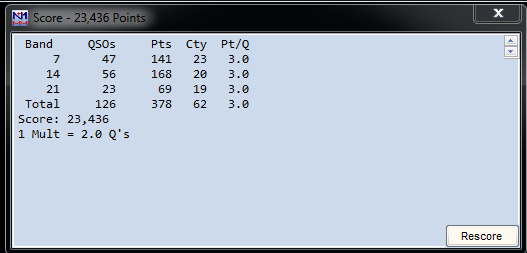
Band QSOs Pts ZN CtyPt /Q
7 6 18 3 5 3.0
14 10 29 6 10 2.9
21 2 5 2 2 2.5
Total 18 52 11 17 2.9
Score: 1,456
I found Sunday to be a tough one my signal was just not being heard and I am guessing it was just the propagation? The few times I was on the radio on Saturday I had no issues making contacts. Some of the bonus things here at VE9KK were:- The new Astron power supply worked just fine. - I was able to work Europe on 40m which never happened at the old QTH with the MFJ 1788 antenna. - Speaking of antennas it was a joy to use the End fed antenna, I was able to change bands without returning. The magloop I used for so long had to be re-tuned on the same band and for sure on band changes. - On Saturday (when I was on) I was able to get into Europe, Central America and South America without issue. During my time on Sunday during the contest I was greeted with an on screen message that N1MM+ stopped working as it was not able to communicate with com3. Com3 is my CAT control for the Icom 7610 and in a nutshell, this meant I was having RFI issues with one or more of my USB cables. I thought I had solved this issue already with snap on chokes?? I had a fast glance at the snap on chokes an noticed some had "un-snapped". I shut things down and spent well over an hour to fix the situation once and for all!! More on that later this week in another post. I restarted the rig and software and did a few tests and I was good to go, but the bands did not seem to want to co-operate. Having said that the bands sure were alive with opportunity. I heard nothing from the south pacific or Asia. Overall, I had a great time while in the chair at the radio and am looking forward to other CW contests. ARRL DX CW 2019 in the books
 |
| The setup |
As for the contest I was running 60 watts (not sure of reason for the 60 watt number) and my antenna is the MFJ 1788 mag loop. I am in a condo so it’s a balcony antenna about 180 feet up facing south east. The software was N1MM+ and MRP40 CW decoder for the super fast fisted contesters. On Sunday the winds for some reason really picked up and my MFJ loop was moving around the balcony. I shut the radio down and took it in I would rather save the antenna from damage than taking a chance on getting more contacts.
I made only 25 contact and a score of 1575 BUT my intention was not to blow the doors off with a great score. Instead after I made contact with a station I would look them up on QRZ.COM and read about either the individual or the contest station. Over all the limited time I was in the contest I had a blast and was very please with the Icom 7610 and the ability of my balcony mounted Mag loop antenna.
Genesee Mountain: SOTA and VHF Contest

For the ARRL January VHF contest, I did a combination Summits On The Air (SOTA) and contest entry. I am recovering from a knee injury so Genesee Mountain (W0C/FR-194) turned out to be a nice easy hike for me. Of course, Joyce/K0JJW joined me and also did a SOTA activation. Caleb/W4XEN came along with us and activated the summit for SOTA using the HF bands. Finally, Brad/WA6MM showed up on the summit for a social visit.

To get to the Genesee Mountain, go west on I-70 from Denver, take Exit 254 to the south. Turn right onto Genesee Mountain Road and head into Genesee Mountain Park. There is an extensive trail system in the park and several different ways to reach the summit of Genesee Mountain. In fact, if the gate is open, you can drive right to the summit. The route we took starts at a parking area that is always open. With only a 0.7 mile hike (300 feet vertical), this is an easy and highly-recommended trail.
Leaving the parking area going uphill, we soon encountered the Genesee Mountain Trail which we followed to the left. Later we transitioned to the Genesee Summit Trail, which goes to the summit. Both of these are well marked but you need to make sure you catch the “summit” trail.


We took more than the usual set of equipment for this activation so that we could cover the 6m, 2m, 1.25m and 70cm bands. For FM, we set up a Yaesu FT-90 2m/70cm transceiver with a ladder-line J-pole hanging from a rope in a tree. This omnidirectional antenna does not have any gain but I figured that for FM it would be most efficient to not mess with having to point a yagi antenna. For 2m and 70cm ssb/cw, I used a Yaesu FT-817 driving an Arrow II dualband antenna. The FT-817 also handled the 6m band, driving an end-fed half-wave wire antenna supported by a fishing pole (HF SOTA style). For the 1.25m band, I just used an Alinco handheld radio.

Genesee Mountain is a popular SOTA summit because it is so easy to access but still provides a good outdoor experience. We encountered a dozen of so hikers and mountainbikers on the summit and it can be very busy during a summer weekend. The summit is wide and flat with plenty of room to set up a portable station. For VHF, it has an excellent radio horizon to the front range cities.

Joyce made 14 contacts on 2m and 70cm FM. I made 52 QSOs, as shown in the table below. SSB activity was relatively light considering it was a VHF contest weekend. I was pleased to work Jay/W9RM in DM58 on 2m SSB at a distance of 167 miles. W9RM is on the other end of the state with many mountains blocking the path. I also worked Jim/WD0BQM in Mitchell, NE (DN81) on 2m CW, at a distance of 175 miles. VHF is not limited to line of sight!
    Band   Mode  QSOs     Pts  Grd
      50  USB      5       5    2
     144  CW       1       1    1
     144  FM      19      19    2
     144  USB      7       7    2
     222  FM       3       3    1
     432  FM      15      30    2
     432  USB      2       4    1
   Total          52      69   11
        Score : 759
We had a great day on the summit, operating for just under 4 hours (with lots of breaks along the way). Thanks to Caleb/W4XEN and Brad/WA6MM for joining the fun. If you are looking for your first or an easy SOTA activation, give Genesee a try.
73 Bob K0NR
The post Genesee Mountain: SOTA and VHF Contest appeared first on The KØNR Radio Site.













