 |
 The NA-034 operation that almost wasn’t, Part III
 30 March 2010 | by
 If you haven’t read Part I and Part II first, you might want to do that.
As I mentioned previously, meeting Larry, KH6ITY on the air turned out to be a great stroke of luck for me, and the contact proved to be beneficial for both of us. Larry is a technology teacher at a high school in Texas, and when he responded to my call on the air, he was looking for a contact to speak with his class via ham radio as a demonstration. I was more than happy to do so, but what Larry told me was that while he could hear me, my audio was very distorted and I was extremely difficult to understand. Somehow, I managed to convey to him enough that he understood that I’d done some pretty extensive  troubleshooting on the antenna system, so he suggested that I try to reduce the transmitter power to see if that would help. Since I’d connected the radio directly to the car battery, I figured that power wouldn’t likely be the source of the problem, but given that nothing else I’d tried had worked, I figured I’d give it a shot.
I turned the power down to about 40% of the maximum and transmitted, asking Larry if my signal was any better. Before he even answered, I knew what the answer was: I was no longer hearing that odd noise in my headset, and Larry confirmed that indeed my signal had no issues. Although the signal strength was somewhat reduced, Larry was able to report that the audio artifacts were completely gone. He then asked me about what kind of radio I was using (an Icom 706 MKIIG), and when I told him that, I think that both he and I figured out the problem, both from similar past experiences. First, a little bit of background.
All electronic equipment requires a power supply that is capable of supplying a certain amount of electrical current at a voltage within a specified range. According to the manual, the 706 MKIIG draws up to 20 amps at 13.8 volts DC+/- 15%. Although the electrical system in a car is rated at 12 volts DC, it turns out that a charged car battery will provide somewhat more than 12 volts, and the battery is charged at somewhere between 13.2 to 14.4 volts. A running engine which is charging the battery should provide enough power for the radio, but what happens if the car isn’t running? It turns out that in practice, there is some “give” in these numbers, but at some point, the radio doesn’t function properly.
For those of you who have forgotten (or never knew), one of the most basic formulas in electricity is known as Ohm’s Law. It states the relationship between voltage, current, and resistance. In order to try to keep my readers awake, I’ll skip all the details and say that Ohms law explains that the length of the power cord, among other factors, affects the amount of actual power that the car battery is able to deliver to the radio. I’d used this exact same setup previously from at least two different vehicles without any issue. However, it seems that the battery in the rental car (a Mazda 5) that I had was a bit weaker than the others that I’d previously used and it just wasn’t capable of delivering enough power to the radio.
The Icom 706 MkIIG is probably one of the most popular radios made in recent years. It is very portable, capable of transmitting on all the HF radio bands, (10m through 160m) and can also transmit on VHF (6m and 2m) and UHF bands (70 cm). This was the first HF radio that I ever bought, and it has served me very well for the almost 10 years that I’ve owned it. However, it does have one problem (perhaps common to other similar radios): When it doesn’t get enough power to transmit properly, instead of simply shutting down or refusing to transmit, the transmitted audio gets distorted.
Both Larry and I had previous experiences where the radio wasn’t supplied enough power and exhibited this problem. In my case, the very first time that I ever tried to operate from a car, I was parked outside a friend’s vacation home in upstate New York, and figured that the accessory adapter (we called them cigarette lighters back then) looked like an easy way to hook up the radio. It turns out that the wiring for the lighter plug wasn’t capable of carrying the 20amps at 13.8vdc that the radio requires to transmit at full power. My audio was distorted, and a helpful ham in Italy (I wish I’d made a note of his call) helped me to troubleshoot the problem. At the time, the solution was to simply connect the radio directly to the car battery, which did the trick.
Since I was already connected directly to the battery, the only other thing that I could do was to start the engine, hoping that the charging current provided by the car’s alternator would provide enough power to the radio when transmitting at full power. I adjusted the transmitter output back to 100%, and Larry verified that my audio was still clear. Finally, I was on the air, and could start making contacts.

The antenna was mounted on a picnic table about 15 meters away, I was sitting underneath some trees, and I was able to make contact with other stations all around the world. This was what I’d planned to do.
However, Murphy still had one surprise in store for me, which didn’t crop up until the next day.
The sage concludes with Part IV.

David Kozinn, K2DBK, is a regular contributor to AmateurRadio.com and writes from New Jersey, USA. Contact him at [email protected].
Handiham World for 31 March 2010
Welcome to Handiham World!
Before we do anything else, I’d like to share last week’s Midwinter Madness Hamfest with our readers. After that, we have a special edition of the Handiham World that is dedicated to operator improvement.
Midwinter Madness Hamfest Photos

Our thanks to the Robbinsdale ARC for table space at Midwinter Madness, the closest Hamfest to Handiham Headquarters! Photo credit: RARC.
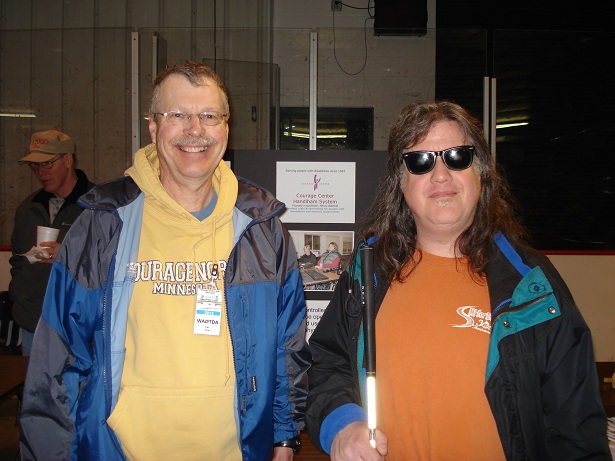
Pat, WA0TDA, and Matt, KA0PQW pose in front of the Handiham table. Photo by Susan Tice.
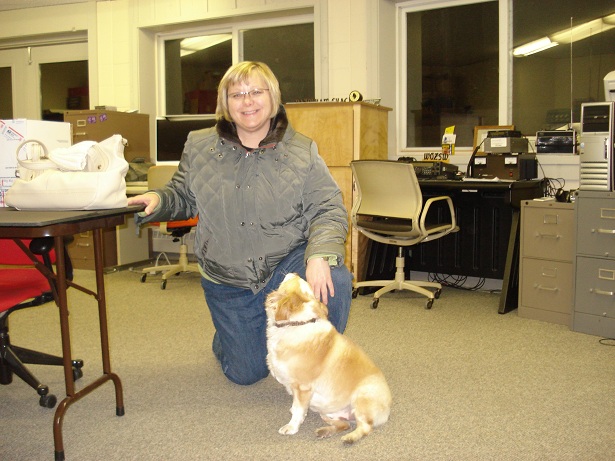
Susan Tice and Jasper get ready for the hamfest by helping to pack the booth equipment at Handiham Headquarters. Asked if it was a tough job, Jasper said, “ruff”. WA0TDA photo.
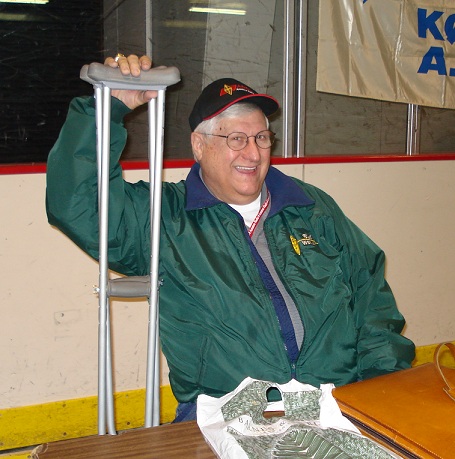
Bob, W0LAW, ARRL Minnesota Traffic Manager, mugs it for the camera at the ARRL booth, right next to the Handiham booth. WA0TDA photo.
Now, to our special feature: Communicating with other hams: It’s all about exchanging information.
Ready to review the basics? Good! Let’s get started.
The basics
Start with callsigns: My callsign is WA0TDA.
Every other station has one, so you will use both of them to initiate a contact:
“W0ZSW, this is WA0TDA”.
Identify!
• Use your callsign.
• Speak clearly & slowly.
• Use phonetics when conditions make hearing difficult.
• Position your microphone correctly.
• Repeat (or ask for a repeat) of the information as necessary.
When you are done talking… (Read more on the Handiham website, or listen to the audio podcast.)

Pat Tice, WA0TDA, is the manager of HANDI-HAM and a regular contributor to AmateurRadio.com. Contact him at [email protected].
Not so super-regenerative
The success of my project to make an FM version of G3XBM’s Fredbox was always going to depend on the receiver. The Fredbox receiver is a simple three transistor super-regenerative design. This is the only practical way to make a receiver small enough to fit in a hand-held case. It is also the only cost-effective way to do it, because making a conventional double-conversion receiver with crystal control just wouldn’t be worth it for such a project.
What I didn’t know were a) would the super-regenerative receiver work with FM signals (the original Fredbox was designed for AM) and b) would it be sufficiently stable to stay on frequency without the benefit of crystal control? However, what I didn’t give too much thought to was the possibility that I wouldn’t be able to get it to work at all.
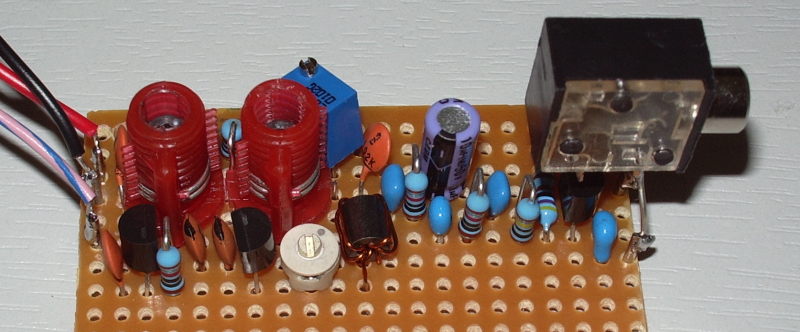 Because this is a VHF circuit I didn’t think I could try it out on the breadboard so I made it up directly on to Veroboard. The layout is pretty similar to Roger’s original layout from what I can tell from the pictures on his website, although I think he made an etched circuit board, something I’m not able to do.
 I drew up the layout using a bitmap editor. This shows the components from the top view. The large outline components are the Toko S18 inductors, and the red lines are wire links below the board connecting the ground traces. The schematic for the receiver part of the Fredbox is shown below. As with the Nano-40 I used an MPS13 in the audio stage in the hope of getting a bit more audio gain.
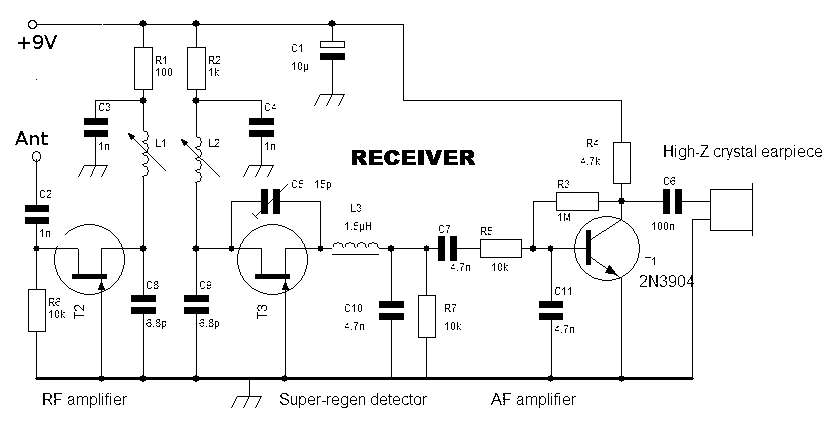 I applied power and expected to hear a hissing sound in the earpiece which stops when a signal is tuned in. However I heard nothing at all. The audio stage appears to be working, as I can hear a faint buzz if I touch something metal to the input.
Alan, VK2ZAY had a lot of trouble getting the receiver to work as well, and he is an experienced constructor who knows what he is doing. I suppose this should have warned me off trying this project. Alan replaced the axial choke for L3 with half a dozen turns of wire on a ferrite bead, and I did the same, but to no avail. I also substituted a variable trimpot for R2 which in many other super-regenerative receiver designs is a variable regeneration control. But no matter what the setting of the pot I could not get any regeneration to occur at all.
I think my FM Fredbox is about to become yet another abandoned project. 🙁

Julian Moss, G4ILO, is a regular contributor to AmateurRadio.com and writes from Cumbria, England. Contact him at [email protected].
Once-Venerable Radio Shack For Sale?
 The New York Post is reporting that Radio Shack may be courting suitors, namely electronics retailer Best Buy. If you have the cash lying around, you can pick up your very own electronics...errrr cellphone store chain for a cool $3B.
 Could this be the next or perhaps last chapter of our once great electronic hobbyist mecca?

Anthony Good, K3NG, is a regular contributor to AmateurRadio.com and writes from Pennsylvania, USA. Contact him at [email protected].
Local hotspot
The Digital Voice Access Point (DVAP) Dongle is a small device now available in the US that plugs into a computer and lets you create your own low power (10mW) RF gateway to the D-Star network.
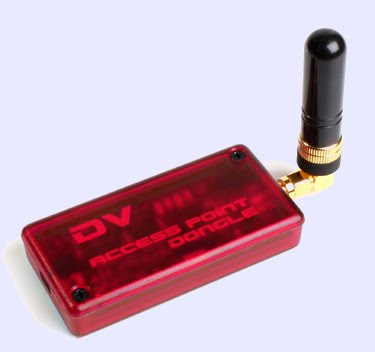 Leaving aside my dislike of D-Star (it is incompatible with existing radios and requires you to purchase an Icom radio to participate, which in my book makes it effectively a proprietary system) for a moment, as someone living in an area where you hardly ever hear any 2m FM activity I can see the attraction of something like this. It would allow one to make some internet-linked ham radio contacts from around the house using a hand-held.
A couple of years ago I started looking into the idea of setting up a low-powered personal EchoLink node, for similar reasons. I prefer EchoLink to D-Star for the simple reason that almost any existing FM radio can use it (as long as it has a DTMF keypad). EchoLink has been going for years and already has a critical mass of users, which is surely more important from the point of view of finding people to talk to than using some new and more state of the art system?
Unfortunately it appeared that in order to set up an EchoLink node I would need to apply for special permission, providing details of three people who could turn the equipment off on instructions from Ofcom, wait months for permission to be granted, etc., etc., which is way too much hassle. I don’t think you are exempted from this procedure simply because the RF output power of the node is very low. Because of this restriction doubt if many people in the UK will be using the DVAP Dongle either.

Julian Moss, G4ILO, is a regular contributor to AmateurRadio.com and writes from Cumbria, England. Contact him at [email protected].
Polar Bear Midnight Madness Event Mar 2010
A fitting end to this season of PBMME … Saturday the weather was finally decent here in Orlando and with 80F temperature and lots of sun, I certainly earned my red neck for the season! I set up my portable station near the tall pine trees in our neighborhood park on Lake Fredrica. A few curious neighbors came by to find out what the crazy guy with the wires in the tree was doing!
I am really liking the latest antenna launching combo shown in the photo below. I have been using a slingshot taped to a shelf bracket and equipped with a spincast reel, but have been considering other alternatives. The monofilament fishing line is prone to wind knots and tangles and does not always slip through the branches as well as I’d like. I found an old post by Russ Carpenter, AA7QU, a co-founder of Adventure Radio Society, which described using an archery reel and super slick braided line. Sure is nice to learn from those that have gone before! The bright yellow line is very easy to see though very thin, 3x stronger than monofilament and flies through both air and branches with ease! KEEPER! Think I will do away with the spincast reel and save it for the grandkids!

Antenna Launching options

Here's my site for the event

Great trees for antenna wire hanging!
If you look closely, you can see the 30m half wave going up to the tree on the left. Nearly vertical for 46 feet and is spooled on a Coleman Camping clothes line and used with a 3 ft counterpoise.
To the right is my 20ft Jackite pole and a W3EDP 84 ft antenna with a 17 ft parallel feed with 3/16 inch PET pipe spacers about every 2.5 ft. it tunes 80-15m with my BLT+ tuner.
The Polar Bear QRP Group is a great bunch of guys… (no yl’s or xyl’s that I’ve heard yet) and our monthly outings are something I look forward to each month. The Yahoo Group is a good source of information and laughs as we swap stories and share our adventures. If you like QRP and portable operation, this is the group to join.
Kelly McClelland, K4UPG, is a regular contributor to AmateurRadio.com and writes from Florida, USA. Contact him at [email protected].
The NA-034 operation that almost wasn’t, Part II

It turns out that there was indeed a park at the southern end of the island named South Lido Park that was the perfect location to try again. There was a parking lot that bordered the park, and there were a few parking spots that were close enough to picnic tables that I could easily set up the radio and antenna on a table (or even on different tables) with the power cables connected to the car battery. This seemed like a good opportunity to get the antenna even farther away from the car and the radio, and hopefully away from the source of the RF interference. I set up the antenna, and was able to throw the counterpoise over a nearby low tree branch. (One of the recommendations for this particular antenna is to keep the counterpoise at least 2 feet off the ground.) I carefully checked the SWR with the antenna analyzer and found a good match.

I decided to try to eliminate the feedline that I’d brought with me as a possible issue, so I connected the antenna to the radio with a very short (about .5 meter) patch cable that I’d brought with me. Normally it’s not a very good idea to set up that close to the antenna, but I figured that for diagnostic purposes I could do it. It turns out that I wasn’t going to transmit very long that way anyway since I had the same problem. At this point, I decided to go back to the regular feedline, which is a 15m length of RG-8x that I’ve used for the past several years without issue. What I did was to create an RF choke by coiling some of the excess feedline at the feedpoint. The idea behind doing this is to help keep RF off the outside of the feedline, where it can radiate and cause issues. Unfortunately, that didn’t seem to help either.
During these tests, in addition to just hearing the odd noise in my headset, and on the radio speaker when I disconnected the headset, I was attempting to call some stations that I had been hearing all afternoon. The location that I had now moved
to was even better than my previous location, as there was water on 3 sides, which means I had an especially good path to Europe, South America, and the southwest US. Some of the stations that I’d tried to contact were extremely strong and should not have been difficult at all to contact. I was finally able to make a contact with S55OO so I knew that the radio was actually transmitting, though he was in the middle of working many other stations so I didn’t have a chance to ask him for a signal report. At that point, I was confused and frustrated at not being able to locate the source of the problem, and given that it was getting late in the afternoon, I decided to break down and shut down for the evening.
After heading back home (well, not to NJ, to where we were saying), I sent an email the Buddipole Users Group to see if anyone there had any ideas what the problem might be. I got back responses from a number of folks within a few hours, most of them suggesting that I try most of the things I’d already tried (which of course they didn’t know I’d done). A couple of folks suggested trying to use some ferrite beads in various places on power cable, microphone cable, and power cables. Unfortunately, I didn’t have any with me, and they aren’t the kind of thing that are stocked in a local hardware store or even Radio Shack. Budd, W3FF, and Scott, NE1RD pointed out that since I’d made one contact that the radio must be transmitting, but it did seem that there was still some problem.
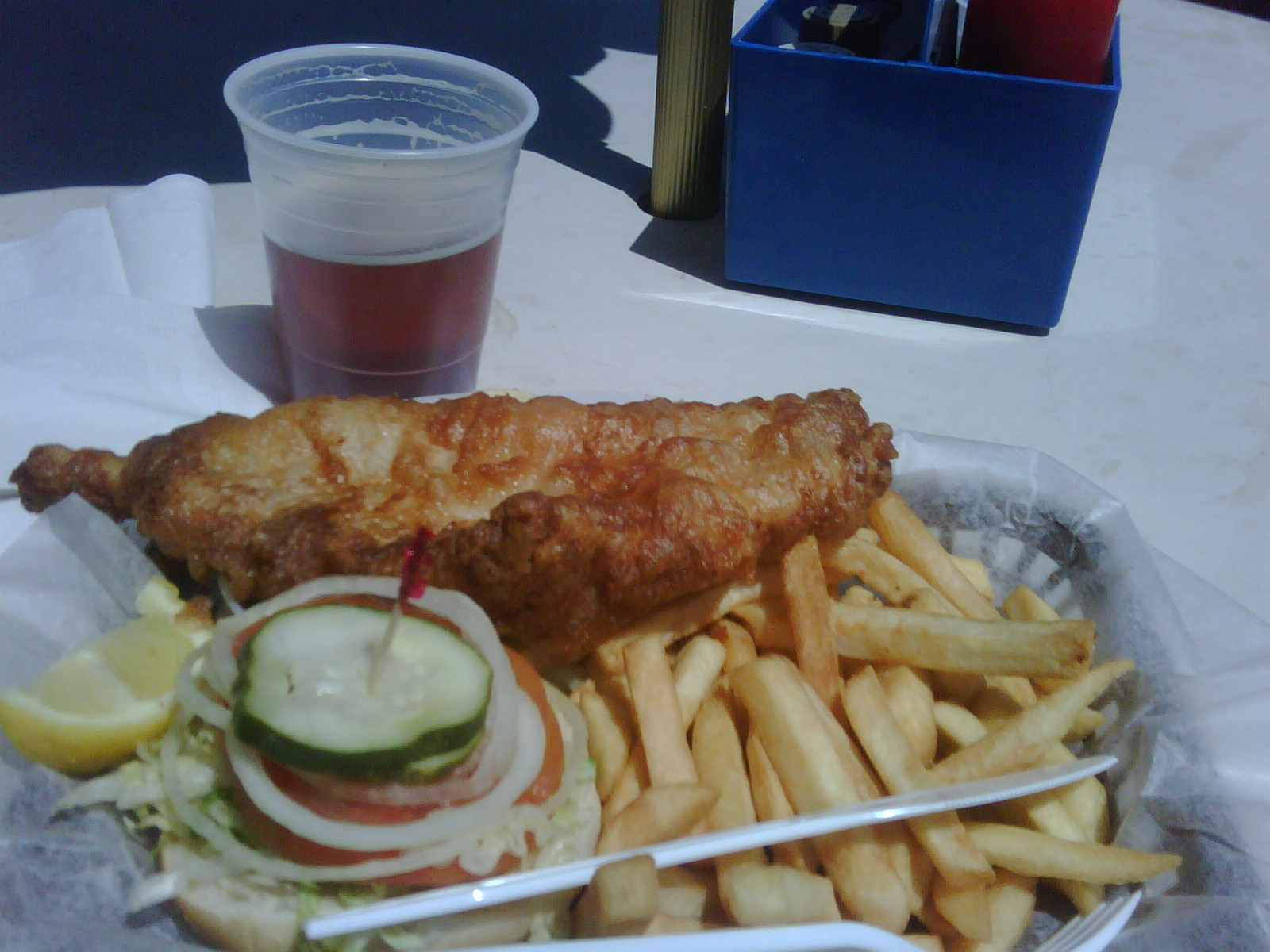
The next morning, I woke up, checked my email and found a few more things to try, packed up the car, and headed out for lunch at The Old Salty Dog on nearby Siesta Key. I was still frustrated that I hadn’t figured out what the problem was, but things always seem better after a beer and a fried Grouper sandwich. They probably would have seemed even better after two or three beers, but since I still had to drive back to the operating site I decided to stop after one.
When I arrived at South Lido Park, I found an even better location than on the previous day, where the operating position was under trees for shade and I was able to set up the antenna on a different table from the operating position, putting even more distance between the antenna, the radio, and the car. I made sure to have the RF choke in place as close as possible to the feedpoint, and wound up as much of the excess feedline into that choke to try to eliminate as much of the unwanted RF on the outside of the feedline as possible.
I was still hearing what I thought was RF in my headset (or from the radio speaker when I switched to the hand microphone), but I decided to call CQ anyway, hoping that perhaps someone would be able to hear me and perhaps let me know what my on-air signal sounded like. I finally got an answer back from Larry, KH6ITY who, as it turns out, was a technology teacher in Texas and was in the middle of demonstrating ham radio to his class. As it turned out, meeting Larry on the air was a wonderful stroke of luck.

David Kozinn, K2DBK, is a regular contributor to AmateurRadio.com and writes from New Jersey, USA. Contact him at [email protected].
 Ham Radio Deluxe |
 W5SWL Electronics |
 Ham Radio Prep |
 KB3IFH QSL Cards  Hip Ham Shirts  HamRadioAuctions HamRadioAuctions Reliance Antennas Reliance Antennas Enigma Shop Enigma Shop |  morseDX  Ni4L Antennas  R&L Electronics R&L Electronics antennas.us antennas.us QRV QRV |
- Matt W1MST, Managing Editor
