 |
 Tallentire Hill
 4 April 2010 | by
 By the time I had finished repairing the TH-205E the sky had cleared and the sun had come out so after tea I thought I should go for a bit of fresh air and exercise. Olga is still suffering from a chesty cough and didn’t want to come so I decided to drive over to Tallentire village and walk to the top of Tallentire Hill. A couple of weeks ago I had spent a couple of hours parked near the top making some contacts from my HF mobile station. But it isn’t possible to get right to the top by car unless you have a 4 wheel drive vehicle, because the track is rather stony. Even if you had a 4×4, there is nowhere to park off the road right at the top. The actual summit is in a small field and accessible through an unlocked gate from the track, but it is presumably private land so whilst walkers enjoying the view may be welcome, hams setting up a portable station would probably be accused of trespassing.
 But on a day like today it is worth going just for the view. The picture above shows the trigonometrical point (a reference point for measuring height used by the Ordnance Survey) looking south east towards the Skiddaw range. On the larger version (click on the small one to see it) you can see snow-covered mountains beyond Keswick in the background.
 The next picture shows the view south west and on the large version you can see some of the buildings of Cockermouth nestling in its valley. The big mountain on the left is Grasmoor with its steep drop towards Crummock Water. In the distance you can see the Buttermere fells.
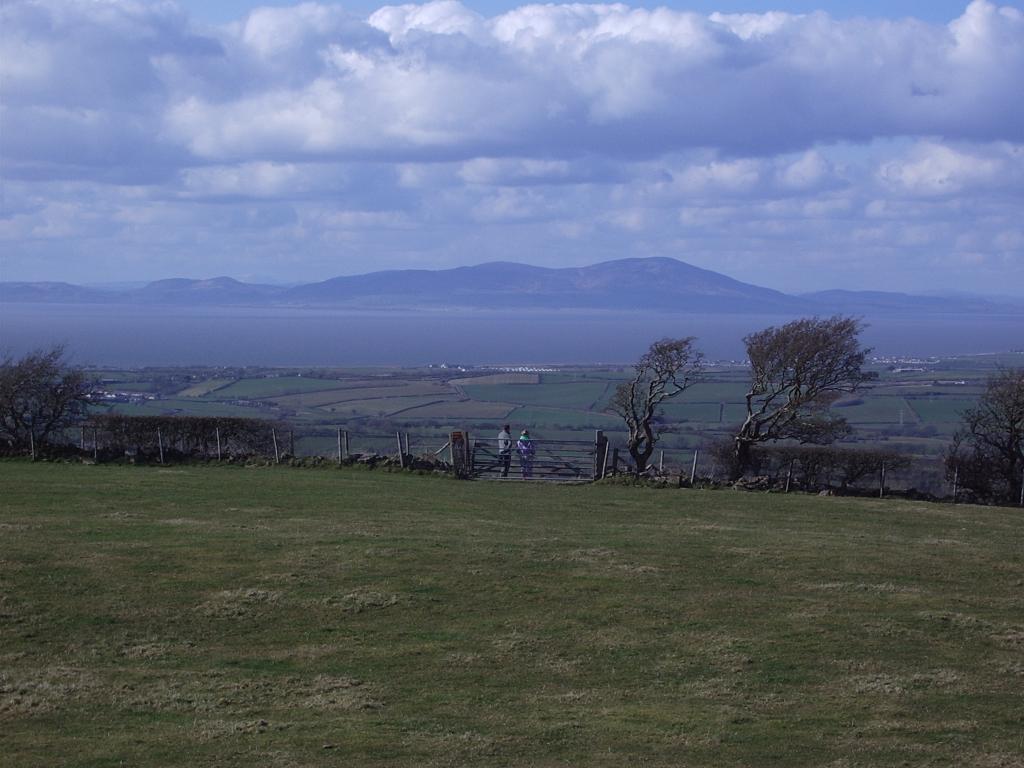 The last picture shows the view north across the Solway to Dumfries and Galloway in Scotland. I don’t know the names of the Scottish mountains.
I would love to own the field containing this summit so I could use it as a portable site whenever I wanted, even if it meant buying a 4×4 vehicle! With the take-offs shown in the pictures the site might be quite good for VHF, so I will have to take the MFD and the FT-817 up there one day when there is a 2m contest in progress.
Today I didn’t manage to raise anyone with the TH-F7E I took with me. But despite the sun it was pretty cold up there with a stiff breeze so after a few calls on 145.500 I headed back down again.

Julian Moss, G4ILO, is a regular contributor to AmateurRadio.com and writes from Cumbria, England. Contact him at [email protected].
Kenwood de-gunked
It’s probably a character weakness, but I have always had a tendency to push my luck a bit too far and end up regretting it. That thought was in my mind when thinking about what to do with the Trio / Kenwood TH-205E that I got for a song on eBay. The rig worked well enough already to do what I thought I would do with it if it worked. But I was finding it hard to resist the temptation to see if I could restore it to full working order even though there was a risk that I might end up breaking it completely.
 In the end, the temptation to try to restore it won. The radio came apart quite easily – it is a big radio, and fairly easy to work on, though surprisingly for 1986 vintage equipment it uses a lot of SMT parts. The back half is a solid cast metal chassis containing the IF and RF boards, and the front half is plastic and contains the front panel with the control logic. The two halves are linked by two ribbon cables and one had been inserted a bit crooked, which led me to hope that repositioning it might solve the problem of the inoperable buttons, but that proved not to be the case, so the front panel board had to come out.
The front panel board is secured to the front panel itself with a large number of small self-tapping screws. Once they were removed and the wires to the speaker and mic unsoldered, the board came out to reveal the sight shown above. The front panel buttons were not sealed units but capacitive switches operated by contact with the rubber buttons, and they were covered by a sticky mess of gunk – presumably the same stuff I had found on the outside of the case which a couple of readers informed me was a cleaning agent used to spruce plastic items up prior to sale. This hadn’t just distributed itself over the switch area, it had even penetrated through some of the vias to reach the other side of the board. What a mess!
Olga found me a few small pieces of rag and I went to work with some white spirit from the garage. I eventually managed to clean most of it off. My fears about causing even worse damage were raised when the LCD display fell off. It didn’t seem to be attached to the board and had perhaps become stuck to it with some of the gunk. However when I reassembled the radio I just rested it in place while I fixed the PCB in place and it still worked.
There was no way I could test if the switch contacts were clean enough without reassembling so eventually I decided that it looked good enough and back it all went. I applied power with trepidation. The display lit up and I could hear hiss in the speaker. I then pressed the Offset button and was able to select repeater shift! The Scan function set the receiver scrolling slowly through the entire 2m band in 5KHz steps – very useful that! I was also able to program and recall frequencies in the three memories, although the memory buttons still need a bit of persistence to get them to work. It isn’t worth taking it all apart again just to try to improve that.
While I had the rig apart I took the opportunity to reset the power levels to give 5W on High power with a 13.8V supply and 0.5W on low power. Some previous owner had probably tweaked the power controls to give 7W out. No point in stressing the probably irreplaceable power transistor for a barely detectable 1dB or so of extra power. Then I put it all back together. Job done, and the TH-205E restored to full working order. I was feeling pretty chuffed.
As usual, there was no-one around on any of the simplex channels to do a test with but I was able to access the GB3DG repeater and even GB3LA on 145.7125 (a 12.5kHz channel) by tuning to 145.715.
I’m starting to feel a bit of affection for this big old radio now that I’ve made it as good as new. I’m thinking that it would be worth trying to resurrect the NiCad battery pack, which at the moment is showing a dead short. But there I’m really stumped, as I can’t see a way in. Clearly the plastic case is made in two halves, but sticking a screwdriver in the crack and twisting is just going to chew up the plastic. Anyone know if it’s possible?

Julian Moss, G4ILO, is a regular contributor to AmateurRadio.com and writes from Cumbria, England. Contact him at [email protected].
Droid
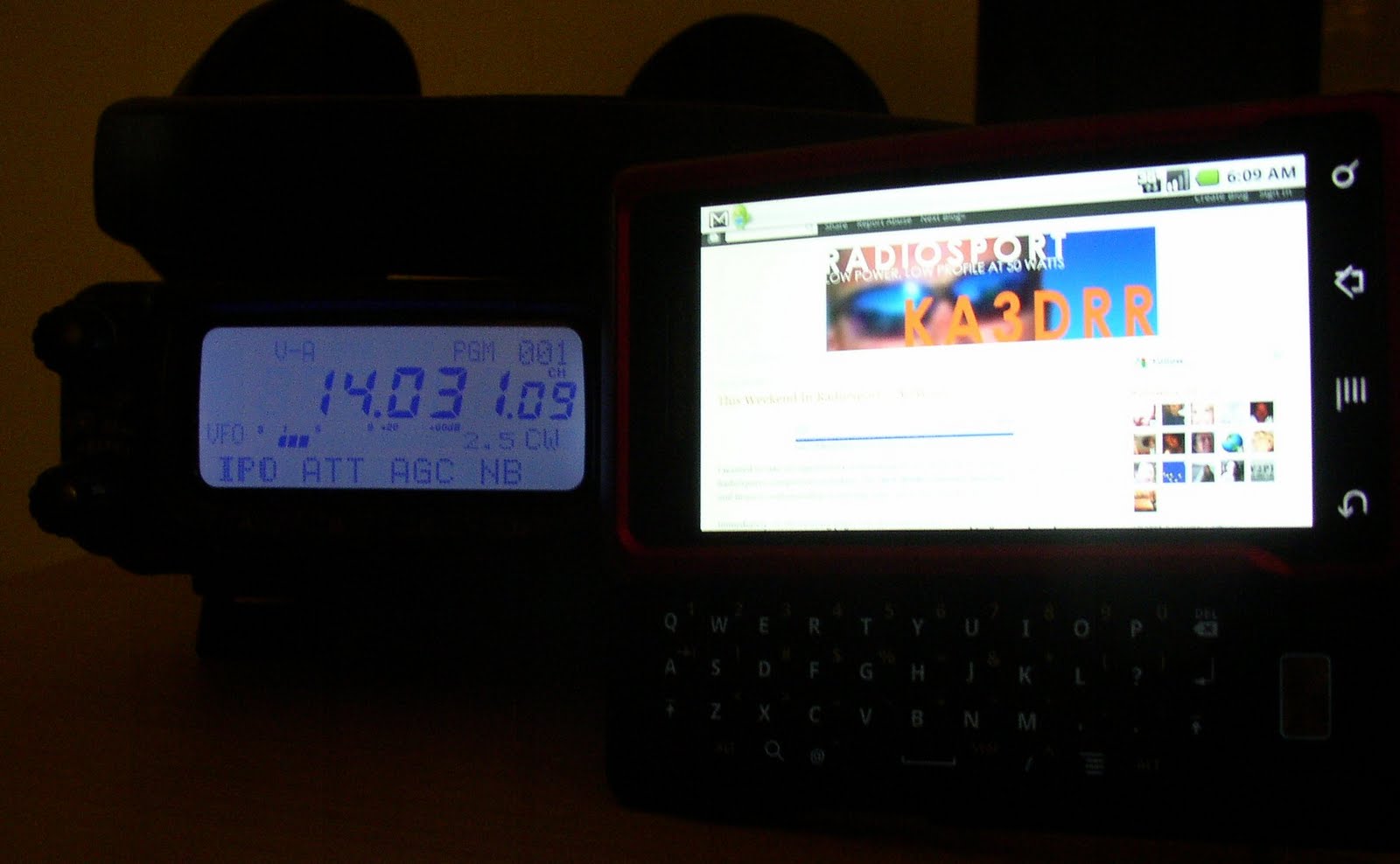 Mobile device disruption of current social and/or business models is a brave new future, perhaps, ultimately displacing one’s desktop computer. Frankly, in comparison, my Droid can accomplish most tasks albeit with a much smaller screen and miniaturized QWERTY keyboard.
I’m impressed with my Droid thus far and can’t help drawing parallels between it and Issac Asimov’s iRobot in addition to Star Trek communicators.
Reviews.
- Engadget Motorola DROID review (link).
- Gizmodo Motorola Droid review (link).
- Ubergizmo Motorola Droid review (link).
The last thing needed in my life is a device that drains scarce time from the mortal hourglass. I want my Droid to accomplish the following tasks —
- Synchronize email.
- Content production.
- Integration with recreational activities specifically ham radio and surfing.
- Social network integration when mobile.
- Decision data such as product and/or service(s) review.
I’m observing a mobile device viewing trend using Google analytics. I recommend thinking about one’s blog layout through the lens of Droid-like devices. Likewise, the presentation of one’s introduction, body, and conclusion as viewed on these screens.
Additionally, when producing video for YouTube, compare it against a desktop monitor and a mobile device screen.
Overall, with 24-hours of experience, I’m pleased with Droid’s near intuitive Google operating system, connectivity to the Internet, its baseline package of applications, and industrial design.
73 from the shack relaxation zone.

Scot Morrison, KA3DRR, is a regular contributor to AmateurRadio.com and writes from California, USA.
March 2010 Wrap-Up
All | 80m | 40m | 30m | 20m | 17m | 15m | Ph | CW | Dig | |
DXCC | 83 | 2 | 43 | 10 | 67 | 13 | 38 | 59 | 5 | 63 |
WAS | 50 | 28 | 49 | 7 | 48 | 19 | 21 | 43 | 1 | 50 |
WAZ | 26 | 3 | 21 | 8 | 23 | 9 | 18 | 22 | 5 | 22 |
eBay bargain
 Whilst buying on eBay can sometimes result in a piece of junk, it can also produce the occasional lucky find. The radio pictured on the right is my latest auction success which arrived this morning. It is a Trio / Kenwood TH-205E of 1986 vintage which was being sold as for spares or repair. It cost me all of ten quid ($15 for my US readers), four of which were for postage.
When it arrived it was a bit oily, for some reason, but a wipe over with some tissues took care of that. From the front it looks almost like new – no scratches or signs of wear on the markings or buttons. The rig has obviously had an active life though as on the back the paint has worn away and the serial number plate and the warning notice on the battery pack have been polished almost clean of lettering.
The seller stated that they could not get the radio to charge up, which is no surprise, as for 24 year old NiCads to still retain a charge would be nothing short of a miracle. I applied 9V of external power, switched on, and was pleased to see “144.000” appear on the display and hear the hiss of an unsquelched receiver from the speaker. My initial delight at having acquired a worker was short-lived, however, as the frequency display failed to respond to the up/down buttons and the squelch did not seem to work either.
After a while spent pressing buttons in the faint hope of getting the frequency to change, it suddenly did increment a few steps and the squelch also operated. Then the radio gradually became more responsive to the buttons and I was eventually able to persuade it up into the 145.500 region. I connected my QRP power meter and was delighted to observe that the TH-205E was putting out a good 5W in the high power position and 1W in low power. I could also receive the signal on the TH-F7E standing nearby, which was somewhat dwarfed by its older sibling. I’d forgotten hand-helds were still this chunky in 1986!
I connected an antenna and found that I could receive all the local repeaters, so sensitivity is acceptable. The TH-205E will only do 5kHz steps so it isn’t suitable for 12.5KHz channeling, but the receiver is broad enough to receive the GB3LA repeater on 145.7125 when tuned to 145.710 with perfect audio. There is no CTCSS, though there is a tone-burst switch (which I haven’t tested.)
Apart from the up/down frequency selectors the only other front panel button that appears to work is the Lamp button which backlights the LCD display. I can’t activate the repeater offset or program or recall any of the three frequency memories. Possibly these buttons will eventually spring to life after repeated pressing. Otherwise it may require a look inside to see if it is possible to clean the switch contacts. But to be honest I’m not all that bothered, as I’m unlikely to be using the TH-205E on any repeaters.
The most I hoped for when bidding for this was a radio that could easily be got working and could then be put to use as a dedicated rig for APRS on 144.800 or something similar. The least I expected was something I could cannibalize for £10 worth of useful parts. So already I have got more than I hoped for!

Julian Moss, G4ILO, is a regular contributor to AmateurRadio.com and writes from Cumbria, England. Contact him at [email protected].
This Weekend In RadioSport | AirWaves
 I wanted to take an opportunity at thanking Bruce Horn, WA7BNM for maintaining RadioSport’s competitive schedule. The WA7BNM Contest Calendar was recently revised and Bruce’s craftsmanship scores big time -Qs in the shack relaxation zone.
Immediately, on the landing page, one discovers niches occupying RadioSport space inside ham radio. Secondly, a schedule table is available with time bar graphic in each respective row — one can quickly analyze a weekend’s worth of activity at a glance. Furthermore, one can receive either a weekly schedule via email or subscribe to the calendar using really simple syndication.
Lastly, one can customize their calendar for specific events while toggling between custom and full calendar as well.
A job well done indeed! Thank you Bruce.
 RadioSport EU | LZ Open 40m Sprint.
The heavyweight exchange is back for a little fun on a low band space this weekend. This one is seeded number one USA East Coast conference against the 12th seed West Coast who may generate a few signals against that radio frequency wall.
LZ Open is all about -Qs not multipliers because everyone can log everyone. A station can be logged after a lapse of 30-minutes on the same band.
This event is not accepting paper logs.
Rules (link).
 RadioSport EU | SP DX.
This event is straightforward in its scoring system that is log Polish stations for three points in the log. Given current conditions, our East Coast competitors can pass out valuable -Q points too participating stations, it’s an event to practice, practice, practice one’s search and pounce skill.
Rules (link).
SFI = 76 | A- index = 15 | K-index = 2 | Current Sunspot Count is 25 @0011UTC.

Scot Morrison, KA3DRR, is a regular contributor to AmateurRadio.com and writes from California, USA.
Chinese crap
Several months ago I had a plan to build a project using Manhattan style construction so I decided to get a tool to make myself some Manhattan pads. Constructors in the US can buy a nice hand punch from Harbor Freight for $25 – that’s less than £18. Over here the nearest equivalent cost around £90 from a tool supplier, except on eBay. I bought the eBay one, but even that cost over £30 including postage.
 In the end, apart from punching a couple of test pads using the 7mm punch that was already fitted when I opened the box, I didn’t use it. Until this afternoon, when I wanted to make some smaller pads. That was when I discovered what a shoddy piece of manufacturing this eBay hole punch is.
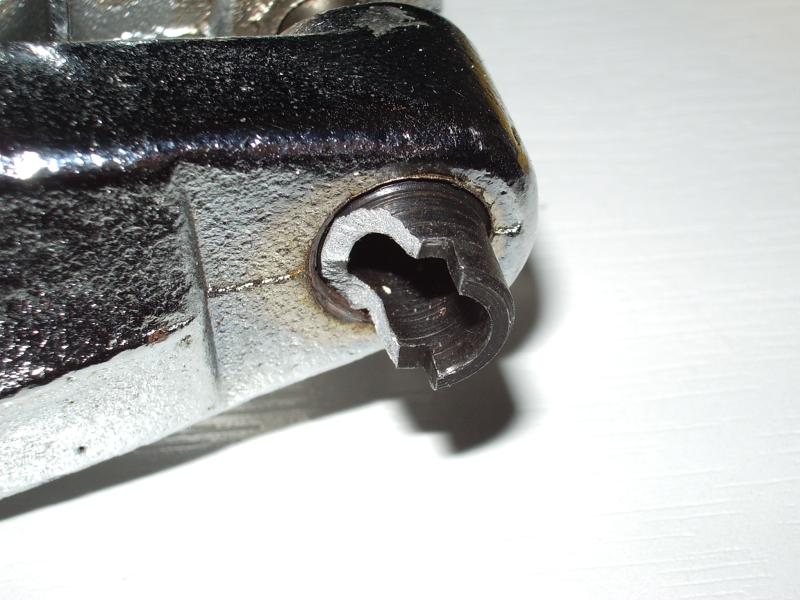
The 7mm die was a bit stiff to remove but came out with the aid of a screwdriver in the slots provided. The 4.5mm one I put in would bind at each turn and got more and more stiff. Eventually it wouldn’t budge, so I put the screwdriver blade in sideways to get a bit of leverage. There was a crack and a whole piece of the die broke off! I guess it was made by the same firm that makes K3 knobs for Elecraft!
It’s far enough in that I can make 4.5mm pads, but not only does it not want to go in any further but it also doesn’t want to come out. I might be able to get it out with some Mole grips but this is probably the most useful size and I might never be able to get it back in again next time I need it. Crap!

Julian Moss, G4ILO, is a regular contributor to AmateurRadio.com and writes from Cumbria, England. Contact him at [email protected].
 Ham Radio Deluxe |
 W5SWL Electronics |
 Ham Radio Prep |
 KB3IFH QSL Cards  Hip Ham Shirts  HamRadioAuctions HamRadioAuctions Reliance Antennas Reliance Antennas Enigma Shop Enigma Shop |  morseDX  Ni4L Antennas  R&L Electronics R&L Electronics antennas.us antennas.us QRV QRV |
- Matt W1MST, Managing Editor
