 |
 A couple of setbacks
 21 May 2010 | by
 Computers and radio really don’t mix. I was trying to connect the FT-817 to the shack computer. I plugged the USB cables into the back of the PC, then as I lifted the cables vertical to feed them behind the shelf unit I heard the noise level on 2 metres come up quite clearly. I could probably reduce the noise using clip-on ferrites but any more noise than I already have is unwelcome. I think I might give up the computer altogether and go back to paper logging!
I also proved today that it isn’t possible to work satellites with indoor antennas. Yesterday I tried receiving AO-51 with the 3/4 wave vertical I made, but I got a readable signal for only a few seconds. Today I tried the 6 element Yagi I made a few weeks ago which received signals off the Moon when used outdoors. Pointing it at the satellite from inside the shack I again heard only a few seconds of signal from the satellite. I think there is just too much attenuation at 70cm to use indoor antennas, so satellite operation is out of the question.
I could probably combine the 6-element 70cm and the Moxon 2m antenna to make a portable hand held antenna for satellite use. But whilst it would be an interesting challenge to make a satellite contact using the FT-817 and a hand held antenna out of doors I had really hoped to be able to do it from inside the shack.

Julian Moss, G4ILO, is a regular contributor to AmateurRadio.com and writes from Cumbria, England. Contact him at [email protected].
More on the TS-930S PA
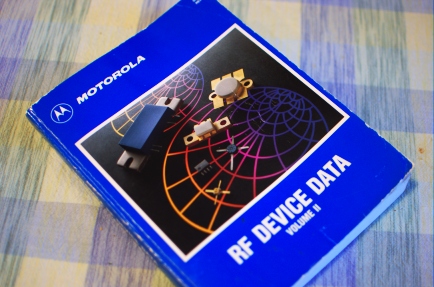
I’m not sure that I’ve shared this on the blog, but I’ve long known that the reason that my “troublesome” 930 burns up PA drivers is a low-frequency oscillation. This mechanism was also mentioned by Leeson in his comprehensive list of 930 upgrades and repairs. At first, I thought that the 28-volt power supply’s filter capacitors might be the culprit—insufficient ripple-suppression. After all, the oscillation sounds like it has a 60-Hz component (I’ve never tried to measure this because I’m concerned about blowing up more transistors). I finally completed the capacitor replacement last night, realigned the power supply voltage and PA bias levels…and the oscillation is still there, just as I increase the drive past the point where I get 50 watts out.
There is a good Helge Granberg article in the September/October 1980 issue of RF Design titled “Good RF Construction Practices and Techniques.” I would like to get a copy of the original article because Motorola, in their infinite wisdom, reprinted the article as AR164 but neglected to include the list of references. Granberg devotes an entire section of the article to instabilities, a full of half of that section to low-frequency instabilities. This is the area I will focus on first:
Causes for the low frequency instability are usually inadequate collector DC feed bypassing or an extremely poor ground in that area. Two or three RF chokes together with various values of bypass capacitors from 1000 pF to several uF may be required in the DC line to stabilize the circuit. (See examples in Reference 1.)
Ah, Reference 1, where (who) art thou?
If I ever get to the bottom of this problem, there should be a useful body of work and notes to prevent this from happening repeatedly to others.
Ethan Miller, K8GU, is a regular contributor to AmateurRadio.com and writes from Maryland, USA. Contact him at [email protected].
WebProp update update
I received a response from the web host support desk about the problem that is causing the WebProp update scripts to fail to access the WWV solar data. The reply was:
There is nothing we can do to fix this it’s a configuration error on their end with their dns. This is occurring because of invalid dnssec configurations at noaa.gov. We will not bypass the dnssec configurations implemented within .gov. The only way to have this corrected is by the dns administrators at noaa.gov signing their zones.
20-May-2010 15:26:00.099 validating @0x827fff000: swpc.noaa.gov SOA: got insecure response; parent indicates it should be secure
20-May-2010 15:26:00.116 validating @0x80284f000: swpc.noaa.gov SOA: got insecure response; parent indicates it should be secure
20-May-2010 15:26:00.159 validating @0xadb055000: swpc.noaa.gov SOA: got insecure response; parent indicates it should be secure
20-May-2010 15:26:00.204 validating @0xad9af8000: www.swpc.noaa.gov A: bad cache hit (www.swpc.noaa.gov/DS)
This is way over my head, but I think they are saying this is due to a problem at NOAA’s end not mine.
I will give it a couple more days, but if the problem doesn’t go away then I will have to remove WebProp. I know this will be a pain for those who have included it in their websites but there is nothing I can do about it.

Julian Moss, G4ILO, is a regular contributor to AmateurRadio.com and writes from Cumbria, England. Contact him at [email protected].
WebProp not updating
The WebProp HF propagation indicator has not been updated since midday today. Since that time the update script has failed with an error saying that it is unable to resolve the host www.swpc.noaa.gov where the WWV solar weather reports come from. Since it can’t get the data, it can’t update WebProp.
I have opened a support ticket with the web host which has replied that there is a “problem with the server DNS.” Hopefully the problem will be resolved shortly.

Julian Moss, G4ILO, is a regular contributor to AmateurRadio.com and writes from Cumbria, England. Contact him at [email protected].
Hearing an old friend
I have been listening when time permits to see whether I can hear – and perhaps even work through – amateur satellites with my attic antennas. Today I caught a couple of passes of Amsat Oscar 7 operating in Mode B.
 Oscar 7 is the first and only satellite I have ever worked through. It was launched in 1974 and I used it during the summer of 1975 when I was home from university. In those days I used Oscar 7’s Mode A (2m up, 10m down) running 50W from an Icom IC201 with an amplifier to a 5 element Jaybeam and receiving using some kind of wire antenna and a Yaesu FRG-7 receiver.
Oscar 7 is more than 35 years old and the fact that it can be used in 2010 is interesting. The satellite failed in 1981 after all the batteries failed short-circuit and that was the last anyone expected to hear of it. But in 2002 its beacon signal was heard once again after one of the batteries went open-circuit allowing the full power from the satellite’s solar panels to be used to run the transponders. Jan King, W3GEY, who built Oscar 7 in his garage all those years ago, wrote about his feelings on hearing his ‘baby’ again – it was clearly an emotional experience.
The satellite now comes on when it is in sunlight and goes off when it is in eclipse. It is pot luck which of its modes it uses when it comes on, but it mostly appears to be Mode B, the downlink of which can be heard on 145.950MHz USB plus or minus 20kHz. You can receive it quite well using a good 2m vertical – in fact I hear it better on my Slim Jim than I do on the SuperMoxon due to the fact that the latter is very narrow band and tuned to the low end of the 2m band.
You would hear the Mode A downlink on 29.450MHz plus or minus 50KHz. (Both transponders are linear and can support multiple contacts at the same time within the bandwidth, unlike an FM repeater.)
I am finding it difficult to find out which of the many amateur satellites now in orbit are usable for communication and when they are actually available. Many of the websites giving information about how to use satellites are well out of date and give details of satellites that are no longer operational. To add to the confusion some sites use names like “Hamsat” or “Echo” while others use the Oscar designation. So you may find the links below useful if you would like to try listening for Oscar 7.
N2YO has an excellent site for all satellite enthusiasts which provides real time Oscar 7 satellite tracking and allows you to generate predictions for future passes. It’s worth logging in to the site so it can remember your location co-ordinates. You should also tick the box “Check to show ALL passes (visible and not visible)” – confusingly this refers to when the satellite is visible to the naked eye, not when it is above the radio horizon.
The Oscar Satellite Status Page lets people enter reports of satellites heard so you can see which ones are operational and get an idea of which mode Oscar 7 is operating in at the moment. Finally Planet Emily has a lot of information about Oscar 7 including a log where people can record contacts made through this antique piece of space hardware.

Julian Moss, G4ILO, is a regular contributor to AmateurRadio.com and writes from Cumbria, England. Contact him at [email protected].
LHS Episode #040: HF in the Mobile Shack
 It’s a couple of days since the end of the 2010 Dayton Hamvention. Cheryl and I would like to send out a special thank you to everyone who stopped by our booth while we were there. We met a lot of interesting folks and had a great many thought provoking conversations. It was our first time so we didn’t know we’d be out in the sticks, so to speak, but we still had a lot of traffic and a lot of fun.
Now that I’m home and most of the work that piled up on me while I was away has been tackled, I got the podcast we recorded before the event finished and here it is. There’s no Dayton content this time around. That will come next time. The drawing for the Alinco radio and the other Linux in the Ham Shack swag will happen on Friday and we’ll announce all the winners in the next show and on the Web site so stay tuned for that. In the meantime, enjoy some interesting feedback from listeners and some insight into Richard’s latest mobile rig install. Keep the feedback coming, visit our Printfection and Cafe Press stores and pick up an item or two, and get ready for next year in Dayton. Linux in the Ham Shack will be back.
73 de The LHS Guys
Russ Woodman, K5TUX, co-hosts the Linux in the Ham Shack podcast which is available for download in both MP3 and OGG audio format. Contact him at [email protected].
Handiham World for 19 May 2010
Welcome to Handiham World!
Getting ready for Radio Camp: Sniffing out problems in the station equipment

Handiham Radio Camp begins on Friday, May 21. We have to make sure that our radio gear is ready to go so that it can be deployed when we do camp setup later this week – and that means doing a few preliminary checks that include connecting the transceivers to a power supply and testing the receive and transmit functions, making sure that there is modulation, and checking to make sure that the speech modules are speaking the frequency for our blind users.
George LaValle, N0SBU, and his dog PJ pose for the camera as they sniff out any potential problems, while Avery, K0HLA, looks on approvingly. Every project needs a supervisor, a sniffer, and a guy who pushes the transmit button!
If you listen for us on the bands during camp week, which is Friday, May 21 through Friday, May 28, 2010, give us a shout and you may earn a QSL card, providing that you send us one. We do plan to be on the Handiham Echolink net every day, including Sunday during camp week, but remember that because Fridays are camper travel days, those days are not going to be the best for making contact with the camp. You may be able to contact campers or volunteers on the road as they travel.
We are often asked, “What frequencies will you be on?” and “Can we make a scheduled contact with the camp?”
I know from years of experience trying to figure out frequencies and schedules that it is best not to promise anything. However, I can say that we will make a good effort to be on the air at Echolink net time, and if you want, you can ask the folks at camp if they are willing to get on the HF bands for a schedule. Be sure to route any requests through the net control station, whoever that might be.
Thanks to Don Rice, N0BVE, we will have Echolink repeater access at Radio Camp. Our repeater will be connected to the HANDIHAM Conference Server, node 494492. This high capacity node, sponsored by N0VZC, can accept 200 connections. The camp repeater will be on all the time, so you can always try a call even outside regular net times. You never know when someone will be listening.
The best times to contact us are:
Early morning before 08:00 CDT (Before breakfast)
Between 13:00 and 15:00 CDT (Camper recreation time)
After 18:30 (Following dinner)
As I said, you can try calling anytime and the call will go out all over camp on the camp repeater system. We do have people listening most of the time, especially those who are in Operating Skills or Extra Seminar.
We hope to hear you on the air soon!
Patrick Tice
[email protected]
Handiham Manager

Pat Tice, WA0TDA, is the manager of HANDI-HAM and a regular contributor to AmateurRadio.com. Contact him at [email protected].
 Ham Radio Deluxe |
 W5SWL Electronics |
 Ham Radio Prep |
 KB3IFH QSL Cards  Hip Ham Shirts  HamRadioAuctions HamRadioAuctions Reliance Antennas Reliance Antennas Enigma Shop Enigma Shop |  morseDX  Ni4L Antennas  R&L Electronics R&L Electronics antennas.us antennas.us QRV QRV |
- Matt W1MST, Managing Editor
