 |
 A simple HF receiver
 19 May 2010 | by
 Before this blog I had a web site with some amateur radio information. It is still out there, but I should close it down or update it totally. Here is one of the projects from those pages which I had great fun with and which is worth adding to this blog. I was quite impressed with the quality of the audio from this receiver which has just seven components (three capacitors, two transistors, a resistor and a transformer). Below is an edit of what was originally written a few years ago.
I constructed this simple receiver having seen the circuit at WB4LFH’s web site which he calls the ‘audion’. This circuit is almost identical to the last circuit on that page, except I changed the inductor connection to the variable capacitor from being a tapped connection to being a transformer coupling.
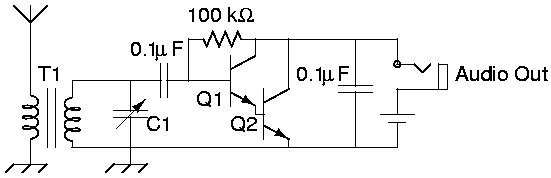
The inductor was a T50-2 toroid with secondary being 28 turns of enameled copper wire and the primary (connected to the antenna) being two turns. (Remember a ‘turn’ on a toroid is the passing of the wire through the hole). The transistors were 2N3904 types, but you can try any general npn transistor. The tuning capacitor was a air plate type taken from an old radio receiver, likely about 300pF. The circuit was constructed ‘ugly style’ on a small piece of unetched circuit board. Use what you have in your junk box and experiment.
The performance is very good considering the simplicity of this receiver. Below are a set of sound recordings from this receiver. The recordings show how the volume can change (no AGC here!) and that the selectivity is not too good.
If you consider building this receiver please note that these recordings were done with the receiver connected to my external antenna at that time, a G5RV. I tried using a long whip antenna, which I had in the junk box, and there was no discernable reception of a signal with it. So you will likely need to use a good length of wire to act as an antenna. Post a comment if you have any success with this circuit.


Alan Steele, VA3STL, is a regular contributor to AmateurRadio.com and writes from Ottawa, Ontario. Contact him at [email protected].
Weather station
After I removed my Ascot weather station due to the interference it caused on the 70cm band, I didn’t have a clock in the shack. I searched for a long time to find a radio controlled digital clock with a nice 24 hour LED display capable of showing UTC but couldn’t find anything suitable. Whilst browsing I found something interesting. It was a Meteotronic WM5100 weather station made by La Crosse, reduced from £49.99 to £17.49. As I still liked the idea of having a weather display in the shack, I decided to get one.
 The Meteotronic is interesting as it is not, in itself, a weather station. It is a radio, tuned to receive transmissions from the German time and frequency standard station DCF77 on 77.5kHz. Besides an accurate time signal, DCF77 transmits weather forecast data for 90 different regions of Europe for up to 4 days ahead. This information is received by the device and displayed on its LCD, as you can see in the picture.
Some of the weather regions are quite large. I am in the region “northern England” which covers the whole area north of Birmingham to the Scottish border. But the forecasts are probably still better than predictions based simply on atmospheric pressure trends, like most home weather stations.
I’m coming to realize that this is a pretty poor location for reception of radio signals of any type. The unit had difficulty receiving the DCF77 transmission, although I am well within the maximum distance at which reception is possible. You need to experiment with different locations to get the best reception.
Although the unit doesn’t have a UTC time option, you can set a time zone offset, so I can set this to -1 during the summer to compensate for the effect of daylight savings time.

Julian Moss, G4ILO, is a regular contributor to AmateurRadio.com and writes from Cumbria, England. Contact him at [email protected].
Out on the fells with Murphy
This morning there was a lot of Sporadic-E about. I spotted – and was spotted by – several stations on 10 metres. I didn’t hear any normal activity on 10, but there was some on 6m and I made a couple of contacts. However the weather was gorgeous, too good to be indoors whatever the propagation, so I took some coffee, a sandwich, the Motorola GP300 and the Intek H-520 Plus and set off to do a couple of Wainwrights.
 I parked in a lane between Mockerkin and Lamplugh and walked along the track above Hudson Place. You are high above Loweswater here and can enjoy some wonderful views for no climbing effort at all. Then it was up over the grassy fellside to Blake Fell (WOTA LDW-140.)
There was a strong, cold south westerly wind so I hunkered down in the stone wind break on the summit to have my lunch. A retired couple over from Newcastle joined me and wanted to chat, so it was not until they had gone that I was able to get the radios out. I put the telescopic 5/8 antenna on the GP300 but the wind was so strong it was blowing it almost horizontal so I switched to the helical. I was using the speaker mic, but no-one replied to my calls and I realized that the rig was not going to transmit. That was the first of my troubles.
Dispensing with the speaker mic I called CQ and made contact with Keith G0EMM in Workington. After we moved down to 145.450MHz we were joined by Colin 2E0XSD and Derek 2E0MIX.
The guys knew I had recently acquired a 10m FM H-520 hand held and anticipated that I would want to try using it. I decided it was too windy to try the 4 foot antenna so I used instead the short one that came with the rig. As soon as I pressed the PTT the rig shut down and re-started. Keith suggested there might be something wrong with the batteries, and that seemed to be the case as when I reduced power to 1 watt the rig didn’t shut down but the battery state indicator went from all bars to no bars. So that was the second of my troubles.
As per usual, I had my digital camera with me to try to take a picture, using the self timer, of me at the summit. But either I got only my legs, or only my head, or the wind moved the camera so the picture was blurred. After that, every picture I took with the timer was grossly over-exposed (although if I took a picture manually it was alright.) That was the third of my troubles, as a consequence of which you are spared a picture of G4ILO this post.
After that I set off for what I thought was Burnbank Fell (WOTA LDW-183). My target was a prominent summit with a large stone summit cairn, about 100m lower than Blake Fell. I reached it in about 20 minutes, put out another CQ call and was contacted by Keith and Colin. They had been tracking my position using APRS and informed me that it looked as if I was on Carling Knott. I was sure I wasn’t, as there is no other Wainwright summit in the area. Carling Knott isn’t a Wainwright, and the one I was on looked like a pretty important top that I’m sure Wainwright would have given a page in his Guide to the Western Fells.
I had hoped to descend from there down to the lake but I couldn’t find the path – the fourth of my troubles – so I ended up re-tracing my steps, though avoiding the actual summits to save a bit of climbing. As I walked back over the grassy hill over which I had walked a couple of hours earlier I put out another call on 2m and was answered by Keith and Colin again, who both confirmed that my APRS position now put me on Burnbank Fell! So this featureless grassy hillock that I had barely noticed on the way up is actually a Wainwright, while the higher Carling Knott with its impressive summit cairn isn’t. I’m sure AW had his reasons…
Back at the shack I found there was nothing wrong with the H-520’s batteries, but it doesn’t seem to like the short whip antenna, which of course I never tested it with before I went out. If I had been able to use the four footer it would probably have been fine. The GP300 worked perfectly with the speaker mic, and I couldn’t reproduce the problem with the camera self-timer either. As for activating the wrong fell – I guess I should look at the map a bit more closely.
But it was still a gorgeous day and a wonderful walk, even if it was a bit windy and Murphy was my invisible companion.

Julian Moss, G4ILO, is a regular contributor to AmateurRadio.com and writes from Cumbria, England. Contact him at [email protected].
Scratching the SDR itch
 One of the blogs I regularly read is that of Larry W2LJ. Larry has been watching some of the streamed video presentations about software defined radio (SDR) coming out of Dayton and believes that SDR is now mainstream and the shape of things to come.
I would be dishonest if I said that I have never looked at some of the SDR products and wished that I had one to try. SDR is becoming an itch that many of us would like to scratch. But I suspect that, in my case at least, it is an itch that once scratched would go away. Although I’m sure that software defined radio technology will find increasing use in tomorrow’s radios – as it already does in the Elecraft K3 – I hope that “black boxes” controlled via a computer console never completely usurp standalone hardware radios.
Dedicated hardware “just works”. General purpose computers are just too much hassle. There are the security issues, the updates, the driver incompatibilities, the crashes, the unfathomable problems. You switch on a radio and it is ready to use. You switch on an SDR and you must then start the computer and wait for it to boot, then start the SDR application and wait for it to load. Is this progress?
Dedicated hardware works until it dies. Computer based devices only work until a new version of Windows comes out that doesn’t support it. How many perfectly good printers and scanners have you had to throw away because they wouldn’t work with your new computer?
Real radios have an aesthetic and provide a sensory experience that simply cannot be matched by a computer interface. Isn’t turning a knob preferable to moving a slider with a mouse? Isn’t making a real audio cable easier than trying to configure a virtual one? Many of us prefer a real S-meter to a graphical simulation. Most of us spend far too much time staring at computer screens already.
With real radios you can look at the schematic and get in there with your soldering iron and make modifications or fix faults. With SDR you are dependent on somebody else unless you are a skilled programmer and have access to the source code and development tools.
I can’t see myself swapping any of my radios for a black box and a computer application interface any time soon. I’ll still work the same bands and the same modes, so what benefits would an SDR give me? A hardware radio is instant-on, intuitive, virus-proof and crash-proof, can’t be broken by some application I install on my PC, doesn’t lock me into using a particular brand of operating system and won’t be made obsolete by the next version.

Julian Moss, G4ILO, is a regular contributor to AmateurRadio.com and writes from Cumbria, England. Contact him at [email protected].
Satellite antenna
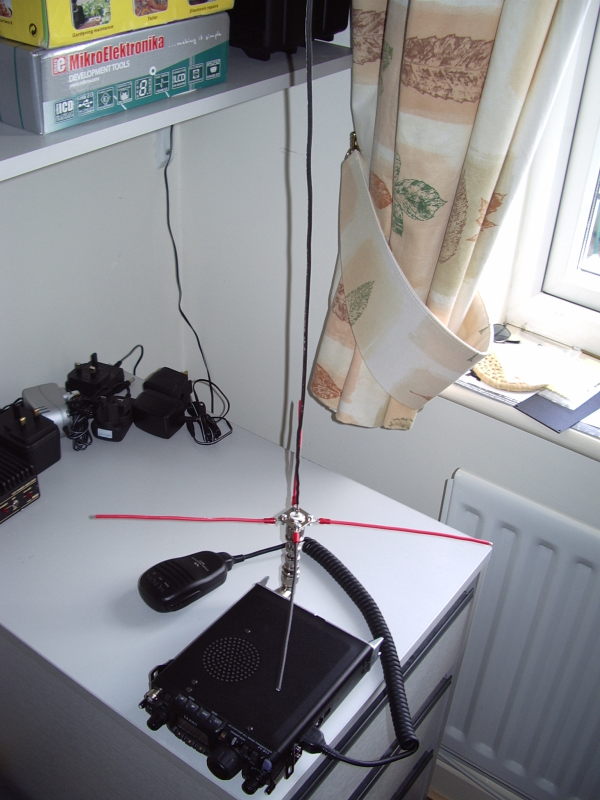 I attempted this morning to make a 5/8 wave ground plane antenna for 70cm out of some solid copper mains cable and a chassis mount SO-239 connector. I tried two designs for the radiating element with a coil at the bottom, but both gave “High SWR” from the FT-817 and were so far away from a match that there seemed no hope of getting anywhere. My SWR analyzer doesn’t go above 200MHz so that wasn’t any help in finding out what was wrong.
After these abortive attempts I decided to straighten out the coil and make a 3/4 wave ground plane instead. This gave a perfect match with barely perceptible reflected power being shown on the SWR meter.
The four radials are each 165mm (6.5in.) long and the vertical element 483mm (19in.) The radials need to be horizontal for the best match, not slanting down as they usually are for a quarter wave vertical.
Hopefully I will be able to receive satellite downlinks with this. There are no 70cm repeaters in this area and no 70cm activity that I know of so it will not be much use for anything else.

Julian Moss, G4ILO, is a regular contributor to AmateurRadio.com and writes from Cumbria, England. Contact him at [email protected].
My 10,000 Hour RadioSport Challenge | 9,804 – 1 = 9,803 Hours To Go
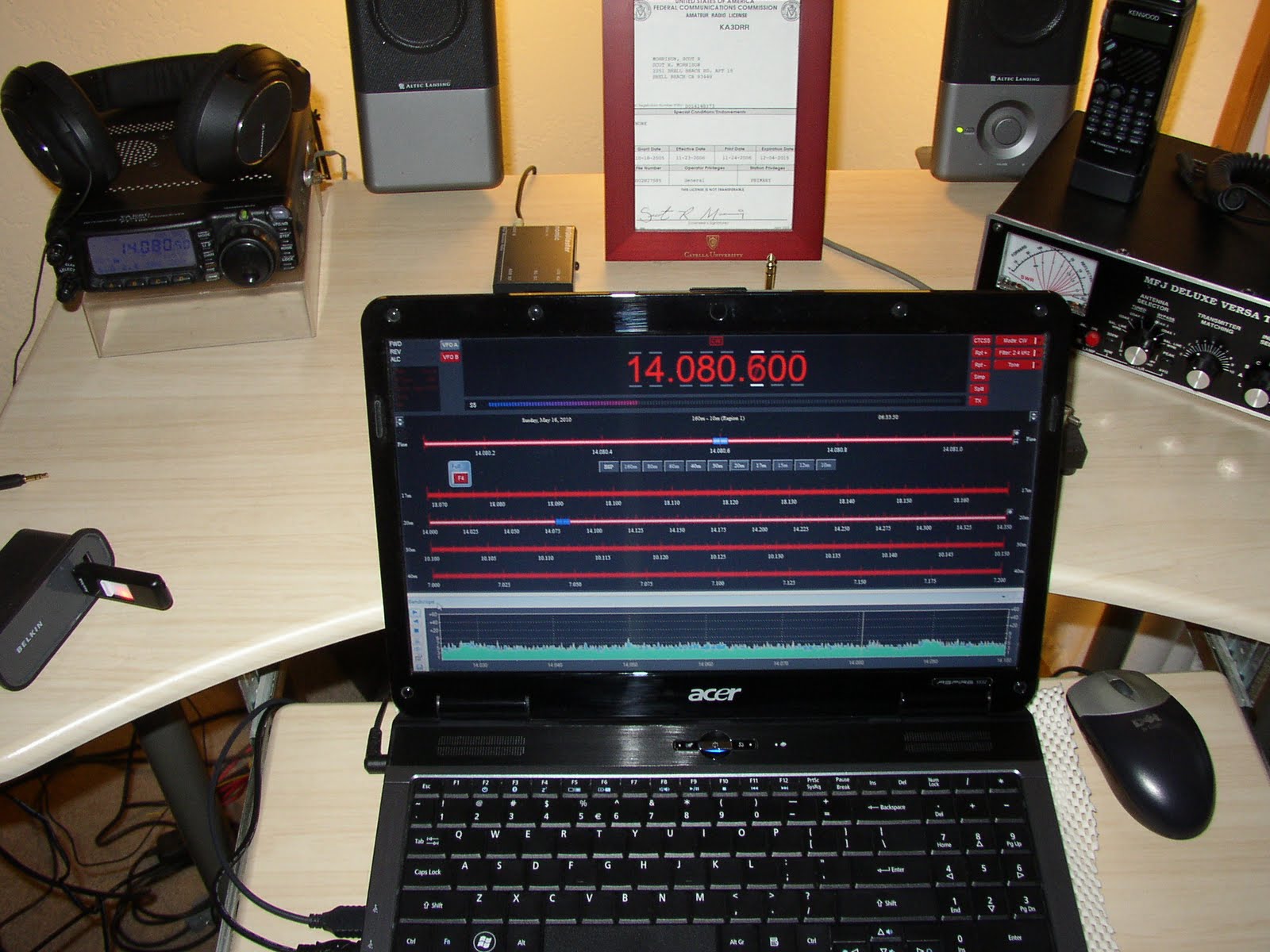 The lull between solar cycle sets allowed me an opportunity to configure Ham Radio Deluxe with bandscope capability. I’m impressed with its user interface and continuous scanning. The scope settings range between 6 dB through plus 60 dB in addition I’m monitoring 75 KHz of bandwidth.
QSO Party.
Recently, I operated in the 7th Call Area QSO Party, for an hour prior to a social commitment. The recent downward sunspot trend suppressed most signals, normally, signals from 7-land range between s5 through plus 10dB on the meter. This season seems exceptionally different unlike previous years.
The Beach Boys Amateur Radio Club is wondering where all the sunspots have gone?
Software Control.
I have reached a milestone inside the shack that is additional software controlling of the Yaesu FT100 because of Ham Radio Deluxe. However I have not completed the project that is interfacing my radio because of port issues. My goal is to resolve the conflict at the end of the month although not in time for CQ WPX CW.
Currently, both N1MM Contest Logger and Ham Radio Deluxe compete on port four, which is assigned to the CAT62 cable off of the FT100.
The DM780 program runs in CW mode and I’m fascinated by the spectral intensity of signals. I feel like ham radio moved to another level because, not only am I hearing the signal, it is also visualized on the liquid crystal display. Likewise, one can watch the Morse code interpreter and I’m curious how it will function at the end of the month for example; can I cut and paste a callsign from the interpreter into N1MM’s dialogue box when searching and pouncing?
CQ WPX CW.
I’m looking forward to the late Spring mega RadioSport event given WPX growth over the past few years. Likewise, I will have an opportunity at using the bandscope and waterfall although WPX is a rate competition. Perhaps, the big question is, will a set of sunspots flow across the solar disc later this month?
73 from the shack relaxation zone.

Scot Morrison, KA3DRR, is a regular contributor to AmateurRadio.com and writes from California, USA.
More ash disruption – hams stranded
 British and European hams who are in the US to visit the Dayton Hamfest may find it a bit tricky to get back next week. Changing weather conditions are likely to cause ash clouds from the Eyjafjallajokull volcano to return to the UK. The Department of Transport is predicting that UK airspace – including the busiest airports in the south east of the country – may be closed from Sunday until Tuesday. Travellers are advised to check with their airlines before setting off for the airport.

Julian Moss, G4ILO, is a regular contributor to AmateurRadio.com and writes from Cumbria, England. Contact him at [email protected].
 Ham Radio Deluxe |
 W5SWL Electronics |
 Ham Radio Prep |
 KB3IFH QSL Cards  Hip Ham Shirts  HamRadioAuctions HamRadioAuctions Reliance Antennas Reliance Antennas Enigma Shop Enigma Shop |  morseDX  Ni4L Antennas  R&L Electronics R&L Electronics antennas.us antennas.us QRV QRV |
- Matt W1MST, Managing Editor
