 |
 VX-8GR battery drain fault
 25 June 2010 | by
 This afternoon I was making some measurements to try to determine the current consumption of the VX-8G (and hence estimate the battery life) and I stumbled across a rather serious flaw. When the internal GPS is enabled it remains powered all the time, even when the radio is switched off. Enabling the GPS causes the current consumption to increase by about 30mA, and that same increase is noticeable in the current drawn when the radio is powered from the external DC socket, whether or not it is charging. This level of current drain would flatten the 1100mAH battery pack in less than two days!
I joined the Yahoo VX-8R group, which is the discussion group for the VX-8G as well, and noticed that some American purchasers of the radio had already discovered this problem. I hadn’t had the radio go flat on the shelf myself, mainly because in the three days since I got it I have been using it quite a lot. But my observation does help to explain why I found the battery life was poor. Like most people I suspect I have been charging it up after an outing and then taking it out of the charger in the expectation that it would still be fully charged the next time I used it. But with 30mA being taken from the battery all the time, even a 12 hour period off-charge would result in a significant loss of operating time.
The VX-8G isn’t yet available in the UK so there is not much point in contacting Yaesu UK for their comments on this issue. It’s possible that when the European VX-8GE version arrives Yaesu will have identified the problem and fixed it. If I was reading this and thinking about getting a VX-8G I’d certainly want to receive an assurance that the fault had been fixed before buying one. And if I’d bought this from a UK dealer I would probably be taking it back. So this is really an example of where buying from Hong Kong hasn’t paid off, even though the problem isn’t the fault of the dealer who sold the radio.
The workarounds would appear to be either to turn the GPS power off from the menu whenever you switch the radio off – a real hassle which will probably result in the GPS taking minutes to get a fix each time it is switched on – or else to leave it on charge all the time. The latter would seem to be the least painful.
It is a pretty annoying fault to be stuck with. I had been thinking about getting the high capacity battery pack but having found this problem I don’t think the VX-8GR will be a keeper. I shall look with renewed interest at the Kenwood TH-D72 APRS handheld when it becomes available, though I shall probably lose a lot on the exchange – giving publicity to this fault isn’t exactly going to help the VX-8GR’s resale value. 🙁

Julian Moss, G4ILO, is a regular contributor to AmateurRadio.com and writes from Cumbria, England. Contact him at [email protected].
Deaf by design
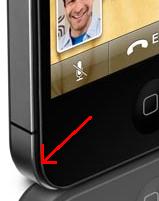 I’ve never been a fan of Apple products. I have always felt that Apple was a brand aimed at fashionistas concerned more with style and the coolness associated with owning a particular product than with practicality. So for example phones were made with non user-replaceable batteries in order to make them very slim.
Now it appears Apple’s engineers have made another slip-up in the name of style. Users of the new iPhone 4 are reporting that they lose the signal whenever they hold the phone. Apparently a section of the stainless steel band that runs around the phone is used as the antenna, and the part that radiates is on the lower left hand side – nicely surrounded by the fleshy palm of your hand if you hold the phone in your left hand.
It seems to be that Apple could do with a radio ham on its design team. Even the newest Foundation licensee – in fact even a CBer – could have told them that antennas are supposed to point upwards.

Julian Moss, G4ILO, is a regular contributor to AmateurRadio.com and writes from Cumbria, England. Contact him at [email protected].
Bouncing off the ISS
There was recently a change of crew at the International Space Station and one result of that has been the reappearance after a long absence of the packet radio digipeater on 145.825MHz. When the Space Station passes over you can receive some very strong signals from it. I have decoded APRS beacons on a VX-8 handheld standing on a window sill inside the shack. But it is even better to use the main station, then you can see the positions of the stations you received on a map.
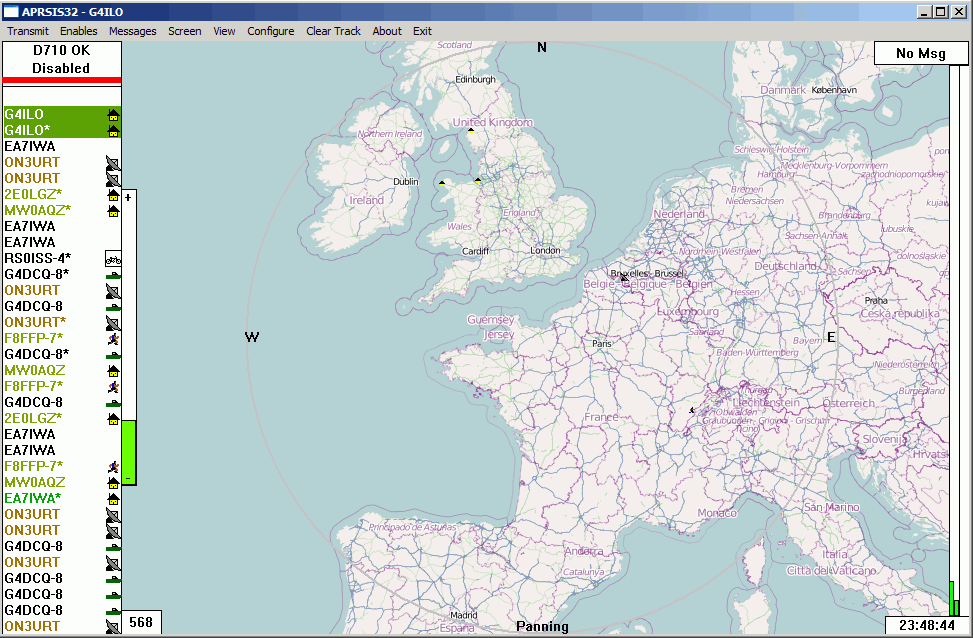 When using the ISS you need to use different settings to what you would use for terrestrial APRS. Digipeating, if enabled, must be turned off. You want to be connected to APRS-IS so you can gate received packets to the internet, but you don’t want to send anything received from the internet out to the ISS. You probably don’t want to display data from the internet on the map, to leave it clear to show those stations received by the radio. If you want to transmit through the ISS yourself you must also change the APRS path to “ARISS”.
After thinking that we really need an ISS option in APRSISCE/32 for this it occurred to me that all I needed to do was make a copy of the program in a new folder, then I could change the settings however I wanted without affecting the copy I use for terrestrial APRS. It worked fine. It was fun to see the stations heard via the satellite show up on the map, although when the map is zoomed out to cover such a large area the icons are hard to see. It was also amusing to see that the icon for the ISS’s own beacon was a bicycle. Perhaps someone should tell NASA!
After several abortive attempts to get my own beacon digipeated by the Space Station I set the transceiver to Narrow FM and got through on the first attempt using just 10W to my 300ohm ribbon cable Slim Jim in the attic. The proof is in the map of stations heard through the ISS at ariss.net.
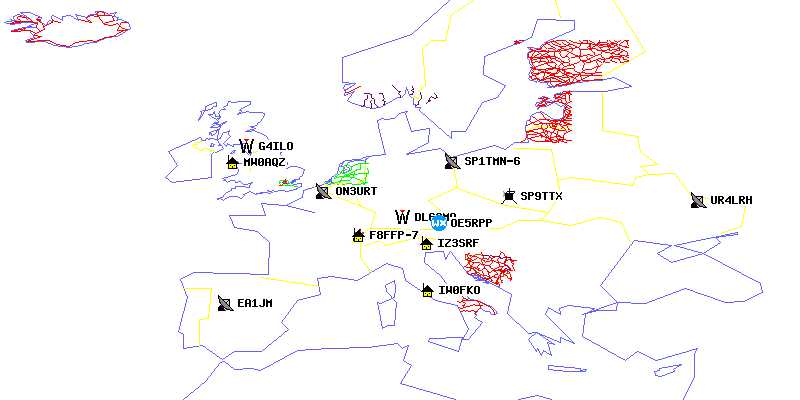 Not a very useful activity perhaps, but fun to try.

Julian Moss, G4ILO, is a regular contributor to AmateurRadio.com and writes from Cumbria, England. Contact him at [email protected].
A most excellent day on four metres
Unexpectedly, owing to domestic circumstances, I found myself at home today. VHF was in good shape and from early on, 50MHz was going well. I decided to concentrate on 70MHz today and see what I could work.
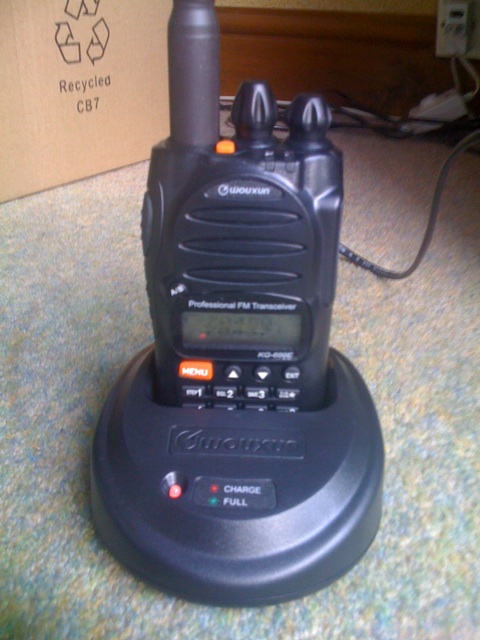
The Wouxun 70MHz FM handheld that arrived yesterday didn’t yield any contacts, but it was a great indicator on a couple of occasions that the MUF had reached 70MHz, when the broadcast FM from Eastern Europe was clearly audible on the handheld. I’m looking forward to playing with the handheld (even though I was the last person in the country to know about their availability, living here under my little rock…!)
So, as I was passing the shack, I kept checking 70MHz on the FT847. IZ8DWF (JM78) was first in the log, I worked him on SSB this time. I was pleased to find IF9/I2ADN (JM67) for a new square. I2ADN always goes to some great places for the Sporadic E season and it was good to work him for the first time on 70MHz, we’ve had many QSOs over the years on 50MHz.
I5OXT (JN52) made it into the log at lunchtime. Later on, IS0AWZ would have been a new one from Sardinia, but he called CQ CQ CQ and didn’t hear me. Lots of QRM from the East at that time, so I’m sure he was getting a lot of interference. At 1530z, I heard a weak SSB CQ on 70.200 which got louder. I was delighted to work YO9HP in KN35 for a new country on the band. ES1CW appeared briefly on 70.200 on the key, but I couldn’t attract his attention.
Just after 1600z the band opened nicely into Italy again. I worked IZ5EME (JN52), IW0FUK(JN61) and I6BQI (JN72). It was particularly nice to work Angelo, I6BQI – someone that we used to work back in the 1980s on 144MHz Meteor Scatter.

Tim Kirby, G4VXE, is a regular contributor to AmateurRadio.com and writes from Oxfordshire, England. Contact him at [email protected].
Fun with Larry & Coleman
Sharon & I spent last weekend visiting my friends Larry, N4VA, and Coleman, K4RZ who live in Virginia. Last year we visited them during the same weekend and I went with Larry & Coleman to W3LPL’s open house, which I wrote about when first attended in 2005. Sharon came with me last year as well and she visited with some friends who lived in the area while we visited the big aluminum farm. This trip has become an annual thing for us, and what happens is that I take off the day from work on Friday and drive down, arriving (hopefully) just before rush hour hits the DC area. We have a great barbecue dinner with some friends (mostly non-hams but also with Fred, K3ZO, who is fairly well-known in ham circles), go to W3LPL’s Saturday and head home Sunday, with the space in between (when not eating or otherwise having a great time) gets filled with “playing radio”, propagation permitting.
When we arrived on Friday, 6 meters was cooperating, and literally just as I walked in Larry had picked up Dennis, 5J0BV who was operating from San Andres Island (which is located to the east of Nicaragua but considered to be a “department” of Columbia). Dennis had a good signal but when I tried to work him with Larry’s paddle, I had a really tough time sending my callsign correctly. I make no secret of the fact that I normally send “computer assisted” CW from a keyboard, but given that I’d just gotten out of the car from the 5 hour drive, I was having a really tough time trying to use the paddles. (By the way, I’ll say that I had no trouble decoding what Dennis was sending by ear, I just could not get my fingers to cooperate.) Larry finally gave me a bit of an assist, and I was able to count this as a “new one” on 6 meters. Very shortly thereafter, Dennis switched to sideband and I was easily able to complete a contact there as well, even having a bit of time to chat and apologizing for the mess I’d made with the CW contact.
After dinner 6 meters continued to be open to the west, and I had a good time watching Larry pick up a bunch of new grid squares. Grid squares, like “countries” can be used to earn credit towards certain operating awards, the most popular being VUCC for grid squares and DXCC for countries. For both of these awards there are rules about where you have to be to gain credit, and those rules say that while you can get credit for any DXCC entity while working anywhere within the same entity/country (in other words, I can get DXCC credit regardless of where in the US I’m located), for the VUCC award you can only count new grids that you work from your home grid. (There is actually a little leeway, I’ll leave reading the rules as an exercise for the reader.) As a result, although my contact with 5J0BV counted for DXCC, it, along with the other grids that Larry was working that evening, don’t count for me for the VUCC award.
More to come …

David Kozinn, K2DBK, is a regular contributor to AmateurRadio.com and writes from New Jersey, USA. Contact him at [email protected].
Handiham World for 23 June 2010
Welcome to Handiham World!
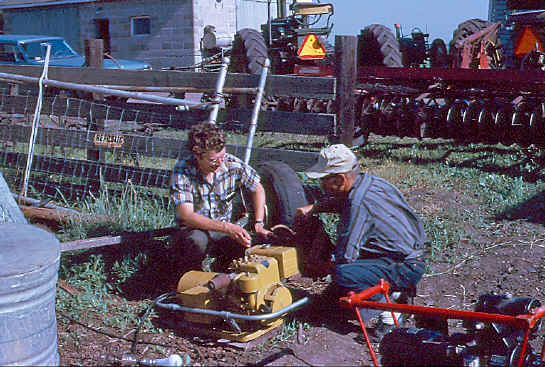
Photo: Pat, WA0TDA, left, and friend Newt, a farmer who let us use his barn for a Field Day ham shack, set up a generator. This was a Field Day with a real field – the end-fed Marconi antenna was hundreds of feet long, extending from a high point on the barn out to a solitary tree in a soybean field. Look at that head of curly hair I had back then, which I think was sometime in the early 1970’s! The old gas generator made considerable racket, so it was located as far as we could manage from the operating position. This rustic setting for the generator was in the farmyard next to Newt’s machine shed. Field Day has changed quite a bit for some of us…
Field Day is this coming weekend, June 26 and 27, 2010. We are looking forward to joining the SARA group, a Handiham-affiliate as well as an ARRL Special Service Club, for this annual operating event. Look for W0JH, our club callsign, and give us a shout. We will be operating on the HF bands as well as on 2 m, and you may even find us on Echolink.
Yes, I know that Echolink contacts do not count for Field Day points, but we will be in this contest for fun, fellowship, the promotion of amateur radio to the general public, and to use and have fun with new technologies. Earning Field Day points is far down on our list of priorities, and that brings me to what I have mentioned before in my columns and podcasts: Different clubs and individual amateur radio operators have different priorities for operation on ARRL Field Day. Some will be in aggressive contesting mode and will work hard to earn as many points as possible, often with multiple CW stations earning double points for Morse code contacts. Considerable effort will be put into impressive antenna systems and station staffing will include the best and most experienced operators. The logging system will be state-of-the-art and the entire operation will be carried off with military precision. Other clubs, like ours, will not consider high point scores as our first goal. The success of our operation will be whether or not we had fun getting on the air. I’ve had decades of ham radio experience, and that has given me a chance to approach Field Day from different angles. This leads to the observation that Field Day rules, while designed to be broad enough to include a variety of interests and goals, also set up a certain tension between contesting and the other goals, such as showcasing amateur radio to the general public, training new operators by getting them on the air, exposing seasoned operators to new technology, preparing for and operating in a simulated emergency situation, and drawing in family members to observe and participate.
Tension? What do you mean by that?
Well, here’s the deal. If a club is really in it for the points, the top priority will be finding a location for the event that enhances operating, setting up stations with elaborate antenna systems, spending a significant amount of time operating CW for the double point score, designing and deploying bulletproof supporting systems that include multiple power sources independent of the grid and a shared logging system. Serious clubs will prepare all year long for this event and operator training will be a significant part of the preparation. All of this is well and good, and all of it is rewarded handsomely in the point scoring system. And who can argue with extensive preparation and training? Both are important aspects of emergency preparedness.
The problem is that the very nature of this kind of operation is that it can suffer enormously if it is compromised by allowing inexperienced operators to run the stations. True, those inexperienced operators may hold General or Extra licenses, but they may have little or no Morse code experience. If they do operate CW, they may do so at a much slower speed than the experienced operators in the club. Relegated to the phone stations, these relative newcomers to HF operation may still work stations at a far slower rate than experienced phone operators. The best Field Day location for antenna systems that are really competitive may not be the easiest site to get to. Club members who have family, work, or school obligations will find it difficult to participate in multiple planning and training sessions in the months prior to the contest. Do you see what I’m getting at? It might be said that “winning” in contest mode requires quite a different mindset and singular dedication toward scoring points than the other goals typically associated with a more inclusive Field Day experience. Let’s take a look at the object of Field Day, as stated in the official rules:
“To work as many stations as possible on any and all amateur bands (excluding the 60, 30, 17, and 12-meter bands) and in doing so to learn to operate in abnormal situations in less than optimal conditions. A premium is placed on developing skills to meet the challenges of emergency preparedness as well as to acquaint the general public with the capabilities of Amateur Radio.”
Okay, working as many stations as possible probably means a no holds barred contest station. However, developing skills to meet the challenges of emergency preparedness is quite a different matter unless you are willing to compromise your point score to spend a significant amount of time during the event training relative newcomers to HF. Furthermore, if your site is optimally placed for contesting but inaccessible to people who can’t hike up a rocky slope, I would have to argue that you would not only be shutting out club members with disabilities but also discouraging observation by the general public.
Some considerable effort over the years has been made to meld these otherwise incompatible goals. The “GOTA”, or “Get on the Air” station concept was designed to fulfill the goal of getting newbies on the air while still allowing the more experienced operators to run up the point score on the other stations. The GOTA station could then also served as a point of demonstration to members of the press or general public who happened to show up. Still, there remains a sort of stigma about the GOTA operation in some clubs, where it is looked upon as a necessary but inconvenient compromise to the primary goal, which is to earn lots of points. Still, the rules do allow bonus points for locating in a publicly accessible place and having an information table. The question for any serious contest group will be how to compromise between optimal contest operation and putting on a show for the general public and training new operators. Some points are awarded for copying or passing messages. Again, this remains somewhat of a sideline activity to simply working as many stations as possible, preferably in a mode that allows for a higher point score.
Can you imagine a real-life emergency situation in which amateur radio repeaters, if they were available, would not be used? When the Interstate 35W bridge collapsed here in the Twin Cities several years ago, you can bet that the repeaters were buzzing with activity. Nonetheless, making Field Day contacts on repeater systems for points is prohibited by the rules. Some clubs will use their repeater systems for so-called “talk-in” information to guide participants to the Field Day site or to give out information of interest to the greater amateur radio community. Of course Echolink and IRLP contacts are not valid for points, either. If your club wishes to use these new technologies, you may not list the contacts for point scoring purposes, though they may be of great interest to the general public.
Extra consideration is given for CW operation, which earns two points for every contact as opposed to a phone contact, which earns only one point. Similarly, digital mode operation counts for two points per contact. From what I have observed over the years, CW is a highly efficient mode of operation that lends itself to really racking up the points, at least at the hands of experienced operators. I’m not sure exactly why it needs the extra boost of a point subsidy, but I suppose this could encourage the old timers to let a couple of newer, less experienced CW operators take over for a shift or two. The two point subsidy for digital contacts might be somewhat more justified as a means to promote more digital operation. Still, if special point considerations are given for digital operation and satellite contacts (bonus points), I do have to confess that I am somewhat at a loss as to why Echolink, IRLP, or WIRES capability isn’t at least recognized in some kind of bonus point scheme if not outright point scores per contact. After all, these technologies will define amateur radio operation for a significant part of the ham radio population in the years to come — as they do right now in this rather disappointing lingering sunspot minimum when HF operation has been lackluster at best.
Yes, I have heard all the arguments before about how repeaters cannot be tied up with any sort of contesting activity and how Echolink isn’t real ham radio. I understand the reluctance of clubs to step too far outside the bounds of tradition. There are good and compelling reasons why unleashing contest activity onto repeater systems might be a really bad idea. Visions of repeaters tied up for hours on end come to mind. A repeater tied up with contest activity would be unavailable in an emergency. Contacts through an Echolink repeater would be said to make use of non-ham radio technology, doing an end run around the purpose and scope of amateur radio. These are all valid concerns, but I would counter that one can drive across the country these days scanning for repeater activity and finding city after city where the repeaters sit virtually dormant if not outright comatose. What would be wrong with actually using these resources? I’m going to stick my neck out and say that the horror stories of repeaters being tied up and in constant use will not come to pass. If using a repeater as a talk-in station or just to make random contacts to demonstrate the repeater and ham radio to the general public suits you, go for it. Believe me, with most repeaters going hours and sometimes days on end with no activity, you probably won’t stand much chance of causing a problem.
And what if you make an Echolink contact or two? Don’t count it in the Field Day log, but at least use the opportunity to enjoy the latest communications technology.
For Handiham World, I’m…
Patrick Tice
[email protected]
Oh, and if you want to join the Field Day fun with us, check out the Oakdale Discovery Center, starting at 10:00 a.m. on Saturday, June 26, when we will be starting the station setup. The SARA Field Day will include a cooperative project with University of Minnesota students to launch a helium balloon, which will be tethered to fly above the Field Day site and transmit ATV – Amateur Television – pictures to the ground from aloft. Points? No. Fun? Yes.
Oakdale Discovery Center
4444 Hadley Ave N
St Paul, MN 55128-2651
W0JH Repeater Talk-In
The SARA 2m repeater is on 147.060 MHz, with a positive offset (transmit on 147.660 MHz). It is an open repeater. You need a tone of 114.8 Hz on your transmit signal.

Pat Tice, WA0TDA, is the manager of HANDI-HAM and a regular contributor to AmateurRadio.com. Contact him at [email protected].
A different route to work – different things to listen to
I took a different route to the station this morning. Leaving home a little bit earlier than normal, I popped into Oxford to see our friends at Jack FM. It’s lovely to see them and see how effortless they make producing a great show appear.
As I was driving down the A34 from Oxford to Didcot, I popped the FT8900 on and had a listen around. To my surprise the GB3CF repeater at Charnwood Forest in Leicestershire was coming in very strongly – approaching S8 on some of the hills to the south of Oxford..
What was interesting to me was that my route this morning wasn’t more than 10 miles or so from my usual one – but it’s quite unusual to hear GB3CF on the normal route – certainly at that sort of signal strength.

Tim Kirby, G4VXE, is a regular contributor to AmateurRadio.com and writes from Oxfordshire, England. Contact him at [email protected].
 Ham Radio Deluxe |
 W5SWL Electronics |
 Ham Radio Prep |
 KB3IFH QSL Cards  Hip Ham Shirts  HamRadioAuctions HamRadioAuctions Reliance Antennas Reliance Antennas Enigma Shop Enigma Shop |  morseDX  Ni4L Antennas  R&L Electronics R&L Electronics antennas.us antennas.us QRV QRV |
- Matt W1MST, Managing Editor
