 |
 ICQ Podcast Series Three Episode Twenty-Seven – Radio Ethics (28 December 2010)
 28 December 2010 | by
 Series Three Episode Twenty-Seven of the ICQ Amateur / Ham Radio Podcast. Our end of year episode discusses Amateur Radio Ethics and a Ham Radio website review.
Colin Butler, M6BOY, is the host of the ICQ Podcast, a weekly radio show about Amateur Radio. Contact him at [email protected].
Over 2000 miles on 80m with the Warbler

Screenshot of QSO with KG6ASY
Last night was a good night with the Warbler, with five contacts made using PSK31 on 80m. The locations of the contacts were varied; Ontario, Illinois, Kentucky, New Jersey and also Nevada. This last one was a real surprise as checking the distance between myself and KG6ASY in Washoe, NV, revealed it was a little over 2,200 miles. As the power out from the Warbler is 3W, it has not yet reached 1000 miles per watt but it is getting close. Tim, KG6ASY gave me a 549 report and his signal was 579 for me.
There is some DX coming in too on 80m as I saw a French and a Spanish station on the waterfall last night.
The Warbler is proving to be a fun transceiver to use during the night on 80m.

Finished Warbler in box


Alan Steele, VA3STL, is a regular contributor to AmateurRadio.com and writes from Ottawa, Ontario. Contact him at [email protected].
Incommunicado
I have spent a frustrating couple of hours trying to make a PC cable to communicate with the VX-8GR. In the VX-8 Yahoo group it was stated that the cable is the same as for the Kenwood TH-D7AG a diagram of which is given in YO3HJV’s blog. It was also pointed out to me that there is a diagram in the back of the manual – the one place I never thought to look!

It is easy enough to make up. No level shifting components needed. Just a 2.5mm stereo jack for the radio end and a 9-pin D plug for the PC end. But the damn thing refuses to work.
I have tried a Prolific USB to serial adapter and an FTDI one. I’ve tried the FTBVX8G software and I’ve tried a terminal program to see if I can detect any data. Nothing. Nada. Incommunicado. I know the cable is OK because if I short between tip and ring of the jack plug I can type in the terminal program and see the text I typed echoed back over the connection.
The only thing I can think of is that the standard 2.5mm stereo plugs I have here are a bit too short. It seems to me that the plug isn’t locking firmly into place, more that the radio is trying to push it back out again. It’s as if the tip needs to be a bit longer to get past the spring loaded contact in the socket. I measure 7/16in from the base of the plug to the tip of it. I had a similar problem trying to make a cable to send audio from my FoxTrak APRS tracker into my Motorola GP300. Then I had a plug from a speaker mic to compare it with and I could see that it needed to be longer.
Perhaps someone who has a VX-8G PC cable that works could measure the plug on theirs. Or perhaps someone will spot the stupid wiring mistake I’ve made from the photo I’ve posted.

Julian Moss, G4ILO, is a regular contributor to AmateurRadio.com and writes from Cumbria, England. Contact him at [email protected].
What Santa brought to me – a Pentaflex PSU
Santa was, as usual, very generous in his, er, deposits here. There were no specific amateur radio themed gifts this year, as I am well provisioned in that department! I did, however, have a couple of things for my astronomical telescope.
One of these was a Pentaflex ‘Mobile Power Station’. This looks like a giant torch, but is in fact, a great big rechargeable battery. The idea was to use this for my telescope which otherwise uses a gazillion AA batteries to guide the tube onto the correct target and it can go through them pretty quickly! I’ve got more crafty and thrifty about moving the telescope around, but I realised that the PSU for the scope would be a good idea.
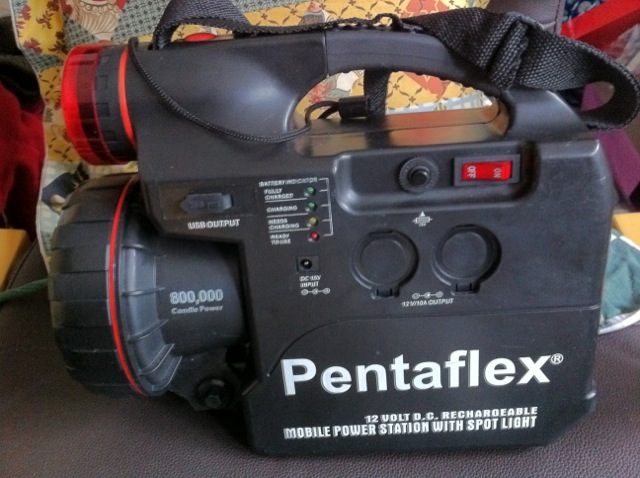
Of course, the unit will not just power a telescope! It will be absolutely ideal for powering an FT817 or similar on holiday. It’s relatively portable, though quite heavy – so I don’t think it’s the answer to carting up a mountain for SOTA or similar activities – but definitely a great answer to having plenty of 12v readily available.

Tim Kirby, G4VXE, is a regular contributor to AmateurRadio.com and writes from Oxfordshire, England. Contact him at [email protected].
70MHz FM: Or when 3 stations came back to a CQ…
Over the last couple of days, I’ve had the 70MHz FM set on when I’ve been in the shack. I’ve probably said, but the set is an converted Philips FM1000 series set.
A few days ago, I called CQ and Dave, G4AQK from Swindon called me and asked if I knew there was a lot of hum on my transmission. I didn’t but, switching on the monitor receivers confirmed the issue. I soon found that if I touched the case, the problem went away. I tried various earthing points without any success. Caught up with Rob, G4XUT a bit later and he suggested that it might have been an RF feedback issue.
Bearing in mind Rob’s suggestion (which I was quietly a little sceptical about, as the issue seemed to be independent of power level) I grabbed a ferrite ring and put it on the power lead, close to the rig. That solved the problem – so I forgot about it.
A few days ago, I called CQ on 70.45MHz FM again and thought I’d check the transmission. Despite the ferrite ring, the hum was back! Tried another ferrite on the microphone lead, but that didn’t do any good! Then the penny droppped!
The outside temperature was around -12C (unseasonally cold in these parts). I think there was ice on the antenna (probably in it too!) and this was affecting the SWR. This morning, outside temperatures had risen and thawed a lot of the snow and ice. The hum has gone! So I’m sure that’s what causes the problem.
Meanwhile, this morning, I heard Chris, G4CCC from near Reading calling CQ on 70.450MHz. Called him back and was surprised to hear him say that three people had come back to his CQ! Two of the others were in Surrey and barely audible up here in the frozen wastes of Oxfordshire – but it’s great to hear more activity on 70Mhz.
Got a 70MHz FM set? Why not hook it up and try and make a contact or two?

Tim Kirby, G4VXE, is a regular contributor to AmateurRadio.com and writes from Oxfordshire, England. Contact him at [email protected].
Underwhelming update
I see that on Christmas Day (though of course it wasn’t Christmas Day in Ukraine) the developers of the MixW sound card digital modes software released the long awaited MixW version 3. I couldn’t find much information on the website about what new features it contained. “MixW3 is a next step on the way to the upcoming multiplatform MixW project. It proposes a new Telnet dialog with talk over DxCluster support and a possibility to have a backup copies of your log on our server, dx.mixw.net.” Nothing about what’s new in the version available now. None of these “proposals” are things that I personally want, and I’m not even sure that chat over the DX Cluster will be welcomed by many users – there are enough non-spots cluttering it up already.”

I decided to download the new version to see what I could find. As the screenshot above shows, it looks pretty much like MixW 2.19 which has been looking dated for years. I didn’t see any new modes, nor support for RSID. What is even more disappointing, given the apparent lack of new features, is that this upgrade is not free. The website states “MixW3 upgrade is free for those who stay with us 10 years or more.” I registered MixW a long time ago but not long enough, it seems. An upgrade to MixW3 will cost me the equivalent of $20 plus VAT.
At the time I paid for MixW It really was the premier digital modes software and I felt it was well worth the money. But after a few years it seemed as if MixW was neglected. In the intervening time new, more modern looking full featured competitors came on to the scene like Ham Radio Deluxe and Fldigi, which were also free. I switched to Fldigi a couple of years ago as MixW never properly supported the K3. And nothing I can see in the new version gives me any inclination to switch back, even if I could use the new version for free.
There is nothing wrong with charging for ham radio software. But charging for an upgrade in which the only apparent change is the version number and then expecting buyers to hang on patiently while new features are added won’t work in a market where so many good products are free. Perhaps the multiplatform MixW 4 will be a must-have upgrade. I’m happy to wait and see.

Julian Moss, G4ILO, is a regular contributor to AmateurRadio.com and writes from Cumbria, England. Contact him at [email protected].
Merry Christmas
Just wanted to wish my readers a very merry Christmas. Thank you for visiting my blog site. I hope to blog again real soon.
Jerry
Jerry Taylor, KD0BIK, is a regular contributor to AmateurRadio.com and writes from Colorado, USA. He is the host of the Practical Amateur Radio Podcast. Contact him at [email protected].
 Ham Radio Deluxe |
 W5SWL Electronics |
 Ham Radio Prep |
 KB3IFH QSL Cards  Hip Ham Shirts  HamRadioAuctions HamRadioAuctions Reliance Antennas Reliance Antennas Enigma Shop Enigma Shop |  morseDX  Ni4L Antennas  R&L Electronics R&L Electronics antennas.us antennas.us QRV QRV |
- Matt W1MST, Managing Editor
