 |
 ARRL January VHF Sweepstakes
 31 January 2011 | by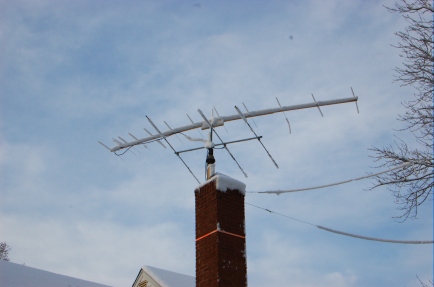
Last weekend (two weekends ago now), Sarah was out of town with friends from college, so I was free to meander in and out of the shack at will. Between making QSOs on 2 meters, I got a “modern” computer set up for SDR. More on this in the future. Was pleased to make some QSOs into New England with the “$200 VHF station” that consists of the TS-700S, Mirage B3016G amplifier, and homebrew FO12 antenna. Nevermind that the Pro-Set, Bencher, and Keyer cost at least that much again.
Still working on getting the other bands going. 50 MHz is very close, although with the recent sale of some extra gear, a K3 is almost within striking distance if I sold one the of the TS-930s. One of the locals has offered to lend me his FT-736R to get on 222 and 432 for now. So, I think I’ll try to finish up the 50-MHz transverter and pick up the ’736 while working on the antenna situation for those bands. I’m going to have to change the rotor/mast situation to do that. Not sure how that will go…I may just duplicate a “rover mast” and accept whatever sacrifice is introduced by stacking the beams too close together.
                    ARRL January VHF Sweepstakes

Call: K8GU
Operator(s): K8GU
Station: K8GU

Class: Single Op LP
QTH: FM19la
Operating Time (hrs):

Summary:
 Band  QSOs  Mults
-------------------
    6:
    2:  44     15
  222:
  432:
  903:
  1.2:
  2.3:
  3.4:
  5.7:
  10G:
  24G:
-------------------
Total:  44     15  Total Score = 660

Club: Potomac Valley Radio Club
Ethan Miller, K8GU, is a regular contributor to AmateurRadio.com and writes from Maryland, USA. Contact him at [email protected].
ICQ Podcast Series Four Episode Three – Magic 6m Band (30 January 2011)
Series Four Episode Three of the ICQ Amateur / Ham Radio Podcast. News Stories include:
- New Amateur Radio bill introduced in Congress
- Italian 145.800MHz repeater shuts down
- Radar intruders in Amateur bands
- Cadets’ using 5MHz WSPR clarified
- Contest University 2011
- FSTV beacon GB3CZ back to full power
- Mass SOTA/WAB activation planned
- Goonhilly rejoin deep space comms programme
- Celebrating 85 years of hospital radio
- D-Star active in Johannesburg
- Cell-phone to fly in space
Your feedback, upcoming events and Martin (M1MRB) discusses the 6m band.
Colin Butler, M6BOY, is the host of the ICQ Podcast, a weekly radio show about Amateur Radio. Contact him at [email protected].
ICQ Podcast Series Four Episode Three – Magic 6m Band (30 January 2011)
Series Four Episode Three of the ICQ Amateur / Ham Radio Podcast. News Stories include:
- New Amateur Radio bill introduced in Congress
- Italian 145.800MHz repeater shuts down
- Radar intruders in Amateur bands
- Cadets' using 5MHz WSPR clarified
- Contest University 2011
- FSTV beacon GB3CZ back to full power
- Mass SOTA/WAB activation planned
- Goonhilly rejoin deep space comms programme
- Celebrating 85 years of hospital radio
- D-Star active in Johannesburg
- Cell-phone to fly in space
Your feedback, upcoming events and Martin (M1MRB) discusses the 6m band.
Colin Butler, M6BOY, is the host of the ICQ Podcast, a weekly radio show about Amateur Radio. Contact him at [email protected].
Showing Brownies simple electronics

(Copyright V Steele)
Ginny, my wife, is a one of a group of leaders for a Brownie pack in a nearby village. Last week we showed the Brownies some simple electronics and they had some fun with a really simple circuit.
We had them put a number of LEDs onto a 3V button cell, rather like a LED throwies but without the magnet. Once they had an arrangement of three or four LEDs on a cell Ginny took photographs of them in a darkened room as they waved the LEDs around. Taking a photograph on a slow file speed setting (ISO 80) and over a relatively long period (15 s) the Brownies created some great art by ‘painting with light’. As well as the example above, a small selection is shown below.


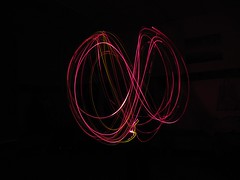

(All photographs copyright V Steele)
There was about 22 or so Brownies and we had them work on an LED ‘circuit’ in pairs. They really enjoyed the fun of arranging the LEDs and working out which way around to place them. However, I think they had the most fun with the ‘drawing with light’.
While some were involved with the photography I showed others the fun that could be had with electronics and how circuits could make things work. To do that I showed them how I could not light up an ultra-bright LED with a used 1.5V battery on its own. But, when I used a few components, connected into a Joule thief circuit, then the LED would light up brightly with the 1.5V battery. I also had some plastic optical fibre too and they had fun watching light bending around corners.
We kept the exercise simple and very visual and they all seemed to enjoy it.
If you want to make your own Joule thief you may find the Make magazine podcast below interesting and useful to watch.


Alan Steele, VA3STL, is a regular contributor to AmateurRadio.com and writes from Ottawa, Ontario. Contact him at [email protected].
Resonant Frequency Video Edition 1 (short Intro to Linux for Radio Operators)
This is a short introduction to Linux for Amateur Radio Operators showing a few things that are available for Amateur Radio.
Russ Woodman, K5TUX, co-hosts the Linux in the Ham Shack podcast which is available for download in both MP3 and OGG audio format. Contact him at [email protected].
RF VE 02: Dx Clusters, Telnet, XDX, and more fun stuff
This video is a short beginning tutorial for XDX and Dx Clusters we even try a little Telnet.
Russ Woodman, K5TUX, co-hosts the Linux in the Ham Shack podcast which is available for download in both MP3 and OGG audio format. Contact him at [email protected].
Sporadic-E on 6m
The first bit of live data I received from my APRS VHF propagation alert reflector was a warning of a possible Sporadic-E opening on six metres. I was rather surprised that there was Sporadic-E this early in the year, but I went to the DX Sherlock website and sure enough contacts had been reported between a station even further north than here and one in the Czech Republic. I then clicked on the map to see the actual contact details and was surprised to find they were WSPR spots!
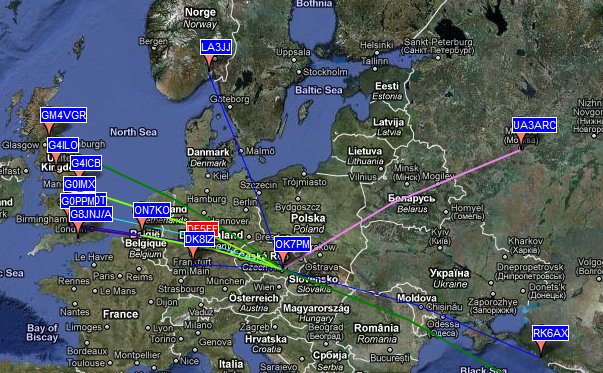
I went to the WSPR website and sure enough the same signals were shown. I decided to fire up WSPR on 6m myself but by then the OK station had gone and no new spots appeared from anywhere.
I have been, and still am, somewhat sceptical of the value of WSPR in showing VHF Sporadic-E propagation. One of the characteristics of Sporadic-E, particularly at the start and end of the season or on the higher frequencies like 2m is that it is very fleeting. A signal can be there for one minute, literally, and gone the next. On the other hand, signals can be really strong when reflected by Sporadic-E. WSPR is designed for detecting weak signals under steady propagation conditions and uses a 2 minute transmit cycle during which the data is transmitted very slowly. It seems to me that what you want to detect Sporadic-E is a mode with short transmit cycles where the data is transmitted quickly, perhaps something more akin to the modes used for meteor-scatter. I wonder if K1JT could come up with something?
Nevertheless I am very interested in anything that helps to detect VHF openings that might otherwise go undetected. I plan on WSPRing more on the 6m band, as long as there are others doing likewise so there is a chance of being received!

Julian Moss, G4ILO, is a regular contributor to AmateurRadio.com and writes from Cumbria, England. Contact him at [email protected].
 Ham Radio Deluxe |
 W5SWL Electronics |
 Ham Radio Prep |
 KB3IFH QSL Cards  Hip Ham Shirts  HamRadioAuctions HamRadioAuctions Reliance Antennas Reliance Antennas Enigma Shop Enigma Shop |  morseDX  Ni4L Antennas  R&L Electronics R&L Electronics antennas.us antennas.us QRV QRV |
- Matt W1MST, Managing Editor
