Archive for the ‘Uncategorized’ Category
 CQWW SSB 2011 wishlist
 October 31st, 2011 |
  Author: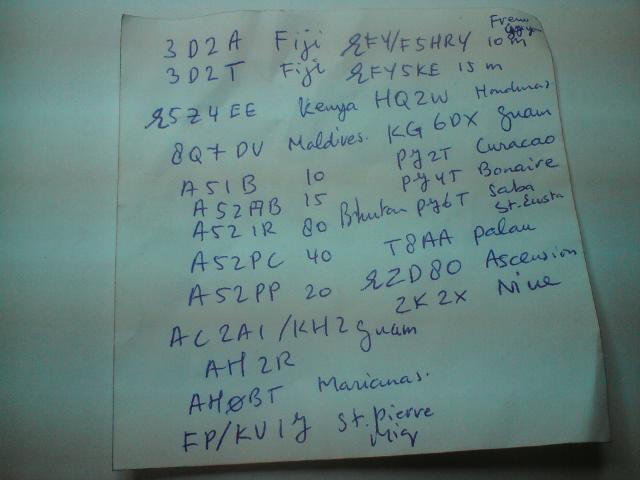
Incredible! Worked 20 !!! new band DXCC on 10m in the CQWW contest last weekend. That’s a lot. Propagation was very good especially on the 10m band. I actually made a wishlist before the contest with the help of the announced DX operations list of NG3K. Did not work everything fom the list as for example the PJ and A52 stations were constantly in a pile-up and I didn’t want to waste time with so many nice DXCC to work. But at last I did QSO with a few of the list. I even made a incredible QSO over the northpole to Alaska on 10m another first on that band. And no, I don’t work with a large beam but with a simple vertical made partially from Aluminium foil! I don’t have a lineair amplifier as well and did make all QSOs with 100W. I was not on the radio the whole weekend, so I missed opening to Oceania. I was simply not able to be on the radio on the right time as family duty calls. But after all I cannot complain I made 450 QSO’s, 200 of them were made on the 10m band. And I was almost jumping in the air….I made my first QSO with XE zone 6 after years of trying on various bands.
Some highlights on 10m, of course I made some QSOs on other bands too:
10m: JH4UTP (Japan), ST2UOK (Sudan), JT5DX (Mongolia), A92GR (Bahrain), BX100 (Taiwan), BD3NCK (China), VU2PAI (India), JY4NE (Jordan), C5A (Gambia), PZ5MM (Surinam), HI3TEJ (Dominican Rep.), P40W (Aruba), 8R1EA (Guyana), A73A (Quatar), A61BM (UAE), AA4V/VP9 (Bermuda), XE1CQ (Mexico), YV5NEA (Venezuela), HR2DX (Honduras), VP2MDG (Montserrat), WL7E (Alaska), 5H3EE (Tanzania), 7Z1SJ (Saudi Arabia), FY/F5HRY (Fr.Guyana)
I didn’t mention the countless northern American stations I worked on 10m. Imagine what would have happen if I used a beam, I think I would have doubled this list !!!
If you don’t use it….then lose it.
 |
| Random shack with random goodies. |

Welcome HamSphere, our newest sponsor

I wanted to take a quick moment to welcome AmateurRadio.com’s newest sponsor, HamSphere.
For those who may not be familiar, HamSphere is a virtual ham radio “simulator.” It doesn’t use RF — instead, hams communicate over the Internet with simulated interference, propagation, and more.
You can download software for PC, Mac, or Linux and try out the service free for a limited time.
Thanks for checking them out and remember that it’s the generosity of sponsors like HamSphere that helps pay for our hosting and bandwidth and, ultimately, keeps AmateurRadio.com “on the air.”
Have you tried HamSphere? Share your thoughts….
QRN a year ago…T32C? not here…
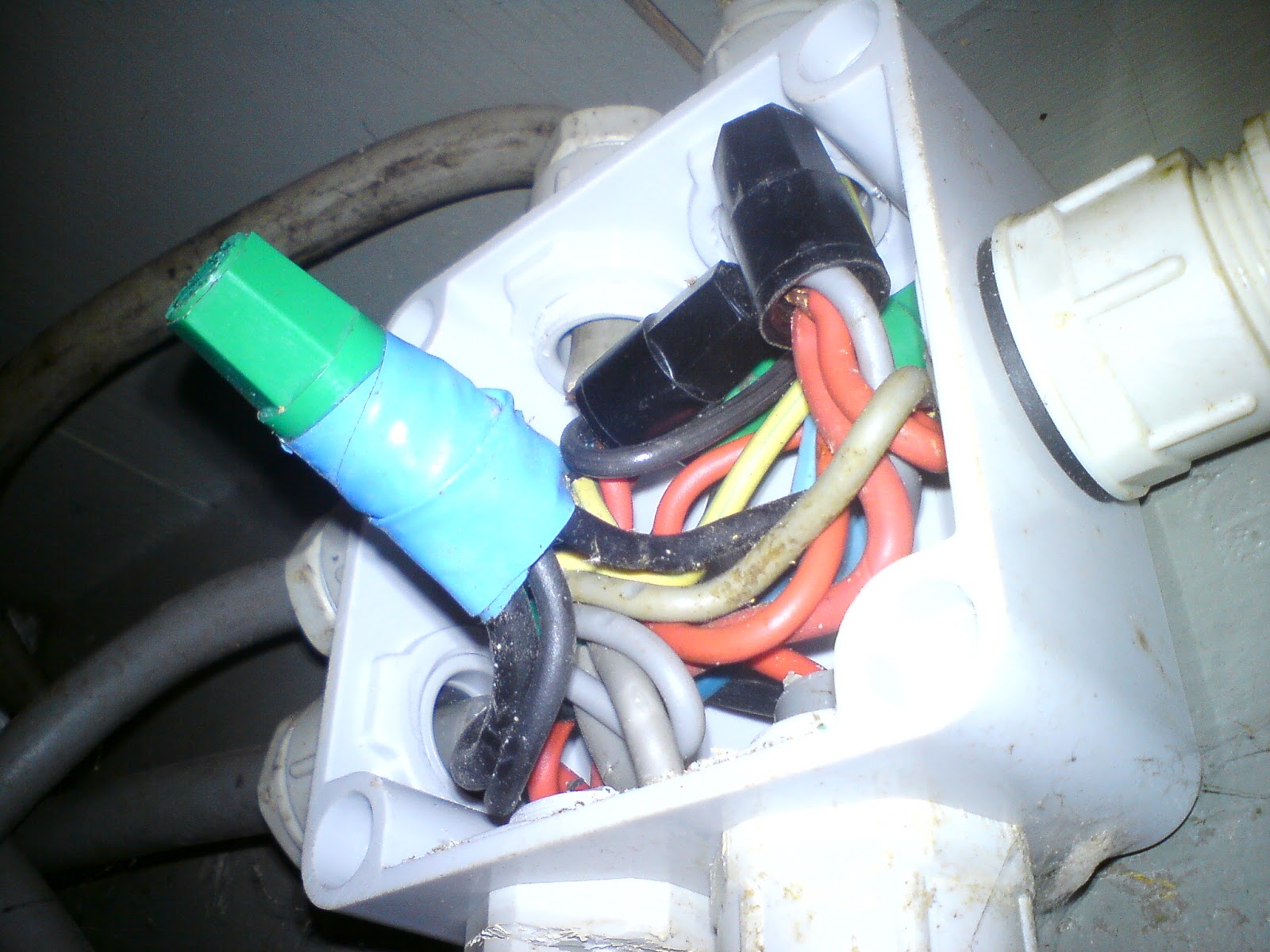
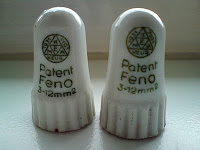
Remember that QRN I had a year ago. It suddenly disappeared after a few days. I never found the real troublemaker but suspected it came from the house or from nearby. Now since we are going to build a new bathroom next week, I had to rebuilt part of the house and wiring I came accross some mains wiring above the ceiling that probabely caused this QRN. When I opened a junction box and touched the wire nuts lights went on and off. Actually all connections were very poor made and the last owner of the house apparently tried to stick everything together with tape, besides that he probabely was colorblind. I removed all nuts and made new connections with new connectors no nuts again. As a result of that blindness wires were switched, I noticed a short circuit at first after reconnecting I thought. But in the end it seems the safety earth was used as switch wire, so it became a life wire as well. That was a 2 weeks ago, in the mean time I did a rebuilt and rewiring, that junction box has been removed together with a lot of other junk. I already made some preparations for the new radioshack and of course for the new bathroom and finally switched over to the new wiring last Sunday. Unfortenately I think other wiring in the house is just the same mess as this, although that wiring is from a earlier date I think around 1950-1960. I already removed parts of it when building the baby room last year and found some nice porcelain wire nuts at one of the old junction boxes. They are originally from the first mains wiring when the house was built, great to find such items in our 1935 house. Well despite a lack of time I’ve tried some radio as well looking for T32C in the evening, reading other blogs it seems they are easy to work from North America. But although I saw a lot of dx cluster spots on 20, 15, 12 and 10m from stations in Europe and even from the Netherlands I could not even hear a whisper from them. So I guess to work them you really need a beam from this part of the world, or I’m just not lucky? If time allows I’ll try again next few days till the DXpedition is over.
Poll: Best used HF rig for the money?

I’m planning on buying a small multi-mode HF rig for a relative who has recently become a ham. It’s been a very, very long time since I’ve bought a radio (used or otherwise). I’m polling the readership for opinions of the very best choice.
Ah, what do I mean by “best”?
Here are my criteria:
- Affordable
Browsing eBay and the other ham classified sites, there is quite a range of prices for used HF gear. I don’t really have a price in mind, but I am looking for a good value. As I can buy a new radio for about $600, I would say that the cost would have to be under $500 in the used market. - Reliable
The radio should probably be solid-state. - Portable
Should be able to be taken “backpack portable”
I would love to be in a position to spring for an Icom IC-7000, IC-718 or an Yaesu FT-817. They’re beautiful rigs, but I just don’t have the cash to spring for one.
What do you recommend? What’s the best value for your money?
I am great!
 Do you see those numbers on the display? Cool, isn’t it? That means I’m smart. Very smart. Bright and clever too. I admit I’m not too good looking, but I do have something of a genius in me. Come on guys, give me a round of applause. I did it! Finally fixed my Kenwood TS-440S. I feel like a million…..whatever currency is worth something nowadays. So, how did this sharp and brainy fellow do it? Simple: follow the 8 Volts.
After I rebuild VFO#5 last week I measured 8 Volts where I should measure 5. This bugged me for a week: where did those 8 Volts come from? So on Sunday morning I fed the family, kissed them good-bye and locked the door of my shack. With schematics, PCB layout and a DVM in hand I started out on my journey following the 8 Volts. It was a difficult track with many resistors on its path, a conductor or two and inductors to counter them. And then I arrived at a three-way junction called FET. Junction FET is known for regulating those obstinate Volts. But what do you know? Junction FET was tired beyond repair and those 8 Volts were going all three ways, where they clearly shouldn’t be. Now those of you who have travelled similar paths before (or should I just call you “old geezers”) know that you should handle junction FET with care. But until now I got away with rough-handling them. Not this time, so I quickly made amends and put in another junction with loads of TLC and some solder. And my journey ended there and then.
My thanks goes out to my family, the Yahoo TS-440S group, Mr. Liu for the components and to you, my dear readers, for putting up with me. SEE YOU ON AIR!!!
P.S. Your turn. I think I deserve at least 10 comments telling me how great I am, don’t you think?
New project– BATC DigiLite DVB-S Modulator
Note: a longer and more technically detailed version of this is at my other 'blog, which I've decided not to syndicate.
Why was I up to 3 AM last night, making me miss the Iowa QSO party today? I received a care package via “Royal Mail” on Friday from the British Amateur Television Club. It is something that was designed almost the same way (actually more clever in many respects) that I had been thinking of doing for close to 10 years.
The DigiLite is based on the “Poor Man’s DATV” by F4DAY. The project has been updated for modern computers by using a 2 channel FTDI USB serial port chip (which is the “why didn’t I think of it?” part of the design) and a closed-source (unfortunately) DSPic33 and Windows PC software to capture data from a “e-bay special” several year old Hauppage PVR-150, 250, 350 (and probably PVR-USB2) analog capture card from e-bay. (What is special about them for this project is an Conexant MPEG-2 encoder hardware chip and they are cheap!)

BATC Digilite card 3/4 way assembled at W0FMS -- topside

BATC DigiLite card 3/4 assembled at W0FMS -- bottom
The BATC’s solution of using an inexpensive PIC and the FTDI serial interface is a maybe slightly kludgy but awfully clever solution of inexpensively and simply pumping data to the QPSK modulator chip. Although there are some disadvantages to this simple interface, it is an awesome start!
The modulation used is DVB-S, which is the older digital standard used by most of the world for satellite transmissions.
I’ve been playing with LEGAL Free-To-Air satellite for many years. The majority of what is left unencrypted on C-band and Ku-band FSS satellite is receivable on an inexpensive set type box and/or PC receiver card. These receivers take in 950-2150 MHz signals as an IF (with a converter and/or a LNA in front of the IF) in Amateur use.
The main disadvantage to DVB-S for ham radio is that the modulation is pretty weak when it comes to handling multipath. Existing Yagi beams other directional antennas will mitigate this greatly in Amateur Use. See the other ‘blog for details.
THE great advantage to DVB-S for ham use– in my opinion– is that the bandwidth and data rates, even the video and audio coding the the MPEG-2 Transport streams are pretty much completely up to the link user. DVB-T in Europe and ATSC in the US is only setup for 6/8 MHz channels and IMHO there is no reason for hams to use this much bandwidth in 2011 for ATV. Neither are a good choice for low bandwidths as we NEED to have in amateur television.
Experiments by the BATC and others show that the digital signal is much more usable and stable than equivalent bandwidth analog ATV and it just gets better with reduced bit rates.
Ho, Hum? ATV? who cares? Well.. see.. it’s not really just that, is it? Data such as DVB-IP can be used for data instead. There are $20 e-bay DVB-S cards capable of receiving data as a native computer network interface via this protocol. Maybe we can restart a packet radio network up again?
So this is the start of an interesting project for me that I’ve wanted to do forever. Hopefully it will turn out well and can be revolutionary.













