Archive for the ‘Uncategorized’ Category
 Why 10 meters is not my favourite band.
 November 20th, 2011 |
  Author:
 Everybody is on 10 meters nowadays! I am no exception, just check out my piece from yesterday. But 10 meters is not my favourite band. I’ll show you why….
http://www.youtube.com/watch?v=70fed-lAcxM
Imagine scanning that in SSB! “Get the aspirin out, honey, I’m going on 10 meters now.” Can it get any worse? Yes, two nights ago someone was singing on 28.325 MHz. And not just for a few seconds, no minute after minute. Amateur radio keeps amazing me.
On a serious note: I can’t make much of the language that is spoken by most of the intruders. It is certainly not Mandarin, but there are definitely Chinese dialects amongst them. Most of what I hear, I think, are from southern Asia, probably the Philippines, Indonesia, Papua New Guinea, etc.
In the mean time I spend more time on 12 and 15 meters than on 10. Especially 12 meters is a fun little band with a lot of the characteristics of 10 meters. Try it out yourself, you’ll like it. See you there.
Frisian 11 cities contest tomorrow

In last years blogpost about this 11 cities contest I told about this movie I didn’t see then. But now I have and I can recommend watching it. I don’t know if there is a english version or a undertitled one. The story is really nice, I would certainly watch it again. Now for over the past week we did have foggy weather. Actually since last Saturday we only had fog, other parts of the country did see the sun last week. But here in the north it seems the sun cannot break through. Is it a forecast for a very cold winter? Like the winter of 1963? I was not born then but heard stories from my father, and experienced the 1979 winter myself with temperatures of -22 Celsius and snow that sticked to the windows so you couldn’t look outside what was happening. Well to get back to the topic, the Frysian 11 cities contest is tomorrow between 10:00-13:00 UTC on 80m and 2m. The 11 cities from this famous iceskating tour are the multipliers and you can work a extra multiplier which is Bartlehiem . A total of 12 multipliers is possible. You can find a english document with the rules on this page. Although most are calling in dutch everyone worldwide can participate. I will also regulary call in english for those that want to participate from outside the Netherlands and will only particate on 80m. It’s also a good chance to obtain the Friesland Award if you like.
T32TV
It has been reported on some sites that the T32C team donated some equipment to Tov, T32TV. That is the real ham spirit and if every DXpedition could do that there would be a lot less “most wanted” DXCC entities.
I have been busy with work and kids lately, so I need my sleep and try to catch as much as possible of it. So why does my daughter have to wake me at 06:00 local time Saturday to go to the toilet? She’s almost 6 and more capable than most other kids her age. Gave me an opportunity to sit behind the set, with the rising sun warming up my face. Even though 10 meters is not my favourite band I did check it out. Guess who was calling CQ? Right, T32TV. He wasn’t strong, but very willing to have a real QSO with me and surprisingly I was the only one answering him. I worked T32C, so Christmas Island isn’t a new DXCC entity for me, but QSO’s like the one with Tov are infinitely better.
The other fun thing that I did – before my battery died on me – was a QSO with Frank W7PAQ. With the rise in sunspots you sometimes stumble upon a “local” QSO that travels half around the world. Well, Frank was having a PSK31 QSO with a fellow American ham. So when that ended I called him. Frank really surprised, but pleasantly. We had rag chew DX session, because signals weren’t a 100%, but we kept it up for 10 minutes before Frank had to QSY to a local net. These QSO’s make me walk around with a smile for at least half a day.
Charging the batteries for Sunday morning now. 73 de Hans
Handiham World for 16 November 2011
Welcome to Handiham World.

Image: Here I am recording AMSAT Journal. I find that using a USB headset with boom microphone gives the most consistent audio quality because you can maintain an exact distance between your mouth and the microphone. It is also more comfortable and allows you to use both hands to hold any print material you may be reading from or using as a reference. All recording is done digitally using the open-source software Audacity, which runs on Linux, Windows, and Mac. For insight into recording digitally, see the “With the Handihams” article in an upcoming issue of Worldradio Online. The headset pictured here is a Plantronics brand, but I don’t have the model number. It was one recommended for voice dictation by Nuance, the makers of Dragon Naturally Speaking®.
This edition of your weekly e-letter is a little bit early because I must be out of the office all day Wednesday for a meeting. I’ve noticed that the ARRL Letter sometimes has to shift its schedule around a little bit and occasionally there will be no audio version. Sometimes it is necessary for staff to have days off or take care of other office duties, and recording a newsletter is a specialized job only certain staff can complete.
[email protected]
Handiham Manager

Eventually they will snap!
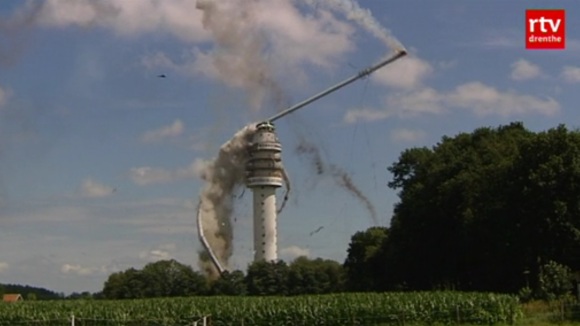
I‘ve been busy to set up to 84m horizontal loop again today. The XYL was not too happy with this. First it is a ugly thing in her garden and second we are still busy to finalize building the new bathroom and I should have spend time for that too. But then, the PA-beker contest is only this weekend, the bathroom is still there next week. It’s always a struggle to divide time between so many things especially when you got a hobby. Well, I always thought the militairy glasfiber mastparts I have to build the supporting poles of the loop antenne would be unbreakable. But the first mast snapped when I tried to get it up. Anyway, I got some spares and the next one did hold it. The loop is up again. Now, a test on 80m didn’t work out, I called several times but no one replied. I heard PA0PSA and YT2SS calling but they didn’t hear me. So I switched to 40m, a few calls to 9A6DX and we had a nice chat. Report 5/5 with 5W into the loop is not that bad. A quick modulation report guide me to another setting of the Turner +3B mike I now have connected to the Yaesu. I hope I’m ready for tomorrows PA-beker contest.
N1MM logger issues with the FT817
 |
| N1MM on the right VFO B… |
Well I decided to use N1MM for the upcoming PA-beker contest event. So first thing of all the preparations I have to do before I’m ready is to connect the FT817 to N1MM. That is done by the famous ZLP modem I described earlier in my blog. The problem only is that my laptop assigned the modem to virtual COM port 11. First problem, N1MM only knows 8 COM port assignments. Luckely someone had encountered that problem before and to solve this you only have to follow the N1MM help document on this subject. Once it was solved I had the FT817 communicating with N1MM. Next problem is that N1MM only reads VFO A, VFO B shows 0,00 MHz even when I switch to VFO B this does not change. I asked for a solution in some internet forums and discussed the problem with PE2KM who has a FT817 as well. Kees tried the same set up with his radio and has exactly the same issue I have. Now I’m in contact with one of the programmers I think on the N1MMlogger yahoogroup to see if we can solve this problem as apparently Ham Radio DeLuxe does read both VFOs and I can switch between them.
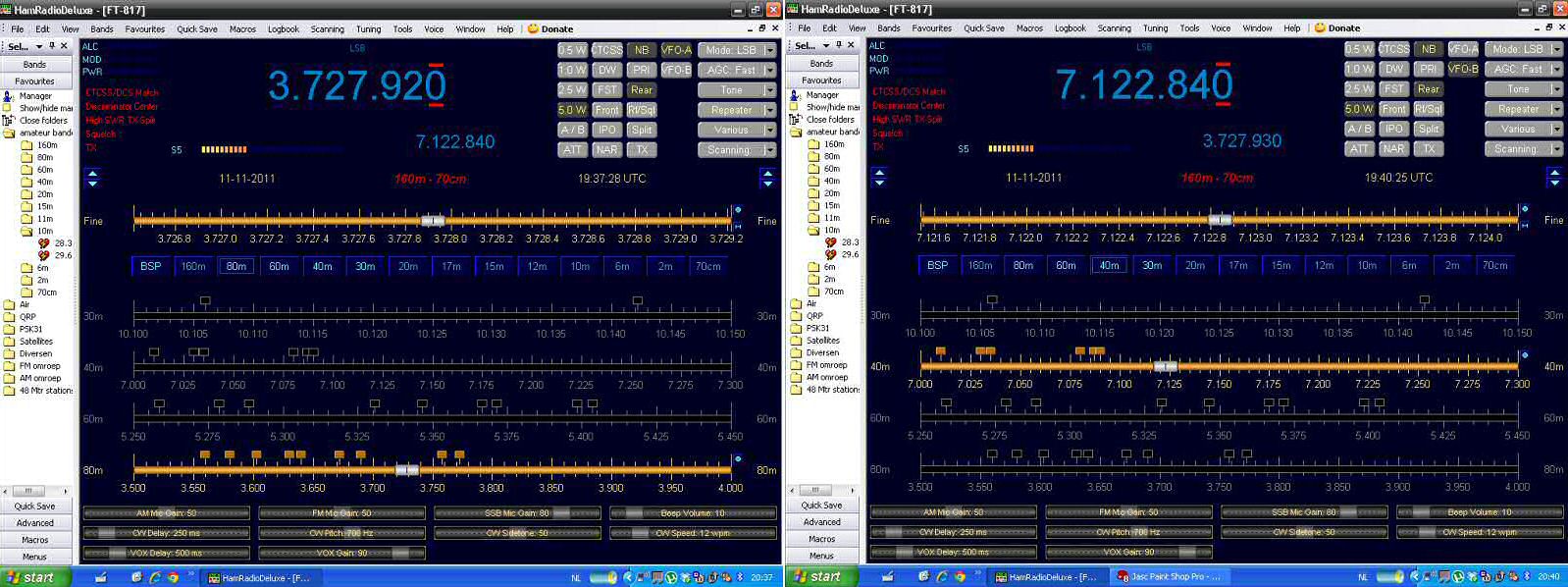 |
| HRD left VFO A, right switched to VFO B |
Toothbrushes and amateur radio
 So, after successfully fixing my TS-440S did I enjoy operating it? Not a lot – I’ll write about this later – but today very much so.
I had to come home early because our water supply was cut-off for maintenance on Sunday and it hadn’t been restored on Monday morning. Well, it had in the mean time, so I did a day’s worth of dishes and turned on the radio afterwards to relax a bit. Found some guys talking on 20 meters, so I listened in. It was a VK4 station with a V63 station talking about antenna’s for the school station. The conversation turned to how John – the V63 operator – was teaching the kids, how he brought over toothbrushes and taught the kids how to brush and how ham radio opened their world.
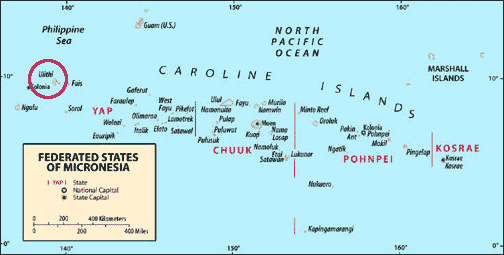
Now I am not really a fanatic ham and I had no idea where V63 is. So when a chance came up I called in and John – V63JB, his home call is KH6DLK – came back. I told him we had the same profession and asked him about his location, which he told me is Federai Island, Ulithi Atoll in the Western Caroline Islands, never activated on the amateur bands before. Wow, impressive. But I was really touched when he put one of his students on air to chat with an operator-friend from Hawaii a little later. This is amateur radio at its best: opening up the world and connecting people with each other.
Later a PY station called in and I believe there was also a States-side station present in the group (signal strengths weren’t great and readability difficult at times), so it was quite a diverse group from half across the globe meeting on 20 meters this afternoon. I didn’t have the chance to say goodbye to John, but I hope we’ll meet again and I hope he gets his station over there in Ulithi Atoll well established for his students to enjoy. In the mean time I’m contemplating sending him some toothpaste.













