Archive for the ‘Uncategorized’ Category
 WD40
WD40
 February 12th, 2012 |
  Author:
 Two days ago we still had 10 degrees Celsius and rain. Sunday saw 24 degrees and sun. So what better to do than cleaning the Spiderbeam pole. WD40 sure made it shine again.

PACC 2012 preparations
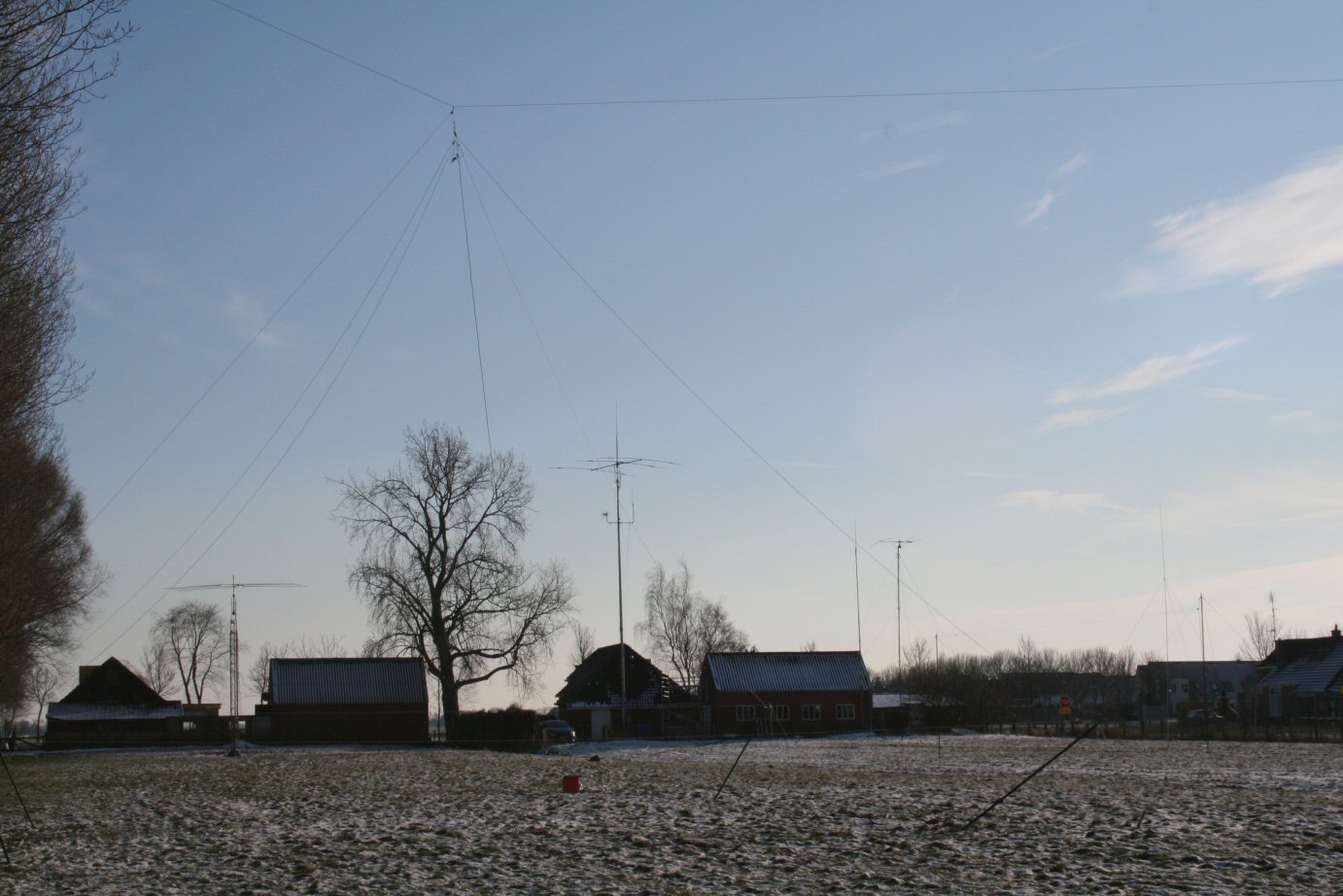 |
| PI4H contest QTH with pyramid 80m antenna on the foreground |
Well, I didn’t have much time to prepare for the PACC this year. A cold period is always a busy time at the job here. Besides that my mother-in-law had a computer that would not do what it should do. I’ve been busy with that too and it resulted in buying a new computer at the end. Probabely another case of a failing motherboard, a waste of time to fix it. I wish I had some time to work HK0NA on other bands, but it didn’t happen. I hope to check if everything is working and set-up the laptop with the latest version of N1MM at Saturday morning. Then I just go for it starting at 10m but not wasting time like last year if propagation is not good enough. I will participate in the low power single operator SSB section like last year, that’s max. 100W. The propagation doesn’t look good with low sunspots and a high A index, but it doesn’t matter as I am at my best then. I don’t have a good 10m antenna and with good propagation that would be a disadvantage. Last year most of my QSO’s were made on 40m and 80m although you need the higher bands for multipliers. Looking at my log from last year I made 552 QSOs with 122 Multipliers, that’s the score before correction. Most multipliers were made on 80m, 40m and 20m. So with bad propagation that will be the bands concentrating on. I had the opportunity to visit the PI4H contest QTH and made some pictures like last year. The guys were really enthousiastic and did made some improvement on the antennas for the contest. The only problem is that the rotor for the 10m beam doesn’t turn as it is probabely frozen. But overall I think they will improve their contest score of last year. Only 14 hours to go for the PACC start.
Should have known better!
Next week a new semester is starting. They gave me more hours to teach, which means more income, but less time to spend on fun things. So I really wanted to finish another project and this week was just the time to do it: an audio filter. In my younger years one of the few kits I build was an notch/bandpass filter. Later I bought the Datong FL-2 and FL-3 filters I always thought it was a must to have one. Ever since I became a ham I thought about building one, but surprisingly there are not many design to be found on the interwebs. Elecraft sells a kit called the AF-1 and they were nice enough to put the schematics on their site. So I gathered the parts and put quite some hours of work in building it according to my own lay-out. The result……

It worked….sort of. But not as advertised on YouTube. I should have known better, so I cleaned up my desk and started anew. Neat and tidy this time and in modules. First up, the power section. Now, how about this?

That’s the way I like it. It worked first time, delivering 12 and 6 Volts. But I’m afraid this is going to be another long term project. Stay tuned.
By the way, after only 41 days I already achieved 25% in the FISTS 25th anniversary Prefix award. The goal is to make 25 CW contacts for each prefix number. Funny to see which number is most issued and thus easiest to score. “7 is up front with 11 entries, closely followed by number 3 with a very respectable 10 entries.” I really have to start looking out for more number six stations. If you have a 6 in your prefix then don’t forget to call me, please.

A little help
I’m just about old enough to remember to tie up my shoelaces in the morning (Although its taken me 2 days to remember that I broke my shoelace and as yet haven’t remembered to open the drawer and replace it with the one I knew I bought a while ago). So I can remember that its quite easy to ‘Just upload your photo’s’ to this site or ‘just back up every 10 minutes’ or other mundane tasks that your computer should do for you without even questioning it. In fact it should almost be law that stuff is backed up as soon as you put it on your PC without having to ‘Just set this or that up’.
Where am I going with this?
The answer is recently I found If this then that (ifttt) and have used it to do simple tasks like cross posting and other little tasks on web based systems that it current supports.
Another one I found is Dropbox automator which like the name suggests does stuff to folders and files in you Dropbox folder as soon as you put them in. A pretty handy tool for when, like me you need to re-size photos for putting in this blog, uploading documents to Google Docs and other little boring jobs.
Hope you get some use out of these services like me, now where’s that shoelace before I forget
HamCation 2012
Are you planning to attend HamCation 2012 this weekend in Orlando, Florida?
Before you go, download this handy printable guide provided by the HamCation folks (shown below). Looks like it’s going to be a lot of fun. Cross your fingers that the weather holds out, but it’s bound to be better than our weather here in New England this time of year!
Don’t forget to visit our friend Ed Griffin from Wouxun.us. He called this morning and said he’s going to be set up by the RV entrance and tells me that he’s got some great new versions of the popular Wouxun HT, the KG-UV6D-IC1 ($140) and KG-UV6D-IC2 ($150).
Ed said that as a bonus, if you stop by his booth and mention you saw this post on AmateurRadio.com, he’ll give you $5.00 off the purchase of a Wouxun radio. Save yourself the cost of shipping and get an extra $5.00 off a great radio at HamCation this weekend.
And no, Ed didn’t pay me to say this or send me a free radio… I paid full price for mine like everyone else 🙂
When in Rome…
Over the Chinese New Year’s holiday I managed to start and (almost) finish a project I have been brooding over for months: a Cobweb antenna. Lightweight, small, multi-band, no tuning needed, in one-word “ideal.” There was a very interesting thread over at QRZ.com about building one and I read all the other literature I could find on the subject. I finally settled for the alternative design by G3TXQ using single wire dipoles which would be easier to tune, but required a balun for impedance transformation.
I’m still on a very tight budget, so the antenna had to be build on the cheap. That means thinking outside the box and starting with taking a good look around you. Fishing rods are expensive here. The cheapest I could find were almost 400 NT dollars per piece. But hey, we’re in Asia: bamboo is cheap, but it is also strong and lightweight. So I spend 200 NT dollars (5 euro’s or 7.50 USD) on bamboo instead of 2000 NT on fishing rods. Aluminium is hard to get in Taiwan, because people find it too soft. Stainless steel is widely used, so the local iron monger cut me two pieces for a little less than 200 NT dollars. U-bolts were also cheap at the local hardware store. Twin lead costed me 400 NT dollars for 50 meters and after two days of work it all looked like this….

The G3TXQ version requires a 1:4 balun to bring up the impedance to 50 ohms, as square folded dipoles have an impedance of 12 ohms (which every one knows, right?). The ferrite of choice is the Amidon FT140-61, but ferrite is not easy to get in Taiwan. Over in Taipei there is a little shop called RF-Parts, run by Mr. Dong, so I went to see what he got. He only had the FT-114-61, so that would mean two stacked together and that twice. Suddenly the Cobweb started to get expensive, because when I left Mr. Dong my wallet was NT$720 lighter. Add another 160 NT dollars for two meters of RG316 coax and the cost of the balun gets close to NT$1000, That’s almost more than the rest of the materials for the antenna together! But the final result looks like this….

After Chinese New Year we had two days of mild weather. Great for pruning the antenna on the balcony. Centimeter by centimeter I started cutting the wires until I had the SWR 1:1 on the frequency I wanted. The five dipoles influence each other, so it was going back and forth from 20 to 10 meters, measuring and cutting. The balcony was full of little pieces of wire afterwards, which refused to be swept up, so they were picked up by hand. But after two days the job was finally done and I could start enjoying my new creation.

NOT! Where are those sun spots when you need them? The bands were pretty empty and my first QSO was with 4W0VB in East Timor on 30 meters, at night. I know, that is not one of the band the Cobweb covers, but the TS-440S build-in tuner did it’s job well. And then it started to rain and I started to cry. Because the rain caused my carefully tuned 1:1 SWR to wander off two to 300 kHz below the resonant frequency that I tuned it for. Again, the TS-440S tuner could manage that, but why? Why does a little bit of rain de-tune my new baby? I don’t want to use a tuner. That’s not why I build the Cobweb.
I did manage to work some nice stations during the last week though: C31HA twice, 4W0VB twice more, XW3DT, PY6HD, CX3TQ and N7DR who mailed me to say I need to be patient, because conditions are indeed pretty lousy. I put up the CB whip to compare signal quality and indeed the Cobweb is quieter than a vertical. Signals are also a bit weaker, but only by one or two S-points.
So, am I happy now? No, because after the rain the wind started to play games. Longtan is not Port Martin, but it comes close. Winds howling all day long and gusts that make you and the house shiver. Longtan is situated on a plateau about 300 meters ASL and the area is known for wind and moisture. The Cobweb is light and strong, but the wires on my version were sweeping and swaying so much that SWR was not stable for a second. And the sectioned fiber glass pole that the Cobweb is mounted on was turning too much and the coax curled around it.
I need to start thinking about a sturdier construction. I saw some springs in a hardware store and I’m thinking about using them to keep the dipoles tight. That is the easy part, but I also need to figure out why moisture is influencing the SWR so much. Could it be the bamboo? Or is it the heavy reinforcement in the house?
I’ll keep the antenna up for another couple of days and then put the 10 meter vertical back up again. I miss roaming the upper bands at night and I want to keep my CW streak going. But a fun project it was and I learned a lot from it. And that’s what it’s all about, not?
Snap Circuits SC-300 on sale for $30

OK, I know…. This isn’t a steals and deals kind of blog, but I wanted to share with you a great promotion Amazon is running on the Elenco Snap Circuits SC-300.
I paid over $60 when I bought one for my kids a year ago and it’s on sale right now at Amazon for just over $30 with free shipping. If you have kids or grandkids who are interested in electronics and science experimentation, this kit can’t be beat. Do a little early Christmas or birthday present shopping and get them something they’ll really enjoy — and learn something from, too! You’ll be truly amazed at the projects they can create with this kit.

OK, here’s the best part! If you buy it through this link, you’ll be helping to support one of my favorite podcasts, Jerry Taylor’s Practical Amateur Radio Podcast. Jerry does a tremendous job and there are many costs associated with creating and distributing a podcast. Buy a fantastic product (the Snap Circuits SC-300) for a special youngster and support a great cause (KD0BIK’s Practical Amateur Radio Podcast). It doesn’t cost you anything to use the link, but he’ll make a dollar or so to help support his podcasting efforts. Win-win!
And lastly, being from New England… GO PATS!













