Archive for the ‘qrp’ Category
 The solar news is on the up swing……..
 April 7th, 2013 |
  Author:
Today I am at it again but so far no luck, I have been finding stations such as F7HKA, HB9TN and IK5ZWU all on 24 mhz but no luck in contacting them. I start out calling them at 1 watt and move my way up to 5 watts. I have not been able to hit the 5 watt level as they seem to fade into the noise level before then. The day is still young and opportunity awaits me on the bands.
VE3WDM's QRPower BLOG 2013-04-02 19:16:00
 |
| CT8/PA4N |
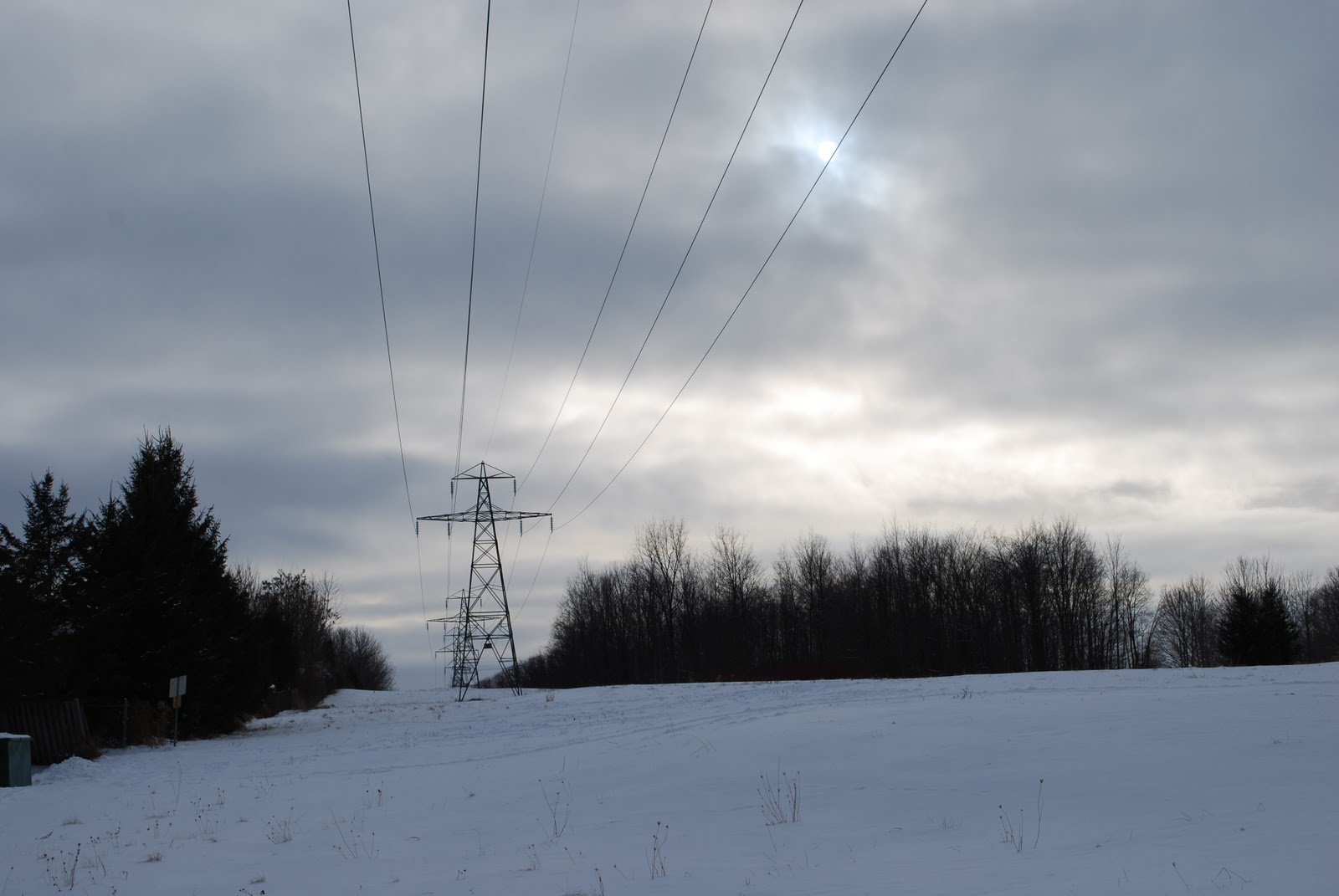 |
| 230KV lines out back |
5 Foot Diameter Magnetic Loop Antenna

A bonus picture here. The one on the left is a 3 foot in diameter loop.
Note: The little box at the bottom of the small one contains an air variable capacitor for tuning.
Compare it to the 5 foot in diameter loop on the right. ‘

5 Foot Mag Loop
I made a QRP CW contact with this mag loop from right where it stands in my drive way.
 Small Loop Feeds the Big One

Home Made Capacitor Clamps.
Home made cap clamps. The clamps are soldered to keep the contact resistance low.
This is very important with High Q antennas.

5 to 150 Pfd capacitor
Russian capacitor. It is available at E-Bay for about $150

Easy to Make PVC Pipe Stand
Where would hams be without PVC pipe!
This stand is made from 2 1/2 inch sewer pipe.
This is a fun antenna to build and use. I made my first contact with W9GY this afternoon on 20 meters. I used 5 watts, he used 10. RST out was 459, RST in was 579. The antenna was in my drive way in front of the garage that you see here. And Jeff was in Indiana. What a hoot! Making contacts on a home made antenna is great fun. The parts are readily available and with a little planning and shop time you can have a Magnetic Loop antenna to play with.
This is my second Mag Loop. The first one is 3 feet in diameter and covers from 20 through 15 meters. I’m planning another for 17 meters through 10 meters. Mag Loop calculator is available at http://aa5tb.com/index.html
Yahoo has Mag Loop groups that are very helpful to get you started. http://groups.yahoo.com/group/MagLoop/
and http://groups.yahoo.com/group/MagneticLoopAntenna/
Copper foil or strapping is available at http://stormgrounding.electrical-insulators-and-copper-ground-bars.com/copper-foil-2.html
If you’d like more information about Mag Loops, please feel free to contact me. [email protected]
73 De AA1IK
Ernest Gregoire
Who says it can’t be done?
I always like reading about what can be achieved using a stealth antenna system, so I always enjoy reading the blog of John, N8ZYA.
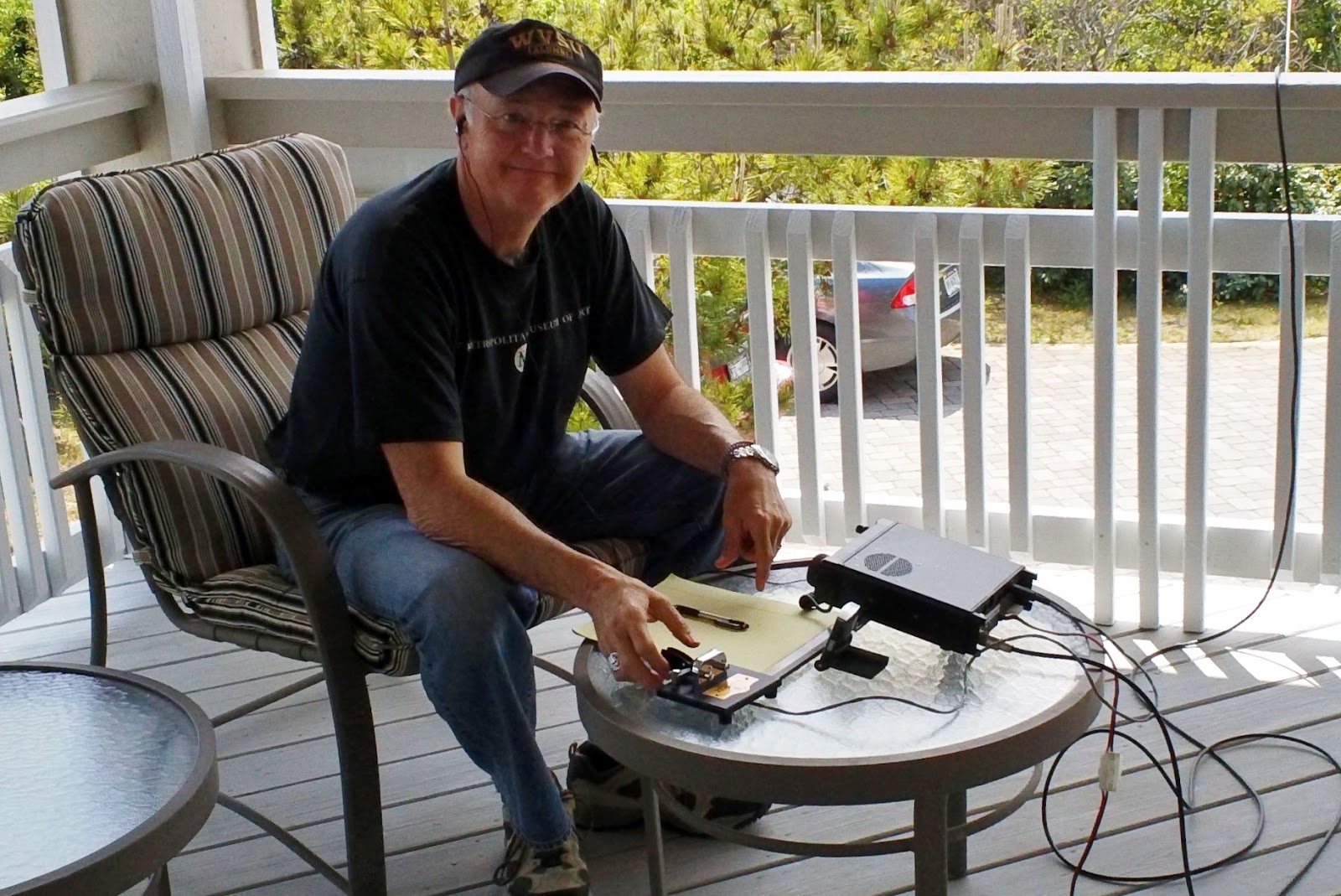
From a town house in Charleston, West Virginia using 3 watts of CW to an indoor random wire, John has made 1,830 contacts including 361 DX stations in 73 different countries. Simply amazing!
I hope you don’t mind me pinching your picture, John!
Too close for CW comfort

So why did I title this post "To close for CW comfort" this has to do with the other CW "events" that I was exposed to! I have read about this in other blogs from other op's which are CW operators who seem for some reason to blend letters together regarding their call. I had at least 6 op's who's call I had a very very hard time making out. There was one DX station who's call ended in WVR BUT for the longest time I was not sure if it was W##, even the code reader on the KX3 was having a real hard time. I then ran across 10+ on the S meter European station but I could not give him a call as I had (and I mean NO CLUE) what his call was!! It was very hard to tell were the CQ stopped and the call was being sent. Now folks for any of you reading my blog and who also have had a CW QSO with me I know my code elegance has left you scratching your head at times.....but I just can't understand how code that has no spaces and just runs as one long word how these op's ever get answers to their CQ requests.
When I got home I put my Elecraft k3 into test mode (meaning no code is sent over the air) and tried to send some sloppy code and watched to see if the K3 was able to decode. (you can setup the K3 to not only show incoming code but also your code as you send it) The only reading the K3 would give me were not letters or numbers just lots of *****......translation...the K3 also has no idea. As with most CW op's out there you also have your code being sent to you through your headphones. Does the code not sound odd to these op's???
Anyway time to get off my soapbox now.............
1 Volt/2 Volt Transceivers
Transceivers with a power supply of 1 and 2 Volts, how much can one achieve with that? Well, actually quite a lot according to DL2AVH, Helmut, who together with DL4ALJ, Gero, wrote two articles about that in the German QRP-Report in 2011. I am impressed by the output power, up to 200 mW with one battery cell (1.5 Volts) and 0.5 Watts with two cells.
I wrote about this in April last year where I also mentioned that the 1 Volt design from 2000 later had been corrected. Those corrections can be found in the article in QRP-Report 3/2011: “Niederspannungs-Schaltungtechnik – der 1-V- und der 2-V-transceiver” (Low voltage circuit technology – the 1 Volt and the 2 Volt transceivers). The improvements are concerned with better input filtering at 14 MHz with a quartz crystal in the front-end filter and better efficiency in the mixer and removal of an audio stage in the direct conversion receiver. This design only uses bipolar transistors and no ICs.
This is different in the newer 2 or 3 Volt transceiver for 7 MHz. Here an impressive figure of only 5 mA power consumption for the receiver is achieved. The transmitter consumes about 250 mA. Several MC1496P balanced modulator/demodulator ICs are used for the mixers in the transmitter and the superhet receiver, and for the product detector of the receiver. They seem to run quite comfortably on only 1.8 Volts as supplied by a low-droput regulator from the battery supply. The TDA7050 is used for the audio output stage. This is a low voltage audio amplifier for headphones which can operate with a supply voltage down to 1.6 V.
The design is said to benefit from low voltage technology of mobile phones. This is the case for circuitry like that of the output stage of the transmitter which consists of a pair of BFG21W transistors. However, both of the ICs have been around for many years.
I think this was a very inspiring read, and the final comment about power consumption from the second article is interesting. They say that with two AA-batteries, the receiver will last for 285 hours, which is the same as 70 days of listening of 4 hours per day. With transmission for 10% of the time, the set of batteries will last for 4 weeks!
- Related post: Whatever happened to the 1 Volt QRP Transceivers?
Something good is going on!!!
 |
| The view at CT9/OM3RM.. |
 |
| C6APG setup |













