Archive for the ‘qrp’ Category

I have started to slow down in the CQ WW CW contest

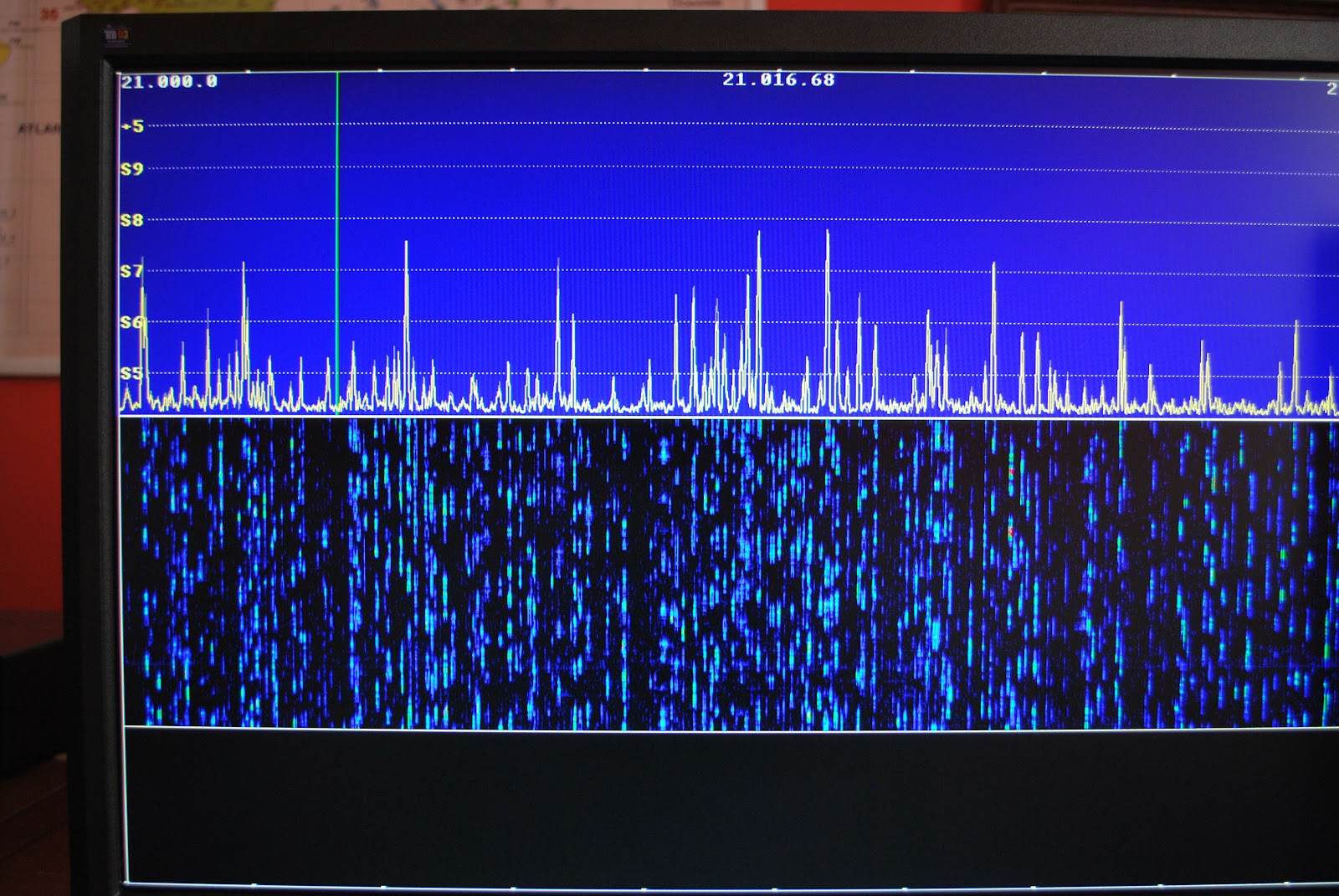
The action on 15m this morning
I am now in day two of the contest seeing I did not turn the radio on Friday night due to spending time with Julie and the first evening I find things to be a zoo and hard to make a contact as QRP. Saturday was just great with lots of action on 10m, 15m and 20m. I was wanting to give 40m and 80m a go but I had to go into work for an all nighter. I did have high hopes of getting more DXCC's added to my ARRL diamond award......but you know what they say "dreams are free" up to this point I have rounded up about 2 new DXCC's. There could have been more but the pileups were out of this world. I did try but was not able to break the pileups. Some highlights up to this point are C5A in Gambia, KH6, T40C Cuba to mention a few. I have heard some very rare DX and some popular DXpeditions but the pileups as I said have been HUGE!!! It's Sunday afternoon here and with working all night I am starting to drift off at times...........but I am going to see how far I can go!!!
Contest on......well easier said than done...

A WSPR in your ear.


Like many of us, I am still amazed by the amount of radio spectrum we have to freely play with. Shots are being fired and eyes are being gouged by companies for small slices of precious bandwidth. Multiply our many electric playgrounds by the number of games (or modes) available and the permutations are enough to overload your front end.

I’ve decided to catch up with WSPR, a mode well known to many but new to me. I’m going to give it a go – the difficult way. Julian, G4ILO has an excellent article on the system here.

WSPR stands for Weak Signal Propagation Reporting and is a computer programme that runs your VHF/HF transceiver automatically in order to receive others running the same system. Successful contacts, one or two-way, are reported automatically to a website. It’s like having a worldwide net of propagation beacons for every band available at your fingertips and the results appear quickly after automatic contact confirmation. What a great thing to leave your equipment running overnight or during the day when you’re otherwise occupied!
Screenshot of WSPR.net Map Page

The best thing is that WSPR works below the noise threshold and you can use very low power. I was staggered the other day to see that Tim, G4VXE had hit Australia on 40m with just 1W! One Watt! So I’m going to give it a go with 1W and just an indoor Miracle Whip antenna. I know many QRP CW experts may cracked this one before – but I’m new and excited. I’ll try 40m and work my way up to 2m and see what happens!

I’ll use my FT-817. A CAT lead arrived this week from Hong Kong but it seems I’ll also need an audio interface between the transceiver packet port and computer sound card to make it all work. Another option is to buy an external interface that has a sound card and interfaces to the computer with a USB. It’s not quite going to be a ‘plug and play’ job, I’m afraid to report.

In the meantime, I’ll be satisfying myself to regular chats on 2m with nearby stations on FM, SSB and even DV mode. So many ways of talking – and that’s just on 2m. I'll 'whisper' my progress here as soon as I'm up and running.

Does the early bird get the DX…it’s said he gets the worm.

Last Friday we had a "situation" at work that had me working until about 3 a.m. and when I got home I was still all pumped from work and was not ready to jump into bed. The thought came to me about getting on the radio and seeing what DX pileups were out there. I had heard of folks getting on in the wee hours of the morning and catching some rare DX. With great expectations  I turned the radio on....10m dead, 15m dead, 17 and 30 same thing!! Alas on 40m my Elecraft P3 showed some faint signals, I spun the dial to the frequency only to find it was some very weak State side stations. Not that there is anything wrong with that but it's kinda a let down when one is anticipating WILD DX!!!

I did not check the propagation that morning so there could had been a storm brewing or maybe everyone but me was in bed sleeping. As I have blogged about in the past I am trying to get my ARRL Diamond Challenge award (and doing it QRP) at this point I am at 81 DXCC contacts. You only have one year to accomplish this goal and it's now almost December!!!  Having said that I am "really" at 95 DXCC's for 2012 according to Club log. The catch is the ARRL for the Diamond award is not counting ALL DXCC on the list. It is a long story but it's just how the ARRL perculates. I was hoping to bring my K2 or my newly acquired KX3 to work as I was wanting to get some operating time in before work. I am usually in around 5:30 in the morning and I have until 7 to make some contacts. With my Saturday mornings performance I am not to sure if bringing  the rig would be a waste of time.....any ideas out there???

How do you sell an Elecraft K2

My first K2 serial 6613
This week I posted a question on the Elecraft reflector "I'm building a bare bones Elecraft K2 radio and later will be putting it up for sale what kind of options would a buyer be looking for?" I had received many replies and all were very good but also got me thinking. I had always thought of the K2 as a CW radio (selfish me as I am a CW op) but one of the first suggestions was to make the radio both CW and SSB friendly by adding the SSB option. To me that should had a been a no brainier as that opens the market much wider to more potential buyers. I was then also reminded of the invaluable add on that I put in my K2 radio (which is still in my shack and goes out on park and car expeditions) the rework eliminators by unpcbs. These folks have
developed a kit that allows the K2 to be setup and ready for any add on you want to put in the K2. Let me clear the waters a bit......if you build a bare bones K2 with no options but later you want to add some options,  it my require you to  remove some components from the K2 in order to add the option.
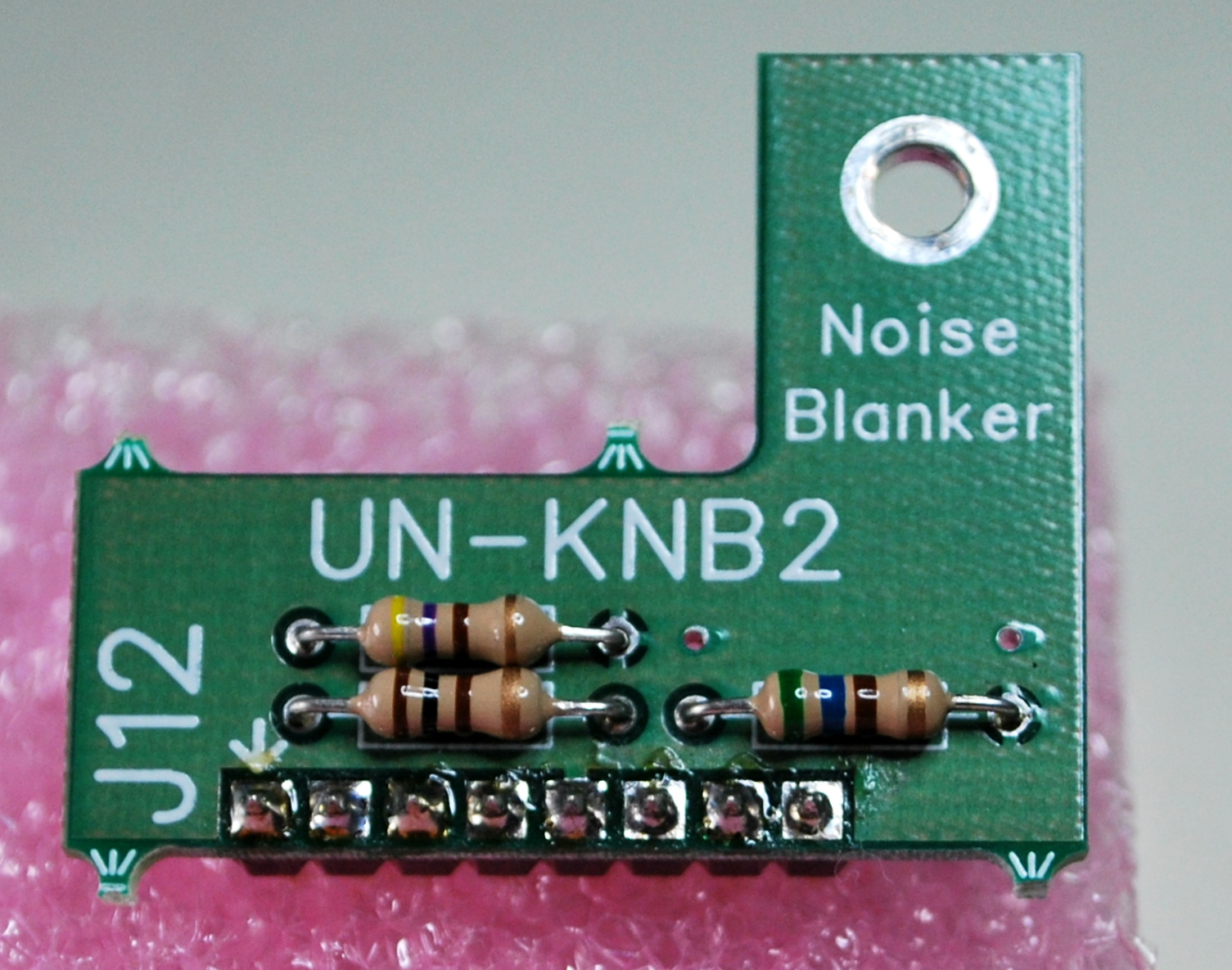
NB rework board top view
With the unpcb kit  there is no de-soldering on the K2. In a nut shell you unplug the unpcb board and plug in the K2 option. There is another great advantage to this, if you think you have a defective DSP filter (or any other option) board you simply unplug the DSP filter and plug in the unpcb board and see if the problem is fixed. Its time for me get off my soapbox for the unpcbs folks.......but if you ever are thinking about an Elecraft K2 build this add-on is well than worth the money!!! I just have to jump on the soap box  for a short time again.....On the top of the noise blanker rework board you see some resistors. These resistor (or other components) would normally be on the K2 board and have to be de-soldered to instal the NB board option from Elecraft. With the rework board you unplug the rework board and plug in the NB board. If there ever is a problem with the noise blanker (or any other option the rework kit looks after) you unplug it and plug in the rework board. You K2 will now work but without the NB option. Without the rework board you would have to re-solder in the components you removed for the rig to function properly.

From the post I received great suggestions on options that should be added while building the kit. The one idea I am leaning toward is to just leave the radio "option free" and
NB rework bottom view showing header
when the kit is done ask potential buyers what they want in the rig. So it becomes a radio that is "made to order" The buyer will pay for the options they want and a small fee for assembly, setup and installation but in the end they will have a radio that is customized to their radio needs. It's the way I have always wanted a car purchase to be!! At this point the kit is going through the parts inventory. 

Elecraft KX3 part 3 youtube assembly video

Well the KX3 is almost completed and this is the 3rd of a 4 part assembly video of the radio. In this YouTube video I go over the problems I had with the ATU installation, the roofing filter board issue and the battery holder oops I had and needed to correct before there was damage. The build is almost complete but have a look and either get excited about purchasing one or pick up some pointers before you do  your build.


New KD1JV ultralight rig for 80/160

There’s been a higher than usual level of activity on the AT-Sprint email list over the last few days as  hints have emerged of a possible new offering of the popular MTR (Mountain Topper Radio) the latest of Steve Weber KD1JV’s radios that define the possibilities of ‘trail friendly’. To get a view of one in action check out this video from G4ISJ shot on a SOTA activation.

Steve KD1JV's popular MTR 'a very small, very efficient, two band rig'

Steve KD1JV’s popular MTR ‘a very small, very efficient, two band rig’ is set for another future offering

Steve KD1JV is the designer behind the PFR-3 and a number of other radios offered by Doug Hendricks’ QRP Kits along with the new Tri-bander Transceiver kit. But he also enjoys a passionate following for his high performance but tiny (Altoids tin size) radios in the ATS series where ATS stands for Appalachian Trail Sprint. These radios (especially the ATS-3B and the MTR) are prized by ham hikers and walkers who watch the ounces and milliamps. They are also an example of masterful interface design using small push buttons and minimal LED display. As Steve mentioned recently in a post reflecting his deep field operating experience “Little tiny rigs and knobs don’t work well together”.

During the buzz earlier today about whether he would offer more of the MTR kits (he will), Steve also announced his latest project “An 80/160 dual band rig with direct conversion receiver and a DDS/PLL hybrid VFO using all through hole parts.” (The ATS series made extensive use of microscopic SMD components and lots of the assistance Steve offers via the AT Sprint Yahoo group is concerned with discovering and rectifying makers’ errors assembling these devices.)

His website carries a pretty detailed three-page description of the design thinking behind the new rig which he’s calling the Super Deluxe Direct Conversion Transceiver. Tantalisingly he’s suggested it may be able to work at 500kHz. The new rig also features an “LCD frequency read out, built-in keyer and rotary tuning”.

He’s planning to offer only 50 kits at about US$75 at the end of November. Expect to see them sell out in two minutes! I suspect if he offered 200, they might last an hour or two.

A good QRP site

Michel F6FEO sent me a link to his website. Many projects of QRP interest will be found there. The site is in French but Michel has provided Translate links for each of the articles. Definitely worth a visit.



Subscribe FREE to AmateurRadio.com's
Amateur Radio Newsletter

 
We never share your e-mail address.


Do you like to write?
Interesting project to share?
Helpful tips and ideas for other hams?

Submit an article and we will review it for publication on AmateurRadio.com!

Have a ham radio product or service?
Consider advertising on our site.

Are you a reporter covering ham radio?
Find ham radio experts for your story.

How to Set Up a Ham Radio Blog
Get started in less than 15 minutes!


  • Matt W1MST, Managing Editor