Archive for the ‘qrp’ Category
 Band conditions were great….if I was a SWL!!!!!
 October 18th, 2012 |
  Author:
 I would not advise this while driving but he did make the contact!!
I gave it a go and there was Chris loud and clear!! He was operating split and with my dual receivers in the K3 I was able to hear both sides of the adventure. It was great the band was not at all as busy as with 3B9SP so I gave him a go...and a go......and a go......until in the wink of an eye he was gone just replaced with static. Well that was my Thursday evening of ham radio. I will say I did have a blast and did miss getting on the radio.

Cracking the Whip….
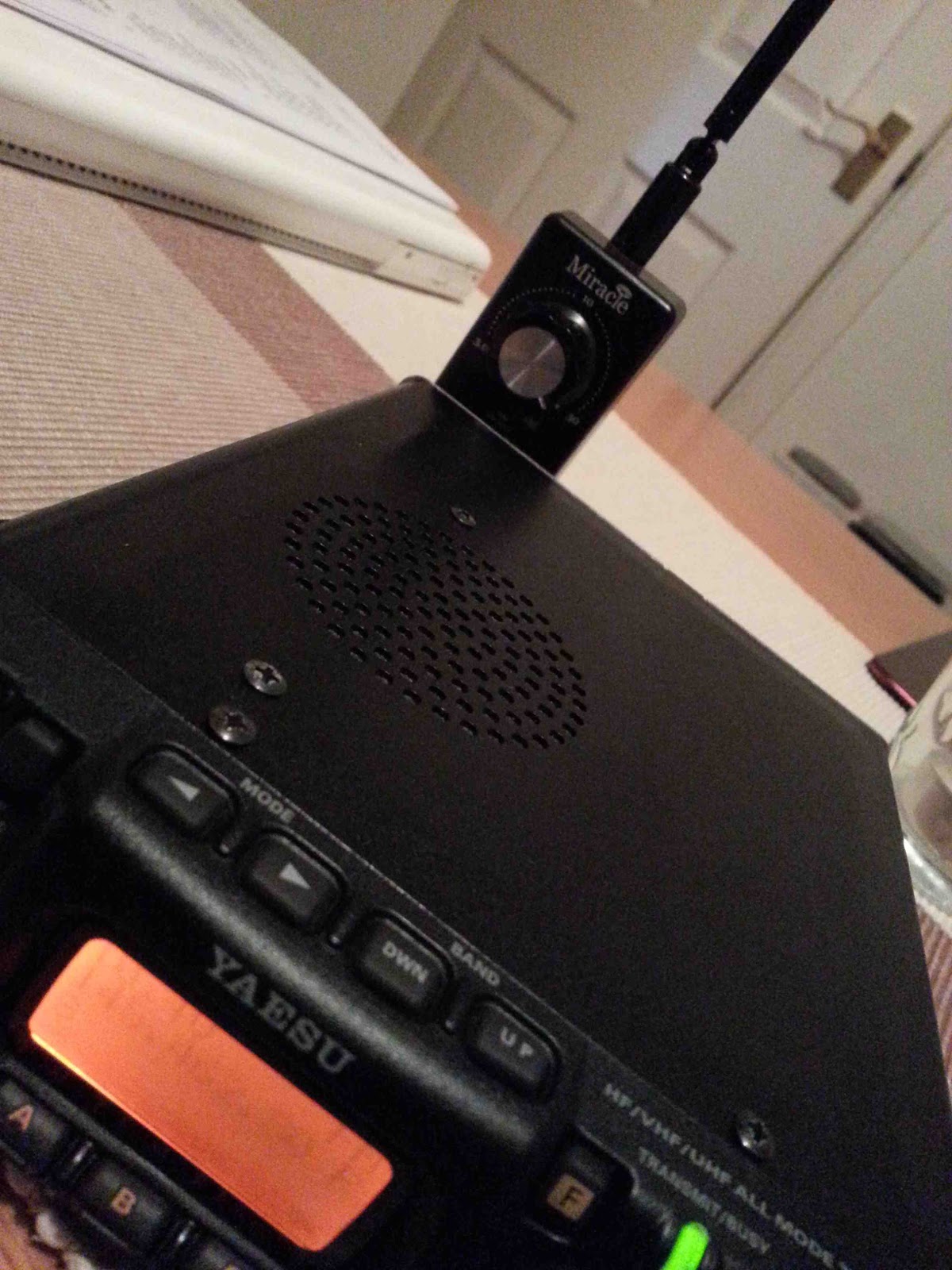 |
| The '817 and Miracle Whip |
 |
| Connect. Extend. Tune. |

What is QRP?
Over on the Elecraft KX3 Yahoo group an argument has been raging as to whether running low power into a tower-mounted beam is QRP. Some folk feel that QRP also means using simple no-gain wire antennas. Others argue strongly that using an antenna with gain is a perfectly valid way to do more with less, that “less” relates to power and nothing else.
On his QRP – Do more with less blog, Larry W2LJ nails his colours (colors?) firmly to the mast. Saying those who use towers and beams aren’t QRP is baloney, claims Larry.
Personally, I think QRP is whatever the ARRL, G-QRP Club, QRPARCI or CQ Contest committee says it is. If you are competing in one of their contests or applying for one of their awards you must follow their rules. And the only limitation they specify for the QRP category is power level. So I don’t think it is possible to win an argument that QRP includes any other restriction besides low power. But I can understand why some people feel that those who have a lot of aluminium in the air have an advantage over those who only use a piece of wire and that lumping them into the same category is unfair.
To really put the cat among the pigeons does the spirit of QRP include the use of store-bought or kit-built equipment too? I certainly feel that the art of QRP is strongly allied to the practise of home-brew, but I still claim to be QRP when operating my FT-817, KX3 or K2. Should the ham who operates an Elecraft KX3 belong in the same class as one who uses a two-transistor Pixie?
Perhaps we need a new term to define this kind of minimalist operation?

QRP Web Ring
For more years than I care to remember my website G4ILO’s Shack has been a member of the QRP Web Ring. Web rings are a tool dating from long before search engines came on the scene and were set up to help web surfers locate sites of similar interest.
In order to be a member of the QRP Web Ring I include some links to other web ring sites on my home page, plus a banner.

Clicking some of the web ring links from G4ILO’s Shack and other linked sites today I found that many of the links were broken and most of the rest were pages of extremely poor quality. So I am considering removing the QRP Web Ring code from my site.
Whether you still use the QRP Web Ring to find other QRP-related sites, or if you have never used it and have no intention of using it now that you know about it, I would appreciate your comments.

The Elecraft KX3 has a pulse……..
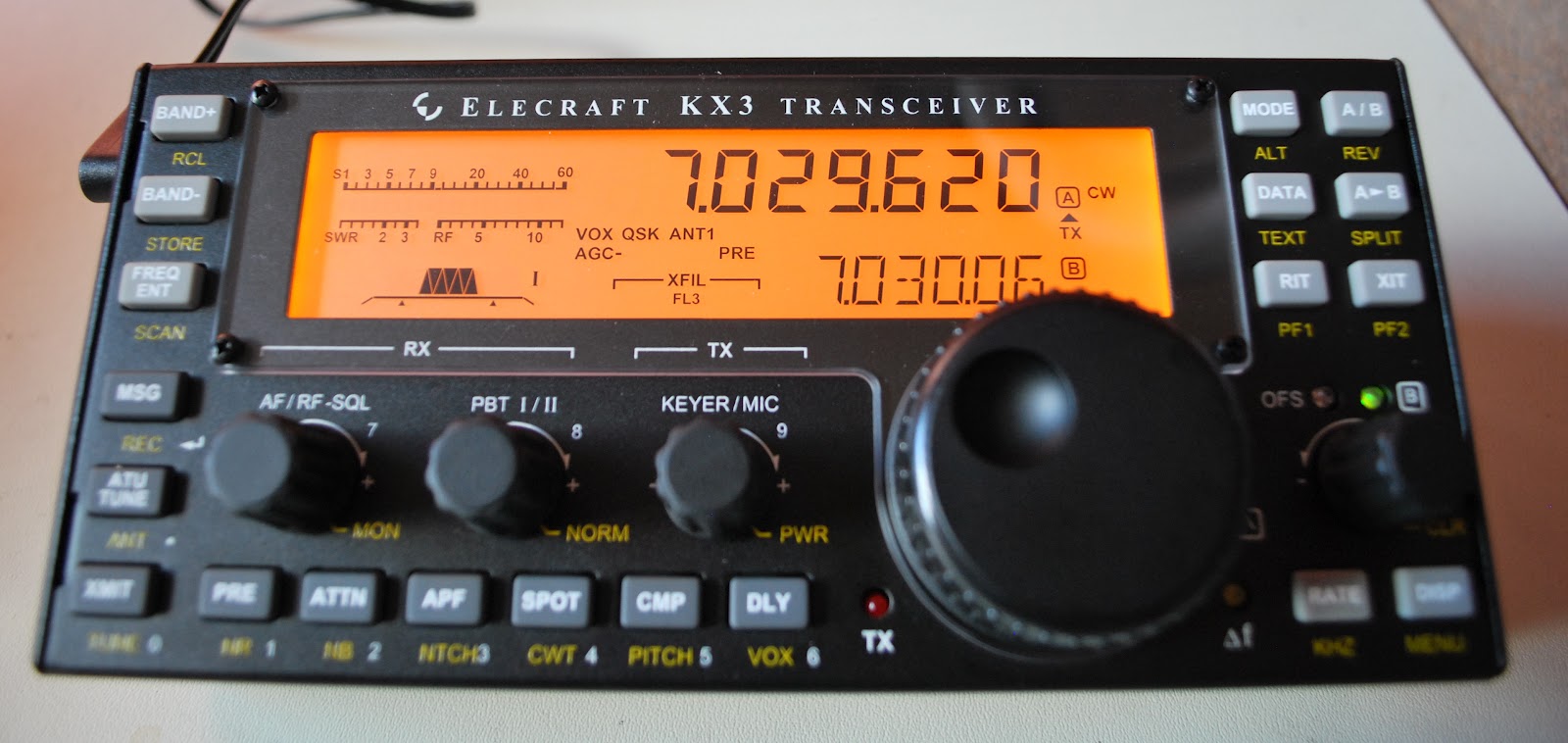 |
| KX3 serial number 1990 |
WWVBTrigger
If you have been following my adventures, specifically with the Etherkit OpenBeacon, you will know that I was investigating a method of triggering WSPR transmissions without leaving it attached to a computer. My requirements were that it be Arduino based, since I am learning about that as well, and have a very stable time source as necessitated by WSPR.
The available options for stable time sources in the Arduino time library include NTP, RTC, and GPS sources, I decided to go a different direction!
While investigating time sources I ran across the WWVBClock Project on Github and thought WWVB would make an interesting time source for this project. The first step was to find a receiver, which are far less common from online shops than I expected, but I was able to find one at my local Wal-Mart in the form of a self setting alarm clock for the reasonable cost of $10.
 WWVBTrigger Clock
As soon as I got home I opened it up to ensure that the module was not integrated into the main PCB as that would be of little use and to my delight it was a separate unit as shown below. It is the module on the left hand side of the larger PCB and the antenna is located at the top. A pair of cutters and one minute later, I had a WWVB receiver module.
 WWVBTrigger Clock Inside
Locating a datasheet for the module proved a little challenging, but I was able to locate the datasheet for IC used on the module, which is located here.
 WWVBTrigger Module
Having all of the necessary information, it was time to start playing. I breadboarded all of the components as show in the schematic and started hacking apart the code from the WWVB Clock Project.
 WWVBTrigger Schematic
 WWVBTrigger Breadboard
My initial plan was to use the WWVB receiver and the Arduino time library to set the internal clock with hopes that it would keep accurate time when a WWVB signal wasn’t available. This proved to be a lost cause as it was 4 seconds behind after 90 minutes without a WWVB signal, far beyond the 2 seconds of accuracy required by WSPR.
The second, and current implementation, only transmits when a WWVB signal is available to guarantee accurate timing. The code by default will transmit at 4 minute intervals, but this value is configurable by manipulating the triggerInterval variable. During normal operations the code displays, via the serial port, each time an output signal is sent, enabling you to not only track transmissions, but also the availability of the WWVB signal in your area.
 WWVBTrigger Output
Here are the spots as reported on WSPR for the last 24 hours all of which have been triggered by this project.
 WSPR Spots
This project has been a lot of fun and works quite well! A WWVB signal is consistently available here in Central Arkansas, in the Central time zone, from about 7PM through the 10AM, honestly much more than I expected. The code for the project is available on Github, so feel free to use it and experiment!
Some new wall paper arrived this week….
 |
| Paper work for the "I love me" wall...:) |
My antenna here at VE3WDM is an attic dipole and it's not the best of setups for sure but it gets me on the air. But then there is John N8ZYA , I thought my antenna situation was a challenge. John's QTH is very close to very large buildings and the types of antennas he can use are limited. He uses indoor antennas, he has two Isotron antennas.....these things look like they are from outer space. Then he has just started using a long wire antenna and I believe that is indoors as well. BUT he has been knocking off 1000 mile per watts contacts one after the other. These are just three hams who have encouraged my QRP adventure there are many more out there. So this new 1000 miles per watt certificate is a result from the encouragement and challenge of other QRP and QRPp hams out there!!













