Archive for the ‘qrp’ Category
 Foxx 3 TRX build
 December 2nd, 2013 |
  Author:
 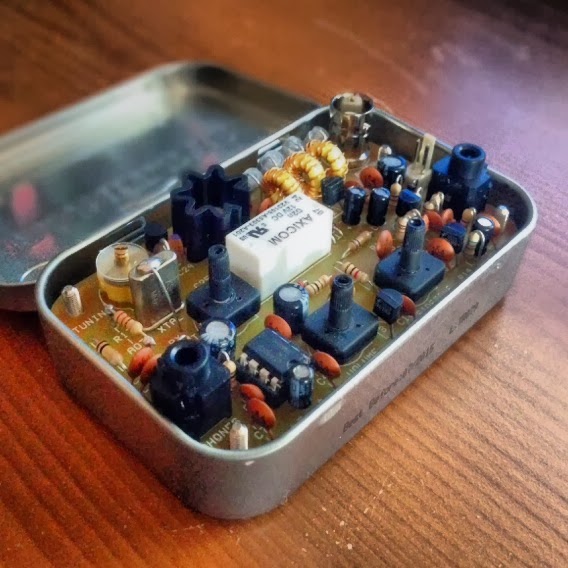 So it was my birthday recently and to celebrate the turning of another year and that I had indeed taken a day off – I decided to build a FOXX 3 QRP CW transceiver. These little kits are available from Kanga-products.co.uk and are designed to fit in a Altoids tin.
The kit comes pre bagged up in separate bags, and its just a case of soldering the correct component to the correct area on the circuit board. The kit itself is a 1 Watt QRP transceiver that can be bought on various bands. Mine was for the 20m band.
The board has a clear and easy to read Silkscreen and the pads are suitably wide enough to allow anyone with different levels of skill to create the kit. Each step allows you to test each part of the board, so you learn how each part of the kit relates to the transceiver as a whole.
I had a great time building it, it’s a simple, easy and great fun little kit. I hope to take it out and about – so hopefully you can hear my tiny signal on 20m soon.
Roger, G3XBM – get well soon
I was enormously pleased to see a new post from my fellow blogger Roger, G3XBM Roger is recovering from a severe stroke and facing difficulties I can only imagine. I’m sure I’m not the only one missing his posts about QRP projects nd accounts of his low power activities. Get well soon, Roger.
QRP Fun; 2 Out of 3 Isn’t Bad
My first target was K9W. Wake Island isn't on very often, so if you have a chance to work them you should, you never know when the island will be on again. At my QTH, northeast of San Antonio, TX, all three stations were coming in nicely, but with good propagation they are heard by many and the pile-ups were significant. I started chasing K9W on 12m, working up, however the operator wasn't paying much attention to NA, so I moved up to 10m where they were working NA/SA. After 10 minutes of chasing him up and down the band, I got them in the log at 00:59z. One down, two to go.
Next up 5J0R on 30m. I called for 15 minutes, no luck and the pile-up was huge. There was then a spot for XR0YY on 10m SSB working simplex. A quick QSY netted a QSO on the first call at 01:18z. Cool. Two new QRP DXCC counters in 20 minutes. Only one more for the trifecta, so back to 5J0R on 30m. Another 20 minutes of calling and no QSO. I stepped away from the radio for a while and came back to their 20m SSB station. I had him in the clear a couple of times, but couldn't manage the QSO, so I called it quits for the night.
Overall a successful night of QRP DXing, my QRP DXCC count is now up to 159. Upward and onward.
QRP/DX IS
Radio on a Monday
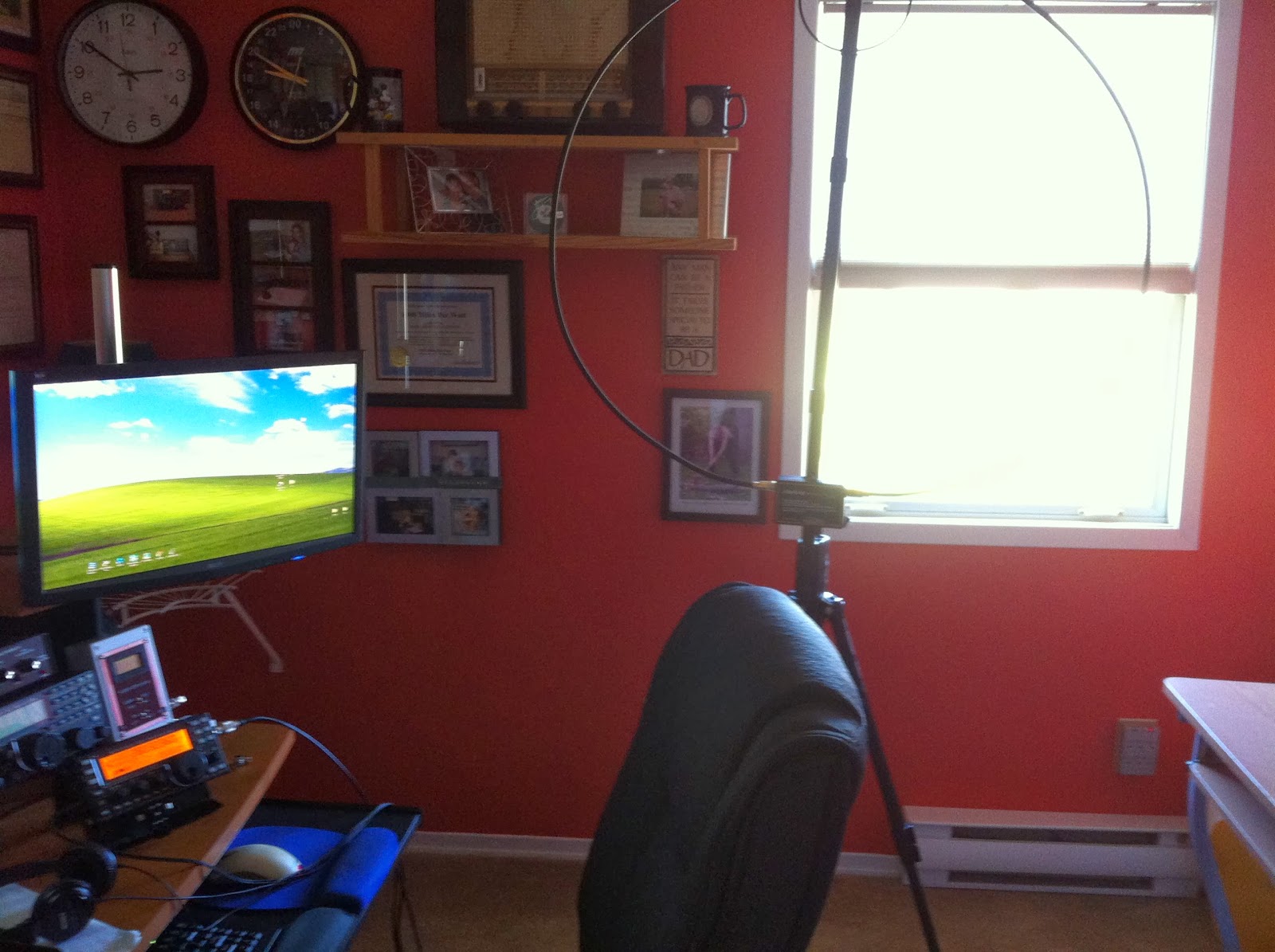 |
| The temp antenna and op position |
This weekend it was DX with the Alexloop!
 |
| SWR 1.1:1, power 5 watts and memory CQ message |
DK1NO
DK9PY
DR4A
LX/DF1LON
I did try dropping the power lower than 5 watts but is was just not doing the trick. I then was on 30m and WA3SCM Dave was calling CQ. I came back to him using 5
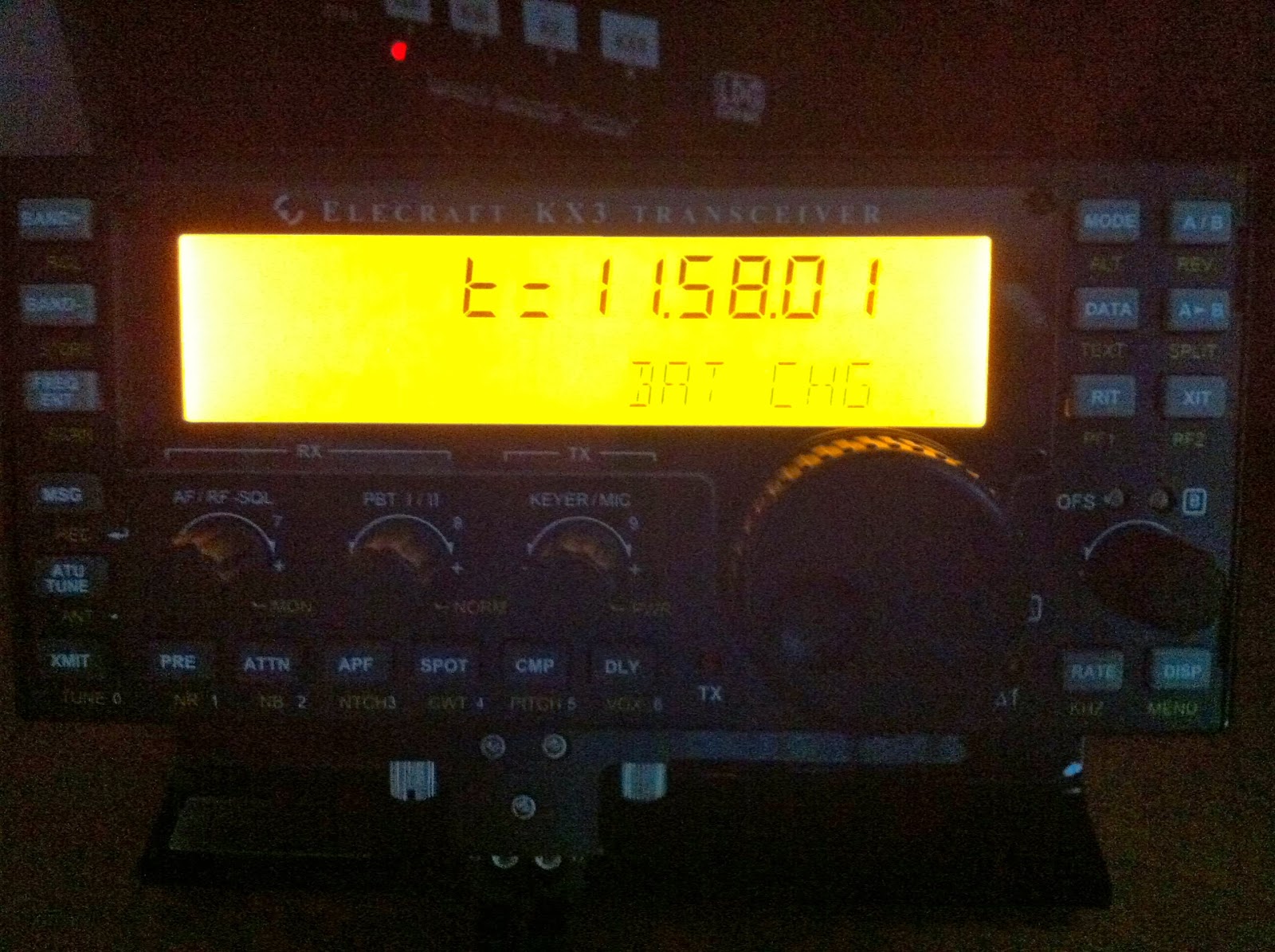 |
| Time to recharge the battery |
I was able to spend some time on the radio today (Sunday) and I again tried 10m to see what was happening.....it turned out that 10m was good to me today. I was only able to make 2 contacts but they were sweet ones!
IS0GQX from Sardinia
MD0CCE from Isle of Man
The radio bug was bitting…………..
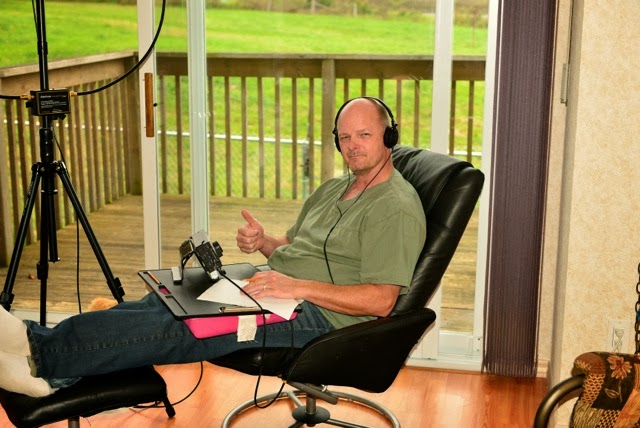
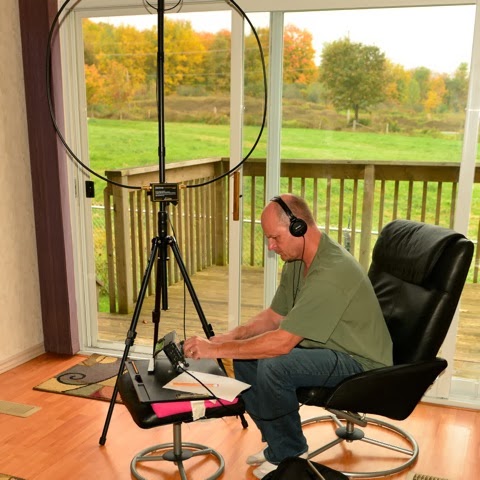
As for contacts I only made 2 short contacts as I did not have much time and was up and down checking on dinner. I was able to make it into Utah to WA7LNW and N3PDT in Missouri, not much but from the ground floor, indoor antenna and 3 watts I was happy with the contacts. I kept tabs on my signal using the Reverse Beacon Network and it showed only U.S stations were copying my signal. I was on again Monday evening and could hear PV8ADI from Brazil at S8 but I was not able to make contact with him.
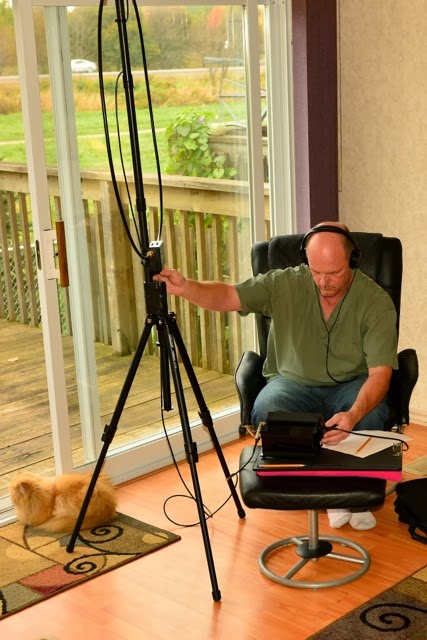 The KX3 now is resting on the radio desk and the Alexloop is away in it's carry case until next time. I was please to get this short radio time in and the results were pretty good as well.
 The simplest possible AM transmitter
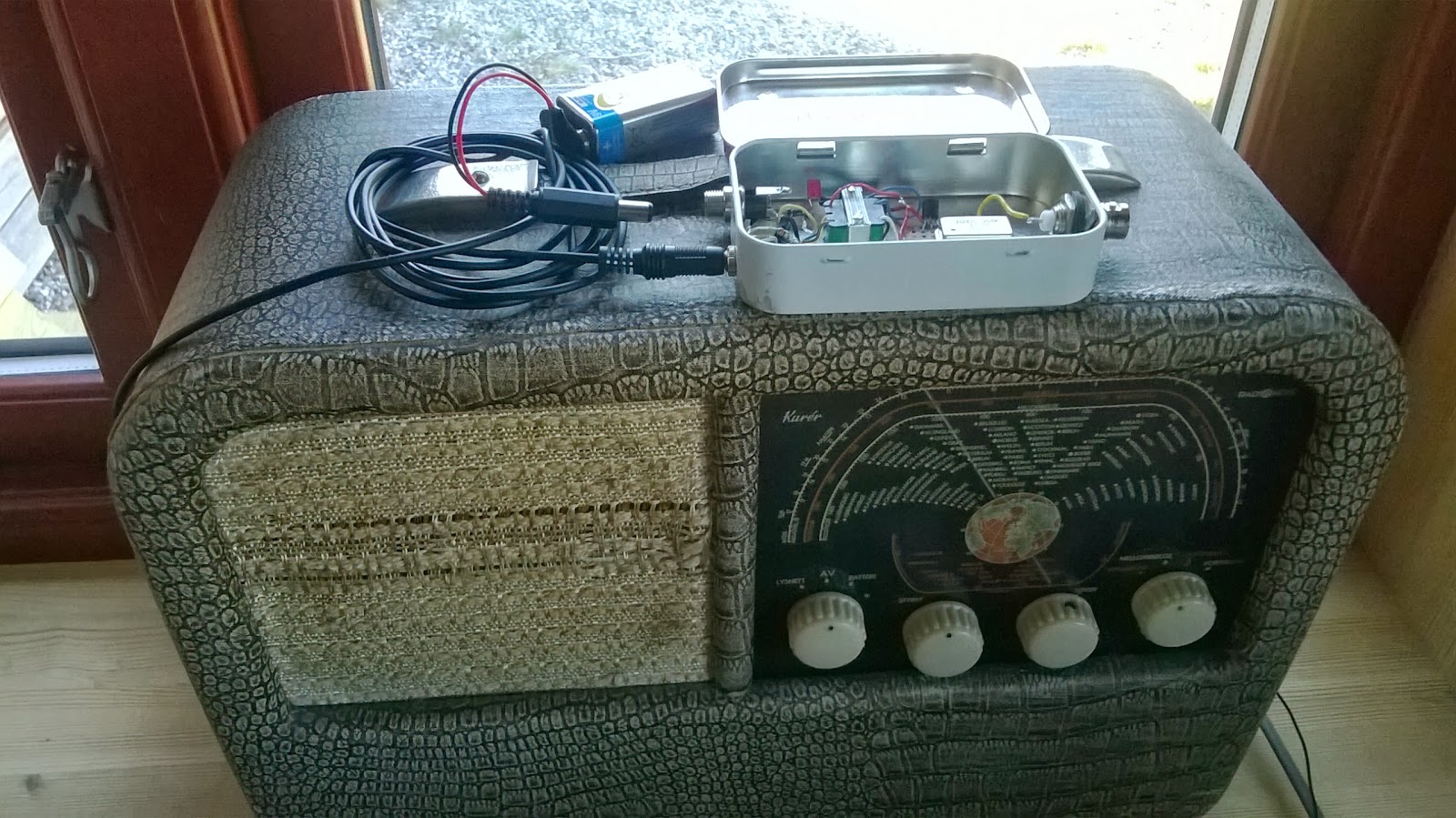
Here’s a design for a 1 MHz amplitude modulated (AM) transmitter. I’ve been looking a while for something like this, a simple short range AM transmitter for the medium wave band, as I needed something for demonstration of my collection of old radios.
The result is the AM transmitter shown here in an Altoids tin on top of a Radionette Kurér radio. This is a portable tube radio from the 1950’s. Several hundred thousands were produced, and it was exported from Norway to 60 countries. It is still popular among collectors.
The transmitter is as simple as it gets. The heart of it is a 1 MHz crystal oscillator in a can. Its 5 Volt power is modulated via an audio transformer, one taken from the output of a transistor amplifier (primary 147 ohms – secondary 3 ohms). I drive the modulator from my cell phone into the low resistance side of the transformer and get good audio when the phone’s volume is set to maximum.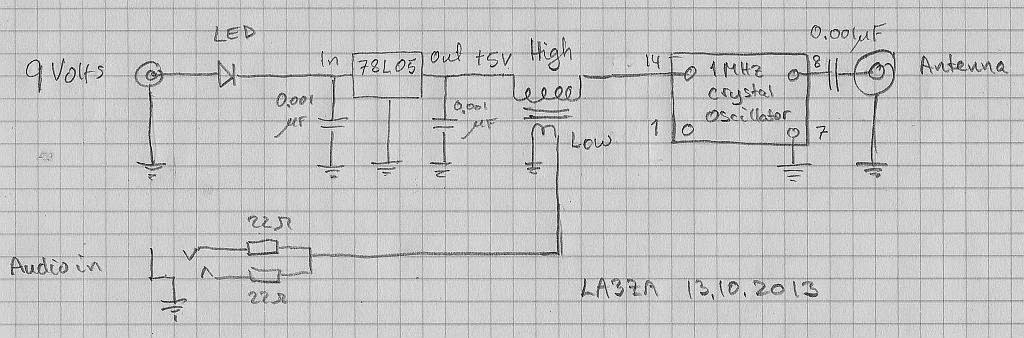
The design was inspired by one from Instructables, but mine also has a 78L05 5 Volt voltage regulator and a red LED in series with the power supply. It indicates that the battery is plugged in. In total the transmitter draws 4.4 mA at 9 Volts. The input power to the oscillator is less than 5 Volts * 4.4 mA or in the order of 20 mW. The power output is just a fraction of that. I have tested it with a 1.5 m wire hanging down behind the built-in frame antenna in the back of the radio with good results.
This is really just a modulated marker transmitter as I have briefly described on this blog before, and the square wave will have harmonics of 1 MHz over the entire short wave band. Some of these frequencies may propagate really well, so if used with a longer antenna, it should really have an output low pass filter to prevent that.
I’m not totally happy with this design, despite its simplicity, though. If I could, I would rather like to transmit in the long wave band at 216 kHz. This is the old frequency of the Oslo transmitter which ceased operation in 1995. As a member of the Norwegian Radio Historical Society, I am allowed to use that frequency with a transmitter input of 0.5 W for demonstration purposes.
For other frequencies, one simple alternative is a standard canned oscillator at 1.288 MHz. I also believe some of the Silicon Labs oscillators can be used in order to get an adjustable frequency, but I haven’t tried that myself.
But until I find a suitable frequency source at 216 kHz, I’ll stay with the 1 MHz alternative at a mere 20 mW. It is in line with the best principles of KISS (keep it simple stupid) or with Occam’s principle : “It is vain to do with more what can be done with less“, i.e. the QRP philosophy.













