Archive for the ‘qrp’ Category
 Still struggling to hear….or am I?
 June 16th, 2014 |
  Author:
 I still think something is just not quite right with my setup. If you remember from a few posts back I installed a 66′ ladder fed dipole in the attic. I thought this would increase my reception ability, but now I am not to sure.
Maybe I am just spoiled by the low noise floor when operating portable in the park, but across multiple weekends and multiple evenings I am beginning to think I just don’t hear as well with the attic antenna.
Sure the noise floor is higher, about S5 – which can be helped with the NR and the ATT, but I just don’t hear signals like I think I should.
For example, typical weeknight on 40 meter CW about 11:00 pm local time. I hear maybe 2 or 3 QSO’s. During the weekend days, I have scanned 30 meters thru 10 meters – CW and SSB portions of the band, and hear nothing – may one or two QSO’s but that is it.
I read about others working DX and plenty of local stations with an attic mounted dipole.
I have worked people on PSK31 on 20 meters in the evenings – even some DX to South America – but overall the signals in general seem very weak.
It just seems like it is more than the higher noise floor that is impacting my operating.
The thing that has me most confused is that when I don’t hear anyone, and then decided to call CQ, I almost always make a contact.
I have not gotten on during a contest, even a QRP sprint, which might be a better way to gauge what I am hearing – I suppose I need to do this.
Am I just expecting more activity than there actually is?
144MHz Backpackers Contest
The Backpacker (3B) section and the concurrent Practical Wireless 144MHz QRP Contest are limited to just 3W. Normally the FT857 can only be lowered to 5W but by applying a negative voltage to the transceivers ALC line via the accessory socket the transmitters output can be lowered. This method is detailed here it is a simple circuit and I will make one up in due course, I didn't have the parts to make one in time.
Anyway I digress, firstly I had to find a suitable hill top that wasn't too far from home. I wanted somewhere quiet and minimised the risk of any confrontation with societies undesirables. A quick look on the local Ordnance Survey map and I spotted a viewpoint symbol.
 |
| 1:50,000 |
 | |
| 1:25,000 |
 |
| The viewpoint |
 | ||
| The information plate on the viewpoint |
 |
| battery wedged behind drivers seat |
 |
| Parasol stand and painter's telescopic pole |
 |
| Operating from the passenger seat, FT857 on dashboard |
 |
| Antenna up |
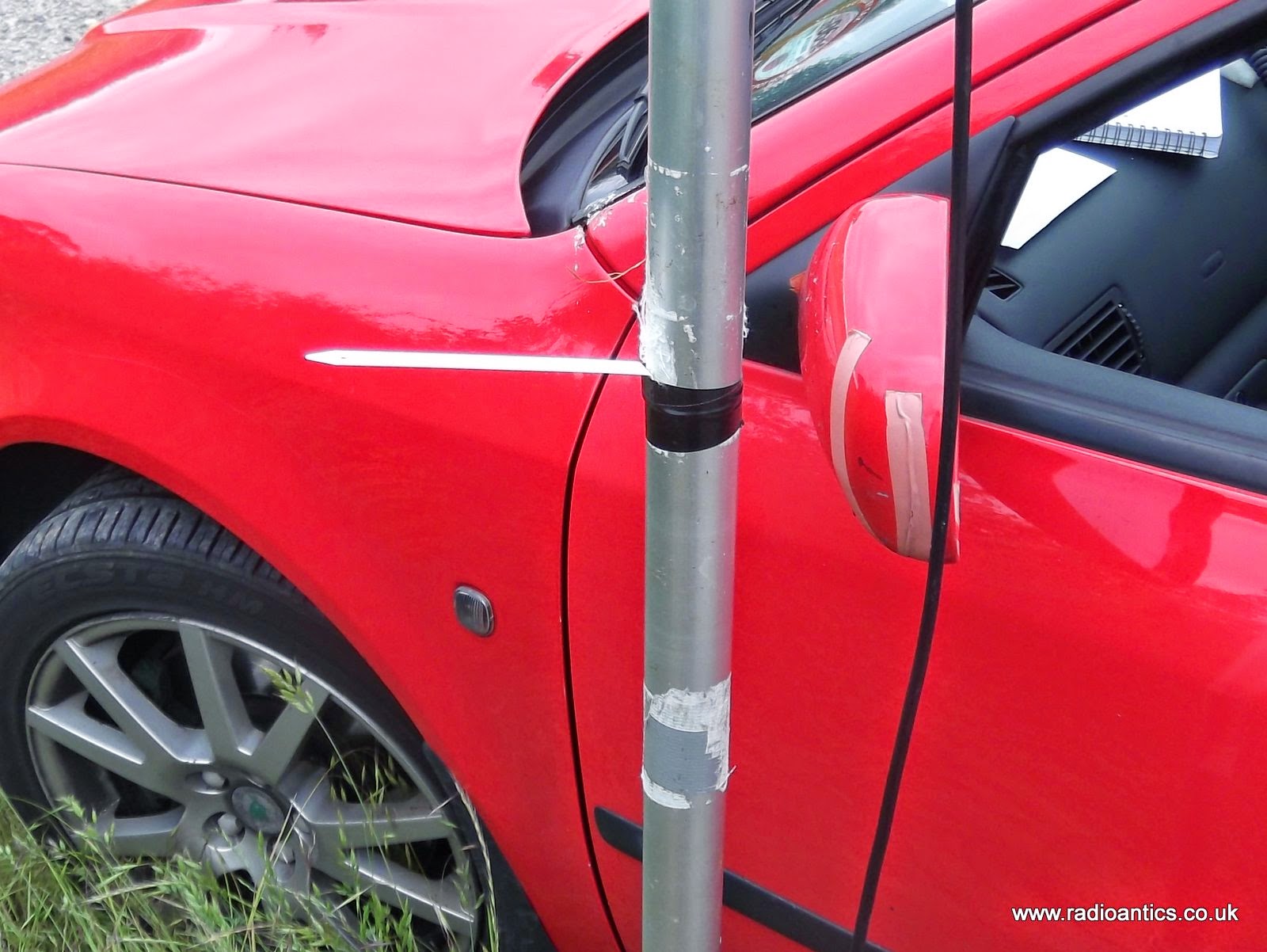
I was initially quite nervous setting up as it turned out the road was actually quite busy and I was getting a lot of quizzical looks from passersby, but once I got going I just ignored them and enjoyed the contest a lot. A number of walkers asked what I was up to and it seemed the viewpoint was a stop off on a MG owner's outing this morning.
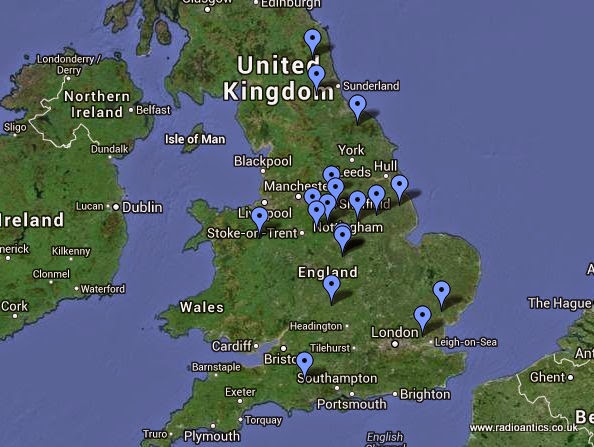
I made a reasonable amount of contacts, given most people were operating QRP with some decent distances. I did suffer one brain fade and missed another potential locator square when the other station repeated my report back and I blindly wrote it down and then lost them before I was able to correct it.
At one point I thought I would have to pack up as I was getting huge static crackles and pops which were due I think to some nearby high tension electricity pylons and what appeared to be a gathering storm, there was some brief rain but it quickly dissipated.
Next month I am looking forward to the VHF National Field Day and the 3rd Backpackers Contest as a number of members of the South Kestevan ARS are keen to have a serious attempt.
A brief overview of my MFJ 1788 loop antenna.
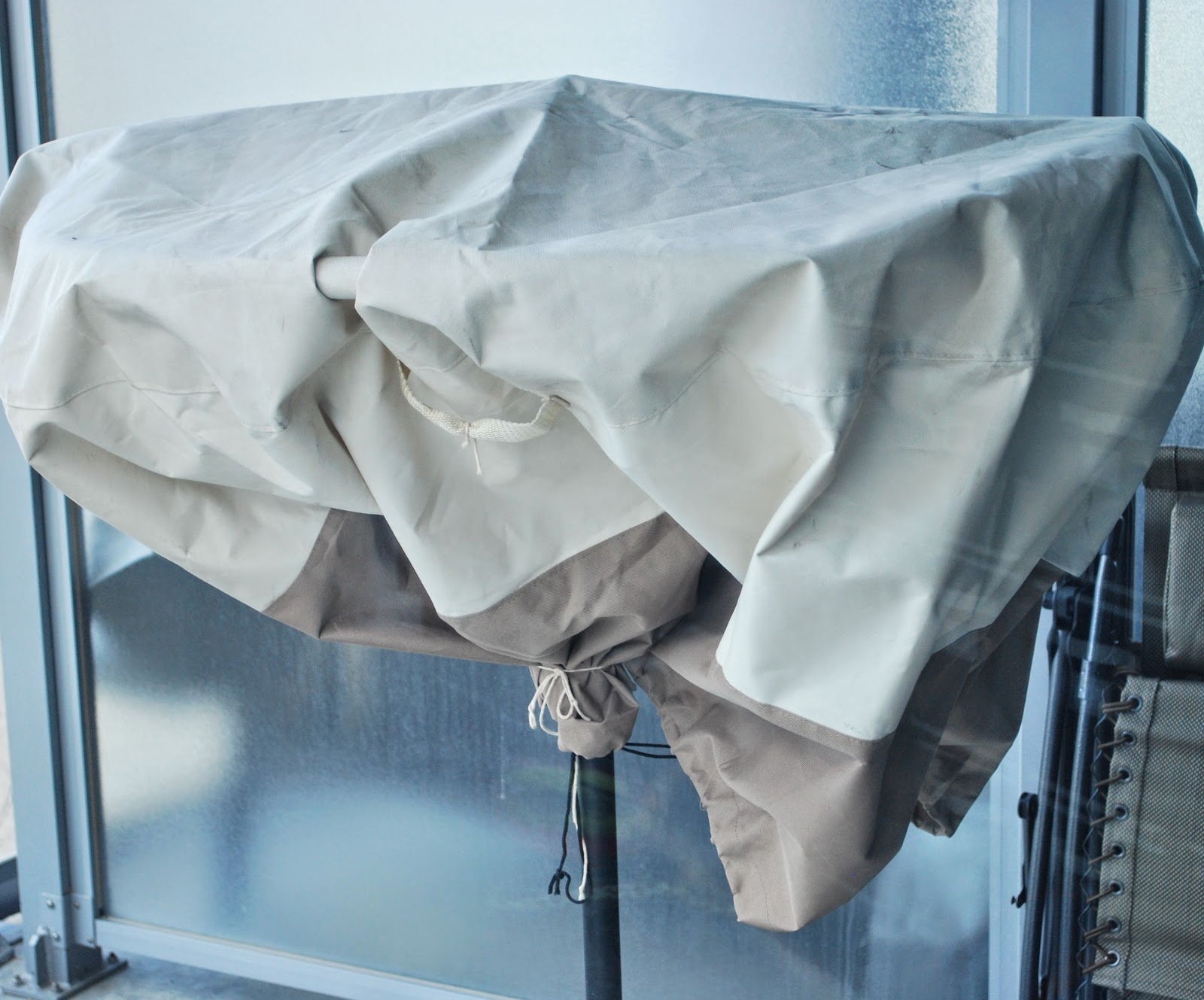 |
| The antenna |
1. Very small foot print for an antenna that will give you 15m to 40m.
2. The antenna can be used mounted horizontally or vertically.
3. Once you get used to the tuning it's very fast and easy to tune.
4. I covered my antenna with as to keep it low profile and it works no problem with the cover.
5. The antenna remote control can operate either on AC or batteries.
6. Can be mounted on a simple tri-pod.
Some of the draw backs
1. The quality of the antenna is low, I had to make some adjustments to make it work as it should.
2. The band width is narrow and retuning has to be down often.
3. The SWR meter in the remote control unit is not very reliable.
4. Buzzer used to tell you the coarse tuning has finished is VERY hard to hear.
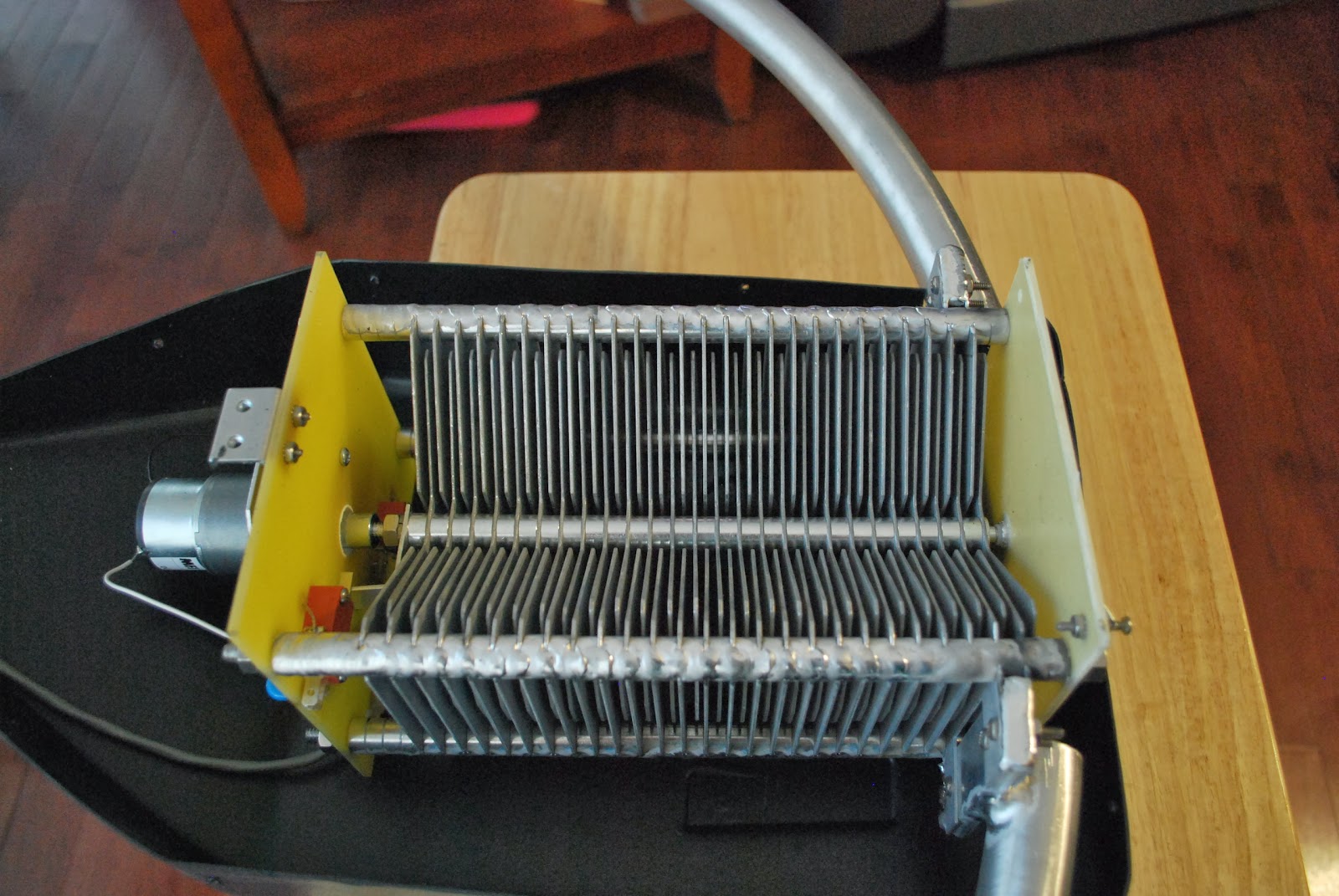 |
| Repairing Cap spacing |
On air results with this antenna have been good, with regards to receiving I have been able to hear the Middle East, South Pacific, Europe, South America and of coarse North America. Now hearing a station and contacting the station is another ball of wax. With my power restrictions I have made some very satisfying contacts. My modest signal has made it into South America, all parts of Europe, Iceland and Africa so far. There are two Loop antennas that MFJ makes and if I was to make the choice again I would had gone with the MFJ 1786 as it covers 10m to 30m. I have found with this antenna there is no way to tune it below 15m. The characteristic of the tuning capacitor will not allow it. I have read the MFJ 1788 is like a wet noodle on 40m and it's true I have not been able to make it into the U.S. The MFJ 1786 would had been a better choice with more band opportunities.
Planning some more /P and /A
Apart from the UKAC on the Tuesday night I didn't do anything else with the radio, I did have the HF antenna up but the trapped nerve in my back meant I was in a lot of discomfort after being out and about during the day and so rested and zonked out on painkillers rather than struggling to set up the rig.
I must sort out a proper portable station that I can just open it up and start operating, I am impressed with Charlie's M0PZT porta-pack frame idea being an excellent solution especially for back packing.
In the past the wife and I used to be keen walkers, tackling many of the peaks in Cumbria, Snowdonia, the Peak District and elsewhere. We completed the Coast-To-Coast Walk back in 1991 and The Cleveland Way the following year.
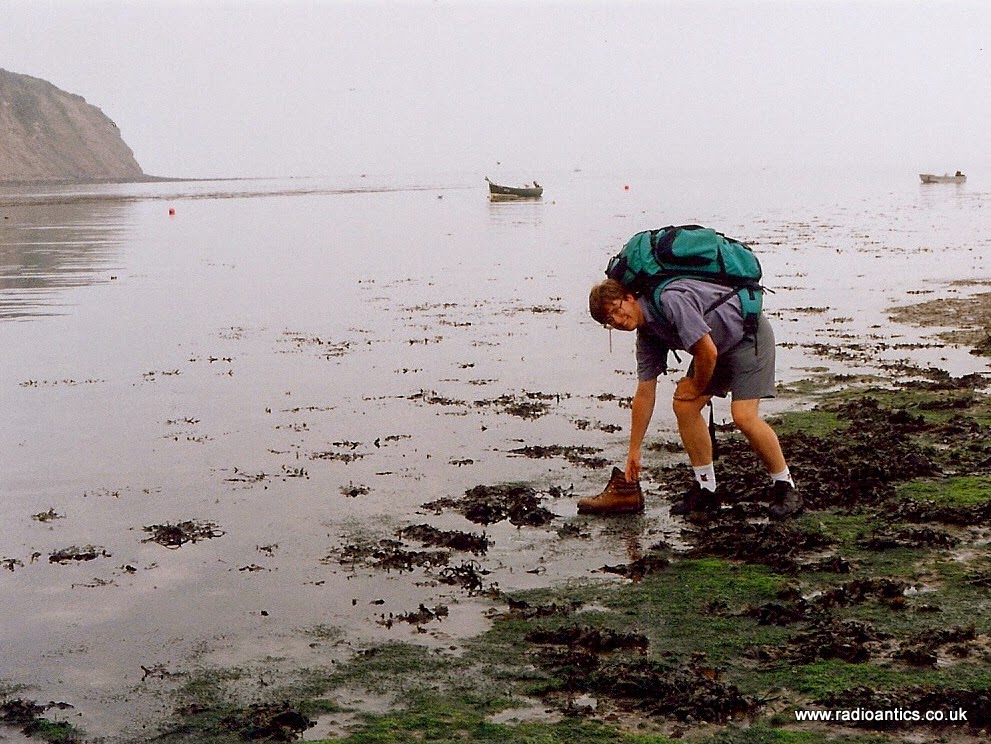 |
| Dipping my boots at Robin Hood's Bay in 1991 at end of the Coast-To-Coast |
Sadly I am too overweight now to be a serious Summits On The Air (SOTA) operator but I plan on getting back to a reasonable level of fitness. As it happens if I'd been more prepared our walk of Latrigg last week could have been my first Wainwright On The Air (WOTA) activation.
Next month we are off to the Isle of Skye. We are staying in a self-catering cottage with plenty of room so rather than being /P portable I can be /A alternative and will be able to set up the rig in the cottage so can use it as and when I want.
I've already mentioned the holiday coincides with the 50MHz/6 Meter UKAC and am currently toying with the antenna choice, one advantage of being so far North is I won't need to rotate it as pointing it South South East should cover most of the UK. From the photographs of seen the cottage is reasonably elevated with clear views across Loch Bay in that direction. There are mountains ranges to contend with but who knows with propagation? I'll be in the rare IO67 locator square so might even have to contend with a pile up!
I will almost certainly operate as 2E0NRD rather than M6GTG for that week as using just 10W might be a bit optimistic.
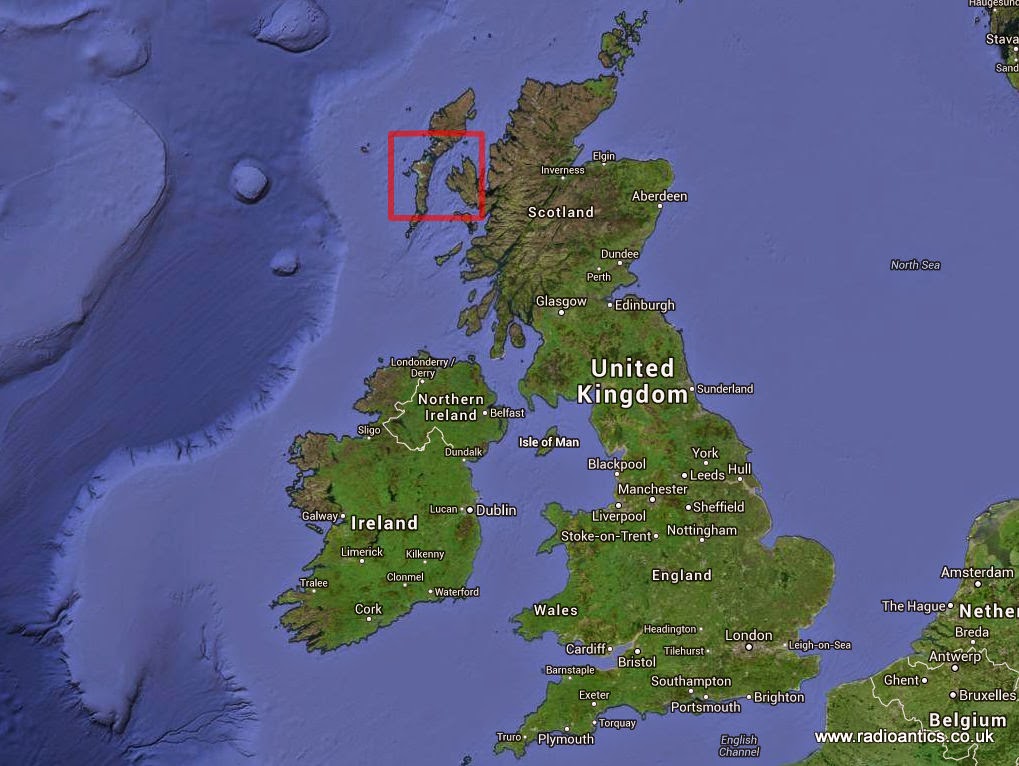 |
| IO67 Locator Square |
Gobsmacked.. pic.twitter.com/sGDI4jDh1W
— Andrew Garratt M6GTG (@nerdsville) June 7, 2014
Perhaps I shouldn't have been quite as quick to brag as it appears I was the only Foundation Level entrant!
Still I managed 4 verified QSOs on what by all accounts was a very difficult contest, with low activity and poor conditions. In fact I almost missed the contest altogether and was only alerted to the contest by a tweet by Robert @G1ZJP and was late starting as I needed to get the antenna up. I actually made 5 QSOs but one was broken because I mistakenly put 59 in as the serial number.. Doh!
This weekend is the 2nd RSGB 144MHz Backpackers contest and the Practical Wireless 144MHz QRP Contest Unfortunately the FT857 is too powerful for the QRP contests as the limit is 3W but I could have a go at the Hill Toppers section in the RSGB contest which is limited to 10W and as luck would have it I am left to my own devices this weekend so might take a drive in the car..
Radio propagation and space weather course
As the propagation columnist for several amateur radio magazines, I hear from a diverse group of interested people that find space weather and the propagation of radio waves fascinating. I admit: I am a space weather and radio propagation nut, and it is always good to correspond or meet with other interested folks. This is an aspect of our hobby that never grows old, as there is so much that we don’t yet know–we communicators are in a perfect space to make discovery and to make improvements to our understanding of this science. Over the years, I’ve heard a lot from readers of my columns, expressing their fascination with the science of radio and solar phenomenon.
Are you interested in learning about the Sun and the Sun-Earth connection (space weather), including topics of sunspots, solar flares, coronal mass ejections, and so on? Do you want to delve deeper into topics including the ionosphere, the magnetosphere, and how radio waves propagate from transmitter to receiver?

The critical frequency (foF2) for mornings during June 2014.
You might consider a time-proven “course”–material that is very comprehensive–that you can self-study, to become well-versed in this information. The course (one that has been used in professional disciplines) is offered either stand-alone, or bundled with the ray-tracing PropLab PRO software.
Some may say, “But, I like the magic of just getting on the air and trying my luck! If I learn all this stuff, then it becomes science, and not a hobby.” It is true that there’s a joy at being dazzled with the magic of radio; buy a super cool transceiver, and a factory-made antenna with coax already fitted with connectors, adding the necessary accessories to make it come alive, then begin exploring the shortwave frequencies. Magical, indeed! But, there are many in the hobby that wish to learn how all of that works. Some even begin learning how to build antennas, radio kits, and discover the joy of the “science” of radio. A few eventually take the step with gained “scientific” knowledge of electronics, and they design and build equipment for their hobby. The course is part of that mix: learning how the Sun affects getting a radio signal from point A to point B, and how to leverage their time and efforts, is a joy, indeed.
Interested? Here’s the web page: http://hfradio.org/swp_course/

PropLab PRO creates ray-traced radio wave analysis
If any disclosure is necessary, here you go: The proceeds from a purchase of this course go to the funds I use to keep cw.HFRadio.org, swl.HFRadio.org, and other resources at HFRadio.org, plus http://SunSpotWatch.com up and running. There are monthly fees, yearly fees, and software licensing to cover, as well as the purchase of hardware from time to time. These operating and maintenance funds are mostly covered by me, Tomas, NW7US, out of my personal funds. Any donations and sales helps out. Haters and Hecklers can send their comments to the bit bucket.
73 de NW7US
KX3: Cool Go Box
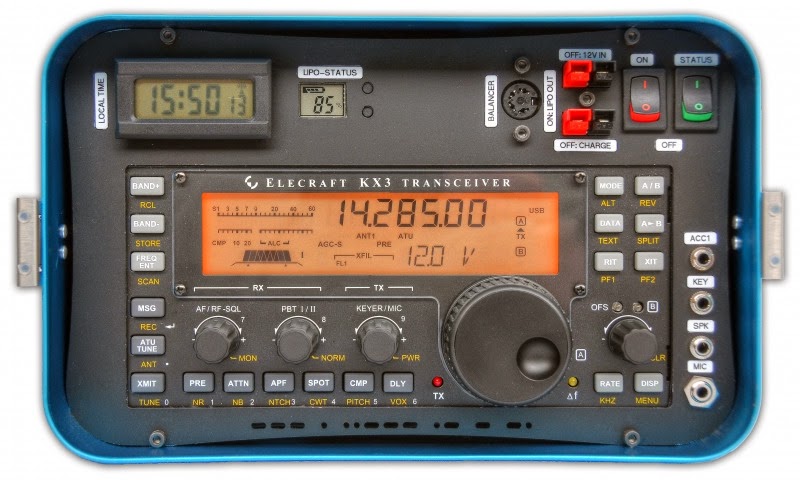
Check out www.oe2atn.at/tom/gobox
If someone would commercialize this, I think it would be very popular.
Learning Morse code? Want to increase your skill?
Are you looking for some aids on learning Morse code, or to increase speed and skill? Let’s look at some great information and some software aimed at making your efforts successful.
(Note: I am not associated with any of the software. I just want to help you…)
I encourage you to look at the time-proven Koch method of learning Morse code. Below, we’ll look a little closer at this method of learning and honing your Morse code skill. In the meantime, if you just wish to skip the details, here are some software links for learning tools using the Koch method:
+ For the PC, I prefer the G4FON Morse code ‘Koch Trainer‘. It is a slick program that is set up to help you learn and enhance your skills with Morse code: http://nw7us.us/g4fontrainer – and his web site is at: http://www.g4fon.net/

G4FON Koch Trainer – Morse code learning on the PC
+ For the iPad and iPhone: On these devices, I use the ‘Koch Trainer’ by Nick / N3WG, found in the store here: https://itunes.apple.com/us/app/koch-trainer/id405137883?mt=8
+ For the Android: I use the same software as for the iPad and iPhone, the ‘Koch Trainer’ by Nick / N3WG, here: https://play.google.com/store/apps/details?id=com.n3wg.kochtrainer – however, note that it is not compatible on the S4.
+ Some other Android possibilities that I have not tried:
- https://play.google.com/store/apps/details?id=net.iz2uuf.cwkoch
- https://play.google.com/store/apps/details?id=uk.co.bitninja.kmtpro
Again, I have not tried those last few.
Now, let’s talk about the Koch Method of Morse code training!
From my page on the Koch method (text was used by permission from the author):
Koch’s method is a simple, direct way of building reflexes. However, it requires either a computer and Morse software or a personal trainer. That’s why it was overlooked for so many years. Now that computers are commonplace, it should become the standard Morse training method. Here’s how it works:
You start out by setting up your computer (or a microprocessor-based code tutor machine) to send you Morse characters at 20 wpm and at an overall sending speed of at least 15 wpm. You then get out your paper and pencil and have the machine start sending — but only two characters. That’s right, for your first sessions, you’ll only have two choices. Copy on paper for five minutes, then stop the machine and compare what you copied with what the machine sent. Count characters and calculate your percentage of correct copy.
If your score is 90 percent or better — congratulations! You just learned your first two characters, and, importantly, you learned them at full speed. You’ll never have to learn them over again. If you didn’t make 90 percent, practice some more. As soon as you can copy the first two characters with 90 percent accuracy, add a third character to your practice. Your accuracy will drop as you work on assimilating the new character, but it will rise again to 90 percent or better. Then you add the fourth character, and so on.
This method does not allow you to build that lookup table in your brain. To copy at full speed, you must build the reflexes in order to achieve 90 percent accuracy. And that’s what you’re spending your time doing — building reflexes. Think of it as a parallel to perfecting a tennis swing or mastering a gymnastic routine; you’re practicing until you get it right. The Koch method of building code proficiency character-by-character is similar to standard methods of teaching touch typing, another skill that must be reflexive.
…
While the Koch method is the fastest method of Morse training, speed alone is not its principal advantage. Its principal advantage, and a major difference from other methods, is that it provides you with constant positive reinforcement. This begins with your realization, after mastering the first two characters, that you can copy code at 15 or 20 wpm, because you just did it. After that, each new character mastered is further proof of your progress. Contrast that to slowly trying to build speed up from 4 or 5 wpm, then hitting the plateau at 10 wpm and seeing no progress for a long time. With the Koch method, frustration is at a minimum.
Constant testing is necessary to ensure that you maximize the effectiveness of the Koch method. You must copy on paper, so you can grade yourself. Remember, if you score 90 percent accuracy or better, add another character. If you score any less than that, try again. By constantly testing yourself on continuous copying of at least five minutes, you know exactly how you’re doing and exactly when you should add another character. This results in the fastest progress possible.
…
As you proceed toward your goal, remember that some days are just going to be better than others and some characters will take longer to assimilate than others.
(Read the entire article: the Koch method).
Again, here’s the PC software link: http://nw7us.us/g4fontrainer
And, here’s a web-based way to learn Morse code.
Good luck! If you have questions, please share them – I’m @NW7US













